The Road to a CGM

Sue B_Head SquareIf you have been reading my blogs, you will already know who I am. If you have not, here is what I have been doing for the past two years. In June of 2012 my husband Marc became eligible for Medicare. He is a type 1 diabetic with hypoglycemia and hyperglycemia unawareness. Prior to entering the Medicare system, his Continuous Glucose Monitor (CGM) was covered by his private insurance company. Once he went on Medicare, this was no longer true. He was denied coverage of a new CGM when his old one stopped functioning.

We decided to fight Medicare because we really believed that the guideline should be changed for this piece of equipment. There are four levels to Medicare’s appeals system. Levels 1 and 2 are basically rejection letters from the insurance company and an independent company hired by the insurance company to review the insurance company decision. Level 3 is a hearing with an Administrative Law Judge (ALJ). I blogged about the 9-month wait for his decision in a mid-March 2014 blogpost. Unfortunately, that decision was UNFAVORABLE.

We decided to go on to Level 4 which is a hearing with the Medicare Appeals Council (MAC). Sadly, after a 5 month wait, we got a decision on Saturday, September 20 and the MAC upheld the ALJ decision. Previously we had thought that we would go to the next Level which is an appeal to the Federal Court System. Fortunately this was unnecessary because three weeks ago, the Veteran’s Administration (VA) supplied Marc with a CGM and sensors. My blogpost titled He Finally Got One! give the details of that wonderful milestone.

The Road to Getting a CGMBecause of Marc’s new situation with the VA supplying the CGM and sensors, even had the MAC given us a favorable decision, we would not have been able to accept the CGM though Medicare. But that doesn’t mean that I’m done with my advocacy. I am now going in a different direction and am going to do whatever I can to encourage everyone I know (and don’t know) to please sign the letter urging their Senators to support the Senate bill S. 2689 introduced by Senators Susan Collins and Jeanne Sheehan and the new companion bill H.R. 5644 introduced to Congress by Representatives Tom Reed, Diana DeGette and Ed Whitfield urging support from their colleagues in the Congress. Both of these bills are called the Medicare CGM Access Act of 2014. At the same time, please sign the Petition put forth by the Juvenile Diabetes Research Fund (JDRF) that will go directly to Medicare. Currently there are over 57,000 signatures but we need many more.

Please check out Laddie’s recent blogpost which gives links to easily contact your Senators and Representative and to sign the petition.

Over the past two years that I’ve been advocating for the CGM, I have met many wonderful people. It is because of them (Janice, Mig, Debbie, Dan, Judy, just to name a few) that I have continued on despite being so frustrated at times that I literally felt as if I could not go on any further. I would be totally remiss if I didn’t thank Laddie and Sue for their support as well. Both of them have been my teachers since as I’ve often said “I am not the diabetic”, and I had a lot to learn. I will keep on advocating and doing whatever is necessary until we collectively reach the goal of getting Medicare to change their guideline. I knew this wasn’t going to be a sprint. I knew this was going to be a marathon. And I knew I was in it for the long run. And I will continue to keep on blogging and working to get the guideline changed until the day that I can finally say WE GOT IT DONE.

More News on Medicare and CGM’s

Laddie_Head SquareOn Friday I received a copy of an email from a Medtronic spokesperson announcing an important development in the battle to have continuous glucose monitors (CGM) covered by Medicare.  This is an excerpt from her email:
We have some great news to share on the Medicare CGM Access Act! Late yesterday, Representatives Tom Reed, Dianne DeGette and Ed Whitfield introduced companion legislation into the House of Representatives.

As you’ll likely remember, back in July Senators Susan Collins and Jeanne Shaheen introduced nearly identical legislation to ensure access to CGM technology for people on Medicare. We can’t thank you enough for all the wonderful social media activity you’ve created to drive the community to urge their Senators to co-sponsor the bill. However, as you likely know, in order for a bill to become a law, it must be passed in both the Senate and the House before going to the President to sign or veto. So, this “companion bill”, which is nearly identical in content with a new number (HR 5644), is a key step in the legislative process.

Of course, this means it’s time to rally the community again, urging people with diabetes along with their friends and family to encourage their local Representatives  (as well as their Senators) co-sponsor the legislation.

Once again, JDRF has provided great resources where people can read about the issue as well as identify and easily contact their own Representatives and Senators.

You can find these resources here. You can also feel free to share our blog post.

For those on Medicare and those of us soon to be there, this is hugely important.  My CGM has been life-changing and I believe that it keeps me safe and improves my blood glucose profile on a daily basis.  My co-blogger Sue from Pennsylvania has repeatedly shared the nightmare that she lives in because of the non-coverage of her husband’s CGM by Medicare.

What can you do?

    1. Contact your U.S. Representative to ask him/her to co-sponsor H.R. 5644 and advocate for seniors with diabetes who require a CGM.
    2. If you have not already done so, contact your Senators to co-sponsor S. 2689 and advocate for seniors with diabetes who require a CGM.
    3. Sign the JDRF petition: Tell Medicare to Cover Continuous Glucose Monitors for People with Diabetes.  As of 9/21/14 the petition has 56,618 signatures and we hope to reach 100,000 signatures.
    4. Forward my blog to your friends and family urging them to take action.
    5. If you are a blogger, please share this with your readers.  If you would like to copy my blogpost word for word, please do so!

The links provided by JDRF make it simple to contact your Senators and Representative.  By filling in your name and address, your appeal is automatically sent to the correct government officials.  You are able to personalize your message by adding a few sentences to explain why this is important to you.  I used to be worried about trying to be an advocate.  JDRF has streamlined the process and made it “easy-peasy.”  You can complete Steps 1-3 in about 5 minutes.

I thank you for reading this.  More importantly, I thank you for contacting your elected officials to help ensure that your fellow Americans on Medicare have access to continuous glucose monitors.

If there is anyway that I can help you, please contact me.

HE FINALLY GOT ONE!

Sue B_Head SquareI have been advocating for over two years for Medicare to cover a Continuous Glucose Monitor (CGM) for my husband Marc. Synopsis – he had been covered for the CGM when he had private insurance through his employer, but when he turned 65 and became Medicare eligible, and needed a replacement CGM, it was denied. Medicare considers the CGM precautionary and therefore, in their opinion, not necessary. Of course, those who desperately need one disagree with this. The first denial came in August of 2012 and shortly thereafter, we started the long and exhausting appeals process. When we got to Level 3, a hearing by an Administrative Law Judge (ALJ), it took almost nine months after our June 26, 2013 hearing for the Judge to render an UNFAVORABLE decision. We decided to go on to Level 4 which is a hearing with the Medicare Appeals Council (MAC). They have the power to overturn the Judge’s decision. This Appeal was submitted to them in April of 2014. We are now in the 5th month of waiting for the Council to make a decision. The Appeals process is almost like watching a tortoise cross the road. It’s very, very slow.

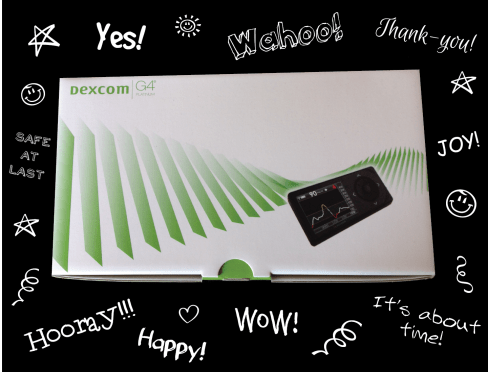
In the meantime, Marc, after 45 years, decided to apply for VA benefits. He had served in the United States Air Force for four years but had never thought of getting any benefits through the VA. From the time he submitted his first application to when they processed him in took almost two years (nothing we do happens quickly). Finally, in May of this year, he became a part of the VA. He had to go through all types of exams, one of which was with the VA endocrinologist. In checking his A1c and hearing about his problem with hypoglycemia unawareness, she definitely thought that he needed a CGM and prescribed one for him. However, as with Medicare, we were told that the wait to get one was 1 – 2 years. For some reason, and I can only guess it was because he had so many instances of blacking out, she went to bat for him and I can finally say, HE HAS A CGM! Two weeks after speaking to her, he received an email from Dexcom that his CGM was on its way. Four days later it came.

To say that we are thrilled is putting it mildly. Our two years without a CGM are finally over. For myself, I can now be at peace during the day when Marc at work knowing that if his sugar starts to drop rapidly, he’ll get those warning beeps. And I welcome those beeps at night (which used to drive me crazy) because now I can sleep better (in between the beeping) knowing that we’ll have time to correct the situation before I have to go running for the Glucagon.

Dex Box Hooray

When I became an advocate for his CGM, I made a commitment to continue to fight for Medicare to make a change in their guideline even if Marc did eventually get a CGM, whether through Medicare or some other source. I intend to keep that commitment and will continue to work towards that goal. To that end, we are letting the Level 4 Appeal play out even though, if we are fortunate enough to get a FAVORABLE decision, we can no longer get a CGM through Medicare. It is our hope that if anyone who is thinking of going through the process will see that it is possible (I hope) to get a good decision and soldier on. No one should have to go through what we’ve gone through in the past two years to get a piece of equipment that is so life-saving.

If you are a Veteran and have not joined the VA, you might want to consider applying for benefits whether you are a diabetic or not. In the past four months, not only have they covered Marc’s CGM and sensors, but also Symlin, which is a synthetic aid in lowering blood sugar and is quite costly, his cholesterol medication, syringes, etc. In a future blog, I will give you a few hints about joining that might make it easier to navigate the VA, one of which is to contact your local County Veterans Service Officers. They are most helpful.

I am Blessed

Laddie_Head SquareToday was a reminder that I live a very blessed life.

This morning my new Dexcom G4 system arrived by FedEx. I currently have good insurance and all it took was one phone call on Monday to have this fabulous medical device show up on my front porch today.  Proving that I don’t live in a rut and am easily amused, I am somewhat excited that my new receiver is blue and replaces my out-of-warranty hot pink receiver.  Life is too short not to grab every opportunity to be happy.

Dexcom Blue Excitement

This afternoon the UPS guy delivered a big box containing 3 months of infusion sets, reservoirs, and test strips.  These supplies were ordered through the Edgepark website on Sunday.  Many people totally bad-mouth Edgepark, but once I learned to ignore the wacky prices they quote for “Retail”, I have had excellent service from them.  (I hope that I have not jinxed myself.)  I was told by a rep in the CGM/Pump department at Edgepark that my good insurance is one reason that things have gone so smoothly for me.  I also give credit to my endocrinologist whose multi-doctor practice is very organized and responds quickly to requests for prescriptions and medical necessity forms.  Nothing was too exciting in this order except that it includes one box of Contact Detach metal sets that I have never tried.  Some Type 1’s at TuDiabetes swear that they are the best, so I figured they were worth a try.  Earlier this summer I tried out Cleos and Insets and neither worked well enough to lure me away from manually inserted Comfort Shorts.

For those of us who participated in the Spare a Rose campaign, my ease in getting needed diabetes supplies is in stark contrast to the difficulties that many children/adults in developing nations have getting insulin to keep them alive.  I won’t need to buy insulin until September.  When I do, all it will take is a few clicks on the computer and a drive to my local Walgreens to replenish my deli drawer with insulin (my refrigerator does not have a butter compartment!).

I wish that I didn’t have diabetes.  But I am blessed because I have supplies on the shelf, a pump in my left pocket, a CGM in my right pocket, and plenty of insulin in the refrigerator.  Not everyone is so lucky.

*******

Thanks to diabetesherosquad.com for permission to use their Dexcom graphic.

Out of the Box

Sue B_Head SquareMany times over the course of this past year since I’ve starting blogging, I’ve made mention of the fact that for the most part I’m a very private person. I’ve never liked calling attention to myself and more then anything, after having worked for over 40 years outside of my home, I’ve enjoyed being a homebody. I love to do anything with my hands. Knitting is one of my favorite hobbies as is doing very intricate beadwork. The tinier the beads, the more I enjoy working with them. I love to read and delight in spending time in the kitchen playing around with new recipes.

When I got the opportunity to start blogging on Test Guess and Go, I realized that writing about the problems that my husband and I were experiencing getting Medicare coverage for the Continuous Glucose Monitor (CGM) was therapeutic. Before I started doing this, I often felt very alone. I have friends who have diabetes but they are all Type 2 and don’t understand the problems that my husband Marc has experienced being Type 1. Through my writings, I have had the opportunity to be in contact with many people who are dealing with the same problems Marc and I are faced with on a daily basis. For me, who had become his advocate in this quest, writing became a great way to get out my frustration at a system that does not recognize the importance of a device such as the CGM. A diabetic with hypoglycemia unawareness needs this in order to feel safe and keep others safe.

On May 1 I took a huge step towards coming out of what I refer to as “my box”. I did a Podcast on DSMA Live. For those of you who don’t know what DSMA Live is or what a Podcast is, it’s an hour long program that is similar to a radio broadcast except that it’s done through a computer and in the comforts of your own home. DSMA stands for Diabetes Social Media Advocacy. Cherise Stockley is the creator and the co-hosts are Scott Johnson and George Simmons. The mission of DSMA Live is to “promote social networking in all its forms (Facebook, Twitter, YouTube, etc) in order to educate and support all people affected by diabetes”. Cherise, Scott and George interviewed me and I was able to speak about my experience as the spouse of a diabetic and my journey during the past year fighting to get a Continuous Glucose Monitor covered by Medicare. The interview is available on iTunes under Podcasts and using the search words DSMA Live or by going to this link.

I was pretty calm leading up to the day of the interview until about an hour before I was to go on the “air”. Then the nerves started to kick in. I am not and never was a public speaker. The thought, to be honest, was pretty frightening; however I felt that it was something that was necessary if I was going to inform as many people as possible about H.R. 3710, the Medicare CGM Coverage Act. This bill was introduced to Congress in December, 2013 by Representative Carol Shea-Porter and asks for coverage of the CGM if recommended by a physician. I feel that this bill is extremely necessary for diabetics with hypoglycemia and/or hyperglycemia unawareness. I will do whatever is necessary to inform the public about H.R. 3710. I am asking everyone to write to their Congressperson and request that they co-sponsor the bill so that it can be brought to the floor of the House. Please read my Join the Crusade post to find out how you can make a difference in the fight for CGM coverage by Medicare.

The Podcast started and Cherise introduced me and much to my surprise, once I started speaking, my nerves dissipated and it was smooth sailing from then on. I I give credit to Cherise, Scott and George for putting me at ease. I was pretty surprised when I looked at the clock and saw that I had already spoken for 30 minutes and hadn’t covered half of what I wanted to cover. The second half went even faster and before I knew it, the hour was up and I still had more to say. But alas, you only get an hour and my time was up. I hope to do a Podcast again in the future. This very private person definitely came out of the “box” and enjoyed doing so.

Out of the BoxA few months back, I wrote a blog about my year of growth, first deciding to advocate for my husband and then starting to write on Test Guess and Go. My experience has taught me that growth can happen at any age (even for a Senior Citizen). It is my hope that with all the effort put into getting the CGM covered by Medicare that I will one day be able to stop blogging about the CGM and go onto other issues that diabetics deal with on a regular basis in getting coverage for much needed items. Until then, I will continue doing whatever necessary to get the guideline for the CGM changed.

Dexcom Cases: Big News!

Laddie_Head SquareIf you use the Dexcom G4 and have been searching for the perfect case for your receiver, I have great news for you!  Yesterday on Facebook I read that Tallygear has come out with a silicone skin that is similar to the cases that many of us use on our cellphones.

In the year and a half that I have been using the G4, I have invested more money than I care to admit trying to find the perfect case for my G4 receiver.  The black leather case provided by Dexcom is huge and extremely masculine.  Great if you want to wear the receiver on your belt, but incredibly clunky if you like to keep it in your pocket.  I tried a few cases designed for Blackberry phones and they almost worked.  But not quite.  A few other cases from Amazon were quickly returned or tossed in the trash.

I ended up using two cases that were okay, but not exactly what I wanted. The first was a case that I found out about in the Dexcom Users group at TuDiabetes.  It was designed by the friend of a Dexcom user and was manufactured with 3D printing at Shapeways.  It has been my main case, but the color has faded terribly.  Although my receiver has survived more than one fall while in this case, I’m not convinced that the case provides much protection especially as it has gotten older and more flimsy.  You can check out this case here.

The other case that I have used was purchased at Tallygear.  It is a lycra fabric case with a clear plastic front that completely encases the G4 receiver. It has a loop to which you can attach the carabiner clip and lanyard that are included with the purchase.  I use that case for hiking and will continue to do so. I loop the lanyard through my belt and feel confident G4 Case Discardedthat I won’t lose the receiver off the side of a mountain. Although it is not completely waterproof, it does protect the receiver from a quick dousing in the toilet.  (My friend Jenn of Sweet Zoo has firsthand knowledge of that fact.)  I personally don’t like how the plastic front sticks to the screen and it has never been my everyday case.  But it’s great for hiking, great to wear around your neck, and a good case that provides cushioning and protection for the receiver.

I am thrilled to see Tallygear is producing a silicone case.  This is what I have wanted all along and I will be ordering one right away.  According to Facebook and the website, red is the only color that is immediately available. Orange, purple, blue, and black are available for pre-order and should be available in a few weeks.  This case does not provide protection to the front of the receiver and I will use a phone screen protector cut-to-size just as I am using now.  The price of the case is $17.95 with a shipping charge of $5.95.  You can save 10% by using the coupon code DexG4.

To check out the new case and to order one, follow this link.  I will be placing an order for purple.  My Dexcom is pink and red just won’t work.  Black might look the best, but with granddaughters who love pink and purple, I’m going with the Double-P/Pink-Purple look.

Thanks Tallygear

Tallygear was founded in 2008 by the parents of a daughter with Type 1 diabetes and sells pump/cgm accessories in colorful, fun fabrics.  They are incredibly responsive to the needs of adults and children with diabetes and I encourage you to support them.  If you’d like to learn more about Tallygear, check out this 2013 post on Diabetes Mine.

I anxiously look forward to my new purple Tallygear silicone skin and will try to remember to post a photo when it arrives.  My number one wish is for the Animas Vibe to finally be released so that I no longer need to carry my Dexcom receiver.  But until then, I say thank-you to Tallygear!

If you explore the Tallygear website, you’ll also find the original G4 case in a rainbow of colors and patterns, a neoprene case which comes in solid colors and gives even more cushioning and protection, a Tallyband wrist or ankle holder, and of course the new silicone skin.  If a new Dex case isn’t enough excitement for you, check out the Tallygear decals for your G4.  Sometimes small things can add a big smile to your day.

Post-publication Note: After publishing this post, I found out that Pump Peelz makes clear screen protectors for the Dexcom G4 in addition to its other decorative “peelz”. I’ve ordered a set for $5 and they should be much easier to use than cut-up phone protectors because they are custom-designed. 

*

Dexcom and Static

Laddie_Head SquareIn my recent post about a blogging vacation, I made a notation on my Dexcom tracing about static interfering with my CGM readings. This has actually been a significant problem for me this winter and deserves some explanation.

Most of us who use CGM’s and pumps have had frustrating phone calls with customer service reps who somehow blame a multitude of problems on the phases of the moon, user errors, and the ubiquitous static. This winter I had multiple Out of Range error messages with my Dexcom G4. My transmitter was out of warranty and was the first device replaced. The number of Out of Range and ??? alerts escalated and I had instances of not being able to enter calibration numbers. Dexcom has always been responsive to my calls and quickly replaced the receiver.

New transmitter. New receiver. Although the calibration errors were fixed, other problems persisted and I assumed that they were somehow related to my sensors. I use each sensor for 2-3 weeks and had been using the same lot number of sensors all winter. I know that the Dexcom manual indicates that Out of Range readings are related to communication between the transmitter and the receiver, not the sensors, but….

I called Dexcom and fortunately got a great technical support rep. We spoke a while and she started asking questions. What was I doing when the Out of Range problems happened? Walking the dog. Shopping at a Target. What was I wearing? Athletic clothes. Golf clothes. I don’t know because I didn’t think about it. Where was the sensor inserted? Mostly upper leg sites.

She indicated that she thought it might be a static problem. I wasn’t convinced but tried to stay open-minded. Because I had used the 7+ for several years and the G4 for over a year with virtually no Out of Range readings, it didn’t make sense to me that all of a sudden static was wrecking my CGM universe. I was surprised when at the end of our phone call, she indicated that she was sending me a new transmitter.

If you work for Dexcom, please quit reading now.

After the phone call, I immediately started wearing some of my cotton clothes. Magically I didn’t have any Out of Range problems. A few days later I wore my favorite synthetic fabric athletic pants. One dog walk later and I was Out of Range for several hours. I wore my golf shorts that are cotton, but have shiny polyester pockets and guess what. Out of Range problems.

After these episodes/experiments my last two Dex sites have been upper arms. No synthetic pockets full of pumps, CGM receivers, and glucose tabs electrifying my transmitter. No static. No Out of Range problems.

Arizona almost always has low humidity, but this year has been even drier than normal. Like most of the Southwest, rainfall has been almost nonexistent in 2014 and my area has only had measurable rainfall one time since January 1. For the most part my wardrobe hasn’t changed. I have worn the same two pair of REI hiking pants for almost ten years and never had problems with the 7+ or the G4 last year. My golf clothes and everyday capris are well-worn and experienced when it comes to diabetes. But the extra dryness Dexcom Avoid Static_Blackthis year must have thrown the G4 over the threshold of what the transmitter can tolerate. I have struggled with my skin this year more than in the past, so I think the G4 and I are both rebelling against the 2014 desert dryness.

Remember now if you work for Dexcom and didn’t quit reading before, please quit reading now.

I have not opened the new transmitter. The old transmitter has been working fine since I’ve been protecting it from static generated by mutant pockets of synthetic/electrifying and polyester/nylon materials. Should I feel guilty and call Dexcom to genuflect and confess my dual sins of synthetic fabrics and static electricity? Probably not. The new transmitter was sent to me with no conditions attached and I was not asked to return the old transmitter. I won’t abuse the possession of the new transmitter by selling it or giving it away. Like most people who use a CGM, I will sleep a bit better knowing that I have a back-up transmitter. Both times when I have begun using a new transmitter since starting the G4 in November 2012, I really didn’t think that there was anything wrong with the old transmitter. I never got a battery warning. I got things like ??? and calibration problems.  But if you have a new transmitter in your cupboard, they won’t talk to you about other problems unless you have started using the new transmitter. Both times the problems did not resolve until the receiver was replaced. So I think I prematurely sent two transmitters to medical trash before they truly bit the dust and I have never had the luxury of a back-up for even a few weeks.

I’m not trying to justify medical theft and if you work for Dexcom and are still reading (even though I warned you to stop!), you know where I live and can give me a call. Another somewhat moral issue I’ve been wondering about is whether I violate any trademark/copyright issues when I use images of medical devices in my graphics as I did today with the G4 transmitter. Because I am not profiting from my use of the image and it’s being used on a personal blog, I doubt that anyone is going to chase me down. Today I obscured the image big time with a sketch filter in Photoshop and don’t know whether that’s a good or bad thing. I will say that I really like today’s graphic and think it does a good job of illustrating the static issue.

I’m back in Minnesota now. Plenty of humidity with rain and snow. I’ll be curious to see how my Dex works this summer. I really like using leg sites in warm weather so that I don’t have a visible mess of the transmitter and dirty adhesive on the back of my arms when I wear short-sleeved shirts. I’ve given up sleeveless shirts forever. 60+ years of sun exposure and diabetes-related skin problems have motivated me to look for long-sleeved shirts that can be worn in warm weather. That will be a blogpost someday soon, but I’m still working with my dermatologist to figure out exactly what is going on and what, if anything, we can do about it.

UNFAVORABLE

Sue B_Head SquareUNFAVORABLE….a word that I really didn’t expect to see. Eight long months of waiting for a decision and when it finally came, it was UNFAVORABLE.

In June of 2012, my husband Marc, a Type 1 diabetic with hypo and hyperglycemic unawareness, entered the Medicare system. A few months later, his Continuous Glucose Monitor (CGM) malfunctioned and needed replacement. His private insurance had always paid for the CGM and sensors without any question, and it never occurred to us that Medicare wouldn’t pay as well. We were wrong. Soon after his endocrinologist sent in the prescription for a new CGM, we were notified that our supplemental insurance, Highmark Freedom Blue, had denied coverage because under Medicare guidelines, CGM is “precautionary” and not covered. Thus began the long road through the Appeals process.

I have been writing of this journey for the past eight months on this blog site. We went through Levels 1 and 2 rather quickly, but Level 3 with an Administrative Law Judge (ALJ) was frustrating to the point of wanting to pull out our hair. There are approximately fifty-six ALJ’s spread throughout the United States and most of the hearings are by telephone. Our telephone hearing was on June 26, 2013. Prior to that date, we sent the ALJ documentation that included a graph of Marc’s blood sugar over a period of a month and various research articles from experts in CGMS. Also included were our statements explaining how our lives had been before the CGM and how they had improved once Marc had a CGM. And then of course, we described how our lives had reverted back to what it was in the pre-CGM days. We also sent a letter from Marc’s endocrinologist explaining how the CGM works and the importance of Marc having one. More details of this story are outlined in my blogpost “A Crusader for Medicare Coverage of CGM”.

We had our telephone hearing in Marc’s endocrinologist’s office. Marc, his endocrinologist, and I all testified. I wrote about this in my “Dear Judge Smith” post and described the frustration we experienced in the months waiting for the Decision to be made. When I wrote that blogpost, we had already been waiting four months. During the next four months, I periodically called the Judge’s Legal Assistant and practically begged for help. Each time I was told that he was not able to divulge any information, that it was on a first come, first serve basis, and that our decision was in “queue” waiting to be drafted.

On Tuesday, February 25th, after eight very long months of waiting, the decision finally came. I was expecting a FULLY FAVORABLE DECISION. I had seen at least five FULLY FAVORABLE DECISIONS from other people whom I had been in contact with over the past months. Their cases were so similar to my husbands that I thought there could be no other decision. Much to my surprise, when I opened the envelope and pulled out my husband’s decision, it was an UNFAVORABLE one. The Judge stated:

While very sympathetic to the appellant’s medical conditions, the ALJ finds that in accordance with guidelines presented in L11520 and Medicare Advantage Medical Policy Bulletin Number E-15, the plan is not required to preauthorize or cover a continuous glucose blood monitor and accessories, because the device is not covered under Medicare’s rules and regulations or otherwise under the EOC.”

The Judge acknowledged that the “appellant has brittle diabetes, and hypoglycemia and hyperglycemia unawareness. His diabetes is difficult to control and his blood glucose fluctuates widely. He has used a continuous glucose monitor for several years prior to enrolling in Medicare. The appellant’s glucose monitor was covered under his private insurance policy with Highmark Blue Shield prior to enrolling in Medicare”.

I understand his statement. However, I have a copy of a different Judge’s decision in a similar case and his ruling was:

“Policy Article A33614 calls continuous blood glucose monitoring “precautionary. The logic of this Policy Article is flawed in this respect and I decline to follow it”. He then goes on to say that “After all, isn’t all blood glucose testing precautionary whether using a continuous blood glucose monitoring system or glucose meter and test strips—as both methods can only tell you that your blood sugar is too high or too low or normal.” He continues “Still further, while the device could arguably be classified as “precautionary” (at least in those instances where the reading is not hypoglycemic or hyperglycemic) they are no more precautionary than standard blood glucose monitors and test strips that are covered my Medicare”.

Furthermore, this gentleman’s hearing was on October 29, 2013 and the Judge rendered his decision on November 6, 2013, just a week after the hearing…not eight months after the hearing.

Two Judges hearing very similar cases and two different opinions. I guess we got the wrong Judge.

Unfavorable_3We are going to soldier on and are now preparing for Level 4.  We will draft an argument explaining why we disagree with the Judge’s decision and present it to the Medicare Appeals Council (MAC). I don’t know what to expect from this. In my perfect world, they would overturn the Judge’s decision. But I am not so sure there will be a perfect world for this. Still I have hope—-or at least try to have hope.

I hope that you have read my blogpost “Join the Crusade”. If you haven’t already done so, please follow the links in the blog and write your Congressperson to let them know how important a CGM is to the health and safety of any diabetic with hypoglycemia unawareness. We need to show our support for H.R. 3710, the Medicare CGM Coverage Act that was introduced into Congress by Congresswoman Carol-Shea Porter. Also, you can go to https://www.popvox.com/bills/us/113/hr3710 to quickly vote to support this bill. It only takes a few minutes and if you fill in the general information, your Congressperson will be notified of your support.

As I have said repeatedly, this issue is not only important to those on Medicare now, but also to the vast number of people who will be entering Medicare in the future. Believe me, you don’t want to have to go through the frustrations that we have experienced fighting for Medicare coverage of the CGM. It’s 100% exhausting, time consuming and frustrating.

UNFAVORABLE….a word that I really didn’t expect to see.

Good Grief! Another Device to Wear at Night?!

Sue May 2013_Head SquareOn December 30 I saw my PCP for my checkup visit. He went over the results of my blood work which were excellent. He asked me how I was feeling overall and I replied that I wake up every night around 2 am, but otherwise I’m fine. He then asked me if I wanted a sleep study done. He followed that question by saying I would lose weight using a CPAP (Continuous Positive Airway Pressure) mask. I said sign me up!

On January 6, I went to the Sleep Disorders Center for a consultation with Carla, the nurse practitioner. She had me fill out their questionnaire to get a general idea of my symptoms and asked me questions about my sleep patterns. She explained that Obstructive Sleep Apnea (OSA) is a fairly common problem in which air cannot flow normally into the lungs during sleep. It is usually caused by the collapse of the soft tissues in the back of the throat and tongue. Carla said that when you stop breathing, your brain wakes you and you gasp for air, fall back asleep, and the cycle continues. I learned that when this happens you don’t get the restorative sleep your body requires, and that OSA increases your risk for many health problems including high blood pressure, heart disease, stroke, brain damage, depression, type 2 diabetes, obesity and mortality. She then explained what a sleep study involved and scheduled me to return on January 8 at 8 pm for the study.

On January 8 I returned to the Sleep Disorders Center where I met Lisa, my sleep technician. She escorted me to my room which looked like a nice hotel room with an attached bathroom. She explained that during the study my breathing, heart rate, sleep state, and oxygen levels will be monitored. She told me to change into my sleepwear, and at 10 pm she returned and led me to another room where she placed electrodes attached to long wires on my head and two bands on my stomach to monitor my breathing. The study began at 11 pm when Lisa plugged the wires into the wall and I went to bed. She retreated to another room where she monitored my sleep throughout the night. I lay awake tossing and turning for several hours and finally fell asleep. I awoke at 6 am when the study was completed. I felt like a failure, but Lisa assured me that I had slept enough for a successful sleep study.

I returned to see Carla on January 27 to get the results of the study. I was informed that I have moderate Obstructive Sleep Apnea. During the study I slept a total of 268 minutes; during that time my airway was partially or completely blocked off 127 times. I also learned that during one REM (rapid eye movement) episode I stopped breathing 90 times in one hour. That alarmed me.

On January 29 I was back at the Sleep Disorders Center, this time to sleep with a CPAP mask that covered my nose. I was once again fitted with electrodes and stomach bands to monitor my sleep. Lisa retreated to her office to monitor me and make gradual adjustments during the night to the H2O pressure in the machine. This time I fell right asleep, waking only once during the night.

Data collected during every study is reviewed and evaluated by a board-certified Sleep Medicine Specialist MD, who then prescribes a CPAP if determined appropriate. Carla told me during the follow-up visit that their doctor, whom I never did meet, had prescribed CPAP therapy for me.

On February 11 I met with Amy, a registered respiratory therapist. We first discussed the nose-only mask that I had used during the study and how I didn’t like the rush of air I got when I opened my mouth. Based on that feedback, Amy set me up with a full-face mask, tubing to deliver the air, and a CPAP machine with an attached humidifier. She explained that my insurance would cover 80% of the cost and I would be allowed to pay the other 20% over a period of 10 months. My insurance requires that I become compliant with my physician’s orders by using my device a minimum of 4 hours a night, 22 out of 30 days. The machine has a memory card and a transmitter that sends the information collected to the home care agency that Amy works for. The first night that I Robot Girl2wore the CPAP was a little awkward, but I gradually got used to it and now I sleep all night with the mask on. Carla had previously told me that people who do well with the mask are determined to make it work because they feel so much better using it.

So now at night I wear my insulin pump, my continuous glucose monitor (CGM), a dental mouth guard to prevent teeth grinding, and the newest device, a CPAP mask. I still wake up when my CGM beeps to alert me of high or low blood sugar, but I return to sleep faster and sleep better. I feel rested, refreshed and more alert in the morning, and my eyes no longer have dark bags under them. And yes, I am losing weight with additional help from My Fitness Pal, a great free app that keeps track of my calories and exercise.

If you are interested in learning more about sleep studies and the decision to use or not use a CPAP machine, please check out Rhonda’s post dated 1/16/14 and another one dated 3/4/14 at her blog Fifteen Wait Fifteen.

Join the Crusade

Sue B_Head SquareMedicare guidelines do not provide for coverage of Continuous Glucose MonitorsI am an advocate for my husband who desperately needs a new CGM and previously received CGM coverage under private insurance before reaching age 65. I am a crusader for the entire diabetes community, whether you are on Medicare, will soon be on Medicare, have a Continuous Glucose Monitor presently, or might need one in the future.

In December 2013 Representative Carol Shea-Porter [D-NH1] introduced a bill into Congress, H.R. 3710: Medicare CGM Coverage Act, which provides for coverage of Continuous Glucose Monitoring Systems by Medicare if recommended by a doctor. My recent post Baby Steps talked about the bill and many members of the Diabetes Online Community (DOC) asked how they could become involved in this crusade.

I have just received an email from Congresswoman Shea-Porter’s Legislative Assistant, Marjorie Connolly, and she suggested the following:

  • The most effective step you can take is to ask your own Representative to cosponsor the bill.
  • Call your Congressperson’s DC office and ask for the email address of your Congressperson’s Legislative Assistant for health issues.
  • Email the Legislative Assistant the text of Shea-Porter’s Dear Colleague letter (below) along with a personal note. That way they will understand why the issue is important to you, the constituent, and they will also have the Dear Colleague to show their boss so that he/she will know how to sign on.

The roster of the House of Representatives along with phone numbers is available at http://www.house.gov/representatives/

CGM CrusaderIf you would like to know more about my story and why I am crusading for CGM coverage by Medicare, please read my About Page and some of my previous blog posts.

There are many diabetics such as my husband who never realized that when they went on Medicare, their CGM would no longer be covered. When the denial for coverage comes, and it inevitably will because Medicare considers the CGM a precautionary device, the arduous journey through the Appeals system is daunting, exhausting and psychologically taxing. The wait for a decision is beyond description and we have waited for 8 months. The entire process will only get harder as baby boomers become Medicare-age in greater numbers. We need to do something about this sooner rather than later.

The only way to fight Medicare’s denial of the CGM is to get the guideline changed. The best thing that we can do now is to let our voices be heard and join with Congresswoman Shea-Porter and her new cosponsor, Congressman Matthew Cartwright [D-PA17] in asking Congress to pass H.R. 3710, the Medicare CGM Coverage Act of 2014.

At the bottom of this post you will find clickable links to download a Sample Letter and a copy of Shea-Porter’s Dear Colleague email blast. Don’t delay because the sponsors of this bill have begun their full-on push for support and every voice is important. If you are a blogger and want to know how to help, click to download this document:  Dear Fellow Bloggers_Final

Please contact me if I can assist you in any way. You don’t have to be a person with diabetes to write the letter. You can be the son, daughter, mother, father, friend or as myself, the spouse of a diabetic.

Please do this for all of those who so desperately need a CGM and can’t afford to pay for it out of pocket. Together we can do this.

Thank you.

Please note that due to problems with spam, comments are blocked on Test Guess and Go posts older than 90 days.  If you would like to make a comment or contact Sue from Pennsylvania, click here.


To download, click on this link: Sample Letter to Congress_Final

Sample Letter

To download, click on this link: Dear Colleague_Final

Dear Colleague Email Blast