Change the World

This is my first time participating in Diabetes Blog Week and I am overwhelmed at the idea of publishing a blogpost every day for seven days.  I usually take a long time (too much time!) to write each blogpost and that just won’t be possible in this scenario.  At least I had access to the topics a week ahead so that I could get a head start thinking and writing and thinking more and writing more and thinking a lot more and ….  Well, you get the picture.  Thanks to Karen Graffeo of Bitter~Sweet™ for being the brains behind this project and organizing it for the fifth year.

 

Banner_DBlog Week

Today’s Topic:  Let’s kick off Diabetes Blog Week by talking about the diabetes causes and issues that really get us fired up. Are you passionate about 504 plans and school safety? Do diabetes misconceptions irk you? Do you fight for CGM coverage for Medicare patients, SDP funding, or test strip accuracy? Do you work hard at creating diabetes connections and bringing support? Whether or not you “formally” advocate for any cause, share the issues that are important to you.

 

Laddie_Head SquareAs I looked at the topics for this week, today’s subject is the hardest one for me to write about.  In recent months, discussions about advocacy have been everywhere.  In some ways I think I’ve already said it all.  And if I haven’t said it, for sure someone else has.  Unfortunately just because we’ve talked about issues over and over again doesn’t mean that the problems have been solved and we no longer need to think about them.  No, the problems are still here and we need to keep bringing them back to the forefront.

I think that there is an umbrella under which all of my advocacy concerns about diabetes fit.  I strongly believe that everyone with diabetes needs access to proper care and supplies.  That can mean a lot of different things.  I participated in the Spare a Rose, Save a Child campaign in February.  That was and is the nitty-gritty of needing proper care and supplies.  Many children diagnosed with diabetes in developing nations have almost no access to education and insulin.  Every donation to the campaign made a huge impact because a child who had absolutely nothing was given the gift of life.

Although insulin and diabetes supplies are more readily available in the United States than in developing countries, I would still argue that many people in our country are not getting proper care for their diabetes.  Every person who is told that she has a “little bit of diabetes” and then sent home without education and test strips is not getting proper care.  Every adult with crazy high blood sugar who is handed pills without any consideration that he might have Type 1 instead of Type 2 diabetes is not getting proper care.  Every child who has the flu-like symptoms of diabetes at the pediatrician’s office and doesn’t get a routine blood glucose test is not getting proper care. Unfortunately these stories happen every day.  Too many people with Type 2 diabetes are only diagnosed once complications have set in.  Too many people with Type 1 diabetes are simply handed Metformin when their bodies are screaming for insulin.  Too many children end up in the ICU with DKA or even die when a simple fingerstick at the pediatrician’s office might have diagnosed diabetes.

My co-blogger Sue from Pennsylvania has written extensively about the struggle to have Medicare cover the cost of a continuous glucose monitor (CGM) for her Type 1 husband.  What was considered proper care for him when he was 64 years old is now considered “precautionary” and being denied now that he is 65.  In addition, Sue’s husband and many other pump-users on Medicare are increasingly having problems finding vendors to provide their insulin under Part B because Medicare’s outdated reimbursement rates are less than the vendor’s cost to purchase the insulin.  Medicare coverage needs to reflect current standards of care for diabetes and its reimbursement rates need to cover current costs for things such as insulin. Without those changes, many seniors with diabetes will continue to struggle to access the diabetes supplies and medications that keep them healthy and safe.

As someone who is living with Type 1 diabetes and getting older, I increasingly worry about receiving proper care once I am no longer able to care for myself.  Whether it is a short hospitalization or a permanent move to a nursing home, I need my caretakers to understand the differences between the types of diabetes and treat me appropriately.  I have been “privileged” to have good insurance throughout my diabetes life, but no amount Umbrella of Concernsof privelege will protect me from a potentially lethal injection of insulin based on a Type 2 sliding scale.  Proper care isn’t a sometimes thing.  It needs to be an everyday thing for every individual with any type of diabetes.

Proper care and access to supplies and medications.  That’s a gigantic umbrella over a huge number of issues for people with diabetes.  Until children in developing countries have reliable access to insulin, until people with Type 2 diabetes are diagnosed before complications have set in, until Medicare recipients with hypoglycemia unawareness have access to CGMS, until no child has to die of undiagnosed diabetes, until….

Until everyone with diabetes receives proper care and access to needed supplies and medications, our job is not done.


The 2nd Diabetes Hope Conference

Laddie_Head SquareIf you are an active participant in the Diabetes Online Community (DOC), you have read about multiple diabetes conferences that seemingly “everyone else” attends.  There are multi-day conventions such as Friends for Life and Diabetes Sisters and single-day events such as TCOYD and the ADA Expos.  Some like the ADA Scientific Sessions are huge and designed for medical professionals.  Others like the JDRF Reach & Teach U’s are sponsored by local JDRF chapters and targeted for children, adults, and families.

But you might live in a small town where nothing like this is available.  You might be terrified of not being able to afford your next bottle of insulin and the cost of attending a conference, especially one out of town, is lightyears beyond your reach.  You might be shy and fearful of immersing yourself in an environment where maybe no one will talk to you or you might have an embarrassing low.  You might have absolutely no interest in spending your time and money to travel somewhere and talk to a bunch of people who have diabetes.

At the same time, diabetes is a nagging and constant companion.  It takes no vacations.  Just when you think things are going well, it slaps you upside the head and reminds you just who is in charge. Maybe you have a few complications and the crippling fear of your next eye exam or blood test has hurled you in a deep dark cave of depression.  Maybe you’ve had this disease long enough to worry that your luck is about to run out and the future is lonely and terrifying.

I invite you to participate in the 2nd Annual Diabetes Hope Conference.  This is a 3-hour online webinar scheduled for Tuesday, May 20, 2014 from Noon until 3:00pm Eastern Time (USA).  There is no cost to “attend” this conference, but you must pre-register and space is limited.

The theme of the conference is HOPE.  No matter how frightening and severe diabetes complications can be and no matter how depressing it can be to live with a lifelong chronic condition, we all need HOPE.  One way to create HOPE for people with diabetes is to talk about our fears and learn from each other, the medical community, and pharmaceutical and device companies.

This is the point where I need to let you know that this conference is sponsored by Pamlab, the company behind the prescription-only nutritional supplement Metanx that can be effective in treating peripheral neuropathy.  Scott Johnson, whom many of us only know as a blogger, is a consultant to Pamlab and has been instrumental in the creation of the Hope conferences.  To read the story behind the development of the conference, click here.  Last year’s online program had about 250 participants and the expectation is to double that number this year.  Nothing about the conference is a marketing ploy and you don’t need to be concerned that your sign-up information will be used in any way by the sponsor.  Okay, that’s out of the way and let me tell you more about the Hope Conference.

Diabetes Hope_RedoThere are three panels for the conference, each lasting about one hour.  The panelists are all A-list diabetes professionals and bloggers/advocates.  For the price of a free ticket and three hours of your time, you have the opportunity to listen to and interact with some of the most influential people in diabetes.  The first panel is titled The Doctor Will See You Now.  Christel Marchand Aprigliano and Karen Graffeo will present questions to Dr. John Anderson, Immediate Past President, Medicine & Science of the American Diabetes Association.  Once you sign up for the conference, you are urged to submit questions for this panel.  What are the questions about the science of diabetes that you have always wanted to ask your endocrinologist?  What do you wish you knew about ongoing diabetes research?  What is the ADA doing for us?

The second panel is The Value of Blogging in Chronic IllnessKerri Sparling and Mike Lawson will talk with Pamela Katz Ressler, the co-author of the research study Communicating the Experience of Chronic Pain and Illness through Blogging.  This should be a fascinating discussion between three experts on the role of social media in healthcare outcomes.

The third panel will be Who’s in Charge? Who Says What? And Why?  George Simmons will dive into patient/doctor relationships with Dr. Jen Nash.  Dr. Jen is a practicing clinical psychologist, as well as author, consultant, and oh yes, a person with Type 1 diabetes.

What should you do?

  1. Put the date and time on your calendar.
  2. Get your ticket to participate.
  3. Check out the website to learn more about the panelists and the conference.
  4. Spread the word about the conference. The Twitter hashtag is #dHopeConf.  You can download graphics at this website.
  5. On the day of the conference, follow the link on your confirmation email to join the webinar.  You can use your desktop computer, your phone, or your tablet.

I participated in last year’s Hope Conference and already have my “ticket” for this year.  The “virtual panels” will be live streamed and the audience (that’s us!) can submit questions live to the panelists via Twitter using the hashtag #dHopeConf.

I’ll be there.  I HOPE to see you there also!

Dexcom and Static

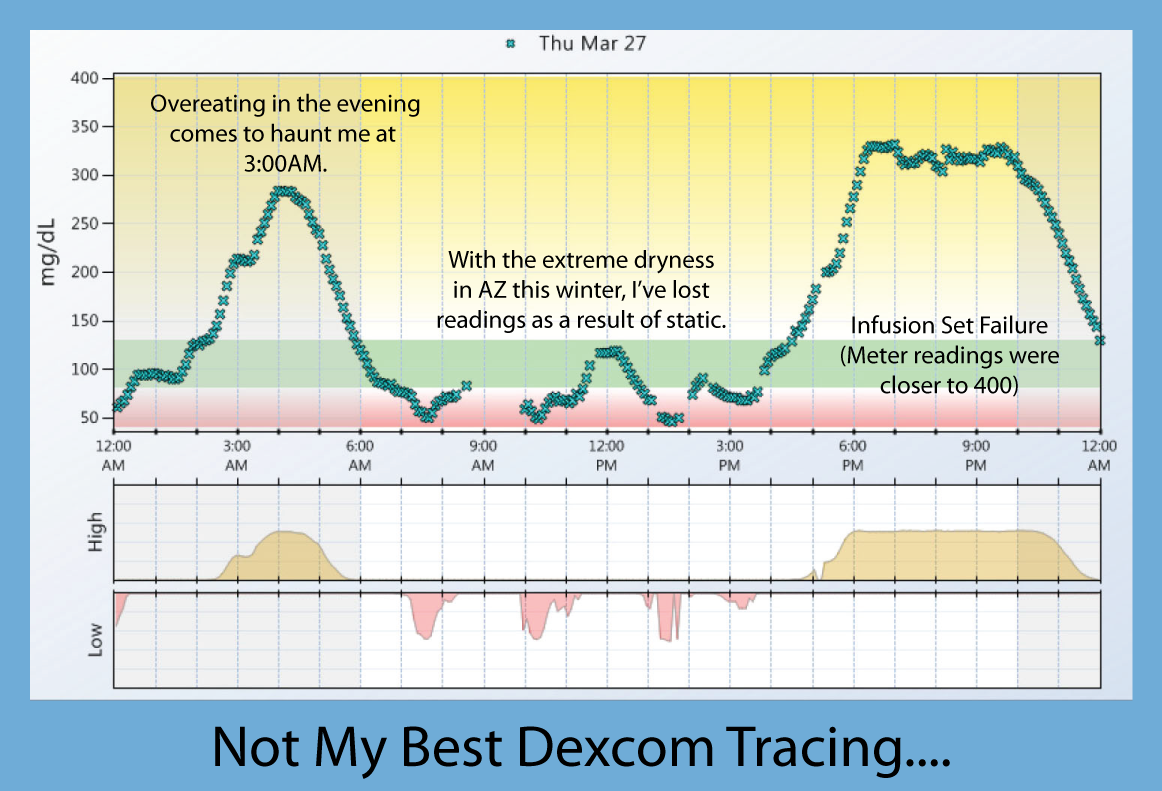
Laddie_Head SquareIn my recent post about a blogging vacation, I made a notation on my Dexcom tracing about static interfering with my CGM readings. This has actually been a significant problem for me this winter and deserves some explanation.

Most of us who use CGM’s and pumps have had frustrating phone calls with customer service reps who somehow blame a multitude of problems on the phases of the moon, user errors, and the ubiquitous static. This winter I had multiple Out of Range error messages with my Dexcom G4. My transmitter was out of warranty and was the first device replaced. The number of Out of Range and ??? alerts escalated and I had instances of not being able to enter calibration numbers. Dexcom has always been responsive to my calls and quickly replaced the receiver.

New transmitter. New receiver. Although the calibration errors were fixed, other problems persisted and I assumed that they were somehow related to my sensors. I use each sensor for 2-3 weeks and had been using the same lot number of sensors all winter. I know that the Dexcom manual indicates that Out of Range readings are related to communication between the transmitter and the receiver, not the sensors, but….

I called Dexcom and fortunately got a great technical support rep. We spoke a while and she started asking questions. What was I doing when the Out of Range problems happened? Walking the dog. Shopping at a Target. What was I wearing? Athletic clothes. Golf clothes. I don’t know because I didn’t think about it. Where was the sensor inserted? Mostly upper leg sites.

She indicated that she thought it might be a static problem. I wasn’t convinced but tried to stay open-minded. Because I had used the 7+ for several years and the G4 for over a year with virtually no Out of Range readings, it didn’t make sense to me that all of a sudden static was wrecking my CGM universe. I was surprised when at the end of our phone call, she indicated that she was sending me a new transmitter.

If you work for Dexcom, please quit reading now.

After the phone call, I immediately started wearing some of my cotton clothes. Magically I didn’t have any Out of Range problems. A few days later I wore my favorite synthetic fabric athletic pants. One dog walk later and I was Out of Range for several hours. I wore my golf shorts that are cotton, but have shiny polyester pockets and guess what. Out of Range problems.

After these episodes/experiments my last two Dex sites have been upper arms. No synthetic pockets full of pumps, CGM receivers, and glucose tabs electrifying my transmitter. No static. No Out of Range problems.

Arizona almost always has low humidity, but this year has been even drier than normal. Like most of the Southwest, rainfall has been almost nonexistent in 2014 and my area has only had measurable rainfall one time since January 1. For the most part my wardrobe hasn’t changed. I have worn the same two pair of REI hiking pants for almost ten years and never had problems with the 7+ or the G4 last year. My golf clothes and everyday capris are well-worn and experienced when it comes to diabetes. But the extra dryness Dexcom Avoid Static_Blackthis year must have thrown the G4 over the threshold of what the transmitter can tolerate. I have struggled with my skin this year more than in the past, so I think the G4 and I are both rebelling against the 2014 desert dryness.

Remember now if you work for Dexcom and didn’t quit reading before, please quit reading now.

I have not opened the new transmitter. The old transmitter has been working fine since I’ve been protecting it from static generated by mutant pockets of synthetic/electrifying and polyester/nylon materials. Should I feel guilty and call Dexcom to genuflect and confess my dual sins of synthetic fabrics and static electricity? Probably not. The new transmitter was sent to me with no conditions attached and I was not asked to return the old transmitter. I won’t abuse the possession of the new transmitter by selling it or giving it away. Like most people who use a CGM, I will sleep a bit better knowing that I have a back-up transmitter. Both times when I have begun using a new transmitter since starting the G4 in November 2012, I really didn’t think that there was anything wrong with the old transmitter. I never got a battery warning. I got things like ??? and calibration problems.  But if you have a new transmitter in your cupboard, they won’t talk to you about other problems unless you have started using the new transmitter. Both times the problems did not resolve until the receiver was replaced. So I think I prematurely sent two transmitters to medical trash before they truly bit the dust and I have never had the luxury of a back-up for even a few weeks.

I’m not trying to justify medical theft and if you work for Dexcom and are still reading (even though I warned you to stop!), you know where I live and can give me a call. Another somewhat moral issue I’ve been wondering about is whether I violate any trademark/copyright issues when I use images of medical devices in my graphics as I did today with the G4 transmitter. Because I am not profiting from my use of the image and it’s being used on a personal blog, I doubt that anyone is going to chase me down. Today I obscured the image big time with a sketch filter in Photoshop and don’t know whether that’s a good or bad thing. I will say that I really like today’s graphic and think it does a good job of illustrating the static issue.

I’m back in Minnesota now. Plenty of humidity with rain and snow. I’ll be curious to see how my Dex works this summer. I really like using leg sites in warm weather so that I don’t have a visible mess of the transmitter and dirty adhesive on the back of my arms when I wear short-sleeved shirts. I’ve given up sleeveless shirts forever. 60+ years of sun exposure and diabetes-related skin problems have motivated me to look for long-sleeved shirts that can be worn in warm weather. That will be a blogpost someday soon, but I’m still working with my dermatologist to figure out exactly what is going on and what, if anything, we can do about it.

What I Need/Want/Deserve

Laddie_Head SquareOn Sunday April 6 The New York Times published an article by Elisabeth Rosenthal titled Even Small Medical Advances Can Mean Big Jumps in Bills.  A friend without diabetes alerted me to the article and I read it along with the comments. For the most part I avoided social media for the rest of the weekend and had time to stew over my reactions to the article.

On one hand it was good to see Type 1 diabetes highlighted by the media.  Parts of the article were correct, but other parts made me feel uncomfortable and marginalized. I work hard to control my diabetes and I have been quick to give credit to my pump and CGMS for greatly improving my health and quality of life. I have no major complications and after my hospitalization at diagnosis in 1976, I have never been hospitalized except for childbirth. I thought that was a good thing.

Although I realize that my day-to-day medical expenses are high, I have been a “cheap” patient when it comes to acute care. Even my chronic care expenses do not surpass the total of my insurance premiums and my high deductible. Insurance companies are not making money on me, but they’re not losing their shirt either. That doesn’t mean that I could have gotten along equally well without insurance. My biggest financial benefit of having insurance is getting access to insurance-contracted rates. The insanity of our healthcare system is illustrated every time I see an EOB (Explanation of Benefits). Without insurance I would pay two or three times what my insurance pays for any procedure, lab test, or office visit. But that’s a topic for another day.

Most of you have already seen this excerpt from the article:

That captive audience of Type 1 diabetics has spawned lines of high-priced gadgets and disposable accouterments, borrowing business models from technology companies like Apple: Each pump and monitor requires the separate purchase of an array of items that are often brand and model specific.

A steady stream of new models and updates often offer dubious improvement: colored pumps; talking, bilingual meters; sensors reporting minute-by-minute sugar readouts.

 If you want to understand at my outrage/disappointment/fear at these comments and the whole article, please check out Kelly Kunik’s letter at her blog Diabetesaliciousness.  For some other well-thought out responses to this article, check out Amy’s post at Diabetes Mine and Bennet’s letter at Your Diabetes May Vary. Or just explore the DOC and you’ll find other great posts on this subject.

I have a few things to confess talk about here. Throughout most of my diabetes career, I have been considered a model patient who is compliant and all of those other adjectives that can be tossed about. One of my endos once told me that “You can get anything to work”. In a sense, I can and have. But the idea of going back to NPH and Regular or a once-a-day Lente injection is terrifying. I rarely make it through a night without at least two or three alarms from my Dexcom that my BG is too high or too low. I use my pump for multiple .25 or .375 corrections every day. That’s impossible with a pen and extremely difficult with a syringe.

But I could survive if I went back to syringes and vials. I don’t know whether I would have more complications than if I had never gone on the pump. I have had approximately the same A1c while pumping that I had with Lantus and Humalog injections, but my highs are not as high and my lows are not as low. I spend much more time in my “target range” and I feel much better. I believe that I am safer because my insulin delivery is more precise and predictable.

Although I have used various CGM devices for over 5 years, the Dexcom G4 has been the most life-changing. In the last year and a half with my G4, I have not once needed my husband to help me with a hypoglycemia episode. I have not wandered around a strange hotel room in the middle of the night desperately trying to find something to eat and then trying to figure out how to chew and swallow. I have hiked hundreds of miles without requiring a Glucagon injection. Bad golf scores have been the result of my bad golf swing and not the result of BG readings in the 30’s and 40’s. My only interaction with firemen/paramedics has been taking my grandchildren to see the firetrucks and ambulance.

Is a pump and/or CGM a luxury “gadget” for me?  The first night in July without my Dexcom when the transmitter died, I woke up with a BG reading of 37. But at least I woke up. If my pump is denied by insurance, will an uninsured T1 diabetic get access to insulin? If I had to choose between my pump and my iPhone, what would I choose? (My Pump.) Should children get access to artificial pancreas technology while senior citizens can’t get CGM coverage by Medicare? If I lived in a country such as the U.K. with national health insurance, would I even qualify for a pump or CGM? What would my current health status and the cost of my care be if I were still checking my urine to determine my BG control and taking only one injection of Lente per day as I did in 1976? Would I still be alive?

I don’t know.

These are important questions.  As I get closer to Medicare age and our country moves closer to universal healthcare, I realize that not every decision related to my diabetes care with be in my favor. No healthcare system will ever have enough money to give Cadillac care to every individual at every stage of life with any health issue and despite unknown return on investment for that care. Some of the toughest questions that must be addressed are:

  • How do we measure value?
  • At what point are increased costs not justifiable in comparison to increases in quality of life and health status?
  • Are these decisions death panels or a reasonable allocation of limited resources?
  • Is it short-sighted to limit access to pumps and CGMS and then willingly pay for dialysis and amputations?
  • How do we decide between keeping 16-week premature babies alive while denying tests strips to millions of people with Type 2 diabetes?
  • Should there be an age limit on joint replacements and organ transplants?
  • How can drug and device companies develop better technology and improved pharmaceuticals if these products are not reimbursable expenses?

Measuring ValueI think that each one of us could add multiple questions to that list. The patient profiled in the NYT article concludes that “You want me to be able to afford good treatment…Because otherwise I end up disabled.”

Does anyone care?

Scary times, my friends with Type 1 diabetes.

Blogger Meet-up in Flagstaff

Laddie_Head SquareLast week I had dinner with three fabulous women. All of them have diabetes and all are well-known bloggers in the DOC. It was invigorating, it was fun, and it was truly an honor to spend time with these women.

We mentioned one guy a few times during dinner. No, none of us had a grilled cheese sandwich, but I bet you know whom I’m talking about. Yeah, it’s Scott Johnson. What does Scott have to do with this dinner? He is absolutely the reason that this meet-up occurred.

A little history here. I’ve been active in the Diabetes Online Community for about ten years. I’ve participated in message boards and read numerous blogs with various anonymous screen names such as Lathump or Casabby. In late 2011, I emailed Scott responding to an invitation he had made to help people in the Minneapolis/St. Paul area get connected with other folks with diabetes. In typical Scott fashion, he replied warmly and generously with the contact information for several groups. I met Scott in the spring of 2012 at a Type 1 meet-up at the Edina Panera Bread and felt like I’d known him forever.

Somehow meeting Scott brought the DOC to life for me. I saw him at a couple of other diabetes events and occasionally we emailed back and forth. I don’t remember how DSMA entered our relationship, but in January 2013 I emailed Scott that my aim for the winter was to listen to the entire archives of DSMA Live of which Scott was one of the hosts. DSMA Live was (and is) is treasure trove of diabetes stories and mid-winter I “met” Kate Cornell. Kate has Type 2 diabetes and blogs at Sweet Success: My Life with Type 2 Diabetes. Listening to the November 2012 interview, I was very impressed by Kate who seemed so composed and so knowledgeable. I started following her blog and filed it in the back of my mind that I wanted to meet her some day. More than once I would read something that Kate wrote and think that “Wow, this woman really knows her stuff and she says things that I might say”.

As the winter of 2013 progressed, I learned about DSMA Twitter Chat on Wednesday evenings. Twitter was a complete unknown to me, but I bravely indicated to Scott that I might try it out. Kerri at Six Until Me had previously published a post outlining the basics of Twitter and I followed her instructions and signed up. At my inaugural Twitter Chat, the first person who welcomed me and gave me the confidence to continue, was @JennMamaBear. I followed Jenn and was daily impressed with her photographs and Twitter skills. I followed her blog Sweet Zoo and also starting playing Words with Friends with her.

When I learned that Jenn was from Utah, I mentioned the idea of a meet-up in Flagstaff and indicated that I had always wanted to meet Kate. Jenn immediately jumped on board and said that she knew someone on Twitter from Flagstaff and her name was Jewels. Although I did not realize that Jewels was from northern Arizona, I “knew” her because of a November 2013 interview on the DSMA ‘Rents show. Jewels has Type 1 diabetes and blogs at SheSugar. One of her daughters also has Type 1 and Celiac disease, so her blog is an incredible resource for information on living a healthy life with both conditions. It is much more than a recipe source, but the low-carb gluten-free recipe that she recently featured for Crispy Cauliflower Crust Pizza is high on my list to try.

To make a long story short, these Scott Johnson-, DSMA-, and DOC-connections led to a dinner meet-up of four diabetes bloggers in Flagstaff, Arizona. In many ways this dinner was a reflection of both the kinship and diversity of the Diabetes Online Community. Despite our instant connection to each other and our thoroughly entertaining evening, our stories are really quite different.

Bloggers_Flagstaff

Kate was diagnosed with Type 2 diabetes nine years ago. She is an independent sort and with no “diabetes team” in 2005 to teach her what she needed to know, she searched the internet to learn everything that she could about diabetes. She combines oral meds with low-carb eating to keep her diabetes ducks in a row and is currently involved in a frustrating battle to convince her doctor to let her begin using insulin.

Jewels was diagnosed with Type 1 as a child and has the unique experience of being a Type 1 who is parenting a child with diabetes and celiac. She is a nurse, freelance writer, and health consultant who embraces a gluten-free lifestyle for her family. She is a Stanford Medicine X ePatient scholar and JDRF volunteer who balances her advocacy work with a crazy-active life spent biking, running, skiing, and participating in yoga.

Jenn has been living with diabetes for almost ten years. Her diabetes story is the ubiquitous tale of being misdiagnosed as Type 2 for six frustrating years before finally getting the correct Type 1 label in 2010. She is an animal lover who manages to make room for her husband and daughter in a house ruled by cats. She works full-time, is active in her church, is a JDRF advocate, and is a fun and enthusiastic travel companion.

A Type 2, a Type 1 diagnosed as a child and parenting a T1, a Type 1 initially diagnosed as a T2, and a Type 1 diagnosed as a young adult. That’s a lot of diabetes mojo at one dinner table.

Jenn and I went to the red rock country of Sedona on Wednesday. We marveled at the beautiful scenery while hiking (18,484 steps and 8.33 miles per my Fitbit), visiting local landmarks, and wandering through unique shops. Never far from the DOC, I had to take a photo of Jenn by the sign of the frog-themed Mexican restaurant where we had a delicious lunch. She needed to send it to Tina who knows of Jenn’s hatred of frogs and always sends her frog photos. Of course I “know” Tina from her September 2013 DSMA ‘Rents interview….

Sedona_Boynton

This blogpost is littered with links to many people in the DOC and once again illustrates how the diabetes community is an interwoven fabric of relationships and stories. Because I have provided photos, everything I have written is the absolute truth. That’s another bit of DOC/DSMA lore as Cherise pronounced last October after my NYC brunch with Alecia of SurfaceFine: “If there’s no photo, it didn’t happen.”

So yes, Cherise, this time there are photos and yes, it really happened.

A Blogging Vacation

Laddie_Head SquareI’ve been on a blogging vacation. It wasn’t intentional, but one missed post turned into another missed post. And another missed post. Before I knew it, my twice weekly postings had turned into none. Blogs aren’t supposed to be a burden, so I’m not feeling too guilty. Unfortunately my blogging vacation has been accompanied by a lapse in my diabetes care.  A few (well, maybe a lot of) bad decisions along with infusion set problems have resulted in a series of days (weeks?) with less than optimal numbers.

My diabetes care is never perfect, but for the most part I do pretty well and spend a lot of time in my “target range”.  For much of the last year I have had success with a low carb diet (most of the time) and an insulin regimen that has controlled my morning blood sugar spikes (most of the time). So what has thrown everything out of balance?

A little bit of this and a little bit of that.

Balance is the hardest part of Type 1 diabetes. Without a functioning pancreas, our bodies have no sense of equilibrium. We live on a tightrope where good numbers are a small step from catastrophic lows and higher numbers seem to send the glucocoaster spiraling out of control. It’s the reality that everything today is connected to everything yesterday and will influence everything tomorrow.

I eat a couple of chocolate chunk cookies. Okay, they are the (huge!) chocolate chunk cookies (delicious!) from Costco. I take a boatload of insulin and my BG numbers seem to stay in check. But at 2:00AM my Dexcom screams that my BG is high and rising quickly.  I program a correction dose into my pump and unfortunately wake up with a low at 6:00AM. Two glucose tabs and before I know it, I’m back to 180 and rising quickly. I test frequently and take enough insulin to vanquish two plates of pancakes, a banana split, and half a loaf of Wonder Bread. But wait, I didn’t eat any of those things. I either ate nothing or my normal 17 carb breakfast of Greek yogurt and apple or blueberries. The dog walk that usually prevents huge post-breakfast BG spikes is rewarded with numbers in the 200’s.

My endocrinologist claims that overnight lows result in hormones that ultimately cause highs. I think she’s right because the more overnight lows I have, the more daytime highs I see. The more I correct the highs, the more I end up low. Dexcom tracings that resemble the Himalayas multiply rapidly and refuse to give way to somewhat gentler blood glucose slopes.

The cookies are long gone and the sweet, yummy, chocolaty taste is a pleasant guilt-laden memory.  The problem is that my diabetes remembers the indiscretions and even when I’m eating a judiciously low-carb meal, my body is quick to spike and quick to crash. Add frustration and diabetes burnout to the mix and it’s hard to get back on the straight and narrow.

Dexcom Tracing

Mixed in with things I can control are things like infusion set failures. I have used angled sets (Silhouettes and Comfort Shorts) successfully for most of my pumping life. Skin problems, inflammation at pump sites, and insertion pain have motivated me to explore other types of sets. In my last supply order, I included a box of Insets and a box of Cleos. I started with the Insets and loved the pain-free insertion.  Since I weigh a little more than the last time I used 90-degree sets, I was encouraged by the performance of the first 9 sets with no pain, no failures, and all of them lasting 3 days. Then came #10. It was a blast from the past with an absolute failure five hours after insertion. I rarely get insulin blockages with angled sets. This site failure reminded me why I had quit using Quick Sets ten years ago and learned to live with the horrible insertion needles of angled sets. I’ll use the box of Cleo’s and probably go back to Comfort Shorts. I can stand a little pain and inflammation to have reliable insulin delivery.

After covering a lot of subjects here without much sense of direction, I’ll wrap up by saying that I’m back to blogging after a brief hiatus. Judging from the last two days, I think my diabetes care is back on track. In many ways these two things go hand-in-hand because they are reflections of how much diabetes is like a spoiled child who demands all of our attention and won’t settle for less than 100%. Not even when you want a vacation….

Diabetes Cookbooks: A First Time for Everything

IN JANUARY I SAW A REQUEST FROM THE BOOK DEPARTMENT OF THE AMERICAN DIABETES ASSOCIATION FOR BLOGGERS WHO MIGHT BE INTERESTED IN READING AND REVIEWING BOOKS. AS SOMEONE WHO ENJOYS READING AND IS ALWAYS LOOKING FOR BLOG TOPICS, I JUMPED AT THE OPPORTUNITY.  RATHER THAN BEING ASSIGNED A BOOK, I WAS ABLE TO SELECT THE BOOK(S) I WANTED TO REVIEW.  I DECIDED THAT I WOULD OPT FOR BOOKS THAT WERE A BIT OUTSIDE MY COMFORT ZONE: BOOKS THAT RIGHTLY OR WRONGLY I MIGHT NOT NORMALLY READ.  THE BOOKS THAT I CHOSE WERE PROVIDED TO ME FREE-OF-CHARGE, BUT MY REVIEWS, AS ALWAYS, ARE MY OWN OPINIONS.

*

Laddie_Head SquareTwo weeks ago I was having a glass of wine with some girlfriends and one of them asked: “When was the last time that you did something for the first time?” I did not have to think for very long to come up with an answer.

The one thing that I have done in recent weeks that was a first time experience for me was to use a diabetes cookbook.  Actually not just one cookbook, but two.  I have had diabetes for 37 years and until recently, I have never owned nor used a cookbook that was intended for people with diabetes.  I may have cut out a few recipes from magazines like Diabetes Forecast or Diabetes Health, but I don’t think I ever fixed any of them.

You might wonder whether I have anything against diabetes cookbooks.  I don’t think so. In general I’m not very interested in cookbooks and most of the cookbooks I own were gifts or purchased to support a fund-raising project. I don’t like to cook and I keep waiting for my husband to have a mid-life crisis and decide that he would like to be a chef. Unfortunately that doesn’t seem to be on his agenda.  My guess is that newly-diagnosed diabetics are a big market for cookbooks, but when I was diagnosed in the 1970’s, I wasn’t carb counting and didn’t need the nutritional analysis that is now contained in diabetes cookbooks.

When I decided to go outside my comfort zone and review two ADA cookbooks, I actually got excited about doing it the “right way”.  For me that meant choosing 4 or 5 recipes from each cookbook and following them exactly. (I have a bad habit of altering recipes and then wondering why they are not as good as advertised.) It also meant using the carb counts as provided and evaluating whether the nutrition info was a helpful tool in my diabetes life.

3D Family ClassicsThe first cookbook I delved into was the ADA standard bearer titled The Family Classics Diabetes Cookbook.  This is a collection of 140 “favorite” recipes from Diabetes Forecast Magazine.  My overall impression was that this is a well-organized cookbook with beautiful photographs and clear detailed instructions.  There is a good mixture of standard favorites such as Old-Fashioned Beef Stew, Classic Potatoes Au Gratin, and Classic Baked Artichoke Dip along with newer-style recipes such as Chickpea Tabbouleh, Tilapia Tacos, and Zesty Broccolini and Garlic.

I tried five recipes from this cookbook.  My two favorites and recipes that I will make again were Fresh Greens Soup with White Beans, Basil, and Tomatoes and Provencal Zucchini and Yellow Squash Medley.  Two other recipes were just fine and maybe worth repeating.  I only disliked one recipe and it was because of ingredient substitutions designed to make the recipe lower in fat than the original dish.

That leads me to a discussion of the “dietary philosophy” of this book.  The recipes are consistent with traditional ADA clinical guidelines prescribing a “heart healthy” diet with an emphasis on eating low-fat with a significant number of calories coming from healthy carbohydrates. This cookbook was published in 2012 and precedes the ADA’s 2013 acknowledgement that low-carb diets might be a successful tool for weight loss and diabetes management. Although the ADA has modified its stance on dietary recommendations, most physicians still advise their patients to follow a traditional low-fat diet.  Therefore this cookbook is a good resource for good food with a low-fat emphasis.  There are also some good recipes that are not high in carbohydrates if that is your preference.

3D Smart ShopperThe second cookbook that I tried out was The Smart Shopper Diabetes Cookbook. This cookbook by Robyn Webb, MS was filled with quick and easy recipes designed to be “stress-free” by using ingredients “from the Deli Counter, Freezer, Salad Bar, and Grocery Shelves”.  This book was published in 2013 and Webb’s introduction addresses the idea that there is no “one-size-fits-all nutritional approach for people with diabetes.”  She attempts to provide a variety of recipes that emphasize healthy fats, high fiber, varying amounts of carbohydrates, and lots of flavor.  Detailed nutritional information for each recipe is provided so that you can make up your own mind about which recipes are appropriate for your meal plan.

Because I am generally a lazy cook, I liked some of the short-cuts she used to make a healthy meal without too much time in the kitchen.  My favorite recipe was Chicken, Artichoke, and Spinach Soup with a close second-place finish for Mexican Chicken.  The other 2 recipes that I tried were fine, but I would probably try another new recipe before repeating them.  And there are definitely a few other recipes that are on my list to try:  Rosemary Turkey Salad and Salmon with Blueberry Salsa.

One thing that I liked, but haven’t used yet was the daily menus provided at the end of the book.  I find that when I want to experiment with a new style of eating, it is helpful to start with a structured program with daily menus.  Just follow the rules and don’t think too much.  These menus very much remind me of the balanced diet that was the basis of the Exchange System that I used in the first half of my diabetes life.  Although I carb count now, I still think in blocks of 15 grams and really feel that the Exchange System was not a bad way to eat.

Summary:  I enjoyed trying new recipes and expanding my normal dinner options beyond meat and vegetables cooked with little creativity.  The carbohydrate counts provided were helpful and saved me a little time.  At the same time, none of the measurements in either book were provided in grams, so I was stuck with guessing at what is the ubiquitous “medium banana” or “large onion.” Because I selected relatively low carb recipes to try, I was comfortable with guessing at some of the quantities.

I am very impressed with Robyn Webb, MS and would love to see the ADA publish a Low Carb cookbook with her input.  Although I am not perfect in living a low carb lifestyle, I am convinced that it makes my diabetes life easier and I would love to infuse some creativity into my menus.  I’ve definitely found some “keeper” recipes in the two ADA cookbooks that I explored.  But a whole low-carb cookbook would be fabulous and I would buy it in a minute.

If you would like to purchase the cookbooks that I reviewed or any other books in the American Diabetes Association Store, please go to this link:  http://www.shopdiabetes.org/  Also, Amy Tenderich at Diabetes Mine recently reviewed and raved about another ADA cookbook titled The Mediterranean Diabetes Cookbook.  To read her review, click here.

Dear Representative Collins

Sue May 2013_Head SquareOn January 16th at 6:01am I sent the following private message on my Congressman’s Facebook page:

Rep. Collins, I am a type 1 diabetic approaching Medicare age and I use a continuous glucose monitor (CGM) to track my blood sugars and keep myself safe from falling blood sugars. My health insurance pays for this device, but under Medicare law it is not covered. I ask you to support H.R.3710, the Medicare CGM Coverage Act of 2014. This bill would allow Medicare to cover Continuous Glucose Monitoring Systems (CGMs) if recommended by a doctor. Thank you for your anticipated support of this bill.

I never got a response. Maybe that wasn’t the correct way to go about contacting him; I’m not sure. Perhaps I should have sent a letter in the mail or contacted him through his website.

In the meantime on February 17, Sue from Pennsylvania published her Join the Crusade post which encouraged people with diabetes or affected by diabetes to become involved in the fight for Medicare coverage of CGMS.  Her post gave instructions on how to email the Legislative Assistant for Health Issues of one’s Congressperson and ask for his/her help in conveying to the Representative the importance of supporting H.R. 3710: Medicare CGM Coverage Act.  A sample letter was provided.

Sue, with help from Laddie and me, followed her blogpost with an intensive push to contact other bloggers and ask them to share her story and the importance of H.R. 3710.  She received responses from several bloggers who either wrote blogposts about the issue or invited Sue to guest post on their site.  A big thank you to Kerri, Kim, Stephen, Diabetic Mainer, and all others who did this!  And many thanks to everyone who spread the message through Facebook, Twitter, and other social media.

Last week I sent my email to Rep. Collins’ Legislative Assistant for Health Issues using the form letter included in Sue’s blog and added the following paragraph to emphasize why this is so important to me:

I have been a type 1 diabetic since 1988, dependent on taking insulin in multiple doses every single day to stay alive. Although insulin is a natural hormone, type 1 diabetics no longer make insulin due to an immune system that goes haywire and attacks the insulin producing cells in the pancreas. Many things can go wrong when taking insulin, resulting in low blood sugars (hypoglycemia) and high blood sugars (hyperglycemia). These can happen very rapidly and without warning, resulting in confusion, coma and even death. The continuous glucose monitor (CGM) is a device the diabetic can wear to alert him or her to an impending low blood sugar in time to act before unconsciousness results. I have been wearing a CGM for 4 years, and have not had a low blood sugar that resulted in unconsciousness in that time. Before I got the CGM, I would have at least one episode every month, many resulting in 911 calls and/or emergency room trips. I will be 65 next year and on Medicare, and unless this law is changed I fear I will once again be experiencing low blood sugars and trips to the E.R. or worse.

Capitol Building_Collins3I am hopeful that I will get a response from either Rep. Collins or his assistant. And if I don’t get a response, I hope that he is so busy working on co-sponsoring the bill that he doesn’t have time to reply to me. I will happily accept that outcome.

Join the Crusade

Sue B_Head SquareMedicare guidelines do not provide for coverage of Continuous Glucose MonitorsI am an advocate for my husband who desperately needs a new CGM and previously received CGM coverage under private insurance before reaching age 65. I am a crusader for the entire diabetes community, whether you are on Medicare, will soon be on Medicare, have a Continuous Glucose Monitor presently, or might need one in the future.

In December 2013 Representative Carol Shea-Porter [D-NH1] introduced a bill into Congress, H.R. 3710: Medicare CGM Coverage Act, which provides for coverage of Continuous Glucose Monitoring Systems by Medicare if recommended by a doctor. My recent post Baby Steps talked about the bill and many members of the Diabetes Online Community (DOC) asked how they could become involved in this crusade.

I have just received an email from Congresswoman Shea-Porter’s Legislative Assistant, Marjorie Connolly, and she suggested the following:

  • The most effective step you can take is to ask your own Representative to cosponsor the bill.
  • Call your Congressperson’s DC office and ask for the email address of your Congressperson’s Legislative Assistant for health issues.
  • Email the Legislative Assistant the text of Shea-Porter’s Dear Colleague letter (below) along with a personal note. That way they will understand why the issue is important to you, the constituent, and they will also have the Dear Colleague to show their boss so that he/she will know how to sign on.

The roster of the House of Representatives along with phone numbers is available at http://www.house.gov/representatives/

CGM CrusaderIf you would like to know more about my story and why I am crusading for CGM coverage by Medicare, please read my About Page and some of my previous blog posts.

There are many diabetics such as my husband who never realized that when they went on Medicare, their CGM would no longer be covered. When the denial for coverage comes, and it inevitably will because Medicare considers the CGM a precautionary device, the arduous journey through the Appeals system is daunting, exhausting and psychologically taxing. The wait for a decision is beyond description and we have waited for 8 months. The entire process will only get harder as baby boomers become Medicare-age in greater numbers. We need to do something about this sooner rather than later.

The only way to fight Medicare’s denial of the CGM is to get the guideline changed. The best thing that we can do now is to let our voices be heard and join with Congresswoman Shea-Porter and her new cosponsor, Congressman Matthew Cartwright [D-PA17] in asking Congress to pass H.R. 3710, the Medicare CGM Coverage Act of 2014.

At the bottom of this post you will find clickable links to download a Sample Letter and a copy of Shea-Porter’s Dear Colleague email blast. Don’t delay because the sponsors of this bill have begun their full-on push for support and every voice is important. If you are a blogger and want to know how to help, click to download this document:  Dear Fellow Bloggers_Final

Please contact me if I can assist you in any way. You don’t have to be a person with diabetes to write the letter. You can be the son, daughter, mother, father, friend or as myself, the spouse of a diabetic.

Please do this for all of those who so desperately need a CGM and can’t afford to pay for it out of pocket. Together we can do this.

Thank you.

Please note that due to problems with spam, comments are blocked on Test Guess and Go posts older than 90 days.  If you would like to make a comment or contact Sue from Pennsylvania, click here.


To download, click on this link: Sample Letter to Congress_Final

Sample Letter

To download, click on this link: Dear Colleague_Final

Dear Colleague Email Blast

Spare a Rose: Part 2

Laddie_Head SquareToday I sent a letter to most of my friends and family members. It was easy for me to write a blogpost that was read by most of the DOC. It was harder to send an appeal to my “real life” friends and family.

I know that the goal this year for the Spare a Rose, Save a Child campaign is $10,000 and we have almost reached it. I think that we can do better than that. Don’t be comfortable in your DOC niche. Be brave and send your appeal out to your co-workers, your neighbors, your family, and your friends.

728x90tag_Spare a Rose

This is the letter that I emailed to most of my friends and family.

Dear Friends and Family,

Most of you know that I have had Type 1 Diabetes for 37 years.  As the beneficiary of good insurance and financial security, I have consistently had access to expert medical care along with the latest and greatest technologies. Most importantly, I have never had to worry about the availability of insulin without which I would quickly die. I have lived a good life with and despite of diabetes and hope to continue to do so for many years.

The Diabetes Online Community (DOC) is sponsoring a huge campaign this Valentine’s Day:  Spare a Rose, Save A Child.  This campaign supports Life for a Child, a program of the International Diabetes Foundation (IDF).  Life for a Child addresses the needs of children in developing  countries, many of whom die within a year of a Type 1 diabetes diagnosis because of lack of insulin and medical care. To understand the scope of the problem, please watch the short video at this site:  http://www.idf.org/lifeforachild/the-programme

Spare a Rose, Save a Child is simple: buy one less rose this Valentine’s Day and donate the value of that flower to children with diabetes.  Your loved one at home still gets flowers and you both show some love to children around the world who need it. 

One rose, one month of life. A dozen roses, a year of life for a child with diabetes.                                            http://www.p4dc.com/spare-a-rose/

I write a blog about diabetes and I encourage you to read my blogpost about Spare a Rose, Save a Child:  https://testguessandgo.com/2014/02/03/spare-a-rose/

It is a rare occurrence for me to approach my friends and family about supporting programs that I am involved in.  I embrace this cause wholeheartedly and encourage you to donate this week as we get ready to celebrate Valentine’s Day.

To donate, go to:  http://www.p4dc.com/spare-a-rose/give/   You will use PayPal to send your gift directly to the IDF.

Please note the down arrow that gives you choices of how much to donate.  Spare 1 Rose = $5 = 1 month of Life for a Child. 2 Roses = 2 Months and other options up to 2 dozen roses for 2 years of life for a child.

As we approach Valentine’s Day 2014, let us all be generous in sharing our bounty with children all over the world.  To us, a rose is small.  To a child with diabetes, that rose represents another day, another month, another year of life.

With thanks to all of you-

Laddie