JDRF One Walk Manhattan 2014

This post is a little dated because I have been on the road and decided to wait until I got home to add the photos and publish my story.  Last Sunday I got the opportunity to walk across the Brooklyn Bridge while supporting JDRF.

My youngest son lives in New York City with his wife and almost one-year-old daughter.  In general I hate New York because I am a suburban girl at heart and get claustrophobic being around all the people and crammed-together buildings. But one night in early summer I saw a post by Alecia of Surface Fine mentioning the JDRF One Walk Manhattan 2014. Before I knew it, I had signed up and pledged to raise a certain amount of money and walk with Alecia’s Stem Cells team.

A little background here. I grew up on the East Coast and have been in and out of NYC most of my life.  But I have never really liked it.  I hate the crowds, I hate the filth, and most especially I hate the smells.  Somehow I managed to have a child who loves New York, moved there after college, and has never left.  Usually we see him when he comes to Minneapolis for family visits, holidays, and friends’ weddings. My husband occasionally has business in NYC and meets him for dinner.  Now that my son is a father, I have pledged to visit him and his family occasionally rather than always make them come to my part of the world.

More background. When my darling granddaughter was born last October, I flew out to NYC to do my best to be helpful. Previously I had “met” Alecia online through Twitter and then her blog. I had also purchased one of her 2013 Alecia’s Stem Cells T-shirts because it was such a great design. So with no fear I emailed her to see if she would like to meet for lunch or a drink. In typical Alecia-style, she replied quickly and suggested Saturday brunch.  We enjoyed our visit and found that we had a lot in common.  Although I am a generation older than Alecia, we have both had Type 1 for over 35 years and we use Animas pumps and Dexcom G4 CGM’s.  Since our first meeting a year ago, we have continued to keep up with each other in typical DOC-style with occasional Tweets, emails, and blog comments.

Alecia is an avid JDRF supporter and this was her 15th Walk. Alecia’s Stem Cells team raised over $37,500 this year. Rather than recreate the wheel, I’ll share Alecia’s summary of the fantastic 2014 walk:

We had Walkers this year from NY, NJ, PA, IL, and MN.  We had our largest Walk team ever. We had friends and family from the very first Alecia’s Stem Cells team in 2001 and first time walkers who’d never been across the Brooklyn Bridge.  We had a grandmother who’s T1D, a 40-something T1D (me), a 20-something T1D and a 8-year old T1D.  The team may carry my name, but we were walking for ALL of us. Alecia’s Stem Cells was announced as one of the top 5 fundraising teams for the JDRF NYC.  We ran out of yellow ASC team ONE to NONE shirts and even had some walkers in the grey shirts from our online fundraising sale last month. Simply put, it was AMAZING adventure this year. 

I am especially glad that I joined Alecia’s walk this year because on Sunday afternoon she announced that this was the last walk for Alecia’s Stem Cells.  She has decided to challenge herself by joining the JDRF’s endurance sports program and begin training for one of the 100-mile bike rides in 2015.

One thing that I know about Alecia is that whenever she tackles a project, she always gives 110% and doesn’t quit until she succeeds.  I look forward to seeing which ride she chooses and I promise to support her with a donation.  Although I was happy to cross the Brooklyn Bridge with Alecia, I can say with absolute certainty that I will neither accompany her on training rides around Manhattan nor join her for a 100-mile ride!

Here are a couple of photos:

With Alecia at JDRF One Walk Manhattan 2014

With Alecia at JDRF One Walk Manhattan 2014

JDRF One Walk Manhattan 2014 is a family affair

JDRF One Walk Manhattan 2014 is a family affair

More News on Medicare and CGM’s

Laddie_Head SquareOn Friday I received a copy of an email from a Medtronic spokesperson announcing an important development in the battle to have continuous glucose monitors (CGM) covered by Medicare.  This is an excerpt from her email:

We have some great news to share on the Medicare CGM Access Act! Late yesterday, Representatives Tom Reed, Dianne DeGette and Ed Whitfield introduced companion legislation into the House of Representatives.

As you’ll likely remember, back in July Senators Susan Collins and Jeanne Shaheen introduced nearly identical legislation to ensure access to CGM technology for people on Medicare. We can’t thank you enough for all the wonderful social media activity you’ve created to drive the community to urge their Senators to co-sponsor the bill. However, as you likely know, in order for a bill to become a law, it must be passed in both the Senate and the House before going to the President to sign or veto. So, this “companion bill”, which is nearly identical in content with a new number (HR 5644), is a key step in the legislative process.

Of course, this means it’s time to rally the community again, urging people with diabetes along with their friends and family to encourage their local Representatives  (as well as their Senators) co-sponsor the legislation.

Once again, JDRF has provided great resources where people can read about the issue as well as identify and easily contact their own Representatives and Senators.

You can find these resources here. You can also feel free to share our blog post.

For those on Medicare and those of us soon to be there, this is hugely important.  My CGM has been life-changing and I believe that it keeps me safe and improves my blood glucose profile on a daily basis.  My co-blogger Sue from Pennsylvania has repeatedly shared the nightmare that she lives in because of the non-coverage of her husband’s CGM by Medicare.

What can you do?

    1. Contact your U.S. Representative to ask him/her to co-sponsor H.R. 5644 and advocate for seniors with diabetes who require a CGM.
    2. If you have not already done so, contact your Senators to co-sponsor S. 2689 and advocate for seniors with diabetes who require a CGM.
    3. Sign the JDRF petition: Tell Medicare to Cover Continuous Glucose Monitors for People with Diabetes.  As of 9/21/14 the petition has 56,618 signatures and we hope to reach 100,000 signatures.
    4. Forward my blog to your friends and family urging them to take action.
    5. If you are a blogger, please share this with your readers.  If you would like to copy my blogpost word for word, please do so!

The links provided by JDRF make it simple to contact your Senators and Representative.  By filling in your name and address, your appeal is automatically sent to the correct government officials.  You are able to personalize your message by adding a few sentences to explain why this is important to you.  I used to be worried about trying to be an advocate.  JDRF has streamlined the process and made it “easy-peasy.”  You can complete Steps 1-3 in about 5 minutes.

I thank you for reading this.  More importantly, I thank you for contacting your elected officials to help ensure that your fellow Americans on Medicare have access to continuous glucose monitors.

If there is anyway that I can help you, please contact me.

Blogrolls….

Laddie_Head SquareLast week I spent two hours updating my Blogroll.  The process began with a print-out of my current blogroll which I compared to my bookmarks for diabetes blogs in Safari. I found about 25 bookmarks which needed to be added to the list. One by one I typed in the name of each new blog and embedded the link to the website.

I had known for months that I needed to work on my blogroll, but the chore stayed at the bottom of my To-Do list.  What inspired me to finally tackle the project was the Wednesday, Sept. 3 DSMA TweetChat. The subject was whether the Diabetes Online Community (DOC) should have a governing body along with standards of conduct and lots of rules. No one seemed to think that was a good idea and the discussion moved to the topic of helping newcomers to the DOC find a foothold in the maze of diabetes social media.  Blogrolls were mentioned.

Blogrolls show up in many different forms.  Some like mine are long lists by category (Type 1, Type 2, Parent) with no description or rating of the blogs.  Others are shorter lists with titles such as “My Favorite Blogs” or “DOC Friends”.  One of my favorite blogrolls is by Scott at Rolling in the D because he has personalized his list with brief and occasionally witty descriptions of each blog/blogger. A nice feature on Blogger sites is a “live” blogroll that automatically updates with recently published posts.  Many DOC writers have chosen to not have blogrolls at all.

Blogroll_!What is the purpose of a blogroll?  When I began reading diabetes blogs many years ago, blogrolls were a magical pathway to “meeting” other people with diabetes.  Without Twitter and Facebook, there was really no other way to learn about other websites.  The first blog I read was either Scott’s or Kerri’s and then it was a dot-to-dot adventure finding other people sharing their stories.  My guess is that newcomers to the Diabetes Online Community (DOC) still use blogrolls in this fashion while most blogrolls are largely ignored.  My blogroll had about 200 views in the last year.  I hope that some viewers used my list to find other blogs.  Unfortunately I suspect that most of the views were just by other bloggers seeing if they were on the list!

The main reason that blogrolls are impossible to keep current is because there are now hundreds of diabetes blogs and new ones appearing all of the time.  If you check out most blogrolls, you will find a dated list that highlights many established D-blogs while including few new blogs and being littered with many blogs that have been abandoned for years.

As an experiment, I checked out the blogrolls of the first twenty blogs listed in my Safari bookmarks.  I chose 3 favorite blogs in addition to my own to see if they were listed in any blogrolls. These 3 blogs are by prolific Type 1 writers who like me have been around for about 1-1/2 to 2-1/2 years. Of the twenty blogs I checked out, 5 did not have blogrolls.  My blog was listed on 5 out of the remaining 15 blogrolls.  Another fantastic newish blog was listed on only 3 blogrolls.  One was seen on 6 out of 15 and the last one had more presence being on 9 out of 15 blogrolls. These stats are not meant to criticize anyone; rather they emphasize how flawed most blogrolls are.  Even if you are able to keep adding all of the new blogs, when do you take an inactive blog off the list?  The ultimate criteria is probably when the link doesn’t work anymore.  But how old is too old?

When blogrolls were mentioned in the September 3 DSMA TweetChat, Scott Johnson immediately tossed out the question of the day. Typical of DSMA, the discussion quickly went off-topic and morphed into shrimp rolls and carb counts.

Blogroll Tweet All

How do I feel about this?  On one hand, it is frustrating to be left off lists by people whom I know read my blog regularly.  At the same time, I know that it is meaningless because I don’t think blogrolls are used for much of anything and most of us rarely look at them.  So after this post I think I will go back to totally ignoring them.

Back to the September 3 DSMA TweetChat.  Although I don’t believe that the DOC needs a governing board or rules, I wonder if something like a DBlog Central website would be useful.  This site could maintain a complete and updated blogroll with descriptions and tags to help users navigate the DOC.  A central website could also be a hub for sharing information with all diabetes bloggers on things like starting a blog, finding diabetes graphics, Twitter names, current campaigns of the DOC such as Spare a Rose, and a calendar of events.

I can’t envision how something like this could be created.  Maybe we should have a governing board for the DOC and “they” could set up the website….  Yeah, right!  I think that most of us would say that the magic of the DOC comes from its somewhat chaotic nature and no one wants to regulate its constant evolution. Why should we change something that isn’t broken?

In the meantime I plan to continue to have a blogroll.  If you’re not on it and would like to be, please contact me.

The Connection: Diabetes and Rheumatoid Arthritis – Part 3 of 3

Banner_Diabetes_Arthritis

Laddie:  Please welcome guest-blogger Rick Phillips who has written a
3-part series about Diabetes and Rheumatoid Arthritis. To learn more
about Rick, please check out my recent post that introduces him to
the readers of Test Guess and Go.

*

Rick Phillips:  RA – Diabetes and Autoimmunity

Rick_Square HeadAs I move to wrap up this series, I am reminded that I am often accused of writing an epistle when a sentence will do the trick.  I cannot help it.  I am trained as a bureaucrat, so I tend to spin in place a lot with my writing.  That is a bad habit I am working to break.  If you have stuck with me up until now, I hope you have found the effort you expended a wise investment.


I really do owe a debt of gratitude to Laddie for publishing my work.  I am reminded that I am a guest here and the first rule of being a guest is to not overstay your welcome.  I hope I have not overstayed my welcome on Laddie’s site.  I am exceedingly grateful for her hospitality.  Rheumatoid Arthritis (RA) is something that interests me a great deal of course.

After diagnosis, I wondered:  “Are RA and Type 1 diabetes connected?  And if so, how?”  They are.  While I had never heard of such a connection before I was diagnosed with RA, the connection, the how, and why these diseases are connected really started to interest me.

First and foremost, RA is an autoimmune disease as is Type 1 diabetes.  In both diseases, it is thought that the autoimmune system mistakes helpful body tissue as being undesirable and in essence revs its engine to attack the body systems it finds offensive.

My dad loved war movies, so I tend to think of it like a war movie.  I imagine the autoimmune system (the General) hanging out in headquarters.  Suddenly, it notices some movement on the map; someone has mistakenly labeled that movement as the enemy.  The labeling is wrong, but the autoimmune system does what it does: it attacks.  It sends in tanks, missiles, aircraft carriers-you name it, to battle this new movement.  The trouble is the movement is not harmful or the enemy; it is the good guys.

In my case, my autoimmune system first attacked the insulin-making cells in my pancreas.  Later, it loaded up and started a war with my joints.  Still later, my autoimmune system got tired of hanging around with no new wars to fight, so I was diagnosed with a third autoimmune disease called Ankylosing Spondylitis (AS).  AS is like RA of the spine.  AS has pretty much the same disease elements as RA, this time just targeting the spinal area.  It hurts as well and I had never heard of it before the doctor said I had it.  Go figure, another prize in the “autoimmunity-gone-wild” lottery.

So, how are these diseases connected?  According to the Arthritis Foundation, there is an overlap between the diseases.  This is how they explain that overlap:

Research shows a genetic connection between rheumatoid arthritis and type 1 diabetes. In recent years, researchers have identified a gene called PTPN22 that strongly correlates with the incidence of type 1 diabetes as well as rheumatoid arthritis, juvenile idiopathic arthritis and other autoimmune diseases.  (Learn About Arthritis, 2014)

After one gets beyond that, finding the evidence for a link tends to get less pronounced.  A very large study in 2010 found the following evidence for a connection between arthritis and diabetes: “Among U.S. adults with diagnosed DM, nearly half also have diagnosed arthritis.”  At first blush, that seems like pretty compelling information for a direct link between the two disease conditions.  However, once one digs a little deeper, it is discovered that this link has more to do with Type 2 diabetes than Type 1.  More than half of the incidence of people with Diabetes Mellitus and arthritis were also judged to have arthritis-attributable activity limitation. While not saying it directly, it does suggest more of a relationship between Type 2 and arthritis than Type 1.

Of course, no matter how you cut it, RA and Type 1 are both autoimmune diseases.  Although I searched for several days and could not find a direct link, I still don’t think anyone will be surprised if one day a common thread between the 80+ autoimmune diseases isn’t found and shown.

There is one other very significant fact that needs highlighting.  Almost 3 in 4 people with RA are female (“Learn About Arthritis,” 2014).  No one knows why women are more susceptible to RA than men.  Whatever the reason, RA is a tough disease. The combination of RA and Type 1 diabetes is even tougher to deal with.  I hope this series has been informative.  If you would like to discuss it further, look me up at my blog at TuDiabetes or send me an email at Rphil2@Yahoo.com.

Special thank-you for help in preparing this series goes to: Erin Mattingly, for administrative support, Carol Eustice, Ask.com arthritis expert, and of course Laddie for allowing me to publish such a long blog series. (Laddie, I hope I did not run anyone off!)

The Connection: Diabetes and Rheumatoid Arthritis – Part 2 of 3

Banner_Diabetes_Arthritis

Laddie:  Please welcome guest-blogger Rick Phillips who has written a
3-part series about Diabetes and Rheumatoid Arthritis. To learn more
about Rick, please check out my recent post that introduces him to
the readers of Test Guess and Go.
*

Rick Phillips:  My Personal Journey with RA

Rick_Square HeadThank you once again to Laddie for me inviting me to blog at her site and especially for encouraging me to blog about arthritis.  While I traditionally blog at TuDiabetes and have been a type 1 diabetic for 40+ years now, I also have Rheumatoid Arthritis (RA).  The connection between the two diseases is always fascinating to me.

I decided to stretch Laddie’s invitation to a three-part blog about RA.  In the first blog, I told of how I was diagnosed; today, I write of my personal path with RA; and the third blog will be a discussion of how RA and diabetes are related.  While sequentially written, each one stands apart and can be read independent of the others.  I hope you find meaning in my experience.  If you wish, I am available to answer questions.  I am not an expert, but I have had an interesting life with the two diseases.

The advancement of drugs in the treatment of Rheumatoid Arthritis (RA) is nothing less than amazing.  In an informative article about Rheumatoid Arthritis at medicinenet.com, RA is defined as:

“An autoimmune disease that causes chronic inflammation of the joints. Autoimmune arthritis diseases are illnesses that occur when the body’s tissues are mistakenly attacked by their own immune system.”

The first line of drug defense is methotrexate.  It is inexpensive, readily available, and a proven agent; although, with some downsides.  One downside is that it does not always work.  In fact, in most cases today, doctors want to move patients with RA to the more aggressive biologic drugs.  You know these by the brand names: Enbrel, Remicade, Humira, and the secondary drug Orencia.  Each is administered via injection or infusion.  I prefer infusion, but most people prefer the injectable varieties.  These drugs, along with a host of others, target proteins linked to the TNF alpha gene (tumor necrosis factor alpha).  This gene belongs to a superfamily of genes defined as “a protein currently consisting of 19 ligands and 29 receptors in humans”  (“TNF Superfamily,” 2014).  This superfamily is thought to be involved in many types of diseases, including cancer (“TNF Superfamily,” 2014).  In fact, the class of drugs used to treat RA mostly came out of cancer research.  To read more about the TNF Superfamily, click here.

The doctor told me on the very first day that if I wished to continue to function, I must go to a biologic drug as soon as humanly possible.  That meant using methotrexate or a similar drug (Arava) alone for six months, then testing and going to a biologic immediately.  Those first six months were pretty tough.  My disease continued to worsen, and by the end of it I was barely walking.  So, my first “big gun drug” (as my doctor called it) was Remicade.  I used this for almost 5 years and it was amazing.  It absolutely stopped the progression of RA in its tracks.  That is, until it didn’t.  Over time, the frequency of doses began to get closer, and then it simply stopped working.  When it did, I moved on to a succession of five biologic drugs; four of which did not work, or worked only slightly, until they stopped altogether.

This is not uncommon for RA patients.  In fact, if you talk to RA patients who have had the disease for some time, many have been on every “big gun drug” out there.  I have been on many, but not all.

After 12 years of using TNF inhibitors, I had a scary incident where I developed something termed ”lupus-like syndrome” which caused me to be hospitalized.  Per the medical understanding at that time, I was forced to give up use of TNF inhibitors.  For those of you who would like the disease function explained, there is a nice technical paper here.   (Although I would skip it, if I were you.)

With the development of the lupus-like syndrome, I was forced to go on a different, potentially toxic, form of treatment using the drug Rituxan.  At the time, it was my last stop on the available drug merry-go-round.  The problem with Rituxan in particular is that during the clinical trials, people died.  So, the first time one takes it is very scary.  Doctors cannot predict who may be affected or when, but death is rare so it is unlikely the lights will simply go out.  With my experience with other drug side effects, it was a troubling decision to use the drug.  I put off the decision for about four months before I agreed.  During that time, my condition worsened and I was barely moving; sometimes during this time frame I returned to using a cane for walking.  I was once again a mess.

Today, my disease is managed with infusions every four months.  With constant appointments with the rheumatologist and a variety of secondary drugs, I am able to semi-manage RA.  I say semi-manage because I have had to stop working, I have periodic flares, and of course stamina is a big concern.  The truth is that no one really manages aggressive RA.  Instead, it is a series of highs and lows.  Some days you feel well, other days you feel terrible.  But with the assistance of biologic drugs, it is possible to live, albeit some days on a tight rope.  I have had no serious side effects using Rituxan, and while I am on the maximum allowable dose, the doctor and I are thinking we might have a chance to stretch the infusion intervals a bit in the future.  The drug is intended to be used on a six month cycle, with four months being the shortest cycle.  I am on a four month cycle at this moment, and doing well.

I also take an unreasonable number of drugs, in addition to the Rituxian.  Now, to be fair, most of these are not related to RA.  But, many are.  To give you an idea of my drug regimen, I have included two pictures that demonstrate the number of medications I use: one for morning meds and one for evening meds.  Yes, I know it is a lot.

Morning medications:

Morning Meds


Evening Medications:

Evening Meds


The Connection: Diabetes and Rheumatoid Arthritis – Part 1 of 3

Banner_Diabetes_Arthritis

Laddie:  Please welcome guest-blogger Rick Phillips who has written a
3-part series about Diabetes and Rheumatoid Arthritis. To learn more
about Rick, please check out my recent post that introduces him to
the readers of Test Guess and Go.

Rick Phillips: My RA Diagnosis Story

Rick_Square HeadFirst, thank you to Laddie for me inviting me to blog at her site, and especially encouraging me to blog about a subject that interests me greatly: arthritis. While I traditionally blog at TuDiabetes and have been a type 1 diabetic for 40+ years now, I also have Rheumatoid Arthritis (RA). The connection between the two diseases is always fascinating to me.

I decided to stretch Laddie’s invitation to a three-part blog about RA. In the first blog, I tell of how I was diagnosed; in the second, I will write of my personal path with RA; and the third blog will be a discussion of how RA and diabetes are related. While sequentially written, each one stands apart and can be read independently of the others. I hope you find meaning in my experience.  If you wish, I am available to answer questions. I am not an expert, but I have had an interesting life with the two diseases.

While I have told my diabetic diagnosis story a number of times, I seldom get to tell my RA diagnosis story. I was officially diagnosed with RA in early spring of 2000. Looking back on things, I likely had it longer. (My best guess, around 1997.) But, like most things that sneak up on you, I had no idea that most people didn’t feel that bad. The turning point came in two parts. The first, was in the late summer of 1999 when my oldest son bought a 1999 Pontiac Firebird. It was truly a beautiful car.  My wife nicknamed it The Beast for its thunderous engine, high end stereo, and awesome looks. He brought the car home; proud, as he should have been, and he offered rides. I could not go because I simply could not get in. The car was too low to the ground and I was much too stiff to bend. Not riding in his new car, of which he was legitimately very proud, hurt my son’s feelings and I went inside and had a good cry.

The second involved my youngest son when I took him for a campus visit at the one college I love: Indiana University Bloomington. While he and all of the other parents and prospective students toured the campus that late winter day, I stayed behind, sipping coffee in the lounge.  I was the only parent to do so. There was no way I could walk and keep pace, let alone walk the distance required for the tour. Now mind you, it was a lovely day at a campus that I have always admired and I was with my son who was enthusiastic to be there. If ever a day was made for a parent to enjoy a brief walking tour, this was it. When I could not go, I told him and myself that I was letting him go alone because it was a part of growing up. In truth, it was the final step in recognition of the fact that something brutally wrong was going on in my body.

Later when asked what tipped the balance, I would often say it was the ride to and from campus. On both the way there and back, I had to get out of the car to stretch because my legs hurt so much. It was a 60 mile, one hour drive each way. Today, post treatment, I routinely make this drive without stopping or issue. It seems silly now that I stopped twice that particular day.

With that second affront to one of my sons, I knew I had to do something. So when I saw my endocrinologist, we discussed it and he ordered some tests. In short order, the hidden truth was revealed. My indicators for RA were simply off the charts and immediate action was required.

Within a few days, I saw a rheumatologist and the cycle started. My insurance company required that the first course of medication involve the exclusive use of Methotrexate.  Almost immediately, my mouth broke out in sores and I went to a newer drug, Arava.  This one also caused mouth sores, but was effective at a lower dose.

With the use of these drugs, I started monthly blood monitoring, something I was not as compliant with as I should have been. By the end of the sixth month, my doctor received insurance approval to move to biologic drugs.

Being diagnosed with RA was an awful punch to the gut. I had learned to live with Type 1 diabetes, despite being very angry about having the disease. With use of insulin therapy, I was able to somewhat make peace with the disease.

With the addition of RA, life certainly got more complicated. First, it meant extensive blood work. Instead of going every three months for an A1C, I was now going one to three times per month to check blood levels for RA factor and various blood chemicals.  It was doubly important to keep up with the blood work because too much of the immune suppressants could ultimately be deadly.

Just as important, I also faced a new reality with work. I loved the job I was doing at the time.  Men are often self-defined by their job and I was no different. But with the diagnosis of RA, I somehow knew that life would change. At 42, it was truly the beginning of the end of my work life and what I defined as Me. Yes, I was scared, but thank goodness I have a wonderful partner in Sheryl who helped me keep the train on the tracks for a few years.

Introducing Rick Phillips

Laddie_Head SquareRick Phillips might be one of the busiest people in the Diabetes Online Community (DOC). The easiest place to find him is at TuDiabetes. He hangs out there under the name of “Rick the Blogabetic” and is an active blogger, forum participant, and member of the Care Team.

For those of you who are not active in the TuDiabetes community, the Care Team is composed of a group of dedicated members who moderate the forums, welcome newcomers to the site, post birthday greetings, look out for spammers, and provide support as needed to members of the community. It’s a big job and a compliment to be asked to be part of the team. After a few weeks of being part of the Care Team, Rick wrote a blogpost summarizing his thoughts on the “challenge to serve”. Here is an excerpt:

I truly love this site [TuDiabetes] and over the last few weeks I come to love it even more than today. Thank you so much for asking. It means a lot to me and if the reader of this post is ever asked and they accept the challenge, they will find a new way to serve you fellow diabetics and believe me it is so worthwhile.

Rick decided in late April 2013 that he needed to do something that was mega-impactful and he pledged to write 200 blogposts in one calendar year. Thus was created Rick Rick_2Rthe Blogabetic. Rick is somewhat like me in that he never uses one word when ten will do. Therefore his 200 posts represent a tremendous amount of writing and research on a vast array of subjects. You can read about anything from “Dogs and Endocrinologists” to the whimsical story of “Chick Duck” and from “What is -30-” to “When are We Not Diabetic?”  To learn more about Rick, you should read his 199th post in which he described what he learned as a result of his blogging marathon. BTW Rick the Blogabetic is still going strong although maybe not at the pace of 200 posts per year.

In recent weeks I have run into Rick at TuDiabetes both in the forums and on his blog. I have read his guest-post at Karen Graffeo’s blog Bitter Sweet™ where he compares diabetes education to spring rains. I have seen him (@LawrPhil) in the thick of the controlled mayhem of #DSMA TwitterChat on Wednesday evenings. Facebook? Yes, he’s there too. So if you don’t already know Rick, chances are you will soon!

Rick and I have a lot in common. He has had Type 1 for 40 years compared to my 38 years. He is somewhat younger than I am, but we have been married approximately the same length of time and our two sons are the same age. Even our grandchildren are close in age. We both live with multiple autoimmune conditions. Here things diverge. Rick lives with severe Rheumatoid Arthritis (RA) that has had a huge impact on his life.  He indicates that his arthritis is much more difficult to live with than diabetes and that the severity of his arthritis required him to abandon the career he loved in education/business/public affairs. Although I also have arthritis, mine is more easily managed and has not yet required me to make significant changes to my lifestyle.

Next week Rick will be guest-blogging at Test Guess and Go about the connection between Type 1 diabetes and Rheumatoid Arthritis (RA). Because many of us with one autoimmune condition have clusters of autoimmune issues, this 3-part series should be an interesting and educational read. Rick will tell his personal story in Part 1, talk about his treatment regimen in Part 2, and conclude with a somewhat scientific discussion of the links between diabetes and RA in Part 3.

Thank-you to Rick for taking time to share his story with us. I encourage those of you reading this blogpost to take time to get to know Rick in the many social media platforms of the DOC. You will quickly learn that he is a Diabetes Advocate to the core and that he is a man dedicated to serving others. Those of us with diabetes are lucky to have him on our team.

I am Blessed

Laddie_Head SquareToday was a reminder that I live a very blessed life.

This morning my new Dexcom G4 system arrived by FedEx. I currently have good insurance and all it took was one phone call on Monday to have this fabulous medical device show up on my front porch today.  Proving that I don’t live in a rut and am easily amused, I am somewhat excited that my new receiver is blue and replaces my out-of-warranty hot pink receiver.  Life is too short not to grab every opportunity to be happy.

Dexcom Blue Excitement

This afternoon the UPS guy delivered a big box containing 3 months of infusion sets, reservoirs, and test strips.  These supplies were ordered through the Edgepark website on Sunday.  Many people totally bad-mouth Edgepark, but once I learned to ignore the wacky prices they quote for “Retail”, I have had excellent service from them.  (I hope that I have not jinxed myself.)  I was told by a rep in the CGM/Pump department at Edgepark that my good insurance is one reason that things have gone so smoothly for me.  I also give credit to my endocrinologist whose multi-doctor practice is very organized and responds quickly to requests for prescriptions and medical necessity forms.  Nothing was too exciting in this order except that it includes one box of Contact Detach metal sets that I have never tried.  Some Type 1’s at TuDiabetes swear that they are the best, so I figured they were worth a try.  Earlier this summer I tried out Cleos and Insets and neither worked well enough to lure me away from manually inserted Comfort Shorts.

For those of us who participated in the Spare a Rose campaign, my ease in getting needed diabetes supplies is in stark contrast to the difficulties that many children/adults in developing nations have getting insulin to keep them alive.  I won’t need to buy insulin until September.  When I do, all it will take is a few clicks on the computer and a drive to my local Walgreens to replenish my deli drawer with insulin (my refrigerator does not have a butter compartment!).

I wish that I didn’t have diabetes.  But I am blessed because I have supplies on the shelf, a pump in my left pocket, a CGM in my right pocket, and plenty of insulin in the refrigerator.  Not everyone is so lucky.

*******

Thanks to diabetesherosquad.com for permission to use their Dexcom graphic.

Why Do I Blog?

Laddie_Head SquareLast week I had my annual eye exam and started to write about it.  Fortunately the appointment went well and as I started to write, I started to wonder why anyone else would have any interest in the appointment.  Sure, you all like me and want to know I’m doing well.  But a whole blogpost worth of doing well?  Maybe not that. There is a certain self-absorption that is present in most blogs and mine is no exception.  At the same time I am uncomfortable with too much personal trivia and you won’t see me posting blood glucose numbers on Facebook or Twitter.  (The one exception is “Twinsies” when my Dexcom G4 and Freestyle meter have matching numbers.)

This got me thinking about now that I have blogged for over a year, why do I blog?  Have I achieved any of the aims that I professed in my first post?  What have I gained from it?  Have I added anything to the Diabetes Online Community (DOC)?  Am I enjoying myself and what do I think about the future of Test Guess and Go?

Why do I blog?  The main reason I blog is that I enjoy writing and creating graphics, some silly and others more serious.  It’s something to do.  I’m at a stage in life where I no longer work and am not satisfied with having something like golf be the center of my life.  I am certainly not an artist or a great writer, but I like having a creative outlet in my life.  Sometimes I think that it is pitiful that I spend so much time writing about diabetes, but there is no doubt that it is something I know a lot about and spend a lot of time dealing with.

Is it to become rich?  That’s a joke, although there are a handful of diabetes bloggers who have used their blogs as stepping stones into careers as diabetes advocates and social media consultants.  Although their lives are purposeful and rewarding, I don’t think that anyone has yet financed a mansion on Diabetes Easy Street through books and consulting fees.  I’m not being paid to blog and except for an occasional book or CGM case, I have received no concrete rewards.  I have not been approached with bribes of cash or chocolate-covered donuts to sway my opinions on any issue.

Little Fish Big PondIs it to become famous?  I admit that one of my aims in starting a blog was to increase my presence in the Diabetes Online Community (DOC). I hoped to become a little fish in what is a big pond for those of us with diabetes and a little pond when it comes to the whole wide world.  The measure of my new-found fame is that now when I Google myself, I find images and links.  Previously I did not.  To put this search engine fame into perspective, my dog shows up in “Abby the Black Lab” Google searches and prominently sports her flowered hat and DSMA crown in the image section.

Is it for diabetes advocacy?  Advocacy is a hot topic in the DOC and it easily becomes a burdensome topic.  One of my favorite discussions of this burden is a January 2014 blogpost by Scott from Rolling in the D.  If I summarize his thoughts correctly, he was writing (and maybe whining) about the expectation that just because he was a diabetes blogger that he was required to become an Advocate with a capital-A.  At the same time he understands that through his sharing his diabetes story, he has probably turned into an advocate.  That’s true for me also.  I refuse to feel guilty that my main goal in blogging is not and never has been to be an advocate.  I am a good follower/supporter and feel proud of my participation in DOC projects such as Spare a Rose.  I have also initiated some projects such as my Type 1/Type Conversations with Kate Cornell of Sweet Success: My Life with Type 2 Diabetes.  But I don’t want to be weighed down by expectations of what I should be doing just because I write a blog.  Nor do I want to feel bad if I feel that I’m not living up to what others in the DOC are doing.

Do I pay attention to stats?  You betcha.  Do they make sense?  Sometimes, but not always.  Some posts that I work really hard on get fewer views than others which are flippantly churned out when I just want something to publish.  Stats provide encouragement because they show that I have gained new readers in the last year.  It’s hard work to write a blog and readership is a compliment.  One of my biggest achievements is that I have finally written some posts with more views than those of Abby the Black Lab.

Where do I fit into the DOC?  I am one of hundreds of bloggers in the DOC.  I am old enough to be the mother of most Type 1 bloggers and I am happy that you have accepted me as a friend.  I believe that my co-bloggers and I are good writers and I am proud of what has been published on Test Guess and Go.  Some of our posts have been highly praised and commented on.  At the same time I am careful not to become jealous of  more-established bloggers who get tons of views and repeatedly get invited to represent us at conferences.  One reason is that they have earned their place and secondly, I don’t want the responsibility that goes along with being “big-time”.  I will continue to be a happy little fish and work hard to support all of the other fish, big and small, in the DOC.

Am I fulfilling any of my goals?  Yes, I think that Test Guess and Go has become known as a blog where people of about my age have a place to talk about how diabetes has affected our lives.  Sue from New York has described both her experiences as a Type 1 approaching Medicare age and her life as a parent of a Type 1.  Sue from Pennsylvania has written extensively about her Type 1 husband and advocated for Medicare to begin providing coverage for CGMS.  I’ve shared stories of diabetes then and now and have not been shy about expressing my opinions on any issue.

What has been the main benefit of being a blogger?  With no doubt, the answer is friendship and relationships.  My blog contributors, Sue from NY and Sue from PA have become good friends who understand and walk-the-walk of Type 1 diabetes.  Building on my Twitter and Facebook relationships, I’ve continued to meet and get to know many people living with all types of diabetes in the USA and around the world.  No one wants diabetes in their life, but the people I’ve met in the DOC are incredible!

What is the future of Test Guess and Go?  It is here today and will be here tomorrow.  Beyond that the future is an unknown.  I would like to hear from more seniors who are approaching Medicare age or are already there.  If you are interested in writing a guest-post or becoming a regular contributor, please contact me.  I hope that our readership will continue to grow.  I hope that I can continue to find things to write about.  I hope that my Windows desktop computer continues to work so that I still have access to my beloved Adobe CS5 design programs.  As always, I hope that diabetes will be cured and that the theme of this blog can be changed to Golf, Hiking, and Dog-walking for Old Ladies.

Upcoming Conversations

Conversations Banner_All

Laddie_Head SquareI am excited to preview two posts to be published this week at Test Guess and Go as part of the Conversations series.  These two blogposts are exactly what Kate Cornell and I envisioned as we wrapped up our Type 1/Type 2 Conversations and invited others to join the project.

Those of you who follow my blog have noticed that my co-bloggers, Sue from NY and Sue from PA, have been on vacation in recent months.  Sue from NY has taken several long trips and had some great family time with children and grandchildren.  Despite being busy, she has not been cured of diabetes and therefore has not permanently abandoned us.  Sue from PA had a bad fall in June that resulted in a severe shoulder injury.  Hampered by pain and the awkwardness of one-handed typing, she needed time away from the computer and her blogging suffered as a result. She did keep busy behind the scenes with her advocacy work for Medicare coverage of CGMS.

But they’re back!

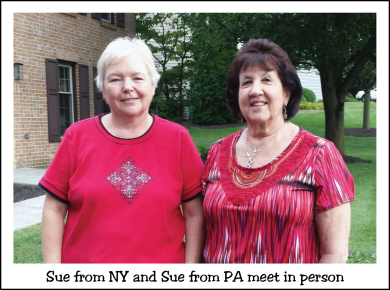
Last week on the way home from a family trip, Sue from NY and her husband Steve stopped in Harrisburg, PA to spend a few days with Sue from PA and her husband Marc.  SueNY_SuePAIt was the first in-person meeting for the two Sue’s.  Inspired by the Conversations project, they decided to rope this husbands into discussing diabetes.  They didn’t interview their own spouses; they talked with the other Sue’s spouse.  The result is two very interesting conversations.  The first will be published tomorrow and highlights Sue from NY who has Type 1 diabetes along with Type 1 Marc from PA.  Their stories are remarkably similar as both were initially misdiagnosed as Type 2 because of their age.

The second conversation to be published on Thursday is between the spouses, neither of whom has diabetes.  Sue from PA and Steve from NY have a frank discussion about what it is like to be the spouse of someone with Type 1 diabetes.  Although never wavering in support of their spouses, both talk about the fears and emotional toll of being the life partner of someone with Type 1.

Please come back tomorrow to read Conversations: Two Type 1 Diabetics Have a Chat and on Thursday for Conversations: Two Spouses of Type 1 Diabetics.
