
The Vibe is Approved!

Laddie_Head SquareThe Vibe is approved.

I say “Finally!” but I say that with excitement not grouchiness.

Kerri of Six Until Me has a sponsorship relationship with Animas and shared the news this morning on Facebook. Rather than have me repeat her words, check out her blogpost here.

I will definitely upgrade to the Vibe once I learn the details of the ezAccess Upgrade Program. When I purchased my Ping two years ago, I was guaranteed a $99 upgrade fee to the Vibe when it was released. I didn’t think that this pump/Dexcom combo would take so long to come to market and I might have purchased a different pump had I known the wait was going to be so long. On the other hand, I don’t know what pump I would have purchased instead and I am glad today to have the option of ordering the Vibe.

Although I am not as excited about the Vibe release as I would have been a year ago, there is no risk for me to upgrade. I previously wrote that the Vibe will not have the recent Dexcom software upgrade. I have also worried that the small Dexcom screen might not be big enough to  show my Dexcom graph clearly and I am concerned about the difficulty of seeing the Vibe screen in the sunlight. The Dex receiver doesn’t perform well in the sunlight either, so that is probably a toss-up. If I don’t like how the Vibe works with my Dexcom, I can just disable it on the pump and go back to using my receiver. Or my understanding is that I can use both devices simultaneously. So no risk.

The Vibe will also get rid of my biggest dislike of the Ping because the recommended bolus will self-populate rather than make me scroll up to it from zero. Huge improvement!  People who use the remote meter with their Ping may have to thing twice about upgrading to the Vibe because my understanding is that the new pump will not have this feature. I do not use the remote so that is a non-issue for me.

As you know, I have been one of many people working to have Medicare approve CGMS for seniors. If that does not happen by the time I get to Medicare, the Vibe eliminates the need for a CGM receiver and that will save me money. However, I don’t think it is known whether the Vibe will be covered by Medicare and the ezAccess Upgrade Program brochure states that “Medicare patients are not eligible for ezAccess.” Because I am still using private insurance and my Ping is in warranty, I am eligible at this time and I can wait to see how it plays out with Medicare.Vibe Upgrade

So this is an exciting day and I look forward to my upgrade to the Animas Vibe.  Although I struggled with the Medtronic Sofsensors, I really liked my years of having my CGM integrated with my pump. I like having one less thing to carry.  And I like having my CGM attached to me with the tubing of my pump. I have never permanently lost my Dex receiver, but I always worry about it. I also like that my cgm receiver will be integrated in a waterproof pump.

Click here to read the news release.  It indicates that the pump will start shipping in January 2015. Once again, thanks to Kerri for sharing this link on Facebook:-)

I was able to order my Vibe this morning by calling the Animas
number 1-877-937-7867 and pressing Option 3. I spoke briefly 
with one agent and was then transferred to another representative
who helped me with the upgrade. Just so you know, I will actually
be charged $799 for the upgrade and receive a $700 credit when
my Ping is returned. So the final cost of the upgrade is $99. For
fun and excitement, I ordered my Vibe in blue.

The Grouch is Back!

Laddie_Head SquareTwo weeks ago I wrote a grouchy blogpost about my frustrations with diabetes devices. Things got a little better for a while, but today THE GROUCH IS BACK!

I am sitting here with a high BG that is 99% likely the result of an infusion set change earlier today. I find that no matter what kind of set I use, I more often than not get highs after insertion. I have a grab bag of tricks that I use to avoid the rise, but none of them worked today. I finally gave up and inserted a new set.

These problems are not the fault of my pump, but they are the fault of an insulin system that makes me utterly dependent on the short-acting insulin delivered by my pump. Why should I have to accept high BG numbers for 4-6 hours every three days? I hate these “blameless” highs. I ate a small breakfast today followed by a 3-mile walk. Then I changed my infusion set and my BG climbed from the 80’s to the mid 200’s in the next couple of hours. If I’m going to have a snarky high, I should at least get to have a cupcake or a chocolate-covered donut.

My Dexcom G4 was not an innocent bystander to this mishap. In fact it was continuing its 2 month vacation from accuracy. Because I felt good and the Dex showed my BG to be level, I didn’t test after breakfast until late morning. I was surprised to see a BG of 181. It didn’t make sense so I tested again: 180. I took a correction bolus and calibrated the Dex which was off by 75 points. I was well up in the 200’s before my BG began to fall as the result of several correction boluses and the new infusion set. When my BG finally started to drop, I gave the Dex an extra 30 minutes to see if it would react. Not even close and I recalibrated it downwards. This is the third day of a sensor that has been a problem from the start.

So what am I going to do besides tear out my hair and curse everything related to diabetes?

First I’ll call Dexcom whose reps have been very helpful by replacing sensors and giving advice during the last couple of weeks. I’ve been using new hardware for the last month and the next step might be to try another new transmitter.

Secondly I am going to make changes to my insulin regimen. In a recent post titled Lantus is Lovely and Amazing,  Katy of Bigfoot Child Have Diabetes revisited the idea of her son using Lantus in tandem with his pump. She saw the benefits as minimizing the effects of a pump failure/bad site and a way to give her son more flexibility for water activities and in general some pump-free time. The use of the pump along with Lantus (or Levemir) is called the Untethered Regimen and is best described by Dr. Steve Edelman in a 2004 article. I have used the untethered regimen several times on beach vacations and wrote about it in a July 2013 blogpost.

I have always thought that the untethered regimen makes a lot of sense. An infusion set insertion, a bad site, or a pump problem will have less of an effect with Lantus in the background. Because you take some of your basal with the pump, you still have the ability to reduce or increase basal rates as needed. I’ve had great success when I have used the Lantus/pump combo in the past and as I said in a comment on Katy’s post: “It works so well that I’ve often wondered if I should do it all of the time.”

So that’s what I am going to do. It’s time to experiment with changing up things because I am not happy with where I’m at. I’ve lost confidence in my ability to get good results by doing my normal “right things”. Of course the real villain here is Type 1 diabetes and there is no doubt that I am going through a bad period where minor things are affecting my blood sugar quickly and erratically.

I have ordered Lantus from the pharmacy and will start using the untethered regimen when I have the long-acting insulin in hand. Will I stay on a combined Lantus/pump regimen for the rest of time? Probably not, but I think it will make things easier in the near future. It could be that I just need an increase in basal, but I’m tired of tweaking things and overreacting to highs and lows.

One thing that I always try to remember is that my body does not know the difference between bolus and basal insulin. Formulas and rules of thumb are just that. Sometimes I need to be creative to figure out ways to deal with blood sugar excursions. Please realize that I have used the untethered regimen before so this is not me going off wildly without understanding what I am doing. I see my endocrinologist in two weeks and this will certainly give us something to talk about. She knows that I am a headstrong and self-managing patient and she has never been upset by that. In fact she always emphasizes that this is “my diabetes” and she is my coach.

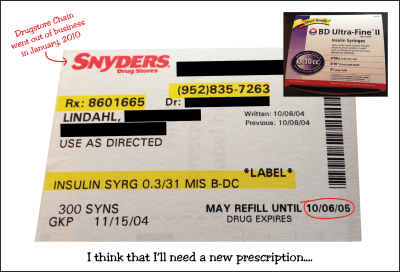
The final topic for today is related to syringes. Whenever I’ve used syringes in recent years, I have pulled them from a box purchased on 11/15/04. Do you think I should buy new ones???

Syringes_Old

Disclaimer: Nothing I say here should be construed as medical
advice and please do not change your insulin regimen without
consulting with your medical team.

A Chance to be Heard

Laddie_Head SquareOver the weekend I was asked by fellow Minnesotan Scott Johnson to write a statement about the value of continuous glucose monitors (CGM) for senior citizens, most specifically as it relates to  Medicare and CGM coverage. Rather than recreate the wheel for why he asked me, here is an excerpt from Scott’s email:

Scott Email Paulsen

Erik Paulsen (R-MN3) represents the Third District of Minnesota. He is a champion of fiscal responsibility and technical innovation when it comes to healthcare. Paulsen is a member of the diabetes caucus in the U.S. House of Representatives and is a supporter of “bipartisan, common sense solutions” for our healthcare crisis. Although Scott did not know this, I live in Erik Paulsen’s district and have previously contacted him by letter, email, and Twitter regarding diabetes issues such as federal funding for diabetes research and the need for Medicare coverage for CGMS. (I also voted for him in the recent November election.)

Luckily for Scott, I had an unfinished blogpost about growing old with Type 1 diabetes and it didn’t take long to draft a statement to be shared at the JDRF advocacy meet-up with Congressman Paulsen. This is my statement as submitted to Scott and shared with The Honorable Erik Paulsen, United States House of Representatives:

Paulsen Statement by Me

Thank you to Scott for sharing this photo from Monday, November 17, 2014. Left to right: Camille Nash, Debbie Evans, Scott Johnson, Rep. Erik Paulsen, Chelsea Grimes.  Camille, Debbie, and Chelsia are mothers of children with Type 1 diabetes and along with Scott, represented the MinnDakotas Chapter of JDRF to advocate for Medicare coverage of Continuous Glucose Monitoring.

2014-11-17 10.51.00


          Oh yes, I am awesome, Scott. And so are you!

Postscript:  The day after this meeting, Representative Erik Paulsen signed on as a Co-Sponsor of H.R. 5644: Medicare CGM Access Act of 2014.  Talk about concrete proof that our advocacy efforts can make a difference!  Thank you to Camille, Debbie, Scott, and Chelsea for representing JDRF and sharing your stories and my story with Rep. Paulsen.  And thank-you to Erik Paulsen for going on record as supporting Medicare coverage for CGMS.

The Grouch Addresses D-Tech

Laddie_Head SquareI am a tech-happy Type 1 diabetic. A new diabetes device gets my heart racing and I treasure my D-devices almost as much as my iPhone and iPad. Maybe more? Nah…. Until there is an iPump, I will love my iPhone and iPad more. But my life is immeasurably better because of my insulin pump, continuous glucose monitor, and even blood glucose meters.

I have come to terms with riffraff hanging off my body and filling up my pockets. I don’t mind the daily minutiae of using these devices and I take things like changing infusion sets and poking my fingers in stride. I’m old enough that I don’t wear cute dresses any more and don’t have to worry about accessing a pump tucked in my underwear. I don’t care about black dots on my fingers and the red spots and occasional bruises that tattoo my body. I am not burdened by my diabetes devices.

At the same time I am very frustrated with my D-devices.

I have been using an Animas Ping since 2012 and am still irked by its menu system. Two years ago I made the decision to purchase this pump despite its shortcomings because I thought the release of the combo Ping/Dexcom device was just around the corner. My Bad. It’s now November 2014 and the rumor these days is that the Vibe release is just around the corner….

Some of my frustration for this delay is directed at Johnson & Johnson which didn’t submit the pump to the FDA until April, 2013 after several years of hinting that the submission would be in the near future. The Vibe was released in Europe in June, 2011 and I sit here 3-1/2 years later hoping to upgrade to one. The fact of the matter is that when the Vibe is finally released in the USA, it will be a 4-year-old pump. In some ways it will be little different than the Animas Ping as it was approved by the FDA on July 1, 2008.  So you could argue that Grouch D-Techthe Vibe is really a 6-1/2 year old pump. My understanding is that the G4 software update just released by Dexcom will not be included in the Vibe. Therefore the Vibe will be an old pump integrated with an out-of-date Dexcom receiver.

In general I am incredibly frustrated with the whole FDA process. I don’t understand why it takes a couple of years to review something that has been in use in Europe for several years. I don’t understand why if Dexcom has been given FDA approval for its latest update that neither Animas or Tandem will be able to include that update in their pumps that integrate with the Dex G4. In my opinion the lengthy FDA approval process punishes innovation and motivates manufacturers to stay with old devices superficially decorated with trivial new bells and whistles. Many or most diabetes tech devices are developed by US companies and we see the overseas market getting access to them years before we do. It’s cheaper and faster for manufacturers to get approval in Europe.

Are users of diabetes tech safer in the USA than in Europe? I’ve never seen proof of that.

The iPhone 4 was released in April, 2011. Some of you might be using it happily: unless you want to use IOS 8 / unless you have a new iPad which can’t use iCloud optimally unless all of your devices are using IOS 8 / unless you don’t mind your phone freezing up on multiple websites and apps / unless you want a beautiful, new sleek device. What if you had to purchase an iPhone 4 today and pay the same price as an iPhone 6?  Yeah, that’s the same excitement (not!) that I feel about the Vibe when and if it is ever released.

Yes, the FDA is trying to keep me safe. Please don’t tell them that the most dangerous thing I can do is go back to injections and accidentally substitute my fast-acting Novolog for my Lantus shot. Or carelessly give my basal insulin twice because I couldn’t remember if I had already given the injection. Insulin is a dangerous drug and everyone with Type 1 diabetes knows that we occasionally play Russian Roulette with our lives.

I recently read Cell by Robin Cook where a smartphone app called iDoc became an integral part of the medical care for test subjects. People with diabetes were implanted with an internal insulin pump that was controlled by iDoc.  iDoc was a master of blood glucose control until the patient got another medical condition (cancer, heart disease, etc.) that threatened to make their health care costs skyrocket. At that point, iDoc programmed a lethal dose of insulin for the diabetic patient. Dead as a door nail. Maybe I would like some FDA oversight on iDoc….

Continuing my frustrations with D-Tech, last Thursday I read reports of the new software release for the G4 by Dexcom. I quickly tried to update, but the Dexcom website was having problems. Kind of like the FDA crash on Monday, Nov. 3 at the #DOCasksFDA event. Don’t these people know that the DOC doesn’t fool around when it comes to sharing information? We arrive quickly and in large numbers and don’t fool around. There is no such thing as a trickle down release of information in the DOC.

Fortunately the Dexcom website was back working in an hour or two and I successfully updated my Dexcom receiver. Because my current sensor was almost two weeks old, I started a new sensor to inaugurate the new software. It ended up being the worst sensor start that I have ever had in my two years of using the G4. Within a few hours, I had Dex results that were a hundred points too high. A recalibration resulted in Dex results that were 80 points too low. Two days later the results were still not in line. Argh!

I hate D-Tech.

My Dexcom debacle has a happy ending (I hope!) and several of my last sensors are being replaced. I had been having problems before the update and I think the rotten sensor start was just an unhappy coincidence. I have had superb customer service from Dexcom in the last couple of days. The jury is still out on whether my problems have been sensor related or equipment related, but I am hopeful that I am back on the right track.

Totally unrelated to my rants in this post, my pump case cracked yesterday when I inserted a new battery. I called Animas and only had to wait 2-3 minutes before talking with a Pump Rep. A new Ping will arrive on my doorstep tomorrow.

Okay, maybe I love D-Tech.


DSMA Blog Carnival: Get the Diagnosis!

Type 1, Type 2, LADA, Gestational, diabetes brought on by surgery . . . . the list of types of diabetes goes on.  Each type may have differences, but ultimately they are all diabetes.  When we think about it, there is a whole lot that all types have in common.  However, that doesn’t mean we can’t give credit for some differences too.  So lets look back to our “Breaking down the barriers between types” chat on September 10th and discuss . . . . .Anything easy about living with your type of diabetes that isnt easy for another type?

Laddie_Head SquareNothing like pushing the deadline for the October Blog Carnival by waiting until today to write my post. I could muddle on forever talking about the differences between the types of diabetes, so I have selected one area in which Type 1’s often have an easier time than people with Type 2.

And that area is Insurance. In general Type 1’s have an easier time than Type 2’s getting test strips and devices like pumps. Medicare’s standard allowance for test strips is crappy for everyone, but non-insulin users are only allotted one test strip a day. Insulin users (and that includes some Type 2’s) get 3 times as many with 3 per day. Still inadequate, but with documentation and proof of medical necessity from a doctor, overrides are available.

Pumps are easier for people with Type 2 to get than in the past, but there are definitely a lot of hoops to jump through to get coverage.  A diagnosis of Type 1 diabetes is often sufficient for automatic pump coverage under many insurance plans. My first pump was approved by insurance in less than 24 hours. When I get to Medicare in 2.5 years, I will be required to have a c-peptide test to prove that I don’t produce insulin. I have been worried about that test but when I asked my endo if I should be concerned, she just laughed.

Continuous glucose monitors are almost impossible for Type 2’s to get insurance coverage for. Under my current insurance, the first mandate for CGM coverage is “Type 1 Diabetes.”

Often I read forum posts by adults who have been diagnosed as having Type 2 diabetes because of their age when they clearly have characteristics of Type 1 or the newer diagnosis of LADA.  Occasionally someone will reply to them that it doesn’t matter what type they have as long as they are being treated properly. I disagree with my statement. I know that I have always had good insurance and I am not a Medicare or insurance expert, but if you are Type 1, you want to be diagnosed as Type 1 not Type 2.  Although many doctors are starting to use the LADA diagnosis, there are currently no Medicare or insurance codes for that. So for insurance reasons, if you are LADA, you are Type 1. Get the diagnosis so you can get the care and devices that you need.

Get the DiagnosisDo people with Type 1 diabetes have better insurance coverage because our type of diabetes is worse?  Well, maybe yes. All types of diabetes are the “bad” kind, but Type 1 is flashier bad. We wear the costume of “cute little kid” even though we can be anything from an infant to an 80- year-old crotchety old guy. We pass out at inopportune times and occasionally scare the crap out of everyone with seizures. Our BG numbers can range from 30-450 in a single day and we don’t consider a jump from 100 to 110 in fasting BG to be significant. Without insulin we could die in a couple of days or weeks. In general Type 1 is more dangerous in the short run and yes, we need pumps and CGM’s more than most people with Type 2.

But Type 2 is a subversive and sneaky kind of diabetes. You may not get access to the fancy devices, but if you ignore your diabetes, you can get the nasty complications. Insurance will pay to treat your complications even if it won’t help you prevent them. So don’t ignore your diabetes. You have the bad kind too!

This post is my October entry in the DSMA Blog Carnival.  If you’d like to participate too, you can get all of the information at:  http://diabetescaf.org/2014/10/october-dsma-blog-carnival-4/

A Thank-you Note to Laura C.

Laddie_Head SquareDear Laura,

We’ve never met in person or crossed paths in the diabetes online community (DOC). I was diagnosed with Type 1 diabetes in 1976 at the age of 24. When my children were born 30+ years ago, I naively never worried about them getting Type 1. When I became involved in the DOC over 10 years ago, I quickly became a supporter of parents of children with Type 1. At the same time I gave thanks every day that I had diabetes instead of my children. Most of the parents whom I’ve met in the DOC would happily live with Type 1 if they could take the burden away from their children. I suspect that you feel the same way.

I recently listened to you and your husband talk on the Oct. 20 DSMA ‘Rents podcast about CGM in the Cloud. I have read many blogposts and listened to multiple interviews about the Nightscout system and am amazed by the #wearenotwaiting project. The technological support and peace of mind it provides for people with diabetes and their parents/families is wonderful. Although some adults with diabetes are using the system, I personally don’t need it at this time. As a diabetes tech junkie, I’ve been tempted to buy the gear and set it up, but so far I’ve resisted.

But Nightscout is not what this letter is about.

I am 62 years old and will be on Medicare in 2.5 years. I have used continuous glucose monitoring (CGM) for over five years and have found the Dexcom G4 to be a life-changing device for me. I am safer, my blood sugars are more tightly controlled, and I feel better both physically and mentally. When I reach Medicare age, I will have used a CGM for almost 8 years with full insurance coverage. I am terrified of the day that current Medicare policy will deny me that coverage. I am befuddled by decision makers who label CGM as “precautionary and without proven value” while this still-improving technology has a proven track record, can save money by reducing hypoglycemia-related ER visits/hospitalizations for seniors, and is a fundamental technology of the Bionic Pancreas.

Today I write to thank you for your closing remarks on DSMA ‘Rents:

“And the other thing I’ll add real quick as the Advocacy Team Chair for our Rochester Chapter of JDRF-  None of this would be possible without the CGM technology and there’s a bill currently going through Congress right now to allow seniors on Medicare access to CGM. Most, I think it’s like 95% of private insurance, covers CGM’s whereas our seniors don’t have access to them. And I feel like just because our son [name withheld] is 6 and not 66 doesn’t mean he is any more or less deserving of this technology. So all these great things that we have because we have access to it, I think our seniors deserve as well. So I’ll just put that pitch in there.”   (Loc. 55:07)

In the last year and a half, the issue of Medicare CGM coverage has moved to the front page Dear Laura Cof DOC advocacy. (One of the leading champions of this issue is my co-blogger Sue from Pennsylvania.) Those of us with insulin-dependent diabetes on Medicare or approaching age 65 have appreciated the support of parents, families, friends, medical professionals, and people with all types of diabetes. With the whole diabetes community supporting us, we have had and will continue to have a louder voice than we would otherwise.

But the fact that you took the time to conclude your interview concerning your project and your son with the importance of my issue is incredibly heart-warming.

So I thank you, Laura. If I ever had doubts that those of us affected by diabetes can be a united and supportive community, your eloquent remarks smashed them. I will sleep better knowing that you are on my team.

Sincerely yours,

Laddie Lindahl

Test Guess and Go

If you have not previously contacted your Senators
and U.S. Representative to support CGM Coverage
by Medicare, please click here to go to the
JDRF page that contains links and easy-to-
follow instructions to have your voice heard.

Playing Nice in the DOC Sandbox

Laddie_Head SquareI try to be open-minded when it comes to my online/offline interactions with people affected by diabetes. On one hand, I can be as snarky and self-centered as anyone. On the other hand, I have learned that being kind and supportive gets easier with practice and soon becomes a very nice way to lead one’s life. I have definitely had good role models in the DOC and I thank you all. I am also old enough that I have learned that there is no right answer to every question and no guarantee that doing the “right” thing will guarantee good results. So I try to be understanding of other people and usually I succeed.

Last weekend I unwittingly became the the central character in an unpleasant diabetes online experience. Neither the group nor subject is important. I have pretty thick skin and was more stunned than hurt by the barrage of comments. I suppose one problem with the Internet is that although you can control what you write, you can’t always control how your words and intent are received. I don’t pretend to be perfect and am willing to accept responsibility for my missteps although I still don’t quite understand what happened.

I’ve spent a fair amount of time this week thinking about my responsibilities as a member of the DOC. I had a recollection that some blogger once outlined behavior suggestions for the diabetes community. The few longtime DOC bloggers whom I asked about this didn’t think that such a thing existed. Chances are that I once read an article about general online etiquette and that stuck in my mind.

Whenever you have interpersonal problems, I think that the best thing you can do is take a deep breath and reread Robert Fulghum’s list of things to be learned in kindergarten. It always makes me smile.Kindergarten Rules_3

Now that we’re feeling all warm and cozy, let’s consider the DOC and whether there should be a code of conduct. The bloggers whom I recently contacted and the DSMA Tweet Chat of 9/3/14 were unanimous in the opinion that there should be no rules for the diabetes online community. According to one writer, rules would go against the “organic flow” of the community. I think that means that we’re an opinionated and rowdy bunch who have a modicum of common sense along with compassion and mutual respect. But when all is said and done, a few rules did come out of the discussion.

Here you go, DOC Friends!  (with special thanks to K-bloggers Kerri, Kelly, and Kim)

DOC Rules

And I’m going to add one more:

4. If someone screws up, give them the opportunity to learn and then forgive them.

If four rules are too much for you to deal with, just go with #3.

Don’t be a Jerk Face.*

That covers just about everything.

* a descriptive term that only Kerri could think of

Monday Miscellany

Laddie_Head SquareThis post is a mixture of important and not-very-important stuff.  If you’re like me and getting tired of ‘heavy” and “try to change the world” issues, you might want to just read the last section which deals with autumn colors and burned-out lightbulbs. November is coming soon and I need to re-energize myself when it comes to diabetes advocacy.  I will — because diabetes never takes a vacation.

Diabetes Related:

Big Blue Test LogoThe Big Blue Test begins today and continues until November 19.  This is a program of the Diabetes Hands Foundation where people are encouraged to exercise for at least 14-20 minutes and log the results at the Big Blue Test website. People with diabetes need to test their blood sugar before and after the exercise session. Those without diabetes just log their exercise session. Each logged test raises $1 to support diabetes programs in the US and the Dominican Republic (Learn about the 2014 grant recipients.)  The Big Blue Test is an easy and meaningful way to advocate for people with diabetes. Join me and start participating!  (BTW-If you use mySugr, you can participate in the Big Blue Test as one of the challenges. My monster is hyped and ready to go!)

FDA Blue CircleThe hashtag #DOCASKSFDA has been everywhere in the diabetes online community recently. On November 3, 1-4pm EST, the FDA will host a live webcast that will feature a panel of people with Type 1/Type 2 diabetes along with representatives from ADA, JDRF, and diaTribe.  Please fill out the short survey created by diaTribe to share your thoughts on important concerns for people with diabetes.  The survey deadline is tomorrow, Oct. 21, so don’t delay.  Your voice is important!  You can learn more about the virtual conference at diaTribe.

Medical Not Diabetes:

CupcakeMost of us try to live a healthy life. Yeah, we make some bad decisions but we also do a lot of things right.  I always think that it is funny how many of us share photos of post-doctor appointment cupcakes.  Why do we work hard to prepare for medical appointments and then revel in “forbidden” treats afterwards?  Are we just being healthy to impress our medical professionals?  Beats me, but I always feel the need to “reward” myself after a stressful appointment or lab test.
I missed the cupcake craze so my reward used to be chocolate-covered donuts. I always swoon over these tasty treats as I walk past the donut case at my local Holiday Stationstore, but I have learned to resist them. (I have tons of other things that I can’t resist, so I’m not being overly virtuous here.)

On Friday morning I had a lab test as a follow-up to my annual physical in September. Internet searches indicated that the rogue result in September could range from meaningless to cancer. I was worried. I stopped at Holiday on the way home from the test and purchased a Diet Coke instead of donuts. I have been working hard to reduce the presence of dark sodas in my life, so Diet Coke is on my try-to-avoid list.  (Can you believe that I am still friends with Scott Johnson!!!)  I have to admit that I don’t like Diet Coke all that much any more, but I still buy it because it has such happy and friendly memories for me.

I got a call from my doctor’s office in the afternoon and fortunately my test was completely normal.  The nurse who phoned indicated that they didn’t want me to worry about the results all weekend.  My doctor earns an A+ grade for understanding how long a weekend can be when you’re worrying about medical issues.

Life Stuff:

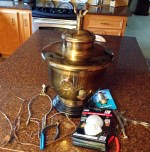
Lamp to Repair_SquareSo far I have not had a great experience with long-lasting power-saving lightbulbs.  My latest glitch was the rattling and sizzling demise of a $15 lightbulb.  I put in another bulb and it died in a day or two. Being the electrical whiz that I am, I determined that I needed to replace the burned out socket in the lamp.  A trip to the hardware store, a new socket, and a $20 LED bulb solved the problem. The new bulb is advertised to last 22.8 years and ultimately save me $231. I’ll be 84 years old when it bites the dust (unless it’s like the old one which only lasted a month).

Autumn Colors SquareMid-October is a colorful time in Minnesota.  This photo was taken late last week on an early morning dog walk.  Unfortunately strong winds and cold temperatures have resulted in a blanket of beautiful leaves in my yard. But one good thing: Raking counts as exercise for the Big Blue Test!

A Bliss Point for Diabetes?

Laddie_Head SquareWhen it comes to junk food, the “Bliss Point” is the “just right” amount of sugar, salt, and/or fat that optimizes our taste and cravings for that food.  If you have doubts about whether the manufacturers of junk food have invested tons of money in the science of addiction, read the 2013 New York Times Magazine article titled The Extraordinary Science of Addictive Junk Food.

In economics, the “Bliss Point” of consumption is that point where any further increase in consumption would make the consumer less satisfied rather than more satisfied.  Maybe owning ten cars makes me deliriously happy while adding an eleventh overburdens me with the worry of  driving and maintaining so many vehicles.

The notion of a bliss point assumes that there is a point of optimization for many of the decisions that we make on a daily basis. My bliss point on salt might differ from yours and you may like your food sweeter than I do. But studies by marketing researcher and psychophysicist Howard Moskowitz have shown that large populations can be sorted into preference groups and products marketed to them accordingly.

I think that it makes sense to think about a bliss point when it comes to diabetes care. On one hand we like to think that we have total power of choice when it comes to consumer products. Therefore it is a stretch to compare the purchase of potato chips to the daily minutiae of diabetes.  After all, none of us invited diabetes into our lives and we often feel that we lack choice in how we deal with this unwelcome intruder. However, I believe that each one of us with diabetes could probably describe an optimization point of self-care where our daily BG numbers, A1c results, and risks of complications are balanced by somewhat acceptable levels of diabetes intrusion into our lives.

Now I am not beginning to suggest that it is easy to hit the bullseye of this hypothetical bliss point.  Diabetes is hard and some days we are dealt a losing hand in controlling the huge numbers of factors that influence blood sugar.  (In the August 2014 issue of Diatribe, Adam Brown listed 22 things that affect blood glucose and admitted that it was an incomplete list.)  But in general I am happiest when my A1c, range of low/high BG readings, and number of chocolate-covered donuts are in a certain range.  It is a balance of working hard while accepting my daily transgressions along with the uncontrollable BG excursions that come with Type 1.  I know that I could probably get a better A1c, but I think that I have hit the point where a better A1c might not be worth the disruptions and sacrifices in my life that it would require.  So maybe I am living close to my diabetes bliss point.

Because the bliss point differs for each of us, I might feel satisfied with test results that are higher than yours because my goals are different that yours.  I might be thrilled to have an average BG of 175 over the last 60 days because six months ago my average was 235.  I might be appalled at an A1c of 6.0% because my last one was 5.5% while you might rejoice at a 6.5% because it is the best result that you have ever had. You might find it acceptable to eat low carb a lot of the time and I am unwilling to give up favorite foods and the social aspects of restaurant eating.  I think that we could all agree that we neither want an A1c of 10.0% nor do we want to spend 100% of our life thinking about diabetes.  Somewhere between those extremes is a spot where we have settled. Maybe it is a good spot or maybe we want to change it.

Bliss Point Graphic

My best days with diabetes are when it lives quietly in the background. I don’t ignore it and I certainly take my insulin and test my BG.  Every so often I have a magical morning playing golf when I don’t hear a peep from my Dexcom for several hours. It’s not that I choose not to look at the CGM, but I feel so incredibly good that I totally forget about diabetes. What is interesting to me is that a retrospective look at my Dex for those rare mornings indicates that my BG usually hovers around 110-125 and it definitely stays within my programmed 70-140 range.  My perfect golf mornings start making me think that my bliss point might be somewhere around 120 and make me question whether my current daily goals are too tight. Having had Type 1 for 38 years, I have no illusions that an increase or decrease of 0.5% in my A1c will make a difference in my health. So this is definite food for thought. (Of course I have never been able to figure out why some golf mornings are perfect, others leave me munching an entire tube of glucose tabs, and others require multiple boluses to keep my readings out of the stratosphere….)

One reason that I have been thinking about optimal diabetes targets is wondering how an artificial pancreas would influence my life.  Many trial results for the bionic pancreas have mentioned that average BG levels for trial participants seem to cluster around 130-140 which approximate A1c’s of 6.2-6.5%. Those numbers are a long ways from the normal BG of 83 (A1c of 4.6%) that Dr. Bernstein espouses. However for the vast number of people with Type 1 diabetes, those numbers would be a huge improvement with the added bonus that hypoglycemia and high/low swings are greatly reduced.

But there are others (myself included) for whom this would result in a worsening of average BG numbers and A1c’s.  This is where the idea of a bliss point comes into play.  What is it worth in worsening BG numbers to eliminate most of the mental and daily-task burden of diabetes? Also, would my health actually be better if most lows and Himalayan BG swings were eliminated despite having a somewhat higher A1c? Interesting questions for sure.

Since one definition of “bliss” is “supreme happiness”, I think it is accurate to say that the only true bliss point for diabetes will be The Cure.  I don’t expect to see that in my lifetime.  At 2.5 years away from Medicare, I don’t even expect to benefit from encapsulated beta cells or an artificial pancreas.  But I think you younger Type 1’s will and that is exciting.  My hope for my old lady years is that Medicare will begin covering CGMS for seniors and that I will remain in good enough health to be the decision-maker for everything related to my diabetes for a long, long time.