The Vibe: Should I Upgrade?

Laddie_Head SquareAfter eight years of using Medtronic pumps, I switched to the Animas Ping in 2012 to be eligible for the $99 upgrade to the highly anticipated Animas Vibe. I am totally committed to Dexcom and the Vibe was in line to be the first pump released in the US with Dexcom integration. Two-plus years later the Vibe has finally been approved by the FDA and is actively shipping.

I ordered my upgrade before noon on the first day that Animas accepted orders. Many people are getting delivery of their pumps, but I haven’t heard a peep. Did everyone order before me or is it because my Ping was supplied through Edgepark rather than directly from Animas? I have no idea how Animas is determining shipping order, but I hope that I have not been lost in their system. “Call Animas” is on my To Do list.

Last week I picked up the phone to contact Animas and then stopped. Do I really want the Vibe?

The Vibe (as will the t:slim/Dex integrated pump) is based on the Dexcom G4. The recent G4AP (Artificial Pancreas algorithm) software update will not be included nor will any future improvements in the Dexcom platform.

Unfortunately when a pump/CGM combo is approved by the FDA, the device is “frozen” in time with the hardware configuration as approved. I don’t know how software updates are handled by the FDA, but one source told me that the Vibe as configured will not allow software changes. Now that Dexcom has multiple hardware and software upgrades in the pipeline, a 4-year (or for me a 2-year) commitment to an older version of the Dex might be a bad decision. In the short run I can keep using my Dex receiver to access the new software. The just-released Share receiver will also be an option because it is compatible with the current generation of transmitters.

Now a word on the “current generation of transmitters.” Vibe purchasers new to CGM are being sent the high-profile Dex transmitters that were replaced by smaller transmitters a few months ago. I assume that the Vibe was submitted to the FDA with the old transmitter and wonder if it will take another FDA submission to change that. Fortunately the only difference between the transmitters is size although I personally can’t wait to get the small transmitter when my warranty expires in February. The new transmitter is compatible with the Vibe.

Dexcom is already talking about the next generation G5 transmitter that will have the ability to communicate directly with cell phones without the use of a receiver. The G5 mobile system transmitter will not be compatible with the Vibe.
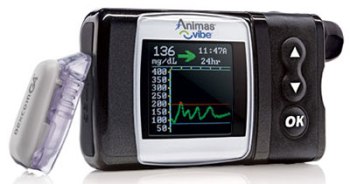
pump_animas_vibeMy Animas warranty expires in December 2016 and I should probably just get the Vibe. The fact that it will populate the recommended bolus rather than scrolling up from zero is a huge improvement. Because I will pay the upgrade fee out-of-pocket, technically my insurance company shouldn’t know that I have the Vibe and then potentially refuse reimbursement for a Dexcom receiver when that warranty expires in August.

Unfortunately it seems that nothing is private when it comes to medical things. My doctor has to write orders for the Vibe and I wonder if Edgepark will be the shipper rather than Animas. Somehow I believe my insurance company will end up knowing about the switch. Maybe I am just being paranoid. Everyone else has been assuming that they will have no problems continuing to use the Dex receiver if that is their choice. But I think that many of us will see the day when insurance companies refuse to cover the cost of CGM receivers because we have pumps functioning as receivers.

I have not yet read one review of the Vibe that is overwhelmingly positive and I know of one person who has already returned it. Kerri Sparling’s preliminary review was the closest to being positive because she didn’t address any of the negatives. She promised a more complete review later and I will be interested to see what she writes. She is upfront about her sponsorship relationship with Animas and you can trust her when she says that her opinions are not for sale. Another Ping user, Sara at Moments of Wonderful also wrote about looking forward to receiving her Vibe. In my opinion anyone who has been using the Ping (except for fans of the Ping meter/remote) will most likely see the Vibe in a more positive light than users of other pumps. There is a definite learning curve to adjusting to the idiosyncrasies of Animas pumps.

Most non-Ping reviewers of the Vibe have been highly critical of the poor menu system, the low resolution color screen, the lag time of button pushes, and other negatives. I believe that Johnson & Johnson missed the boat by not starting from scratch when designing this pump. IMO Mike Hoskins of Diabetes Mine summed it up best:

my honest final verdict is this: the Vibe feels like an outdated, counter-intuitive medical device that seems like it would have been more relevant if released several years ago as promised. Today, it doesn’t feel innovative, but rather like a device that’s filling a market need for choice only because it promised that a long time ago, and it’s “better late than never.”

When I purchased the Ping, I underestimated how much I would hate the menu system and how long I would regret the decision. Because I have no option to change pumps until 2016, my feelings about the Ping are inconsequential as I make my upgrade decision. Frankly two years after the purchase, I have to admit that I have become a whiz at moving through the menus; the scrolling and button pushes have become second nature and I rarely think about them anymore. But it took a long time. The Ping has been a workhorse for me with no technical problems in two years. (I had my pump replaced once due to cracking of the battery compartment, but it was a quick process with good customer service.) Another important feature of the Ping is the waterproof guarantee. With the Vibe I like the idea of having a waterproof CGM receiver.

So what am I going to do? Today I am meeting with an Animas rep to get a hands-on look at the Vibe. Some early reviews have criticized how many button pushes it takes to access the CGM info and how slow the pump moves from screen to screen. The display is small and a different shape than the Dexcom receiver. If I upgrade, will I even use the CGM part of the pump except on an occasional basis? Is it worth $99 to populate the bolus recommendation with the push of one button? Will I be able to see the Vibe CGM in the sunlight because I find it impossible to see my Ping screen when hiking? (The Dexcom is bad in the sun; the Ping is worse.) Is there a risk that when my Dexcom receiver goes out of warranty that my insurance will not approve a new one because the Vibe functions as a receiver?

Had Animas contacted me about shipping the Vibe a few weeks ago, I would have jumped on board immediately. Now I am not so sure.

I’ll keep you updated on what I decide. I wish that I felt excited about getting the Vibe and maybe I will be once I make the decision. At some point I need to contact Animas. Or maybe they will get in touch with me….

If you’d like to read recent reviews of the Vibe, here are some to check out:

Kerri Sparling at Six Until Me

Melissa Lee at A Sweet Life

Adam Brown at Diatribe

Mike Hoskins at Diabetes Mine

Manny Hernandez at Ask Manny

Sara Nicastro at Moments of Wonderful

Midnight Two and Five

Laddie_Head SquareThe big thing around the DOC these days is the NY Times Op-Docs feature titled “Midnight Three & Six.” This twelve minute video was filmed by Joe Callander and funded by the Sundance Institute. In remarks accompanying the film, Callander begins the story as follows:

For the past eight years, the Chamberlain family in Fort Worth, Tex., has been coping with a nightmare all parents fear: In 2006, their daughter, Grace, was given a diagnosis of a life-threatening disease. Grace has Type 1 diabetes, for which there is no cure. Now 15 years old, she has endured approximately 34,000 blood tests, 5,550 shots and 1,660 medical tubing injections to keep her alive.

Later he writes:

But I was most struck by the realities of the family’s daily routine. Grace’s mother …. told me about nights punctuated by alarms to get up and check her daughter’s blood sugar, at “midnight, 3 and 6.” That timetable became my structuring device for making this film.

By Sunday afternoon there were 165 comments on the documentary. Some claimed that the Chamberlain’s family mirrored their life perfectly. Others labeled it as an overly melodramatic depiction of Type 1 diabetes and criticized the parents for how they care for their daughter. My guess is that all of the comments have some merit and mirror fragments of life with Type 1. To put it all in perspective, you should read the comment by Grace’s father who defends/explains his family’s experience and concludes that the film is an artistic peek at one family’s life with diabetes, not a factual textbook. He writes:

finally, please remember that a very talented, creative film maker asked us for a behind the scenes look at our family situation with T1D; then , he crafted a 12 minute film to encapsulate his subject matter in an artistic way. The film is getting a huge response, and we are happy about that…including the disagreements!

If you haven’t seen the film, watch it here. Be prepared to be disturbed whether or not you agree with the depiction of Type 1 diabetes. If you have time, read the comments.

The purpose of this blogpost is not to give my views of the documentary, but rather to use the title “Midnight Three & Six” as a starting point to discuss how often Type 1 diabetes and a good night’s sleep are incompatible.

I have had Type 1 since 1976—diagnosed at age 24. Parents were never involved in my T1 life and no alarms were ever set to test my blood sugar. Of course I had many years of diabetes before I even had a home BG meter. I also lived with diabetes before the Internet and as a somewhat ignorant young adult never considered that I might not wake up in the morning.

Although they were not an every night occurrence, I have vivd memories of horrific lows in the middle of the night. Waking up sweaty, shaky, and disoriented. Staggering downstairs for orange juice followed by multiple bowls of Frosted Flakes and milk. When I was lucky, I was able to find a dry nightgown before returning to bed, but it was always a struggle to avoid the sweat-drenched tangle of sheets where I had previously slept. I remember the freezing cold that permeated my bones and the inability to get warm even with the electric blanket on high. I can still appreciate the buzz as sugar raced through my body reviving my numb limbs, lips and brain. Although I probably woke the next morning with crazy high numbers, I have no memories of that.

As I aged, it became rare to sleep through the night without at least one trip to the bathroom. I began testing my BG when I got up. If it was low, I’d go back to bed with a couple of Werther’s candies in my mouth. It was many years before it became part of my Sleepy Dwarfwheelhouse to take an injection to bring down a high. I never woke at night without diabetes being the first thing on my mind.

I now live with a CGM. You would think that this watchdog would enable me to sleep soundly, but sometimes I think it is the exact opposite. There are many nights that the Dexcom is on the Midnight 3 & 6 schedule along with Grace’s parents, or more accurately for me, the Midnight 2 & 5 shift. I struggle with eating too many snacks through the evening. Sometimes it’s junk food. Other times by trying to avoid carbs, I eat things like nuts and cheese. It doesn’t matter which. The pattern is to go low early in the night from too much insulin and then go high at 2:00AM. Although I try to be conservative with corrections, usually the highs are followed by lows in the predawn hours. My G4 definitely earns it keep by alerting me to each one of these out-of-range numbers. Since I am confessing my sins, I might as well admit that I eat glucose tabs and dose insulin based on Dex numbers all night long.

On Friday after being frustrated with the current sensor, I ripped it off at bedtime and decided to splurge with an uninterrupted night of sleep. I had eaten nothing since an early supper, had no IOB, and felt confident that nothing too disastrous would happen. I think that it was the first night in two years that I had gone to bed without a functioning CGM (except for a few times when my transmitter died and I had to wait for a replacement).

I slept marvelously. No, I slept marvelously until 5:56AM when my Animas Ping starting singing Für Elise signaling a pump alarm. It turned out that I had not pushed any buttons for 12 hours and had triggered the Auto Off safety feature. A button push or two and insulin delivery resumed. Back to sleep. Back to sleep until 6:12AM when a twinkle alert indicated that my pump had lost prime. (Losing prime is an extremely annoying problem with Animas pumps and requires that you unhook your infusion set and prime a few units of insulin to restore pressure in the insulin delivery system.) A trip to the bathroom, bright lights, my infusion set reattached, and I was awake for the day.

Although my diabetes control is “good,” the fact that I rarely have a night without Dexcom alarms would indicate that I have problems that need to be addressed. I have a list of things that could be improved. In the meantime, if there are any parents who would like to take the Midnight 2 & 5 shift and start testing my BG, dosing insulin and giving juice as needed, I’m taking applications….

Two Life Hacks and a Story

Laddie_Head SquareGoing Home with an Animas Ping/Vibe:  I have been using an Animas Ping pump for over two years and still go crazy with the convoluted menu system. One of the most frustrating things is the lack of an Escape or Back button and I have b*tched about that more than once, twice, ten times, a hundred times. Many bloggers reviewing the just-released Animas Vibe complained about the same thing.

in the Animas Users Group at TuDiabetes, a Norwegian Vibe user with the screen name of Siri (not my iPhone Siri) told me about a shortcut to escape the endless menus of Animas pumps and return to the home screen. Just press the Audio Bolus button on the right side of the pump. Then press the OK button or any key on the front of the pump. You will be returned to the home screen. Siri learned this from her Animas Rep.

With this trick, I will probably save an inconsequential 5 minutes a year, but I will save myself oodles of frustration. Honestly I have to admit that in the last couple of months, I have become so adept with my Ping that I really don’t hate it anymore…. I am definitely looking forward to receiving my Vibe:-)

iPhone trick:  Younger readers of this blog who have grown up texting probably know about keyboard shortcuts. Even I knew about them and had seen the “omg” already programmed into my iPhone and iPad. Because I text like an “old person” and type out exactly what I want to say, I never bothered using shortcuts and never programmed any into my phone. A couple months ago after being annoyed about having to type my email address into so many online forms, it dawned on me that I could use a keyboard shortcut for my email address. Therefore I programmed “mgm” into my phone as a keyboard shortcut for my gmail account.  I set up “mcm” for an alternative Comcast email account. “tgg” enters my blog web address. These shortcuts work on most websites and blogs and save me a lot of error-filled typing.

To set up a keyboard shortcut, go to Settings/General/Keyboard/Shortcuts. Click on the + in the upper right hand corner. Enter your email address as the phrase and a series of letters for your shortcut. One glitch is that a space is automatically entered after your email address when you press the space bar to use your shortcut. That is great for emails and texts, but most website forms interpret this space as meaningful and will reject your address. So after the email populates itself, you may have to backspace before entering your password. Keyboard shortcuts entered on one device automatically show up on your other Apple devices.

If you decide to give this a try and like it, just remember that you learned this from a 62-year old woman. It is never too late for this old dog to learn new tricks!

A Story:  Last Wednesday I hiked in the morning with a group of friends. I came home, cleaned up a bit, and had lunch. The refrigerator was empty so I went to “town” to shop. In the winter I live in the boondocks of Arizona and have a 20+ minute drive to the grocery store. Although I had drunk a lot of water on my hike, I was still thirsty and grabbed a can of carbonated water for the road.

I went to the hardware store, took Abby the Black Lab to the dog park for tennis ball retrieving on grass, and went to Safeway to buy food (low carb of course!). I was still thirsty so stopped by the adjacent convenience store to buy an unsweetened iced tea to carry me through the afternoon.Bud Light Box I grabbed the almost empty can of carbonated water to throw away and gasped as I saw it was a can of Bud Light! I had been driving around town drinking beer. Arizona has no-tolerance laws for alcohol and driving and I think that I would have been thrown in jail had a policeman seen me chugging beer as I completed my errands.
Bud Light in cans is not our beer of choice. I think this can was 3-4 years old and a remnant of the last time my husband entertained Minnesota golfing buddies in our winter paradise. Because I try to avoid Diet Coke, I drink enough weirdly-flavored carbonated water and iced tea drinks that a flat, tasteless beer didn’t register as something I shouldn’t be drinking.

I’ve told this story to many of my local friends. Everyone proclaimed that I was the last person that they would have envisioned drinking and driving at lunchtime. They also swore that they would have visited me in jail. It is a funny story that is actually quite terrifying.

When I got home, I checked my refrigerator’s “canned water” bin and there were no other cans of beer. I wish that I had checked the date on the beer can to see how old it was. At the same time I am glad that this is just a funny story told from the safety of my living room. Because I was totally unaware of what was going on, I have no idea how I would have tried to explain this to a policeman.

Summary: One diabetes hint, one iPhone hint, and a story about drinking and driving. Sounds like a great blogpost to me:-)

The Lantus Experiment Part 2

Laddie_Head SquareMy previous blogpost about my Lantus experiment ended with a hint that the story was not over when I returned to a pump-only regimen. So what happened?

A week and a half after quitting Lantus, I had one of those middle-of-the-night diabetes fiascoes that we all hate. My Dexcom CGM buzzed me at about midnight and I corrected a high that seemed odd but not unprecedented. 3 hours later Dex screamed that my BG was 381. After confirming the number with my meter, I gave a correction bolus by syringe. Exhausted and nauseous, I filled a new reservoir and inserted a new infusion set. Mind you, this was all happening at 3:00AM.Dex_Dec14

Upon priming the tubing, I saw insulin flood out of the plastic connector piece rather than drip from the metal needle. I had accidentally attached the old tubing and immediately understood my sky-high BG. I attached the correct tubing, primed, and went back to sleep. As is typical after correcting Himalayan highs, I woke up to a low of 51 at 7:00AM.

I was mad. I was frustrated. I was angry at myself and exasperated with the devil that we call Type 1 diabetes. I decided to go back to the untethered regimen. Big deal if I was stressed by cell phone alarms. It was time to suck it up and use an insulin regimen that would protect me from “not my fault” pump problems.

I reactivated the cell phone alarms for 7:30AM and 8:30PM. To correct the problems that I had with only infusing 0.1 units per hour by pump, I doubled the pump basal rate to an average of 0.2 units per hour. Using the original Lantus doses from late November, I was taking a much larger amount of basal than in recent years. Because it was holiday time with lots of food, alcohol, and stress, the higher basal worked fine. Some people believe that there is one “nirvana” basal rate. My opinion is that it just needs to be in the ballpark because every day is different and my ideal insulin dose is always a moving target.

So I was back on Lantus. Blood sugars were fine, but not spectacular. I tend to do really great at first whenever I make a major change in my insulin regimen. If I switch insulin brands, I often go low as though the new insulin is magically potent. Then after a week or two, things get back to normal. Similarly the addition of Lantus initially made my morning numbers incredibly stable, but during this second experiment I began seeing the return of a few unpredictable BG excursions.

I always wonder if my body actually reacts to changes in insulin or hardware in a physical, measurable way. Or is it all psychological and I just get better results because I pay more attention to my diabetes and make better choices on food and other controllable factors? Either way I will always be optimistic that there is something better out there and I will always keep trying new things. If nothing else, these experiments alleviate some of the daily boredom of living with diabetes.

Ten days ago I ditched Lantus again. I hated the cell phone alarms and was actually waking up in the night concerned that I would miss the morning alarm. After pumping for ten years, I had no confidence that I would remember two injections a day without reminders. In general on Lantus I had pretty good numbers except for poor food/drink decisions and a couple of “WTF” BG excursions. But in the end it wasn’t hugely different from a pump regimen.

Summary: I am back on my pump 100%. As outlined in My Lantus Experiment Part 1, there are many advantages to using Lantus or Levemir with a pump. However, at the moment I just can’t live in that world. That doesn’t mean that I won’t try it again someday. I will definitely continue to use Lantus as a pump supplement on beach and lake vacations as I have in the past. But for now the mental stress and “diabetes burden” of using Lantus are just not worth the slight improvement in my BG numbers.

*****

Disclaimer: Nothing I say here should be construed as medical advice and please do not change your insulin regimen without consulting your medical team. At the same time remember that diabetes is a life-long science experiment (Thank-you Ginger Viera!). When things aren’t going well, take some time to investigate different diet plans and alternative ways of dosing your insulin. And no matter what, test your blood sugar often and always carry glucose tabs:-)

The Lantus Experiment Part 1

Laddie_Head SquareIn a recent blogpost I wrote about my plans to experiment with using Lantus along with my pump. Although unusual, this is not a novel idea and is described by Dr. Steve Edelman in a 2004 article as the untethered regimen.

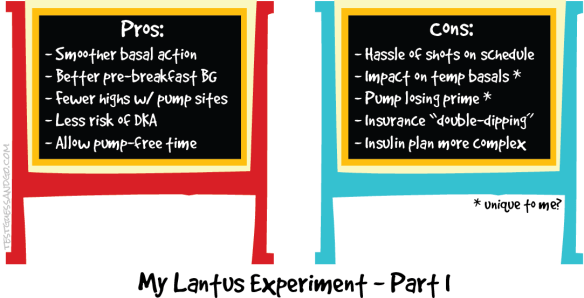
Starting in late November I used Lantus in tandem with my pump for two weeks. Although there were measurable benefits to injecting part of my basal, there were some definite negatives that were specific to my insulin requirements and the type of pump that I use. There were also a few things such as ease of use and expense that demanded consideration.

I started the trial by giving about 75% of my total basal split between two injections of Lantus: one at 7:00AM and the other at 8:30PM. There was nothing scientific about that except those were convenient times and I wanted any Lantus overlap to be first thing in the morning which is a problematic time for me. The balance of my basal was programmed into my pump with a little less through the night and a little more in the morning and evenings.

Let’s start with the positives. For the first couple of days I felt that my blood sugar between meals and overnight was more stable than it had been in ages. The most noticeable effect was in the mornings before breakfast. I often struggle with my BG starting to rise the second I get out of bed. It is not an easy basal fix because I tend to go low in the dawn hours before getting up. Sometimes I take a bolus right after getting up and that helps. But sometimes that bolus makes me go low. And other times I have already started to go high and struggle to get back on track even with boatloads of insulin. With the slight overlap of Lantus at this time, my BG remained stable almost every day until I chose to eat. It was a wonderful result.

The addition of Lantus also minimized BG rises after changing infusion sets. Set changes tend to be a problem for me even though I’ve tried lots of the tricks of the trade to avoid that: extra prime, never change sets in the morning, leave old site in, put new site in a few hours before using, and increase basal rates for several hours. I have never found anything that works every time. Of course nothing works every time with diabetes….

Now for some negatives.

At this stage in my life my basal rates are extremely low. After taking 75% of my basal by injection, I was left with only an average of 0.1 units per hour to be delivered by pump. The total of Lantus and Novolog ended up being a slight basal increase for me and maybe that is the reason I felt as though my BG levels were more stable.

The first problem I had with the untethered regimen was with temporary basal rates which I use on a regular basis. Unlike my previous Medtronic pumps where you can set temp basals either to a specific amount or by a percentage change, the Animas Ping only allows percentage adjustments. With a 0.1 hourly rate, it was difficult to make meaningful changes to my total basal. As I thought of insulin adjustments for my winter hiking excursions, even if I set my pump basal to Off, a reduction of 0.1 per hour might not be sufficient.

Another result of the extremely low basal rates on the pump was that it lost prime three times during the two week period. (Losing prime is an extremely annoying problem with Animas pumps and results in no insulin delivery until you correct the problem.)  If you are in the middle of Target, you don’t really want to reach down your pants to unhook your tubing to re-prime the pump. And that is if you’re lucky enough to hear the musical chime that the pump is no longer delivering insulin. Technically some children use basal rates as low as 0.1/hour and the pump shouldn’t have lost its prime. But it did with both of the reservoirs that I used.

My Lantus Experiment_1

After a few days I began to have daytime lows probably because of the increased basals. So I reduced the Lantus by one unit. Then a few days later I tried another reduction and decided to take it all at night and none in the morning. I increased my pump rates to compensate for the reduction in Lantus. Very quickly I lost the benefits that had been provided by two injections of Lantus. Frankly that means that I didn’t have a clue what was going on anymore.

Although I do not have insurance problems buying both Lantus and pump supplies, it is certainly a more expensive regimen and could be considered to be “double dipping.” Many people justify a pump purchase by indicating that long-acting insulin can’t be customized to fit their basal needs. So here I am saying that the pump by itself isn’t doing the job and I need to add Lantus to the mix….

I also got to the point that the addition of two Lantus injections and the corresponding cell phone alarms added too much complexity and regimentation to my life. Diabetes takes up a huge chunk of my brain power already and I don’t need more nagging demands from it.

So I decided to go back on the pump full-time after the 2-week experiment. I was back to where I was before the experiment. But not exactly. I suspect that increased basal rates were part of the reason I benefited early on and my basal rates are set slightly higher than before. But not a lot because I am trying to avoid lows.

Try not to go too high. Try not to go too low. That’s Type 1 diabetes in a nutshell. Not much has changed, I guess….

This should be the end of the story, but it is not. Please stay tuned for the next installment of the Lantus experiment.

*****

Disclaimer: Nothing I say here should be construed as medical advice and please do not change your insulin regimen without consulting your medical team. At the same time remember that diabetes is a life-long science experiment (Thank-you Ginger Viera!). When things aren’t going well, take some time to investigate different diet plans and alternative ways of dosing your insulin. And no matter what, test your blood sugar often and always carry glucose tabs:-)

Flat Tires and Diabetes

Laddie_Head SquareI had a great day planned for December 31.

I started the day by meeting my oldest son and his three children at McDonald’s. The kids ate a breakfast of varying portions of scrambled eggs, sausage, and pancakes. (Health Alert!!! I bought the fruit cup once and no one would eat it, including me. I now save my money and leave vegetables and fruit to lunch and dinner.) The kids had a fabulous time playing on the indoor playground and I got a rare opportunity to catch up with my son one-on-one. After almost two hours we headed to their house so that I could see the wondrous things that Santa had brought.

Next on my agenda was lunch with a couple of D-friends. One of the attendees was Ann W. accompanied by her diabetes alert dog (DAD) Lily. I wrote a blogpost about Ann in July 2014. Also coming was Kathy P. who used to write a blog called Purple Haze but now mostly hangs out on Facebook and TuDiabetes. And drumroll please! This was going to be my first opportunity to meet Molly K. and her new DAD, Hope, who were in town from Wisconsin.

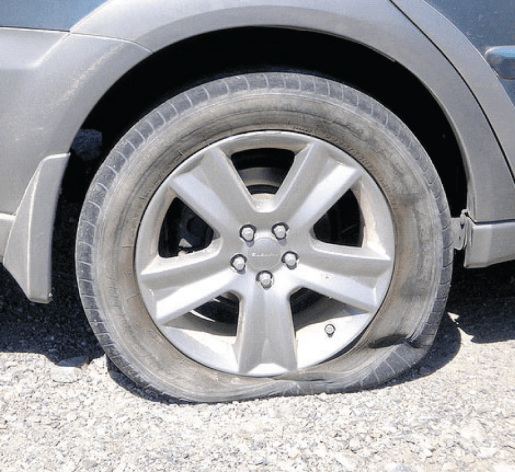
At 11:30 I went out to my car to drive to the restaurant in the Uptown area of Minneapolis and unfortunately was greeted with a flat tire. (I had heard a bang on the highway back from McDonalds but didn’t think anything of it.) Because the temperature was in the single digits, I knew that AAA would be backed up. I made the call and hoped for the best. The whole experience ended up being a comedy of errors when they couldn’t get the wheel off the car and then the air compressor didn’t work to fill the spare. It took a couple of guys with various trucks 3-1/2 hours to get me back on the road. At least I was stranded at my son’s house rather than by the side of the highway.

At lunch I wanted to be here (thanks to Kathy and Molly for the photos):

Ann_Kathy_Molly

But I was here:

Flat Tire_Square

Once I was safely home, I decided to skip the New Year’s Eve party on my agenda. My husband was out of town and I had an airport taxi showing up at my house at 5:15 the next morning. Although there were two cars in the garage, I didn’t trust either of them to get me safely home at midnight. One was wearing the donut spare tire and the other one doesn’t like to start in cold weather….

Later in the day, Ann sent me a text that summed up the entire day.

Text Flat Tire

Yeah, that pretty much says it all.

A Twofer

Laddie_Head SquareToday’s post is a twofer. Two topics for the price of one. Short and sweet so we can concentrate on more fun activities during this week of Christmas.

Diabetes complications come in many forms. Some problems are serious and even life-threatening. Some are minor but annoying. Today I am looking for sympathy for a crack in my thumb that is sore and resistant to healing. The cold weather in Minnesota and the lack of humidity in Arizona make me vulnerable to skin cracks like this especially since I have horrible fingernails that do not protect my fingertips.

And why am I calling this a complication of diabetes? Am I usually slow to heal? No. Do I have neuropathy in my hands? No. Is my circulation impaired from diabetes? No. Is my Hand Roundskin dry because of erratic blood sugars? Not really. This stupid crack is related to diabetes because I keep using this thumb to squeeze drops of blood from my cold Minnesota fingers which tend to be stingy in the cold weather.

I put bandaids and Aquaphor on the thumb and it starts to improve. And then boom! I forget about the almost-healed crack and squeeze a frigid finger on my left hand. If I didn’t have to test my BG, this thumb would be perfectly fine. Darn you, diabetes!

My current solution as seen in the photo is a trimmed gel toe protector. (These little stretchy gizmos are great for hiking and help minimize injuries to vulnerable toes from long hikes on rocky trails with lots of ups and downs.) It has more cushioning than a bandaid and stays on well. Plus you can take it off to wash your hands. Since I just thought of this today, we’ll see how it works:-)

The second topic of this post is to wish you a Merry Christmas, a Happy Hanukkah, or just a good day depending on your beliefs and traditions. I am looking forward to a visit from my New York son and his family and to spending time with my Minnesota son and his family. On Christmas Eve we will celebrate with four grandchildren aged six and under and life will be busy and chaotic. I can’t wait!

As you celebrate (or try to survive) this holiday season, may your blood sugars be stable and your days filled with joy!Happy Holidays 2014

Why I Don’t Download

Laddie_Head SquareThere are many discussions around the DOC about data interoperability and ownership of data. There are also survey results that indicate how rarely most people with diabetes download their devices.

Last week I had an endocrinologist appointment. I know that I am guilty-as-charged about not downloading my devices very often. But I always do it prior to endo appointments. I consider data extraction a tedious process and it seems to take forever. To figure out if the download time is a legitimate excuse or whether I am just a slacker, I decided to chart my experience.

10:38  I gather up the necessary cords and my two Freestyle meters. My pump and CGM are of course close by in my pockets.

10:40  I prepare my Animas Ping pump for the download. I change the Display Timeout from 15 seconds to 1 minute. If I don’t do this, the pump will sometimes turn off before the Diasend Uploader can start reading its data. Then I suspend the pump and unhook it from the infusion set. I open the Diasend Uploader and attach the wireless upload device to my computer.  I start the download which is always a slow process. After the pump is downloaded, the Diasend uploader asks for my login info and I type it in.

10:47  I have finished the download of my pump and I download Freestyle Lite Meter #1 to Diasend. Quick and and easy.

10:48  I download Freestyle Lite Meter #2 to Diasend. Once again, quick and easy.

10:49  I plug in my Dexcom G4 receiver. The download to Diasend is simple and finished within a minute.

10:50  I follow the Uploader prompt to go to the Diasend website and sign in.

10:51  While the Dexcom receiver is attached to the computer, I open Dexcom Studio and download the CGM data to the Dexcom program.

10:53  All of my devices are downloaded and I cram the cords back into my “Diabetes Download” handy-dandy storage box.

I have invested 15 minutes in my diabetes download project. If I didn’t have an endo appointment and just wanted to view the reports on the computer, the bulk of the work would be done. Both Diasend and Dexcom Studio do a good job of displaying reports clearly and quickly.

But I want to save some of the reports to my “Medical Reports” folder and print them out for my doctor to review.

10:54  In Dexcom Studio I open the Summary Report in Microsoft Word using the last 14 days of data and save it to my computer. Then I print it for my endo. I have felt that I have really been struggling lately with my diabetes, but the reports look quite good. When you’re stuck in the trees, life can look bad although the forest view is quite respectable.

10:57  I go to the Diasend website to print reports. The Compilation Report is the most useful summary because it merges data from my pump, meters, and CGM. I also like one of the CGM reports. I save both to PDF.

I am going to digress here and talk about how some endocrinologists hate Diasend reports. They look fabulous on the computer and many doctors view them that way. But when they are printed, the charts are so small that they are almost unreadable. HEY DIASEND! NOW THAT YOU FINALLY DOWNLOAD ALL OF MY DEVICES, PLEASE PRINT THE REPORTS SO THAT MY DOCTOR CAN READ THEM!  

We own a full version of Adobe Acrobat (a different program than the free Adobe Reader) and I am able to crop the Diasend reports and enlarge them. They are still small but better than the standard reports. My endo will be able to read them. I print the reports and save them to my computer.

11:08  My pump and CGM are back in my pocket. Freestyle Meter #1 is in my purse and Freestyle Meter #2 is on the floor by the stairs to be returned to the master bathroom on my next trip upstairs. (I never put anything on the stairs because my first frozen shoulder developed after a fall from stepping on shoes left on the stairs.)

So here’s a summary:

15 Minutes: That’s what it takes to download my diabetes devices to Diasend and Dexcom Studio. If I didn’t want to print anything, various reports are immediately available.

30 Minutes: That was the total time to download my devices, print several reports for my doctor, and save those same reports to my computer. Obviously I spent more time than other people might.

15 minutes. 30 minutes. That is why I don’t download all of my diabetes devices very often.Download Time

Okay, now it is time to stop making excuses. The data from my Dexcom G4 is by far the most useful information I have when it comes to evaluating blood sugars. I can download the receiver to Dexcom Studio in one minute. It takes another minute to download to Diasend. And maybe another minute to find the download cord and open the computer programs. So from start to finish it’s two or three minutes. I can even save a minute by downloading to only one program instead of two.

So what have I learned from my time study? I have learned that it would make sense to start downloading my Dex G4 on a more regular basis. It’s super quick unlike the time and effort that it takes to download four devices. I can download my G4 to Diasend (unfortunately not yet to Dexcom Studio) on my MacBook and that is even faster and more convenient than with my Windows desktop.

Will I change? I actually think I might. (Just for my Dexcom, not the other devices)

One last question: If I download my data, am I supposed to look at it?

Celebrating Tom Beatson

Laddie_Head SquareYesterday Tom Beatson of Phoenix, Arizona celebrated his 72nd anniversary of living with Type 1 diabetes. I’ve been lucky to get to know Tom in recent years through Valley Pumpers, an insulin pump support group that I attend during the winter months in Arizona. Many people in the diabetes community know Tom through Facebook and other online venues. He’s an incredible guy who is always kind, inspirational, smart, and opinionated. Tom has participated in the Joslin 50-year Medalist Program and supports diabetes research through the Joslin Diabetes Center.

If you’d like to learn more about Tom, check out this TuDiabetes interview from January 2013. In this video he and Richard Vaughn (diagnosed in 1945) discussed living with Type 1 diabetes for over 70 years.

Below you will find Tom’s story as he shared it in an email and on Facebook yesterday. I asked Tom if I could post his statement and photo here today and he graciously gave me permission.

With no further ado, here is Tom Beatson in his own words:

“Today is my anniversary. Exactly one year after Pearl Harbor was the first day I was sick with T1D Type 1 Diabetes. I was 10 years old.  Two days later Dr. Wright made a house call and decided I needed to be in the hospital. Since my mother didn’t know how to drive, Dr. Wright drove me and my mother to the hospital in his car. Shortly after arriving at the hospital I lapsed into a coma. Of course, insulin saved my life. I don’t have any records or recollections by my parents, but I think I was comatose for several days, and remained in the hospital for a month. That was 72 years ago, in 1942.

Lots of people have asked me how or why I have survived through all these years.  I don’t have a magic answer for you.  I take one day at a time and do the best I can. It’s been pointed out to me that I have a lot of determination, and that has been very helpful.

Another thing that has been helpful is exercise. When I was about 45 I started riding a bicycle and did that for 35 years. During those years I accumulated 106,000 miles. I have stopped riding currently because of soreness in my lower back, but hope to resume bicycle riding.

Back in the 1940s the insulin pump hadn’t been invented yet, so I used shots every day  for 52 years. That was long enough to earn me a 50-year medal. Then in 1995 Dr. Levy started me on the insulin pump. My control has been much TJB 11-9-14 at 7.26 PMbetter using the pump. I am currently on my fourth pump – the Animas Ping. It was preceded by the Cozmo, 508, and 506. Since I’m on Medicare, they won’t approve a CGM. Their rules are not medically sound. My daily dose ranges between 35 and 45 units of Humalog insulin.

Since I am already 82 I’m not very optimistic about seeing a cure within my lifetime. But I’m keeping a close eye on the Bionic Pancreas that Dr. Ed Damiano is working on at Boston U.  His goal is to get FDA approval by 2017, and that’s when I reach 75 years of T1D, so I’m hoping to be able to get a Bionic Pancreas in time for my 75th anniversary.

Unlike some of you who still claim no complications, I’ve been dealing with retinopathy for 50 years. It remained background until about 10 years ago, when one eye became proliferative. And I’ve got kidney problems. But I have no neuropathy and no gastroparesis. My hearing is still good.  I’ve had chronic lymphocytic leukemia for 20 years with a white cell count around 60,000 but it never gets high enough for them to treat (80K). And I have colitis.

What was the biggest mistake of my life?  I never got married, and have lived alone for more than 50  years.”

Thank you, Tom, and best wishes for many more years of good health with Type 1 diabetes. I’ll give you a call in three years and see how you like your 75th Anniversary gift of a Bionic Pancreas!

What I Listen To

Laddie_Head SquareI spend a lot of time walking. For years and years I listened to music on every walk. First I had a Walkman tape player and FM radio, then a CD Walkman followed by my son’s old Dell DJ. I followed with a succession of iPod Nanos, an Android phone or two, and now an iPhone. The type of music I listen to hasn’t changed much from device to device and I enjoy rock, pop, country, classical, alternative, jazz, and show tunes. My iTunes library also stores much of the music that my young grandchildren listen to. Therefore when I listen to songs on the shuffle setting, I am apt to move from John Mayer to the Messiah to Cookie Monster and Big Bird.

My listening habits changed significantly in early 2013 when I started listening to DSMA Live, a podcast about diabetes produced by DCAF (Diabetes Community Advocacy Foundation). Abby the Black Lab introduced herself to Test Guess and Go readers in May 2013 and explained the hows and whys of our DSMA walks. It took six months and 447 miles of walking to listen to the entire archives of DSMA which was at that point 149 shows. Almost two years later I still listen to every DSMA show although I have long since lost count of how many episodes there have been.

Once I became current with DSMA, I had to find something else to listen to. All of a sudden music became boring while I walked and worked out and I was much more interested in podcasts. Currently these are the podcasts I listen to regularly:

DSMA Live: On iTunes you’ll find all three of the DSMA podcasts (Live, ‘Rents, and en Vivo!) under the umbrella of DSMA Live. The accompanying iTunes description indicates that the aim of these interviews and discussions is to “empower, connect, support people affected by diabetes.” You’ll definitely learn everything you need to know about diabetes news and the people in the diabetes online community by listening regularly to these programs.

Just Talking:  A weekly podcast by Chris Snider in which he interviews guests about various topics such as diabetes, Medicine X, and video games. Chris’ interviews are unscripted and he describes them as “free-flowing but with a purpose.” His guest list is diverse and the show is always interesting.  Because my fascination with video games ended in the 1980’s on about Level 5 of Super Mario Brothers, I tend to skip the video game episodes. His podcast earlier this week was an interview with Amy Tenderich and three scholarship recipients from the recent 4th Annual DiabetesMine Innovation Summit.

NPR: TED Radio Hour:  Each week’s show has a theme and incorporates portions of relevant talks from the TED (Technology, Education, Design) Stage and interviews with Podcastssome of the speakers. Titles of recent shows have been The Source of Creativity, the Balance within Us, The Edge, and The next Greatest Generation?. The topics are always interesting and this podcast exposes me to lots of ideas and subjects that I might otherwise know nothing about.

Recently Added

Good Mythical Morning (Audio only): I learn a lot from Katy at Bigfoot Child Have Diabetes. Some of it is important and some of it is a bit odd, but oddness is the spice of life. Along that lines I was introduced to this show in Katy’s blogpost yesterday titled “Will It Pumpkin Spice?”  She provided a link to comic duo Rhett & Link’s YouTube video of the same title. I don’t know whether the audio-only version of their show will be as funny as the YouTube videos, but it’s worth a try.  How can you not want to listen to podcasts such as “Making a Dog Yawn”, “Facon Bacon Taste Test”, and “Wrapping a Cat for Christmas”?

Recently Deleted

NPR: Car Talk: I have no interest in cars but have listened to Tom and Ray Magliozzi, (aka Click and Clack, the Tappert Brothers) discuss cars, interpersonal relationships, and life in general for years. The show is no longer in production and Tom Magliozzi passed away in November 2014. An episode from the archives is released every week on NPR and the humor is timeless. Warning: you might embarrass yourself in front of your neighbors as you walk down the street laughing out loud at this podcast. Because I have listened to the show for so many years, I decided to take a break. It’s still a favorite!

NPR: Wait Wait… Don’t Tell Me!: This is a weekly comedy show camouflaged as a current events quiz. It can be very funny but I got tired of the same format week after week. So it’s off my list for now. However, the two guests last week were Itzhak Perlman and Amy Schumer. That episode might be worth a listen.

The Atlantic Voice:  The subtitle for this podcast is “3000 Miles of Opinion” and features Eric and Zeff, one who lives in the USA and the other in Great Britain. I found it engaging for a while, but not enough to keep me from exploring other options. After all, there is only so much time to listen to podcasts every week.

I use iTunes to search for and subscribe to podcasts. It’s easy to do and my selections magically show up on my iPhone. I’m sure that Android users have a similar way to do this, but I am an iPhone user because I don’t want to have to figure things out….

I am always open to trying out new podcasts. If you have a favorite, please share it in the comment section.