Message Monday

Laddie_Head SquareWelcome to the 7th year of Diabetes Blog Week. This is my 3rd time participating and I swore I wasn’t going to do it again this year. Why? Because I get totally burned out by writing blogposts every day and trying to read the posts of 100+ participants. Somehow I am incapable of staying low-key during the week and always overdo it. So why am I here? Because Diabetes Blog Week links me to voices of diabetes from all over the world. At the end of the week I will feel exhilarated after meeting new bloggers and catching up with those whom I already “know”. I’ll learn more about myself and my diabetes as I tackle the topic list. On Friday I will be proud that once again I have survived Diabetes Blog Week! As always, thanks to Karen Graffeo of Bitter-Sweet™ for organizing everything.

Today’s Topic:  Lets kick off the week by talking about why we are here, in the diabetes blog space. What is the most important diabetes awareness message to you? Why is that message important for you, and what are you trying to accomplish by sharing it on your blog?

When I started my blog in 2013, I wrote:

“The DOC (Diabetes Online Community) has become a family to me…. I think there is room for my voice in the DOC and I hope that I can help and inspire others  in the way that I have been helped and inspired by others…. I hope to use my blog to chronicle my journey through life with diabetes. Many of my posts will be reflections on the last 36 years as well as my opinions on current issues.”Blah Blah Blah2_DBW

That is typical blah for mission statements and I could easily write the same words again today. The main change is that it’s now been almost 40 years of diabetes.

I wrote one sentence in my first blogpost that seemed innocent at the time. It has morphed into one of the main reasons I continue to blog.

“The medical system in the United States is changing and I really wonder what the next years will bring for those of us with diabetes.”

Talk about the understatement of the year. I predicted that the Affordable Care Act (ACA) would bring me lower premiums and worse coverage. Wrong! I still have good coverage for diabetes expenses, but my premiums have almost doubled and they were expensive to begin with. Many DOC friends have fared far worse with huge increases in premiums and deductibles along with difficulty obtaining needed supplies and medications. Insulin prices have soared and for each insurance company mandating Humalog, there is another one requiring Novolog. The recent UnitedHealthCare mandate for Medtronic pumps is symptomatic of a broken healthcare system that increasingly devalues patients and results in huge profits for insurance companies, pharmaceutical/durable medical companies, and middleman wholesalers.

I also mentioned Medicare in my first blogpost:

“And before I know it, I will be on Medicare with a new set of rules that will save me lots of money in some areas, but will try to dictate that I live with 3 test strips a day and throw away my CGM because it is not proven technology.”

I am now counting down the months until Medicare. I am proud of my gray hair and feel strongly that I would like Test Guess and Go to become an information and advocacy resource for seniors with Type 1 diabetes. CGM coverage is one of the most visible battles but it may be just the tip of the iceberg with programs like Competitive Bidding threatening choice and access to needed supplies.

In three years of blogging I have been learning how to advocate. I know that I am a better writer than speaker. I know that I prefer one-on-ones to larger advocacy forums, but I am trying to grow. Regardless of where my senior years take me, Type 1 diabetes will be there and there is no reason to fight that. I don’t know how long I will continue to blog, but I’m not ready to quit yet.

*****

To read other Diabetes Blog Week posts on this topic, click here.

Access Matters: My Statement for DPAC

Laddie_Head SquareIn order to amplify the voices of those of us who oppose the recent mandate by UnitedHealthCare to cover only Medtronic pumps, DPAC (Diabetes Patient Advocacy Coalition) is asking everyone affected by diabetes to share their story. Follow this link to help DPAC gather “stories to share publicly within the community and, perhaps more importantly, within the healthcare and legislative communities.” Your voice will help prove that #DiabetesAccessMatters and will advocate for #MyPumpChoice and #PatientsOverProfits.

I don’t know whether my experiences will help because my diabetes narrative is that of a “privileged patient” who has always had access to prescribed insulins, meters, pumps, and CGM’s. How do I prove that access and choice have made a difference?

My Story as Submitted to DPAC:

I have had Type 1 diabetes since 1976. When I was diagnosed there was no home blood glucose monitoring and I took 1 injection of insulin per day. My chances for a long healthy life were minimal and complications such as blindness, amputation, and kidney disease were seen as almost inevitable.

Today I am 64 years old. I have gray hair and am stiff from arthritis, but my eyes are fine. My body has bruises and rashes from pump and CGM sites, but I have no numbness in my feet and my kidney function is fine. I rarely have a day without lows requiring glucose tabs, but I have not needed my husband to fetch emergency orange juice since starting the Dexcom G4 in 2012. My lab tests are good and my cardiac function tests are excellent.

So what happened?AccessMatters

Hard work paid off. Lucky genes probably helped. But what is most important is that I had ACCESS.

ACCESS to medical professionals who learned through the Diabetes Control and Complications Trial (DCCT) that controlling blood sugar results in better health for people with Type 1 diabetes.

ACCESS to new and improved insulin products as they were brought to market.

ACCESS to the newest technologies which began with home BG meters in the early 1980’s and expanded to insulin pumps and continuous glucose monitors (CGM) in later years.

ACCESS to education about how to optimally manage my diabetes.

ACCESS to social support through the DOC (Diabetes Online Community).

Along with access, I had CHOICE.MyPumpChoice

When my internal medicine doctor was unqualified to prescribe a pump, I CHOSE to switch to an endocrinologist.

After experimenting to prove that the blood glucose monitor I was using was unreliable, I CHOSE to switch brands to a meter which provided more consistent results.

When my endocrinologist and I agreed that my diabetes could be better managed with an insulin pump as opposed to injections, I investigated my options and CHOSE the pump that I believed would give me the best results.

When my doctor prescribed a CGM to combat my hypo-unawareness and extreme lows, I CHOSE to give it a try.

After a few years of failure with the CGM brand that I selected, my doctor and I worked together and CHOSE the competing brand.

I am incredibly lucky to have always had good insurance. I have had access and I have had choice. Many years ago my insurance was provided as one of my husband’s work benefits. The cost to us was minimal. Today I pay huge insurance premiums, but I still have access to the medications and durable medical equipment (pump and CGM) that my endocrinologist and I choose.

An insurance company is in business to make money and does not have a license to practice medicine. Once I pay my premiums, access and choice should be in my hands and those of my medical team. The idea that UnitedHealthCare has the right to change its policies on insulin pumps mid-year and mid-contract is wrong. Big players in the game making deals to reduce competition and limit choice should not be allowed.

How do I prove that ACCESS and CHOICE have made a difference in my life with diabetes?

I look in the mirror.

UnitedHealthCare and Medtronic Diabetes: I Could be Mad

Laddie_Head SquareI could be mad at UnitedHealthCare.

I could be mad at Medtronic Diabetes.

I could be mad at a healthcare system that allows health insurance companies to practice medicine and mandate care decisions for their subscribers.

But mostly I am sad.

I am sad for everyone with diabetes. I am especially sad for those of us with Type 1Sad Emoji diabetes for whom improvements in technology have been life-changing. I am sad for everyone who has diabetes today and for those who will be diagnosed in the future.

In some ways the last five to ten years have been a golden age of diabetes care with the release of new insulins, new medications, innovative insulin pumps, and increasingly reliable CGM systems. We see parents able to monitor their child’s blood sugar while at school. We see artificial pancreas clinical trials where blood sugar levels are optimized and the mental burden of care is reduced. Encapsulated beta cell trials have allowed some patients with T1 diabetes to reduce or eliminate the need for insulin injections. The next five years could be even more impressive for the Type 1 market with the probable release of several artificial pancreas systems, the advent of smart insulin, and explosions in ways to monitor our data.

How can I be mad at UnitedHealthCare and Medtronic? They are doing what big companies do. They are trying to grow bigger, squash competition, and make money. They can talk about visions of patient-centric care, but ultimately their DNA drives them to base most of their decisions on the bottom line.

As patients in the United States, what are we supposed to wish for and whom should we blame? It is easy to lobby for national health insurance to eliminate huge profits earned by companies such as UnitedHealthcare. At the same time as a person with longterm Type 1 diabetes, there are few countries in the world where I would have access to an insulin pump and even fewer where a CGM would be funded. I can idealistically hate the idea of our dysfunctional for-profit healthcare system, but there is no doubt that I have benefited from it.

I currently use an Animas Vibe insulin pump and a Dexcom G5 CGM. Fortunately I do not have insurance through United Healthcare. As someone who will be on Medicare in less than a year, I have slowly been coming to terms with the idea that much of the future of diabetes tech will be denied to me. I wrote a blogpost in early April titled “Countdown to Medicare with Type 1 Diabetes: 12 Months” and shared my feelings:

“There is a sadness in realizing that I will probably not get access to any or all of the new technologies and medications coming to market in future years. Things like the artificial pancreas, encapsulated insulin-producing cells, and smart insulin will likely not receive Medicare coverage for many years, if ever.”

But what if the future doesn’t come? The scariest part of the UnitedHealthCare mandate for Medtronic products is the threat that no one with diabetes will receive these life-changing therapies because they will not come to be. Although I sometimes think that Medtronic is taken for granted as a workhorse and powerful player in the diabetes market, in my opinion the most cutting-edge tech devices in recent years have come from the smaller players: Dexcom, Tandem, Asante, and even back to the beloved-Cozmo insulin pump. Innovative medical breakthroughs are apt to be eliminated when choice and competition are trampled by the bigger and more financially-secure players.

As I tweeted during the DSMA TwitterChat on Wednesday night:

Tweet_R

I am not mad.

I am sad.

*****

For more information about the UnitedHealthCare agreement with Medtronic Diabetes, I suggest you start with Mike Hoskins’ article at Diabetes Mine. He provides links to other passionate blogposts and social media responses and outlines actions that we can take to have our voices heard.

Hashtags:  #DiabetesAccessMatters #MyPumpChoice #PatientsOverProfits #AccessMatters

Countdown to Medicare with Type 1 Diabetes: 11 Months / Options for Testing Supplies

Laddie_Head Square11 months from now I will be on Medicare. April 2017. My aim is to write a monthly blogpost about what I am learning as I get closer to that date. Last month I wrote a general overview of my Medicare thoughts. This month I want to talk about testing supplies and Medicare’s national mail-order program for diabetes testing supplies.

Background:  In July 2013 Medicare instituted a national mail-order program for diabetes testing supplies that requires all beneficiaries to use a Medicare-contracted supplier for home-delivery of testing supplies. (Note: this applies to original Medicare only and not to Advantage plans. Also note that it is possible to buy testing supplies locally instead of through the mail-order program.) Part of the Competitive Bidding Program (CBP), this program was launched in nine test markets in 2011. According to a 2012 Centers for Medicare & Medicaid Services (CMS) update report:

 “CMS real-time claims monitoring has found no disruption in access to needed supplies for Medicare beneficiaries. Moreover, there have been no negative health care consequences to beneficiaries as a result of competitive bidding.”

The Government Accountability Office (GAO) challenged the safety monitoring methods used by CMS and questioned whether beneficiaries were receiving supplies on time and whether adverse health outcomes were resulting from problems accessing testing supplies. Adding to the GAO analysis, the National Minority Quality Forum worked with leading endocrinologists to analyze the data and released an online report in March, 2016 followed by a print article in Diabetes Care, the professional journal of the American Diabetes Association. This analysis indicated that:

“the Competitive Bidding Program disrupted beneficiaries’ ability to access diabetes testing supplies, and this disruption was associated with an increase in mortality, higher hospitalization rates and inpatient costs.”

This article received a lot of attention in the diabetes online community and prompted an initiative by DPAC (Diabetes Patient Advocacy Coalition) urging Americans to contact their elected representatives to #SuspendBidding. Click here to learn more about DPAC’s analysis of the problem and to contact your representatives.

My Perspective:  Rather than stress about my ability to get high-quality testing supplies once I get to Medicare, I decided to contact some experts: people I know with Type 1 diabetes who are on Medicare. I communicated with eleven seniors by email, phone, and/or in person. Some live in Minnesota and others in Arizona.

In general each T1 senior is getting diabetes testing supplies on a timely basis and is able to get their brand-of-choice. Several people buy test strips at local Medicare-approved pharmacies while others purchase them through mail-order Medicare suppliers. Although their Medicare experiences are not without occasional glitches, most of my contacts are satisfied with their ability to obtain testing supplies through Medicare.

Some of the comments I received are:

“It is not as fretful as you may think although some resources are better than others. Type 2’s have a harder time. At the beginning of your Medicare enrollment there may be some stumbling blocks until the required documentation is submitted appropriately by each member of your health care team”

“I am getting all the supplies I need of my choice, excluding CGM.”

“Once I couldn’t get the test strips I use, but it was a temporary thing. They were not able to get them from the supplier…. I get my supplies in a timely matter.”

“I have been on Medicare (with a supplement) for the last 8 years. I haven’t had any trouble with getting pump supplies or strips. My doctor is very cooperative and prescribes what I need.”

“I have never had a problem getting my test strips.”

But all is not perfect. One friend was recently forced to change strip brands, but she was able to select another “name-brand” meter and strip. Another friend has continued to work past age 65 in order to continue receiving CGM coverage.

A few more comments:

“They limit me to 5/day because that’s all I have shown on my logs…. I don’t think my endo has been any help at all.”

“I haven’t had any trouble with Medicare, but I have read about many others who have had trouble.”

“I find the whole medical insurance business so confusing. I have stacks of documents that come in the mail that make no sense.”

Summary:  I am encouraged by the feedback I received from my Medicare T1 friends. At the same time I know that these seniors are a unique subset of Medicare beneficiaries with Type 1 diabetes. They are empowered, well-educated, and reasonably financially-secure. Many of them have had Type 1 for more than 50 years and are used to navigating the US healthcare system to fight for what they need.

I plan to enter Medicare with a stockpile of testing supplies and know that I will need to get my ducks in a row to have the transition go smoothly. I need to remember that there will be bumps in the road along with a definite learning curve. I understand that new rounds of competitive bidding will continue to take place and just because things are fine today doesn’t mean that they will be fine tomorrow.

If you are on Medicare, I’d be interested in hearing about your experiences obtaining testing supplies and any advice you might have navigating Medicare. I have a lot to learn for sure.

2016 Medtronic Diabetes Advocate Forum: Transforming Diabetes Care Together

Laddie_Head SquareLast week I had the opportunity to attend the 2016 Medtronic Diabetes Advocate Forum in Northridge, CA. This was the first time I have been invited to such an event and I found it to be a great experience. The advocacy power in the room was palpable with representatives from 5 Latin America countries, 2 from Canada, and 14 from all over the US. I was proud to be the one with gray hair in the group photos. My social media skills were not quite as adept as those of the younger attendees, but I represent a growing population: seniors living with diabetes. I felt welcomed and respected by all.

image

In the last two years Medtronic Diabetes (MDT) has been reorganized to move from a product-based pump and sensor company to a patient-centric model. The MDT executives with whom we met described the future role of MDT as a “holistic diabetes management company.” They were consistent and comfortable using phrases such as:

Inspired by people

Global human insights

Behind numbers are the patient

No two journeys are the same

Together we can make change

The Medtronic Vision was shared often and highlighted on walls throughout MDT headquarters:

TRANSFORMING

DIABETES CARE TOGETHER,

FOR GREATER FREEDOM

AND BETTER HEALTH

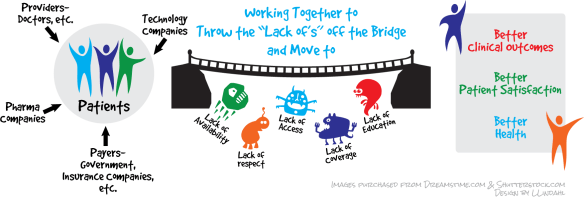
This idealistic philosophy envisions a table where all of the players meet with the patient as the focus. Doctors, pharma/tech companies, government, payers, and patients work together to achieve better clinical outcomes and high levels of satisfaction for patients. This is easy to draw on a white board, but unfortunately not the reality for most people affected by diabetes.

What is the role of Diabetes Advocates in this vision? I like to think that we are working to bridge the gap between how things are and how things should be. We are fighting to identify and throw the “Lack of” monsters under the bridge: lack of availability, lack of access, lack of coverage, lack of education, and lack of respect.

Bridge to Good Health 2

There is a huge gap in diabetes care between the “haves” and the “have-nots.” This disparity is significant in the United States and becomes even more staggering in a global view. In the conference room of advocates we had the mother of a child who was part of an artificial pancreas trial. In contrast we had representatives from countries with little or no access to diabetes education and advanced technology. Missing from the room were people from all over the world with marginal access to insulin and diabetes supplies.

The future success of a company like Medtronic is tied to providing products and services that deliver value-based quality healthcare. Positive clinical outcomes and patient satisfaction are worthy goals. Those are big words to describe what we all want: a happy and successful life with and despite of diabetes.

We advocates have a symbiotic relationship with companies like Medtronic. They need us as the faces and voices of people with diabetes. We need them for products, services, and the ability to open doors to decision-makers. I believe that their success results in better health for those of us with diabetes. Similarly, better outcomes for me should ultimately result in a healthier bottom line for them. Sitting at the table together gives both of us a better chance for success.

Transforming diabetes care together, for greater freedom and better health.


Disclosure: Medtronic Diabetes paid for my travel and hotel expenses to attend the forum. As always, my thoughts and opinions are my own.

Considering the Heart | Part 2 | Women with Type 1 Diabetes

Laddie_Head SquareIn Considering the Heart | Part 1 | Type 1 Diabetes, I addressed my pretense of belonging to the “Not Me” club. As a woman, it is easy to think that I have a similar “Not Me” pass when it comes to heart problems because isn’t heart disease a man’s disease? Based on the attention given to breast cancer in this country, shouldn’t cancer be my biggest concern? Wouldn’t I have symptoms if I had cardiovascular disease (CVD)? Won’t I know if I am having a heart attack or a stroke? Although I know that my risk for heart disease has risen because I am in my 60’s, aren’t younger women protected from cardiac problems?

Let’s burst these bubbles right away—

FACT:  Heart disease is the leading cause of death for women in the United States. About 1 of every 3 female deaths is the result of heart disease.

FACT:  Every year since 1984, more women than men have died of heart disease in the United States. Alarmingly, women are twice as likely as men to die following a heart attack.

FACT:  Heart disease is more deadly than all types of cancer combined. Six times as many women will die of heart disease in the coming year compared to deaths from breast cancer.

FACT:  Heart disease may be silent and not diagnosed until a woman has a heart attack or stroke. Almost two-thirds of women who die suddenly from CVD had no previous symptoms.

FACT:  Symptoms of heart attacks can be different for women compared to men. Although many women experience the most common symptom of chest pain, about 40% Considering the Heartof women experiencing a heart attack have no chest symptoms at all. Instead of or in addition to pain, they may have severe fatigue, shortness of breath, indigestion, and anxiety.

FACT:  Although heart disease is more common in older women, it is a threat to all women. The incidence of sudden cardiac death for women in their 30’s and 40’s has risen 30% in the last decade.

The above statistics are relevant to all women. Now for a few disturbing facts that pertain to women with Type 1 diabetes.

♥︎♥︎♥︎  Although rates of CVD in the general population are lower for premenopausal women than for men, this female sex protection is not seen for women with Type 1 diabetes. At all ages women with T1DM are more likely to have a CVD event than healthy women.

♥︎♥︎♥︎  According to one large meta-analysis of sex-specific mortality from 1966-2014, women with Type 1 diabetes were found to have nearly twice the risk of dying from heart disease compared to men with T1 and a 37% increased risk of stroke.

♥︎♥︎♥︎  CVD risk factors are more common in children with T1DM than for the general population and even at a young age, girls with Type 1 have a higher risk burden than boys with T1DM.

In the past and even currently, the incidence of heart disease in women has been under-estimated. I follow an excellent blog about women and CVD disease titled Heart Sisters. Patient Advocate Carolyn Thomas launched the blog in 2009 to provide current and relevant CVD information to all women. She had previously suffered a heart attack with a 99% blocked coronary artery two weeks after being sent home from the ER with a diagnosis of acid reflux. A startling statistic in her About Me page says it all:

“According to research published in the New England Journal of Medicine, women my age and younger are seven times more likely to be misdiagnosed in mid-heart attack and sent home from Emergency compared to our male counterparts presenting with identical symptoms.”

There is hope that the diagnosis/care gap for women with heart disease is being addressed as evidenced by a January 2016 AHA Scientific Statement titled “Acute Myocardial Infarction in Women.” This paper received broad coverage by mainstream media, including this report on CBS News. The most powerful statement in the CBS video is by NYC cardiologist Dr. Holly Andersen: “Heart disease in women is under-researched, under-diagnosed and under-treated.

Most of us with Type 1 diabetes have learned the value of education and how to advocate for ourselves.  As women, particularly women with Type 1 diabetes, we need to do the same in regards to our cardiovascular health. A lot of the information in this post seems to be gloom and doom. In general I prefer to be an optimist and view it as a wake-up call to intensify my efforts to address my controllable risks for cardiovascular disease. Because CVD is highlighted in the ADA Standards of Medical Care in Diabetes—2016, those of us with diabetes may have a head start on other women in having these conversations with our doctors. Below you will find some links to launch your education on women and cardiovascular disease.

In the concluding section of this 3-part series on CVD, I will share my experiences and thoughts on my cardiovascular risks as a woman with diabetes. There is no doubt that although I follow most of my doctors’ recommendations, I have often dismissed these risks in the past. It is a difficult post to write because like all of you, I am dealing with statistics and probabilities along with no black-and-white answers or guaranteed outcomes. For the most part, I just don’t know.

Please remember that I am not a medical professional. Although this blogpost presents a lot of information about women and cardiovascular disease, it is by no means complete. Do your homework and talk to your medical professionals about your risks.

*

***   Relevant Links for Women & CVD Disease   ***

AHA statement on women and heart disease January 2016

American Heart Association Go Red for Women

Am I Having a Heart Attack? | Heart Sisters

Heart Disease Statistics | The Heart Foundation

Myths & Facts | Heart Sisters

*

***   Relevant Links for Women with Type 1 Diabetes & CVD Disease   ***

ADA Women, Coronary Heart Disease and Diabetes

AHA/ADA Scientific Statement: Type 1 Diabetes Mellitus and Cardiovascular Disease: A Scientific Statement From the American Heart Association and American Diabetes Association

How Diabetes Differs for Men and Women, Diabetes Forecast, Oct., 2011

Women with Type 1 Diabetes “Twice as Likely” as Men to Die from Heart Disease

***  Related Posts  ***

Considering the Heart | Part 1 | Type 1 Diabetes

Considering the Heart | Part 3 | My Story

Considering the Heart | Part 1 | Type 1 Diabetes

Laddie_Head SquareThose of us with any type of diabetes are constantly told that we are at high risk for cardiovascular disease (CVD). As someone who is in relatively good health despite 39 years of Type 1 diabetes, I have been quick to play the “Not Me” card. Although I follow through with all of the tests that my doctors recommend, I do them with the conviction that I don’t have heart disease. My internal dialog has been along the lines of:

♥︎  Heart disease affects people with Type 2 who have metabolic syndrome. Metabolic syndrome is defined on Wikipedia as “a clustering of at least three of five of the following medical conditions: abdominal (central) obesity, elevated blood pressure, elevated fasting plasma glucose, high serum triglycerides, and low high-density lipoprotein (HDL) levels. Metabolic syndrome is associated with the risk of developing cardiovascular disease.”

♥︎  I have diabetes because of an autoimmune attack on my pancreas. That doesn’t have anything to do with metabolic syndrome or heart disease. I am not overweight nor do I have other characteristics of metabolic syndrome.

♥︎  I understand that heart disease can result from “poorly controlled” Type 1 diabetes. My A1c’s are well within the ADA guidelines and have been for a long time. My diabetes is “well controlled.”

♥︎  All of the recommendations for addressing cardiac risk factors for people with diabetes are based on research of people with Type 2 diabetes. There are few studies of specific cardiac risks for people with Type 1 diabetes, especially for those with A1c’s in target range.

♥︎  I am extremely active and exercise daily. I have no pain or fatigue that might suggest CVD.

♥︎  I am a woman and heart disease affects more men than women.

Considering the HeartI could go on and on listing excuses for discounting my risk for heart disease. Instead I decided to do some research by starting with the Google search term “Type 1 diabetes and heart disease.”

I was surprised to find quite a few links. Some were relevant. Others were just the inclusion of Type 1 diabetes into “general” diabetes, really meaning Type 2. By far the most helpful document I found was a 2014 article titled “Type 1 Diabetes Mellitus and Cardiovascular Disease: A Scientific Statement from the American Heart Association and American Diabetes Association.” This statement was prepared by a committee of physicians chaired by Sarah D. de Ferranti, MD, MPH and is a thorough investigation into current knowledge and studies on the relationship of Type 1 diabetes and cardiovascular disease. The introduction to the statement begins:

Despite the known higher risk of cardiovascular disease (CVD) in individuals with type 1 diabetes mellitus (T1DM), the pathophysiology underlying the relationship between cardiovascular events, CVD risk factors, and T1DM is not well understood. Management approaches to CVD reduction have been extrapolated in large part from experience in type 2 diabetes mellitus (T2DM), despite the longer duration of disease in T1DM than in T2DM and the important differences in the underlying pathophysiology.”

This statement is long, but very readable. If you have Type 1 diabetes, you should definitely read it or at least bookmark it for future use. The full text of the article is available for free. There is no way that I can summarize the statement completely, but below I will share some things that I learned:

♥︎  Although I tend to think of the link of ‘heart disease” to Type 1 diabetes, I need to consider the whole CVD package of coronary heart disease (CHD), cerebrovascular disease including strokes, and peripheral artery disease (PAD).

♥︎  While admitting that more research is needed to understand the incremental risk and clinical presentation of CVD in people with T1DM, the authors state that “Overall, CVD events are more common and occur earlier in patients with T1DM than in nondiabetic populations.” Statistics mentioned are that the age-adjusted risk in Type 1 is about 10 times that of the general population and that CVD events occur on average 10-15 years earlier than for matched non-diabetic subjects. One analysis of 5 studies indicates that for each 1% increase in A1c, the risk for peripheral artery disease goes up by 18%.

♥︎  Although rates of CVD in the general population are lower for premenopausal women than for men, this female sex protection is not seen for women with Type 1 diabetes. At all ages women with T1DM are more likely to have a CVD event than healthy women.

♥︎  Atherosclerotic abnormalities can be seen in children and adolescents with T1DM.

♥︎  Autonomic neuropathy in T1DM can result in silent (asymptomatic) cardiac events with delayed diagnosis due to absence of pain and other vascular symptoms.

♥︎  The follow-up study to the Diabetes Control and Complications Trial (DCCT: 1983-1993) was the Epidemiology of Diabetes Interventions and Complications study (EDIC: 2005). EDIC reported that intensive therapy reduced the risk of cardiac events by 42%.

♥︎  The downside of improved glycemic control is that it can lead to weight gain and insulin resistance in people with Type 1. It is assumed that as A1c levels improve, the importance of general cardiac risk factors such as central obesity, high blood pressure, high LDL cholesterol, and high triglycerides gain increasing importance.

♥︎  Most research on the incremental risk and clinical presentation of CVD in people with diabetes is based on studies of people with Type 2 or no distinction is made as to type. However, the studies which are specific to Type 1 find increased risks for people with Type 1 when compared to healthy control subjects.

One other article of particular interest is from the August 2013 issue of Diabetes Forecast and is titled What’s Behind Heart Attacks in Type 1 Diabetes? This article highlights the research of Joslin Diabetes Center Investigator Myra Lipes, MD and outlines the idea that autoimmunity may be behind the increased rates of CVD for people with Type 1. Initial studies have suggested that an out-of-control autoimmune response post-heart attack is responsible for the fact that people with Type 1 diabetes are at high risk for poor outcomes after a heart attack.

Summary:  I have learned a lot about cardiovascular disease and Type 1 diabetes. Although more studies are needed to understand the specific CVD risks for people with Type 1 diabetes, there is definite proof that I should not continue to play the “Not Me” card. In my next post of this 3-part series on cardiovascular disease, I will share information on the particular risks that women have for heart disease.

Please remember that I am not a medical professional. Although this post presents a lot of information about cardiovascular disease and Type 1 diabetes, it is by no means complete. Do your homework and talk to your medical professionals about your risk. 

*

***   Relevant Articles   ***

AHA/ADA Scientific Statement: Type 1 Diabetes Mellitus and Cardiovascular Disease: A Scientific Statement From the American Heart Association and American Diabetes Association

Type 1 Diabetes and Coronary Artery Disease, Diabetes Care, November, 2006

Type 1 diabetes and cardiovascular disease, Cardiovascular Diabetology 2013

What’s Behind Heart Attacks in Type 1 Diabetes?, Diabetes Forecast, August, 2013

Wayback Wednesday: All About Diabetes and Heart Health, Diabetes Mine


***  Related Posts  ***

Considering the Heart | Part 2 | Women with Type 1 Diabetes

Considering the Heart | Part 3 | My Story

Countdown to Medicare with Type 1 Diabetes: 12 Months

Laddie_Head SquareA year from today I will be on Medicare.

I have been one of the privileged. I have always had good health insurance and have never had to worry about running out of insulin or test strips. I have never had to choose between buying groceries and filling my prescriptions. I have had access to insulin pumps and full insurance coverage for a continuous glucose monitor.

I don’t exactly know what to expect with Medicare. Over time I suspect that I will figure out most of what I need to know. Right now I feel as though I am looking into the dark abyss of the unknown.

I know that there will be a lot of hoops to jump through to obtain a sufficient number of test strips and supplies for my insulin pump. I know that due to Medicare law I will no longer be eligible for medical device upgrade programs. I know that CGM’s are not covered by traditional Medicare and I will continue to advocate to have that changed. I know that a handful of Medicare Advantage plans cover CGM’s and I will have to do my homework to choose the best option for me. Because I use an insulin pump, I will purchase my insulin under Part B and I have heard nightmares about finding suppliers. The newly-instituted competitive bidding program for diabetes supplies worries me.

I currently pay a huge monthly amount for health insurance. It is possible that even if I must self-fund a CGM, Medicare will be a better financial deal than my current situation. I know that I will have a lot of decisions to make as I select my Medicare coverage and I suspect it will take many hours to figure out how things work. I know some people who have cruised into Medicare with few problems. I know others who have struggled to get test strips, pump supplies, and insulin.

There is a sadness in realizing that I will probably not get access to any or all of the new technologies and medications coming to market in future years. Things like the artificial pancreas, encapsulated insulin-producing cells, and smart insulin will likely not receive Medicare coverage for many years, if ever. At the same time I have to remember that I was diagnosed with diabetes in the days of one daily injection of a pork- or beef-based insulin. There was no home blood glucose testing and I peed on Diastix strips to get an approximation of what my blood sugar was several hours earlier.

The likelihood that I won’t always have the newest and greatest doesn’t mean that I won’t thrive under Medicare. Medicare is not something that I have a choice about and therefore I will make it work. I am expecting roadblocks and hassles in getting the medical supplies and medications that have always been easily purchased. I’ll probably scream as I navigate automated menu systems on my phone. I’ll probably rant and rave when things don’t go the way that I expect. But I will learn and I will be fine.

Many years ago very few people with Type 1 diabetes lived long enough to make it to Medicare in relatively good health. People like Richard Vaughn and Tom Beatson were a rarity. In coming years more and more of us with Type 1 will be reaching Medicare age. We have a lot of learn about Medicare and Medicare has a lot to learn about our needs.

My aim is to chronicle my journey as I countdown to Medicare. Over the last year I have occasionally grown tired of blogging. However, I have never doubted that I want to keep Test Guess and Go going as a storybook about Medicare with Type 1 diabetes. Right now I have no great words of wisdom to share. For better or worse I am on a one-way road to growing older with Type 1 diabetes and I don’t don’t plan to spend my senior years complaining or in poor health. So let’s get going….

********

Please note that Medicare began reimbursing the Dexcom G5 continuous glucose monitor  in 2017. Most of my concerns in the Countdown to Medicare series are still relevant. But the details may have changed by the time you read this post.   Laddie 6/28/18


Happy Birthday, Abby the Black Lab!

Laddie_Head SquareAbby the Black Lab, who is wise about all things related to diabetes, is celebrating a birthday. Her blogposts are some of the most-read posts at Test Guess and Go. Someday I hope to have half as much wisdom as she does.

Please wish her a Happy #10!

*

Abby Birthday

*

***   Related Posts   ***

Abby the Black Lab Discusses DSMA Live

Abby the Black Lab Discusses Nutrition

The Great Divide in the DOC

A Diabetes Poem

Abby the Black Lab Discusses Community


Choosing the Dexcom G5—Again

Laddie_Head SquareIn September I wrote a blogpost about the pros and cons of upgrading from the Dexcom G4 CGM to the Dexcom G5. Since my upgrade was free and I did not have to return the new and still-unused G4 transmitter, the decision to accept the G5 transmitters was a no-brainer.

Two weeks ago my transmitter warranty expired and I was once again faced with the G4/G5 decision. Most of the arguments from my September post are still valid, but probably my biggest concern was whether I liked the positives of the G5 enough to outweigh the increased cost of the transmitters. As most of you know, G4 transmitters are warrantied for 6 months but operate until they die—sometimes as long as a year after initial use. G5 transmitters are sold in pairs with each transmitter programmed to shut-off after 108-112 days (90 days + 18-22 days grace period).

Around the DOC I have seen many CGM users who have chosen to remain with the G4 for various reasons. Read Mike Hoskins’ post at Diabetes Mine for a good description of valid reasons for not changing. Recently on Facebook there have been discussions where some users are considering going back to the G4 as their G5 warranties expire. In most cases the motivation is financial although some users have been dissatisfied with the transmission range and signal reliability of the G5 system.

I have been using the Dexcom G5 since late February. Initially I was quite frustrated by the alert sound options on my iPhone and in typical fashion wrote a rant blogpost. At that point I was too new to the system to evaluate other pros and cons of the G5 platform.

Fast forward a few weeks and when once again faced with the G4/G5 decision, I chose without hesitation to remain with the G5 system. So what changed and why am I totally on board with the G5?

Dexcom G5 Choice

1. Although I never really minded carrying the Dex receiver, I quickly fell in love with not carrying it. I appreciate having one less thing in my pockets and one less expensive device to keep track of. I like how my BG numbers are displayed on the phone and how the G5 app allows me to key in calibration numbers rather than scrolling on the receiver wheel. I like the use of color in the app and the ability to see graphs in landscape mode. I appreciate the new iPhone “complication” that allows me to see my BG number without unlocking my phone.

2. When I use the receiver, I find the screen with the white background easy to read unlike the G4 screen with colored numbers and tracings on a black background. As someone who spends a lot of time hiking in bright sunlight, I found the G4 receiver impossible to read at those times when I needed it the most. (See “Sunlight and the Dex G4: A Bad Mix.”) I will admit that I dislike the glaring spotlight of the G5 screen when checking it in the middle of the night.

3. Although I am still not happy with the sound profiles on the iPhone, it is not bothering me very much. I am experimenting with using the receiver at night and my phone during the day. When I combine the musical Dexcom alerts with my Lantus reminder alarm in the evening, I feel like a digital music box.

4. Because I am a year away from Medicare and no CGM coverage, it is easy to argue that I should be hoarding transmitters and continuing with the extended life of the G4 transmitters. A great idea in theory, but it ignores the probable release of the Dexcom G6 in 2017 or early 2018. The G6 promises improved accuracy and reliability and I suspect it will quickly leave the G4 and G5 platforms in the dust. Because the G5 does not require a receiver, maybe it will be more economical than the G4. Or are you required by the FDA to purchase a new receiver every year?

Right now Medicare is a huge “unknown” in my life and I will soon be writing about my preparations and guesswork as I move closer to April 1, 2017. I hate the idea of hoarding supplies and technology that will become obsolete and possibly unused. But I am not optimistic about a change in Medicare CGM policy and am I crazy not to stock up on G4 transmitters?

5. I have not been bothered by things that could be considered flaws of the G5 system. I have experienced very few dropped data points. I have occasionally lost the signal on my phone, but that also happened periodically with my G4 receiver. The battery of my almost 3-year old iPhone 5 runs down more quickly due to the Dex G5, but not enough to be a real problem. I am still not satisfied with the lack of a robust vibrate alert on my phone, but I’m losing no sleep over it.

Summary:  As I am reminded whenever I write technology blogposts, I am indeed one of the “Diabetes Privileged.” I would of course prefer not to have diabetes and it is certainly not a “privilege” to live with this difficult-nagging-frustrating-serious-chronic health condition. But given that I do, I have many things in my favor. I am educated. I have good health insurance and am able to buy insulin and other required medications/supplies. I have a computer, an iPhone, and a connection to the Internet and the Diabetes Online Community. I have access to good food and a safe environment in which to walk and exercise. I am the beneficiary of the newest diabetes technologies and able to debate whether I want to live with the fabulous Dexcom G4 CGM or the newer and fabulous Dexcom G5 CGM.

And today I choose the Dexcom G5.