
Insulin Pump Decision 2016

Laddie_Head SquareAnd the choice is…

Next week I will be ordering a new pump or at least I hope I will. My decision could have been difficult, but because of the narrow time window for ordering my pump and looking at my future under Medicare, it was easy.

Timing:

As someone who uses a lot of technology to manage my diabetes, I satisfy my insurance deductible long before the end of the year. With my 2016 deductible satisfied, my pump will be covered at no cost to me—as long as it is shipped before the end of the year. I think I dawdled last time I purchased a pump and ended up with a warranty expiration date in December. Not great timing as I would feel more comfortable if I already had the pump in hand.

My timing is also affected by my move to Medicare in April 2017. I will have individual insurance for January-March, but it will have such a high deductible that a pump purchase would essentially be out-of-pocket. If for some reason I don’t get the new pump in December, I will wait until after April 1. It is not ideal to start Medicare needing a high-ticket item and I don’t know whether I would be forced to abide by the Medicare policy of a 5-year warranty on pumps. I don’t think so because Medicare did not purchase my current pump, but you never know.

Timing also affects what pump I will select. I would like the opportunity to try out the Medtronic 630G, but only if I would be eligible to upgrade to the 670G. Unfortunately I will be on Medicare by the time the 670G is released and Medicare beneficiaries are not allowed to participate in manufacturer upgrade programs. I have been told that this rule is part of anti-fraud regulations, but it truly makes no sense to me. It is not as though there is any cost to Medicare to allow me to upgrade if I pay the out-of-pocket cost (if any) and I don’t see how anything about it is fraudulent. But this is not a battle I can win and therefore I will not buy a Medtronic pump at this time. I don’t find the 630G sufficiently appealing to live with for 4 or 5 years especially since it uses the current generation of Enlite sensors and not the improved sensors that are part of the 670G system. I could wait until the 670G is released but there is no guarantee of Medicare coverage.

Pump Options:

Accu-Chek: I have never considered an Accu-Chek pump. I think some people are very happy with the Accu-Chek Combo, but there is little about it that excites me. I don’t want a meter-remote and given my recent experience with the Accu-Chek Connect meter, I don’t want to be tied to using Accu-Chek test strips. Just not a good fit for me.

Animas: I currently use an Animas Vibe and it is an okay pump although I do not use it as a Dexcom G4 receiver. I have a very difficult time reading the screen in bright sunlight and that has been a real problem when hiking. It has started to lose the date/time info when I change the battery and I would not trust it for very long as an out-of-warranty device. A new Animas pump with Dexcom G5 integration is on the horizon, but there is no timetable for its release. Four years ago I purchased an Animas Ping because the market release of the Vibe was expected to be any day. It was over two years later.

Insulet: I have never been interested in the Omnipod and do not mind pump tubing. Although some Medicare Advantage and Cost plans cover the Pod, basic Medicare does not. As someone moving on to Medicare in four months, there is no reason to fall in love with the Omnipod.

Medtronic: It is mostly a timing problem as described above. I won’t purchase the Minimed 630G because it is a Windows Millennium pump. If you don’t know what that means, you are lucky. We owned several Windows ME computers and they ended up being a very short-lived and poorly-supported generation of computers. If the 670G were available today, I would seriously consider it.

So what’s left???

Tandem: I have decided to go with the Tandem t:slim X2. I am excited to move to a touchscreen device and am especially excited about the integrated Bluetooth and Tandem Updater. Do you notice that I used the word “excited” twice? When I selected the Animas Ping four years ago, I considered the t:slim and passed on it because of the lack of an upgrade program and I didn’t want a rechargeable pump. I never liked my Ping and was jealous of those who “loved” and were “excited” about their t:slims.

A huge selling-point of the X2 is that it will allow users to update the software in the future to accommodate new features, the first being integration with the Dexcom G5 CGM. Automated insulin delivery algorithms are also on the horizon. I personally hope that the Bluetooth connectivity will allow Bluetooth BG meters to automatically populate BG numbers into the pump. Although Medicare does not allow participation in hardwaretslim_x2_insulin_pump_front_view_rgb upgrade programs, my fingers are crossed that software updates will be allowed. I discussed the Medicare problem with my local Tandem Rep and he indicated that Tandem is aware of the issue and hopes to make Medicare recipients eligible for software updates. I know that nothing is guaranteed.

To tell the truth, I still do not want a rechargeable pump. I have always liked the confidence generated by a spare battery in my meter case. But I will adjust.

One Worry:

My individual insurance policy is being cancelled at the end of the year because BCBS of MN is leaving the individual insurance market except for one hugely expensive policy. When I ordered sensors 10 days ago, the supplier indicated that I needed an insurance pre-authorization which I had not needed in several years. I panicked thinking that the insurance company was implementing a year-end money-saving policy of denying DME. I had visions of a new pump being denied. Fortunately Tandem has reviewed my policy and indicated that they are confident the pump will be approved. But until it is safely in my hands, I will worry. (And I did receive the sensors.)

Final Thoughts:

In our family we keep cars a long time. Although my primary car is a 2012 model, I still drive a 1999 SUV several times a week. As I age, it is easy to wonder if my current or next car will be my “last car.” That makes me a little sad because I love the excitement of buying and driving a new car.

I am not yet at the point where I think that the pump I select today will be my “last pump.” But with Medicare’s pump 5-year warranty policy, I am certainly not looking at an unending stream of new insulin devices. At age 64 I hope to have many years of continued good health and many more pumps, but the future is unknown. Will I get the opportunity to use an artificial pancreas-enabled pump? Maybe. Will I quit pumping entirely? Maybe. Will I some day live with implanted beta cells? Doubtful. Will I be cured of diabetes? No. I am not worrying about any of this. It is all in the “I wonder” category.

Today I look forward to using a Tandem X2 pump. Unlike previous pump decisions where I had doubts about the “right” choice, I am confident about this decision. I don’t expect absolute perfection with the X2, but I hope for excitement and the opportunity to have pump hardware that can move into the future with software changes. Fingers crossed.

********

Pump comparison charts quickly become out-of-date as new pumps and manufacturers enter and leave the market. If you’re considering an insulin pump purchase, a good place to begin is here and here along with technology articles at Diatribe and Diabetes Mine. Ultimately manufacturer websites and sales reps are an excellent (but biased?) source for current information. And don’t forget to ask your DOC friends for their experiences and opinions.

Not FDA Approved

Laddie_Head SquareAfter my husband and I finished putting up the Christmas tree this morning, I discovered that my Dexcom G4 Share receiver was missing. We searched tree branches, boxes of decorations, upstairs, and downstairs and couldn’t find it. I knew that the receiver was somewhere in the house because I was getting numbers on my phone through the Share app.
My BG at this point was in the 140’s several hours after breakfast and normally I would take a correction bolus. Instead I ate a couple of glucose tabs and hoped that I would hear vibrating alerts as my BG passed over 160. No luck. My BG went up but we heard nothing. (All of my alerts are set to Vibrate.)

Once my BG hit the stratosphere, I gave up on high alerts. My only recourse was to drop below 55 and get the mandatory audio alert. I injected a mega-dose of insulin and got ready for the gluco-coaster ride. Don’t try this at home, Kids.

It took a while but eventually I was below 100 with double down arrows. About this time my husband asked if an ambulance ride would cost more than replacing the receiver. I explained that I had reached my deductible for the year so emergency care would be free…. Then I assured him that I would be okay and ate a couple of Smarties to control the BG drop.

We didn’t hear vibrations as the BG dropped below 70. So it was 55 or Bust!

Finally we heard muffled audio beeps, but we couldn’t figure out where they were coming from. Certainly not near the Christmas tree or the couch or the many boxes where I expected to find it. I’m not sure how many minutes separate each series of alerts—maybe about ten. Finally on the 3rd or 4th round of beeps, we found the receiver upstairs in the pocket of my pajamas.

This should be the end of the story, but it is not. The reason that I had not checked upstairs is that I had been on a 40-minute walk long after getting dressed. I had seen reasonable BG numbers on my Apple Watch while walking and given no thought to the idea that the receiver was not with me.

It turns out that obviously my receiver was upstairs all morning and the number I was seeing on my Apple Watch was from the Watch Sugar app. When the Dex Share app on the phone and watch loses contact with the Dexcom receiver, it displays blank dashes instead of numbers. Had I been using this app during the walk, I would have noticed a problem. But I was checking my watch face with the Watch Sugar complication. Well, I learned today that the Watch Sugar app will keep displaying the last number received whether it is 30 seconds ago or 5 hours ago.

Once my BG returned to normal according to my meter, I turned off the Dex receiver for 20 minutes. As expected, the number 46 for Watch Sugar never changed while the Dexcom Share app (not shown on watch face) quickly showed no data. Hypothesis confirmed.watch-face

Everything is now fine in Diabetes Land.

I found my Dexcom receiver.

My post-Thanksgiving low carb diet got blown to bits with glucose tabs, Smarties, an apple, a pear, yogurt, and an English muffin.

I learned that it is better to keep the Dexcom app open on my watch rather than rely on Watch Sugar.

My BG’s are stable and back in range. Dexcom 91. Freestyle 93.

Just another day with Type 1 diabetes.

Postscript:  Sometimes I think I have little control over my diabetes. Today I felt totally in charge of what I wanted my blood glucose to do. I never felt that I was doing anything dangerous. I was not alone and I had lots of orange juice and glucose tabs available. That being said— please remember that nothing you read on this blog should be considered medical advice or even good advice.

Back to the Future:  Dexcom G4 Share and Apple Watch

Laddie_Head SquareIn the last 10 days, my diabetes technology world has changed. On one hand I have reverted to an older tech platform. On the other hand I have zoomed into the future with a modern and cool-for-a-64-year-old-woman device.

Stepping Back:  After getting my free(!) upgrade to the Dexcom G5 last fall, I was lucky to be left with an unused G4 transmitter. I didn’t start using the G5 until March when my previous G4 transmitter passed its 1-year anniversary. It was still working fine, but I abandoned it to transition to the G5 platform. A bit wasteful, but gee whiz, that transmitter was never going to die! I used two G5 transmitters and for the most part was happy with G5.

That unused G4 transmitter did not disappear and kept sending “Use Me! Use Me!” messages to my brain inbox. If I were not moving to Medicare and no CGM coverage in 6 months, I probably would have used my “privileged diabetes patient” status to stay with G5 and give the unused G4 transmitter to a  needy DOC friend.

Last weekend my second G5 transmitter timed out and I bit the bullet to go back to G4. My CGM warranty expired in early September and I was able to order a new G4 Share receiver. Although it had only been 6+ months since I had last used Share, I panicked as it seemed totally foreign to me. Also because I am using the mySugr logbook, I needed to be sure that my CGM information would continue to sync to the app. Miraculously I figured everything out and it is working correctly.

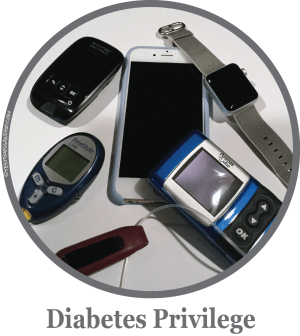
Onward to the Future:  Earlier this fall I decided that I would use my #firstworldprivilege to order an Apple Watch so that I could see my current blood sugar just by raising my wrist. Please remember that I started my diabetes career in the days of urine testing and things like this are magical to me.d-tech-privilege-circle

My Apple Watch 2 arrived last week. I have not worn a wristwatch in 12+ years since I got my first insulin pump, aka pocket watch. It wasn’t terribly difficult to add the Share app to the watch and it works okay. Unfortunately it cannot be used as a watch face “complication” like the G5 app. There is another app called “Watch Sugar” that allows me to add the Dexcom number to my watch face, but it is so time-delayed that I don’t find it helpful.

Basically I leave the Dexcom Share app open on the watch all of the time and it is usually what I see first when I raise my wrist. When Share is not the wake-up screen, it is easy to find the app in the dashboard and restore it. My difficulty with this whole set-up is that occasionally it just doesn’t work. If I am using other Bluetooth devices such as headphones or a speaker, I think the phone gets confused and occasionally loses the signal from the Dexcom receiver. There are also user-error problems such as leaving the receiver upstairs or closing out the Share app on my phone.

Clash of the Past and Future:  The bad part about these D-tech changes is that now I have two more devices to carry, coordinate, and charge than I did two weeks ago. The G4 requires a receiver and of course the watch is added. The blood glucose number that I see on my wrist starts with the transmitter beaming info to the receiver which communicates with the phone that sends it to the watch. There is definitely some mental fatigue and data overload with this set-up. At the same time I love not having to reach into my pocket to retrieve Dexcom data.

Life is good. It might would be nice if I didn’t diabetes but that horse left the barn a long time ago. So today I give thanks for access to technology that make my life with diabetes a little bit easier and a lot more interesting. 😀

Congrats to Medtronic!

Laddie_Head SquareUnless you are living in an underground bunker, you know that Medtronic Diabetes announced yesterday that the MiniMed 670G hybrid closed loop system has been approved by the FDA with anticipated shipping in the spring of 2017. Here’s a link to the press release if you haven’t read it yet.

Am I excited about this? Absolutely yes!!! Will I purchase it? Absolutely not!!!

You may think that I won’t purchase this because I am currently a Dexcom and Animas user. You may think that I won’t purchase this because I’m mad about the United Healthcare/Medtronic agreement. You may think that I won’t purchase this because “The Cure” will be here in five years. No, those are not the reasons. What is preventing me from pursuing this device is my next pump and CGM is ⚡️⚡️⚡️⚡️

Those lightening bolts are supposed to grab your attention and make you sit on the edge of your seat as I explain my predicament.

My issue is that I am going on Medicare in April 2017 after having my current pump go out of warranty in December 2016. I long ago satisfied my deductible for 2016 and if I purchase a pump before the end of the year, it will be at no cost. The individual health insurance market in Minnesota is in chaos and I plan to purchase the cheapest insurance plan possible for January through March 2017. It will be expensive despite a high deductible. No way can I purchase a new pump in that time frame.

So my choice is to purchase a pump in early December or enter 2017 with an out-of-110089warranty pump and wait until Medicare. A naive advisor might suggest that I buy the Medtronic 630G in December knowing that those buyers will be the first in line for the 670G pump when it is released in the spring. But guess what! Once you get on Medicare, it is against Medicare law for beneficiaries to participate in upgrade programs. So if I purchase a 630G, that will be my pump for the next 4-5 years because I will not be allowed to upgrade to the 670G.

A Medtronic representative told me on Saturday that the 630G is now being reimbursed by Medicare. The sensors are not Medicare-eligible, but at least the pump is covered. If I wait hoping to purchase a 670G after April 1, the most likely possibility is that it will not be covered by Medicare for quite a while. Hopefully I am wrong on that.

I am excited that the FDA has approved the MiniMed 670G. Medtronic is not calling it an  artificial pancreas, but it is an important step on the journey to complete insulin automation. That is good for all of us excited about the future of diabetes technology.

But for me, it is not in the game. My reimbursement scenarios just don’t fit the timing of this release. Anyone who reads my blog regularly knows that I currently use Dexcom after several unhappy years with Medtronic SofSensors. The Guardian Sensor 3 that is part of the 670G is many generations removed from that nightmare and I would be open to trying them. But it would be too big a leap of faith to move back to Medtronic without a trial run. Maybe that will be possible in the future when hopefully, hopefully, hopefully CGM/pump systems will be reimbursable under Medicare.

Today my options are too tangled and uncertain to make the MiniMed 670G part of my plans. But I will still camp out in the grandstands with other diabetes advocates yelling “Congrats!” to Medtronic. We live in a golden age of diabetes tech. Unfortunately we also live in a stone age of diabetes reimbursement for those of us who are approaching age 65 and older.

Moosh and Monsters:  A Journal about mySugr

Laddie_Head SquareI am currently one of the beta-testers for the coaching module which has just been added to the mySugr Diabetes Logbook app. You may have seen a recent announcement about this feature which will allow users to receive virtual coaching from Gary Scheiner and other CDE’s of Integrated Diabetes Services. To learn about the program, check out “mySugr Coaching – your shortcut to great diabetes management” by Scott Johnson, the USA Communications Lead for mySugr. Another good source of information is this Diabetes Mine article by Mike Hoskins titled “A New Age of Mobile Diabetes Education and Coaching.”

I have been using the mySugr Diabetes Logbook full-time for two months. To best describe the experience, I am sharing my journal of insights, problems, and opinions. Please note that I am in the early stages of the coaching experience and will share that story in another blogpost.

Journal

Thursday 7/21/16:  I saw Scott Johnson at an ADA seminar today. He asked if I would like some personal consulting sessions with Gary Scheiner of Integrated Diabetes Services. I have several times been a phone call away from calling IDS for help, but have never done it. So of course I said yes. According to Scott, the details of the project are still a little sketchy but will involve using the mySugr Logbook app to communicate virtually.

I like mySugr and have always thought that it is by far the best of the diabetes logging apps. But I have never been a faithful user. Too much data entry has always sidelined me after a week or two.

Friday, 7/22/16:  I began using mySugr again. I have to admit that it has been a year since I last used it and it is much more functional than before. My Dexcom CGM data ismy-monster automatically synced to the app through Apple Health. Most of the data entry is easy with icons and the ability to customize, rearrange, and delete line items. My personal monster whom I named Glukomutant is cute.
Friday 7/29:  I am a week into logging and a day into using the Accu-Chek Connect meter provided to me by mySugr. The meter automatically sends BG numbers to my phone and the mySugr app.

The Connect meter makes mySugr infinitely easier to use because it is one more piece of data that I don’t have to type in. The hardest part of having my phone be a medical device is that I am using my sometimes-bad memory to coordinate data from the Dexcom app, the mySugr app, my pump, my meters, and my life. Scott showed me a couple of shortcuts and let me know what info he enters and what he ignores. He indicated that the app will “moosh” all data entered within 10 minutes into one entry. “Moosh” is Scott-lingo for “fetch and combine.” For example, I test my BG and enter a correction bolus. A few minutes later I decide I to eat and enter my food, carb count, and a couple of tags. It will “moosh” it all together into one log to prevent an unwieldy number of entries in the logbook.

Right now I keep forgetting bolus details the second the pump delivers the insulin and I have to go to the pump history menu to get the info. I’m sure that I will get better at remembering numbers and not get so tangled up creating an entry. Long term mySugr hopes to automate all data sources so that there is very little manual data entry.

Tuesday, August 2:  Today I started a new Dexcom sensor. For the 2 start-up calibrations, I got the following numbers from the Accu-Chek Connect meter: 85 / 108. I did a 3rd test to get a better sense and got 78. This is why I use Freestyle meters. I will try to stick with the Accu-Chek meter for my trial and I did order a bunch of test strips. Out of curiosity I tested on my Freestyle Lite meter. I got 84 / 87. For consistency I used the Accu-chek to calibrate my CGM which interpreted the two tests as 96. Since Freestyle is often considered to test on the low side, the numbers aren’t too horribly different.

Saturday, August 6:  The mySugr app allows basal changes by the hour or half-hour. When using half-hour, I would prefer that the basal rate still show the hourly rate because I have never thought of basal rates in half-hour segments although I often change rates on the half-hour. Does that make sense?

logbook-en-homescreenSaturday, August 6:  I am used to reviewing my CGM tracings and feel as though I get a good overview of the “forest.” With mySugr I feel as though I am down in the trees with a lot of emphasis on average and deviation, both of which are highly affected by a single number. I think that once I have more weeks of data, the summary reports will be more helpful.

Saturday, August 6:  Once again not thrilled with meter. CGM 145, Accu-Chek 118, Freestyle 138. Most of the time the meter is fine and aligns very well with my Freestyle. It syncs amazingly fast to my phone.

Sunday, Aug 7:  Would like an icon for combo/extended bolus and maybe a way to log it besides using notes.

Although the ability to take photos of food is nice, I rarely do it. One of the most useful features is Search. Since I live in a rut and often eat the same foods every day, I can search by things such as “Lunch” and “Salad” and compare how I have bolused for similar meals in the past.

Thursday August 11:  Love how the app learns words I use. For example: CGM, Oatmeal, Walking.

Wish pump bolus info was synced. I do everything on my pump and then enter it again on app. I have accessed my pump history more times in the last month than the previous four years. Wish I remembered it better.

Would like an icon for CGM calibration.

Sunday, August 14:  I learn something new every day. When scrolling down BG numbers, I see that the ones from the Accu-Chek meter are marked with a “Verified” symbol while manual entry ones aren’t.

Saturday, August 20:  I am definitely in the habit of logging, but am hitting the wall of data fatigue. It is quite horrible to see how many “interactions” I have with diabetes every day.

Wednesday Aug 24:  Noticed that my step count from Apple Health is now included in the mySugr daily summary. I love data that I don’t have to enter!

Sunday, Aug 28:  I need to learn more about the reports and graph. Would like to see the graph in landscape view.

Wednesday, Sept 7:  When I activated the consulting module, I filled out everything. Then when I went to settings to activate the camera for a selfie, everything was lost. The perils of being a beta-tester. 🙁

Monday, Sept 12:  Learned that I can swipe an entry to the right to see a menu of Share-Edit-Delete (I had been selecting the entry and pressing the Edit button). This is so much faster. Scott probably showed me this and I forgot. #OldAge. 😀

Saturday, September 17:  My consulting request has been submitted and I am waiting to hear back from Gary. I usually think that my numbers are erratic and unexplainable. However mySugr reports show that my 7-day, 14-day, and 30-day summaries are eerily consistent. I am nervous about having someone review my data.

To be continued…. 

***

The Last D-Tech

Laddie_Head SquareThe last CGM.

The last pump.

The last D-tech before going on Medicare.

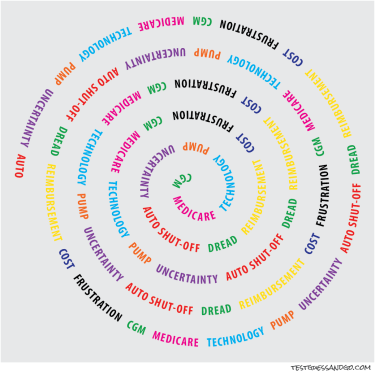
In early September I will purchase my last CGM system before going on Medicare in the spring. That will be followed by my final pump selection in early December. Rather than view these decisions with my usual excitement, I sit here with a stomachache of dread, frustration, and uncertainty. I tend to be naive and think that there is a “correct” decision when it comes to things like this, but there is enough going on in both the reimbursement and technology landscapes that I am faced with a lot of doubt.

First the CGM. It will be Dexcom for sure, but I am torn between staying with the G5 or going back to G4 platform. Although Dexcom is primarily marketing the G5, I use an Animas Vibe and have the option of staying with the G4 for the foreseeable future. (Please ignore the fact that I rarely use my pump as the CGM receiver. Click here for an explanation.) Currently Medicare does not cover continuous glucose monitoring for seniors with Type 1 diabetes. Many individuals and organizations are working hard for a policy change, but I am discouraged and convinced that I will have to self-fund my CGM starting at age 65.

Dexcom has made and continues to make decisions that make self-funding a CGM increasingly expensive. Looking at transmitters, G4 transmitters had a 6-month warranty but many of us experienced a much longer life than that. My most recent G4 transmitter lasted a year. G5 transmitters place a higher demand on batteries, but also have a software-mandated drop-dead date of about 100 days. Thus for someone who self-pays, transmitter costs have almost doubled from G4 to G5.

As yet no changes have been made that impact the cost of sensors. Unfortunately as reported at Diabetes Mine last week, the Dexcom CEO brought up the idea of Sensor Auto Shut-off during the latest quarterly earnings call. This was presented as a safety consideration and my initial snarky response was tweeted by Diabetes Hands Foundation: “So we can kill ourselves on Day 1 of a sensor when Dex is at its most inaccurate, but not on Day 11″ bit.ly/2b4fmjx @MNAZLaddie.” In Dexcom’s defense, no one can ignore the financial repercussions to Dexcom of customers using sensors for 2-3 times as long as warrantied.spiral with words_2016

I currently use most of my sensors for about 2-1/2 weeks. I have full insurance coverage for sensors, but experience better accuracy the second week than the first. I often finally change out a sensor for scheduling reasons or because it falls off despite SkinTac and additional tape. Very rarely is it because of performance problems. I doubt that there will be sensor auto shut-off until the G6, but it is another change that will greatly impact those who self-pay.

I think it makes sense for me to return to G4 for now, especially since I can use the Share feature to see data on my phone. Going back to carrying a receiver won’t bother me much, especially because I like the alarm profiles of the receiver much better than my phone. I am also tired of keeping my phone with me all of the time.

The CGM decision is tangled in my thoughts about a new pump. I am not in love with the Vibe and it doesn’t make sense to buy another one. Tandem is close to retiring the t:slim G4 and I know that if I go with Tandem, I would prefer to buy the t:slim X2 to be released in the fall. The last time I selected a pump for CGM reasons was the Ping in 2012 and it wasn’t a good choice for me. I’ll be writing more about pump musings in the fall, but as with previous pump decisions, it will be complicated by insurance considerations and the uncertain release date of new technology. Medicare rules will also come into play.

One undiscussed topic in today’s post is: If the cost of using a Dexcom continues to spiral upwards and there is no Medicare coverage, at what point will I choose to live without a CGM? Going back to the second paragraph of this blogpost, that is the sort of decision that fills me with “dread, frustration, and uncertainty.”

And fear.

*******

I sometimes conclude technology posts with the admission that my concerns are a #firstworldproblem. I am a privileged patient when it comes to diabetes and I am grateful.

Subtracting the Adjunct from Dexcom G5

I will preface this blogpost by reminding you that I am not a medical professional and I am not suggesting that you do what I do.

Laddie_Head SquareSetting the Scene:  On July 21 Dexcom will have an Advisory Panel hearing with the FDA to discuss whether Dexcom’s G5 CGM should be officially approved for dosing insulin. (This Diatribe article gives information on the meeting and how to provide comments or attend in person.) Currently the G5 has “adjunctive” labeling which means that it is approved by the FDA to be used with confirmatory finger stick testing. Non-adjunctive labeling will help CGM’s receive approval for Medicare coverage as well as justify CGM use for more people with diabetes. In September 2015 the G5 was approved with proper calibration for insulin dosing in Europe.

Background:  Three years ago I wrote a blogpost about how frequently I dose off of my Dexcom. In that post I mentioned bolstering my Dexcom confidence with an average of 8 meter tests a day. Not much has changed since then except I now back up my Dexcom with only 4-6 daily finger sticks. Two of those BG tests are for calibration so it is evident that I am relying on Dexcom for most of my BG information.

Dexcom Blindman’s Bluff:  Earlier in June I decided to test my confidence in the Dexcom G5 and play a game that could be called Dexcom Blindman’s Bluff. The purpose was to experiment with reducing the number of meter tests even further and to consider whether I have enough trust in a CGM to allow it to be the basis for all insulin dosing as it might be in an artificial pancreas (AP) system.

Articles about improvements in AP technology seemed to be published daily. Many clinical trials report average blood glucose numbers in the high 120’s to the low 140’s. For the vast majority of people with Type 1 diabetes, those numbers would be a significant improvement.

I am a T1 who has managed to have lower averages than that for many years. Would I be willing to trade a higher A1c for a huge decrease in the mental burden of diabetes alongBlindFolded Woman with a significant reduction in variability and the number of lows? I suspect that I would although I know some T1’s who definitely would not. Secondly, would I trust a Dexcom sensor to give sufficiently accurate results to dose insulin without my input?

For 48 hours on June 7-8, I decided to accept all numbers in my Dexcom target range of 70-160. The rule was No peeking at my G5 screen for any reason other than to act on prompts for calibration and alerts for out-of-range BG’s. I would use my Freestyle meter only for calibrations. I would rely on Dex alert numbers as the basis for correcting lows and highs and no meter tests for confirmation were allowed. Before eating I would not check my Dex for my current BG status and I would dose insulin based only on the carb count of the food I was eating and my anticipated activity level. If I hadn’t received an alert, I knew that my BG was somewhere between 70 and 160 and that was it.

Because I had Dexcom alerts and calibrations, I didn’t believe that I was doing anything horrendously dangerous. After all, those of us diagnosed with Type 1 diabetes before the mid-1980’s had no home blood glucose monitoring and played “chicken” with diabetes every day.

Results: I had no problems blindly following my Dexcom G5 for 2 days and I was comfortable letting Dexcom run the show. That confidence came with a couple of caveats. The sensor was a week old and had already proven itself to be reasonably accurate. I was close to home both days and not climbing mountains, playing golf, or eating chocolate-covered donuts.

I am the first to admit that my results were skewed for the experiment because I tried to avoid anything that would push my BG out of range. It was two days of the best diabetes numbers that I have seen in ages. But good numbers weren’t the purpose of the experiment and when I got a couple of low alerts overnight, I treated them with no meter confirmation and the same with an afternoon high.

Dexcom Clarity Graphs

This experiment reinforced how little I can feel differences in my blood sugar. Most of the time I had no clue where my BG was in my range. 75 or 155? I had no idea.

Although a two-day test is not sufficient to prove that I would trust the Dex as the compass for an artificial pancreas, it did show me how quickly I could adjust to accepting all numbers in a target range and letting a tech device deal with the minutiae. The idea of not thinking about blood sugars all of the time was very enticing and a slightly higher A1c, especially with less BG variability, might be a small price to pay for a more “normal” life.

Longterm:  Two days was only a toe in the water of using a CGM as my primary blood glucose guide. I thought about doing a longer test, but I couldn’t think of any reason to continue using a CGM blinded. Trends, spot-checks, and pre-meal info are crucial features of CGM use and it is an artificial, somewhat silly game to do without them.

Even when personal experiments aren’t scientific and don’t prove a lot, they definitely relieve the tedium of diabetes and that is something I need. A more apt experiment for testing the G5 as a non-adjunctive device would be where I used my meter only for calibrations and as Dexcom recommends in Europe, when BG is low or changing rapidly. I don’t need to do that test because that’s close to what my life is right now.

Access Matters: My Statement for DPAC

Laddie_Head SquareIn order to amplify the voices of those of us who oppose the recent mandate by UnitedHealthCare to cover only Medtronic pumps, DPAC (Diabetes Patient Advocacy Coalition) is asking everyone affected by diabetes to share their story. Follow this link to help DPAC gather “stories to share publicly within the community and, perhaps more importantly, within the healthcare and legislative communities.” Your voice will help prove that #DiabetesAccessMatters and will advocate for #MyPumpChoice and #PatientsOverProfits.

I don’t know whether my experiences will help because my diabetes narrative is that of a “privileged patient” who has always had access to prescribed insulins, meters, pumps, and CGM’s. How do I prove that access and choice have made a difference?

My Story as Submitted to DPAC:

I have had Type 1 diabetes since 1976. When I was diagnosed there was no home blood glucose monitoring and I took 1 injection of insulin per day. My chances for a long healthy life were minimal and complications such as blindness, amputation, and kidney disease were seen as almost inevitable.

Today I am 64 years old. I have gray hair and am stiff from arthritis, but my eyes are fine. My body has bruises and rashes from pump and CGM sites, but I have no numbness in my feet and my kidney function is fine. I rarely have a day without lows requiring glucose tabs, but I have not needed my husband to fetch emergency orange juice since starting the Dexcom G4 in 2012. My lab tests are good and my cardiac function tests are excellent.

So what happened?AccessMatters

Hard work paid off. Lucky genes probably helped. But what is most important is that I had ACCESS.

ACCESS to medical professionals who learned through the Diabetes Control and Complications Trial (DCCT) that controlling blood sugar results in better health for people with Type 1 diabetes.

ACCESS to new and improved insulin products as they were brought to market.

ACCESS to the newest technologies which began with home BG meters in the early 1980’s and expanded to insulin pumps and continuous glucose monitors (CGM) in later years.

ACCESS to education about how to optimally manage my diabetes.

ACCESS to social support through the DOC (Diabetes Online Community).

Along with access, I had CHOICE.MyPumpChoice

When my internal medicine doctor was unqualified to prescribe a pump, I CHOSE to switch to an endocrinologist.

After experimenting to prove that the blood glucose monitor I was using was unreliable, I CHOSE to switch brands to a meter which provided more consistent results.

When my endocrinologist and I agreed that my diabetes could be better managed with an insulin pump as opposed to injections, I investigated my options and CHOSE the pump that I believed would give me the best results.

When my doctor prescribed a CGM to combat my hypo-unawareness and extreme lows, I CHOSE to give it a try.

After a few years of failure with the CGM brand that I selected, my doctor and I worked together and CHOSE the competing brand.

I am incredibly lucky to have always had good insurance. I have had access and I have had choice. Many years ago my insurance was provided as one of my husband’s work benefits. The cost to us was minimal. Today I pay huge insurance premiums, but I still have access to the medications and durable medical equipment (pump and CGM) that my endocrinologist and I choose.

An insurance company is in business to make money and does not have a license to practice medicine. Once I pay my premiums, access and choice should be in my hands and those of my medical team. The idea that UnitedHealthCare has the right to change its policies on insulin pumps mid-year and mid-contract is wrong. Big players in the game making deals to reduce competition and limit choice should not be allowed.

How do I prove that ACCESS and CHOICE have made a difference in my life with diabetes?

I look in the mirror.

UnitedHealthCare and Medtronic Diabetes: I Could be Mad

Laddie_Head SquareI could be mad at UnitedHealthCare.

I could be mad at Medtronic Diabetes.

I could be mad at a healthcare system that allows health insurance companies to practice medicine and mandate care decisions for their subscribers.

But mostly I am sad.

I am sad for everyone with diabetes. I am especially sad for those of us with Type 1Sad Emoji diabetes for whom improvements in technology have been life-changing. I am sad for everyone who has diabetes today and for those who will be diagnosed in the future.
In some ways the last five to ten years have been a golden age of diabetes care with the release of new insulins, new medications, innovative insulin pumps, and increasingly reliable CGM systems. We see parents able to monitor their child’s blood sugar while at school. We see artificial pancreas clinical trials where blood sugar levels are optimized and the mental burden of care is reduced. Encapsulated beta cell trials have allowed some patients with T1 diabetes to reduce or eliminate the need for insulin injections. The next five years could be even more impressive for the Type 1 market with the probable release of several artificial pancreas systems, the advent of smart insulin, and explosions in ways to monitor our data.

How can I be mad at UnitedHealthCare and Medtronic? They are doing what big companies do. They are trying to grow bigger, squash competition, and make money. They can talk about visions of patient-centric care, but ultimately their DNA drives them to base most of their decisions on the bottom line.

As patients in the United States, what are we supposed to wish for and whom should we blame? It is easy to lobby for national health insurance to eliminate huge profits earned by companies such as UnitedHealthcare. At the same time as a person with longterm Type 1 diabetes, there are few countries in the world where I would have access to an insulin pump and even fewer where a CGM would be funded. I can idealistically hate the idea of our dysfunctional for-profit healthcare system, but there is no doubt that I have benefited from it.

I currently use an Animas Vibe insulin pump and a Dexcom G5 CGM. Fortunately I do not have insurance through United Healthcare. As someone who will be on Medicare in less than a year, I have slowly been coming to terms with the idea that much of the future of diabetes tech will be denied to me. I wrote a blogpost in early April titled “Countdown to Medicare with Type 1 Diabetes: 12 Months” and shared my feelings:

“There is a sadness in realizing that I will probably not get access to any or all of the new technologies and medications coming to market in future years. Things like the artificial pancreas, encapsulated insulin-producing cells, and smart insulin will likely not receive Medicare coverage for many years, if ever.”

But what if the future doesn’t come? The scariest part of the UnitedHealthCare mandate for Medtronic products is the threat that no one with diabetes will receive these life-changing therapies because they will not come to be. Although I sometimes think that Medtronic is taken for granted as a workhorse and powerful player in the diabetes market, in my opinion the most cutting-edge tech devices in recent years have come from the smaller players: Dexcom, Tandem, Asante, and even back to the beloved-Cozmo insulin pump. Innovative medical breakthroughs are apt to be eliminated when choice and competition are trampled by the bigger and more financially-secure players.

As I tweeted during the DSMA TwitterChat on Wednesday night:

Tweet_R

I am not mad.

I am sad.

*****

For more information about the UnitedHealthCare agreement with Medtronic Diabetes, I suggest you start with Mike Hoskins’ article at Diabetes Mine. He provides links to other passionate blogposts and social media responses and outlines actions that we can take to have our voices heard.

Hashtags:  #DiabetesAccessMatters #MyPumpChoice #PatientsOverProfits #AccessMatters

Choosing the Dexcom G5—Again

Laddie_Head SquareIn September I wrote a blogpost about the pros and cons of upgrading from the Dexcom G4 CGM to the Dexcom G5. Since my upgrade was free and I did not have to return the new and still-unused G4 transmitter, the decision to accept the G5 transmitters was a no-brainer.

Two weeks ago my transmitter warranty expired and I was once again faced with the G4/G5 decision. Most of the arguments from my September post are still valid, but probably my biggest concern was whether I liked the positives of the G5 enough to outweigh the increased cost of the transmitters. As most of you know, G4 transmitters are warrantied for 6 months but operate until they die—sometimes as long as a year after initial use. G5 transmitters are sold in pairs with each transmitter programmed to shut-off after 108-112 days (90 days + 18-22 days grace period).

Around the DOC I have seen many CGM users who have chosen to remain with the G4 for various reasons. Read Mike Hoskins’ post at Diabetes Mine for a good description of valid reasons for not changing. Recently on Facebook there have been discussions where some users are considering going back to the G4 as their G5 warranties expire. In most cases the motivation is financial although some users have been dissatisfied with the transmission range and signal reliability of the G5 system.

I have been using the Dexcom G5 since late February. Initially I was quite frustrated by the alert sound options on my iPhone and in typical fashion wrote a rant blogpost. At that point I was too new to the system to evaluate other pros and cons of the G5 platform.

Fast forward a few weeks and when once again faced with the G4/G5 decision, I chose without hesitation to remain with the G5 system. So what changed and why am I totally on board with the G5?

Dexcom G5 Choice

1. Although I never really minded carrying the Dex receiver, I quickly fell in love with not carrying it. I appreciate having one less thing in my pockets and one less expensive device to keep track of. I like how my BG numbers are displayed on the phone and how the G5 app allows me to key in calibration numbers rather than scrolling on the receiver wheel. I like the use of color in the app and the ability to see graphs in landscape mode. I appreciate the new iPhone “complication” that allows me to see my BG number without unlocking my phone.

2. When I use the receiver, I find the screen with the white background easy to read unlike the G4 screen with colored numbers and tracings on a black background. As someone who spends a lot of time hiking in bright sunlight, I found the G4 receiver impossible to read at those times when I needed it the most. (See “Sunlight and the Dex G4: A Bad Mix.”) I will admit that I dislike the glaring spotlight of the G5 screen when checking it in the middle of the night.

3. Although I am still not happy with the sound profiles on the iPhone, it is not bothering me very much. I am experimenting with using the receiver at night and my phone during the day. When I combine the musical Dexcom alerts with my Lantus reminder alarm in the evening, I feel like a digital music box.

4. Because I am a year away from Medicare and no CGM coverage, it is easy to argue that I should be hoarding transmitters and continuing with the extended life of the G4 transmitters. A great idea in theory, but it ignores the probable release of the Dexcom G6 in 2017 or early 2018. The G6 promises improved accuracy and reliability and I suspect it will quickly leave the G4 and G5 platforms in the dust. Because the G5 does not require a receiver, maybe it will be more economical than the G4. Or are you required by the FDA to purchase a new receiver every year?

Right now Medicare is a huge “unknown” in my life and I will soon be writing about my preparations and guesswork as I move closer to April 1, 2017. I hate the idea of hoarding supplies and technology that will become obsolete and possibly unused. But I am not optimistic about a change in Medicare CGM policy and am I crazy not to stock up on G4 transmitters?

5. I have not been bothered by things that could be considered flaws of the G5 system. I have experienced very few dropped data points. I have occasionally lost the signal on my phone, but that also happened periodically with my G4 receiver. The battery of my almost 3-year old iPhone 5 runs down more quickly due to the Dex G5, but not enough to be a real problem. I am still not satisfied with the lack of a robust vibrate alert on my phone, but I’m losing no sleep over it.

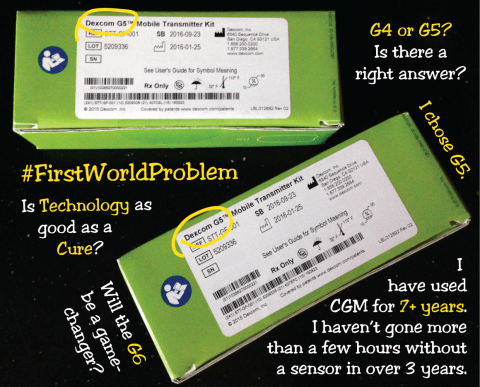
Summary:  As I am reminded whenever I write technology blogposts, I am indeed one of the “Diabetes Privileged.” I would of course prefer not to have diabetes and it is certainly not a “privilege” to live with this difficult-nagging-frustrating-serious-chronic health condition. But given that I do, I have many things in my favor. I am educated. I have good health insurance and am able to buy insulin and other required medications/supplies. I have a computer, an iPhone, and a connection to the Internet and the Diabetes Online Community. I have access to good food and a safe environment in which to walk and exercise. I am the beneficiary of the newest diabetes technologies and able to debate whether I want to live with the fabulous Dexcom G4 CGM or the newer and fabulous Dexcom G5 CGM.

And today I choose the Dexcom G5.