
 It’s been a while since I’ve shared what I am reading and listening to. In the past couple of days I read one blogpost and listened to two podcast episodes that I think are worth your attention.
At the top of my bookmarks for non-diabetes blogs is a website titled Heart Sisters. This blog is self-described as “All about women and heart disease – our #1 killer – from the unique perspective of CAROLYN THOMAS, a Mayo Clinic-trained women’s health advocate, heart attack survivor, blogger, speaker.”
Currently I do not have heart disease although as a woman in her 60’s with Type 1 diabetes, I know that I am at risk. The appeal of this website for me has less to do with heart disease and more to do with the shared experiences of women (really all people) living with a chronic disease.
On October 17, Thomas published a blogpost titled “How Minimally Disruptive Medicine is happily disrupting health care.” She highlights the Mayo Clinic’s KER (Knowledge & Education Research) team led by Dr. Victor Montori. Dr. Montori is well-known for his discussions of the chronically-ill patient’s “burden of treatment” and is a proponent of eliminating terms such as “non-compliant” and “non-adherent.”

Those of us with diabetes are experts at recognizing the burden that our care places on our lives. Thomas shares a quote from a 46-year old woman (V. T. Tran interview) whose comments will hit home for many of us:
“There is stuff that I am SUPPOSED to do, and stuff that I actually DO. If I did everything I am SUPPOSED to do, my life would revolve around doctors and tests and such and there wouldn’t be very much left for living my life.”
I strongly urge you to read this blogpost and dream about an ideal world where medical professionals no longer blame patients and instead work towards patient health goals with a secondary emphasis on diagnostic test numbers.
***********************
Juicebox Podcast is an offshoot of the well-known diabetes parenting blog Arden’s Day. In 2007 Scott Benner began sharing life stories after his daughter Arden was diagnosed with Type 1 diabetes at age 2. Scott proudly proclaims that he is a stay-at-home dad and the author of Life Is Short, Laundry Is Eternal: Confessions of a Stay-At-Home Dad. Never one to shy away from a challenge, Benner began a podcast in early 2015 and named it after the numerous juiceboxes his daughter has consumed to treat low blood sugars.
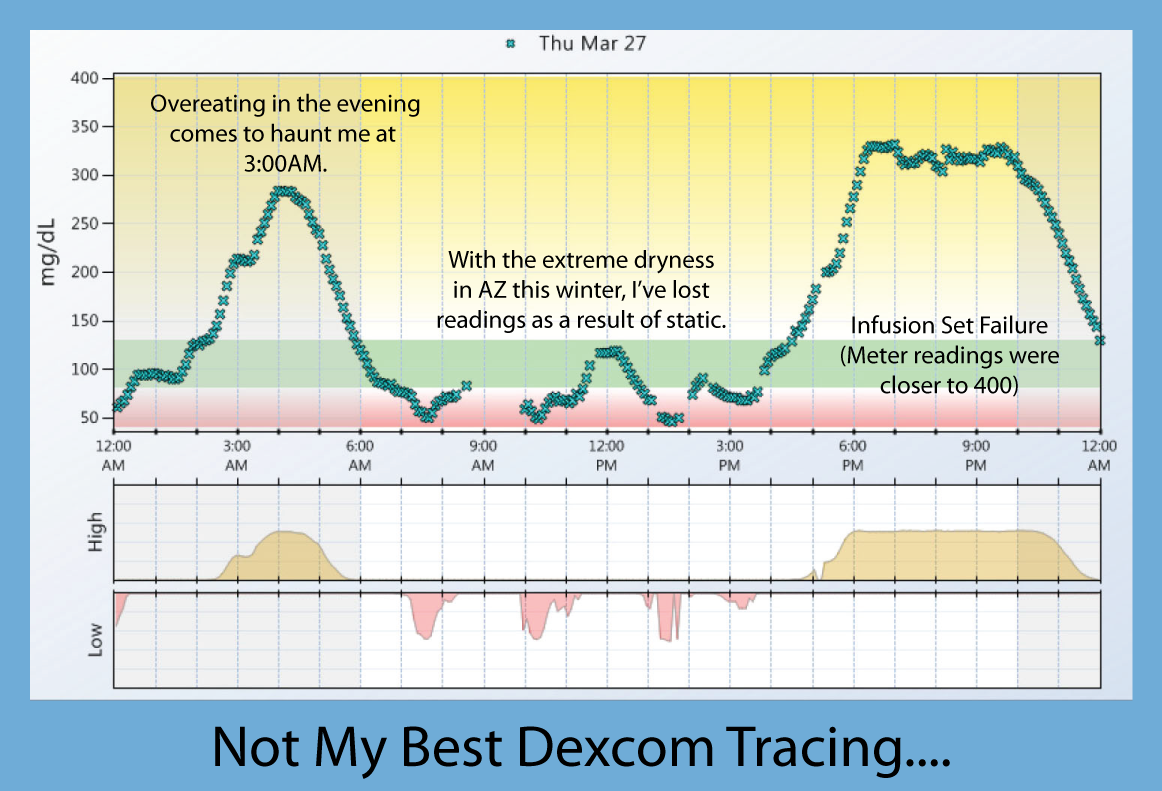
This weekend while walking the dog, I listened to two Juicebox Podcast episodes which focused on Dexcom. Episode #27 was an interview with Kevin Sayer who is the CEO of Dexcom. Rather than recreate the wheel, I’ll share Scott’s synopsis of the episode: “Dexcom CEO Kevin Sayer talks about the Dexcom/Google collaboration, pump integration, Android and iOS/CGM in the Cloud issues, Medicare, Medicaid, Adhesive concerns…. Sayer was an open book who dished about things that I thought for sure he’d decline to speak about.”
Episode #28 was an interview with Steve Pacelli who is Dexcom’s Executive VP of Strategy & Corporate Development. Once again per Benner: “Just 24 hours after the surprise FDA approval of the Dexcom G5 continuous glucose monitoring system, I spoke with Dexcom EVP Steven Pacelli and asked him all of the questions that were submitted to me by my blog readers and podcast listeners – I even threw in a few of my own. If you’re wondering about Dexcom G5 upgrading, cost, out of pocket, battery life and more?”

Both of these Dexcom interviews were released in August and some of the G5 discussion is a bit dated. A minor point because both conversations are fascinating with insider views of Dexcom’s past, present, and future. I found Sayer’s discussion of the Google/Dexcom collaboration to be particularly interesting with his views on device miniaturization and the possibilities for the Type 2 market.
As an adult with Type 1 diabetes, I am not necessarily the Juicebox Podcast‘s target audience—parents of children with T1. Some of Benner’s interviews focus on parenting issues such as 504 plans/talking with school administrators and I skip those. Many are interviews with other T1 parents sharing their unique stories. I listen to and enjoy those podcasts while giving thanks that I live with Type 1 rather than my children. Finally there are interviews with people such as NASCAR driver Ryan Reed, American Idol contestant Adam Lasher, John Costik of Nightscout, and the two Dexcom executives that are interesting to anyone with a connection to diabetes.
I subscribe to the Jukebox Podcast through iTunes and new episodes are automatically downloaded to my iPhone podcast app. You can also listen to individual episodes through iTunes.
***********************
Summary:
Read this! How Minimally Disruptive Medicine is happily disrupting health care
Listen to this! Dexcom CEO Kevin Sayer Talks
Listen to this! Dexcom G5 Approval with Dexcom EVP Steve Pacelli
 I’ll start with a little history. In late 2012 I left Medtronic for Animas because I wanted upgrade access to the first pump to be released in the USA with a Dexcom integration. I had read a lot about the convoluted menus of the Animas Ping but figured that I would get used to them. Very quickly I figured out that I had greatly underestimated how much I would hate these menus. Over a year later I was still grouchy with my pump decision and frustrated with the constant scrolling, the need to populate each recommended bolus from zero, and the lack of a Back button.
 like the fact that it is waterproof. Although I might not choose to use my CGM very often with the Vibe, it is a nice back-up option for times when I don’t want to carry the Dexcom receiver. (This point will be moot once the Dex G5 is released because a receiver won’t be required and it won’t be compatible with the Vibe.)
 wheelhouse to take an injection to bring down a high. I never woke at night without diabetes being the first thing on my mind.
 I will turn 65 in May, which means I will be Medicare eligible. I have several friends and family members who thought going on Medicare was a wonderful blessing, because they now had affordable health insurance that also covered extras like well exams and gym memberships. Of course I think that Medicare is a blessing for seniors. However, for Type 1 diabetics who have had use of a continuous glucose monitor (CGM) to give them a continuous readout of their blood sugars, thus minimizing hypo and hyperglycemic episodes, this often meant that they lost whatever health insurance plan they were on, and were forced to go on Medicare. Unfortunately,
 I have been advocating for over two years for Medicare to cover a Continuous Glucose Monitor (CGM) for my husband Marc. Synopsis – he had been covered for the CGM when he had private insurance through his employer, but when he turned 65 and became Medicare eligible, and needed a replacement CGM, it was denied. Medicare considers the CGM precautionary and therefore, in their opinion, not necessary. Of course, those who desperately need one disagree with this. The first denial came in August of 2012 and shortly thereafter, we started the long and exhausting appeals process. When we got to Level 3, a hearing by an Administrative Law Judge (ALJ), it took almost nine months after our June 26, 2013 hearing for the Judge to render an UNFAVORABLE decision. We decided to go on to Level 4 which is a hearing with the Medicare Appeals Council (MAC). They have the power to overturn the Judge’s decision. This Appeal was submitted to them in April of 2014. We are now in the 5th month of waiting for the Council to make a decision. The Appeals process is almost like watching a tortoise cross the road. It’s very, very slow.



 Test Guess and Go