The Road to a CGM

Sue B_Head SquareIf you have been reading my blogs, you will already know who I am. If you have not, here is what I have been doing for the past two years. In June of 2012 my husband Marc became eligible for Medicare. He is a type 1 diabetic with hypoglycemia and hyperglycemia unawareness. Prior to entering the Medicare system, his Continuous Glucose Monitor (CGM) was covered by his private insurance company. Once he went on Medicare, this was no longer true. He was denied coverage of a new CGM when his old one stopped functioning.

We decided to fight Medicare because we really believed that the guideline should be changed for this piece of equipment. There are four levels to Medicare’s appeals system. Levels 1 and 2 are basically rejection letters from the insurance company and an independent company hired by the insurance company to review the insurance company decision. Level 3 is a hearing with an Administrative Law Judge (ALJ). I blogged about the 9-month wait for his decision in a mid-March 2014 blogpost. Unfortunately, that decision was UNFAVORABLE.

We decided to go on to Level 4 which is a hearing with the Medicare Appeals Council (MAC). Sadly, after a 5 month wait, we got a decision on Saturday, September 20 and the MAC upheld the ALJ decision. Previously we had thought that we would go to the next Level which is an appeal to the Federal Court System. Fortunately this was unnecessary because three weeks ago, the Veteran’s Administration (VA) supplied Marc with a CGM and sensors. My blogpost titled He Finally Got One! give the details of that wonderful milestone.

The Road to Getting a CGMBecause of Marc’s new situation with the VA supplying the CGM and sensors, even had the MAC given us a favorable decision, we would not have been able to accept the CGM though Medicare. But that doesn’t mean that I’m done with my advocacy. I am now going in a different direction and am going to do whatever I can to encourage everyone I know (and don’t know) to please sign the letter urging their Senators to support the Senate bill S. 2689 introduced by Senators Susan Collins and Jeanne Sheehan and the new companion bill H.R. 5644 introduced to Congress by Representatives Tom Reed, Diana DeGette and Ed Whitfield urging support from their colleagues in the Congress. Both of these bills are called the Medicare CGM Access Act of 2014. At the same time, please sign the Petition put forth by the Juvenile Diabetes Research Fund (JDRF) that will go directly to Medicare. Currently there are over 57,000 signatures but we need many more.

Please check out Laddie’s recent blogpost which gives links to easily contact your Senators and Representative and to sign the petition.

Over the past two years that I’ve been advocating for the CGM, I have met many wonderful people. It is because of them (Janice, Mig, Debbie, Dan, Judy, just to name a few) that I have continued on despite being so frustrated at times that I literally felt as if I could not go on any further. I would be totally remiss if I didn’t thank Laddie and Sue for their support as well. Both of them have been my teachers since as I’ve often said “I am not the diabetic”, and I had a lot to learn. I will keep on advocating and doing whatever is necessary until we collectively reach the goal of getting Medicare to change their guideline. I knew this wasn’t going to be a sprint. I knew this was going to be a marathon. And I knew I was in it for the long run. And I will continue to keep on blogging and working to get the guideline changed until the day that I can finally say WE GOT IT DONE.

The Connection: Diabetes and Rheumatoid Arthritis – Part 3 of 3

Banner_Diabetes_Arthritis

Laddie:  Please welcome guest-blogger Rick Phillips who has written a
3-part series about Diabetes and Rheumatoid Arthritis. To learn more
about Rick, please check out my recent post that introduces him to
the readers of Test Guess and Go.

*

Rick Phillips:  RA – Diabetes and Autoimmunity

Rick_Square HeadAs I move to wrap up this series, I am reminded that I am often accused of writing an epistle when a sentence will do the trick.  I cannot help it.  I am trained as a bureaucrat, so I tend to spin in place a lot with my writing.  That is a bad habit I am working to break.  If you have stuck with me up until now, I hope you have found the effort you expended a wise investment.

I really do owe a debt of gratitude to Laddie for publishing my work.  I am reminded that I am a guest here and the first rule of being a guest is to not overstay your welcome.  I hope I have not overstayed my welcome on Laddie’s site.  I am exceedingly grateful for her hospitality.  Rheumatoid Arthritis (RA) is something that interests me a great deal of course.

After diagnosis, I wondered:  “Are RA and Type 1 diabetes connected?  And if so, how?”  They are.  While I had never heard of such a connection before I was diagnosed with RA, the connection, the how, and why these diseases are connected really started to interest me.

First and foremost, RA is an autoimmune disease as is Type 1 diabetes.  In both diseases, it is thought that the autoimmune system mistakes helpful body tissue as being undesirable and in essence revs its engine to attack the body systems it finds offensive.

My dad loved war movies, so I tend to think of it like a war movie.  I imagine the autoimmune system (the General) hanging out in headquarters.  Suddenly, it notices some movement on the map; someone has mistakenly labeled that movement as the enemy.  The labeling is wrong, but the autoimmune system does what it does: it attacks.  It sends in tanks, missiles, aircraft carriers-you name it, to battle this new movement.  The trouble is the movement is not harmful or the enemy; it is the good guys.

In my case, my autoimmune system first attacked the insulin-making cells in my pancreas.  Later, it loaded up and started a war with my joints.  Still later, my autoimmune system got tired of hanging around with no new wars to fight, so I was diagnosed with a third autoimmune disease called Ankylosing Spondylitis (AS).  AS is like RA of the spine.  AS has pretty much the same disease elements as RA, this time just targeting the spinal area.  It hurts as well and I had never heard of it before the doctor said I had it.  Go figure, another prize in the “autoimmunity-gone-wild” lottery.

So, how are these diseases connected?  According to the Arthritis Foundation, there is an overlap between the diseases.  This is how they explain that overlap:

Research shows a genetic connection between rheumatoid arthritis and type 1 diabetes. In recent years, researchers have identified a gene called PTPN22 that strongly correlates with the incidence of type 1 diabetes as well as rheumatoid arthritis, juvenile idiopathic arthritis and other autoimmune diseases.  (Learn About Arthritis, 2014)

After one gets beyond that, finding the evidence for a link tends to get less pronounced.  A very large study in 2010 found the following evidence for a connection between arthritis and diabetes: “Among U.S. adults with diagnosed DM, nearly half also have diagnosed arthritis.”  At first blush, that seems like pretty compelling information for a direct link between the two disease conditions.  However, once one digs a little deeper, it is discovered that this link has more to do with Type 2 diabetes than Type 1.  More than half of the incidence of people with Diabetes Mellitus and arthritis were also judged to have arthritis-attributable activity limitation. While not saying it directly, it does suggest more of a relationship between Type 2 and arthritis than Type 1.

Of course, no matter how you cut it, RA and Type 1 are both autoimmune diseases.  Although I searched for several days and could not find a direct link, I still don’t think anyone will be surprised if one day a common thread between the 80+ autoimmune diseases isn’t found and shown.

There is one other very significant fact that needs highlighting.  Almost 3 in 4 people with RA are female (“Learn About Arthritis,” 2014).  No one knows why women are more susceptible to RA than men.  Whatever the reason, RA is a tough disease. The combination of RA and Type 1 diabetes is even tougher to deal with.  I hope this series has been informative.  If you would like to discuss it further, look me up at my blog at TuDiabetes or send me an email at Rphil2@Yahoo.com.

Special thank-you for help in preparing this series goes to: Erin Mattingly, for administrative support, Carol Eustice, Ask.com arthritis expert, and of course Laddie for allowing me to publish such a long blog series. (Laddie, I hope I did not run anyone off!)

The Connection: Diabetes and Rheumatoid Arthritis – Part 2 of 3

Banner_Diabetes_Arthritis

Laddie:  Please welcome guest-blogger Rick Phillips who has written a
3-part series about Diabetes and Rheumatoid Arthritis. To learn more
about Rick, please check out my recent post that introduces him to
the readers of Test Guess and Go.
*

Rick Phillips:  My Personal Journey with RA

Rick_Square HeadThank you once again to Laddie for me inviting me to blog at her site and especially for encouraging me to blog about arthritis.  While I traditionally blog at TuDiabetes and have been a type 1 diabetic for 40+ years now, I also have Rheumatoid Arthritis (RA).  The connection between the two diseases is always fascinating to me.

I decided to stretch Laddie’s invitation to a three-part blog about RA.  In the first blog, I told of how I was diagnosed; today, I write of my personal path with RA; and the third blog will be a discussion of how RA and diabetes are related.  While sequentially written, each one stands apart and can be read independent of the others.  I hope you find meaning in my experience.  If you wish, I am available to answer questions.  I am not an expert, but I have had an interesting life with the two diseases.

The advancement of drugs in the treatment of Rheumatoid Arthritis (RA) is nothing less than amazing.  In an informative article about Rheumatoid Arthritis at medicinenet.com, RA is defined as:

“An autoimmune disease that causes chronic inflammation of the joints. Autoimmune arthritis diseases are illnesses that occur when the body’s tissues are mistakenly attacked by their own immune system.”

The first line of drug defense is methotrexate.  It is inexpensive, readily available, and a proven agent; although, with some downsides.  One downside is that it does not always work.  In fact, in most cases today, doctors want to move patients with RA to the more aggressive biologic drugs.  You know these by the brand names: Enbrel, Remicade, Humira, and the secondary drug Orencia.  Each is administered via injection or infusion.  I prefer infusion, but most people prefer the injectable varieties.  These drugs, along with a host of others, target proteins linked to the TNF alpha gene (tumor necrosis factor alpha).  This gene belongs to a superfamily of genes defined as “a protein currently consisting of 19 ligands and 29 receptors in humans”  (“TNF Superfamily,” 2014).  This superfamily is thought to be involved in many types of diseases, including cancer (“TNF Superfamily,” 2014).  In fact, the class of drugs used to treat RA mostly came out of cancer research.  To read more about the TNF Superfamily, click here.

The doctor told me on the very first day that if I wished to continue to function, I must go to a biologic drug as soon as humanly possible.  That meant using methotrexate or a similar drug (Arava) alone for six months, then testing and going to a biologic immediately.  Those first six months were pretty tough.  My disease continued to worsen, and by the end of it I was barely walking.  So, my first “big gun drug” (as my doctor called it) was Remicade.  I used this for almost 5 years and it was amazing.  It absolutely stopped the progression of RA in its tracks.  That is, until it didn’t.  Over time, the frequency of doses began to get closer, and then it simply stopped working.  When it did, I moved on to a succession of five biologic drugs; four of which did not work, or worked only slightly, until they stopped altogether.

This is not uncommon for RA patients.  In fact, if you talk to RA patients who have had the disease for some time, many have been on every “big gun drug” out there.  I have been on many, but not all.

After 12 years of using TNF inhibitors, I had a scary incident where I developed something termed ”lupus-like syndrome” which caused me to be hospitalized.  Per the medical understanding at that time, I was forced to give up use of TNF inhibitors.  For those of you who would like the disease function explained, there is a nice technical paper here.   (Although I would skip it, if I were you.)

With the development of the lupus-like syndrome, I was forced to go on a different, potentially toxic, form of treatment using the drug Rituxan.  At the time, it was my last stop on the available drug merry-go-round.  The problem with Rituxan in particular is that during the clinical trials, people died.  So, the first time one takes it is very scary.  Doctors cannot predict who may be affected or when, but death is rare so it is unlikely the lights will simply go out.  With my experience with other drug side effects, it was a troubling decision to use the drug.  I put off the decision for about four months before I agreed.  During that time, my condition worsened and I was barely moving; sometimes during this time frame I returned to using a cane for walking.  I was once again a mess.

Today, my disease is managed with infusions every four months.  With constant appointments with the rheumatologist and a variety of secondary drugs, I am able to semi-manage RA.  I say semi-manage because I have had to stop working, I have periodic flares, and of course stamina is a big concern.  The truth is that no one really manages aggressive RA.  Instead, it is a series of highs and lows.  Some days you feel well, other days you feel terrible.  But with the assistance of biologic drugs, it is possible to live, albeit some days on a tight rope.  I have had no serious side effects using Rituxan, and while I am on the maximum allowable dose, the doctor and I are thinking we might have a chance to stretch the infusion intervals a bit in the future.  The drug is intended to be used on a six month cycle, with four months being the shortest cycle.  I am on a four month cycle at this moment, and doing well.

I also take an unreasonable number of drugs, in addition to the Rituxian.  Now, to be fair, most of these are not related to RA.  But, many are.  To give you an idea of my drug regimen, I have included two pictures that demonstrate the number of medications I use: one for morning meds and one for evening meds.  Yes, I know it is a lot.

Morning medications:

Morning Meds


Evening Medications:

Evening Meds


The Connection: Diabetes and Rheumatoid Arthritis – Part 1 of 3

Banner_Diabetes_Arthritis

Laddie:  Please welcome guest-blogger Rick Phillips who has written a
3-part series about Diabetes and Rheumatoid Arthritis. To learn more
about Rick, please check out my recent post that introduces him to
the readers of Test Guess and Go.

Rick Phillips: My RA Diagnosis Story

Rick_Square HeadFirst, thank you to Laddie for me inviting me to blog at her site, and especially encouraging me to blog about a subject that interests me greatly: arthritis. While I traditionally blog at TuDiabetes and have been a type 1 diabetic for 40+ years now, I also have Rheumatoid Arthritis (RA). The connection between the two diseases is always fascinating to me.

I decided to stretch Laddie’s invitation to a three-part blog about RA. In the first blog, I tell of how I was diagnosed; in the second, I will write of my personal path with RA; and the third blog will be a discussion of how RA and diabetes are related. While sequentially written, each one stands apart and can be read independently of the others. I hope you find meaning in my experience.  If you wish, I am available to answer questions. I am not an expert, but I have had an interesting life with the two diseases.

While I have told my diabetic diagnosis story a number of times, I seldom get to tell my RA diagnosis story. I was officially diagnosed with RA in early spring of 2000. Looking back on things, I likely had it longer. (My best guess, around 1997.) But, like most things that sneak up on you, I had no idea that most people didn’t feel that bad. The turning point came in two parts. The first, was in the late summer of 1999 when my oldest son bought a 1999 Pontiac Firebird. It was truly a beautiful car.  My wife nicknamed it The Beast for its thunderous engine, high end stereo, and awesome looks. He brought the car home; proud, as he should have been, and he offered rides. I could not go because I simply could not get in. The car was too low to the ground and I was much too stiff to bend. Not riding in his new car, of which he was legitimately very proud, hurt my son’s feelings and I went inside and had a good cry.

The second involved my youngest son when I took him for a campus visit at the one college I love: Indiana University Bloomington. While he and all of the other parents and prospective students toured the campus that late winter day, I stayed behind, sipping coffee in the lounge.  I was the only parent to do so. There was no way I could walk and keep pace, let alone walk the distance required for the tour. Now mind you, it was a lovely day at a campus that I have always admired and I was with my son who was enthusiastic to be there. If ever a day was made for a parent to enjoy a brief walking tour, this was it. When I could not go, I told him and myself that I was letting him go alone because it was a part of growing up. In truth, it was the final step in recognition of the fact that something brutally wrong was going on in my body.

Later when asked what tipped the balance, I would often say it was the ride to and from campus. On both the way there and back, I had to get out of the car to stretch because my legs hurt so much. It was a 60 mile, one hour drive each way. Today, post treatment, I routinely make this drive without stopping or issue. It seems silly now that I stopped twice that particular day.

With that second affront to one of my sons, I knew I had to do something. So when I saw my endocrinologist, we discussed it and he ordered some tests. In short order, the hidden truth was revealed. My indicators for RA were simply off the charts and immediate action was required.

Within a few days, I saw a rheumatologist and the cycle started. My insurance company required that the first course of medication involve the exclusive use of Methotrexate.  Almost immediately, my mouth broke out in sores and I went to a newer drug, Arava.  This one also caused mouth sores, but was effective at a lower dose.

With the use of these drugs, I started monthly blood monitoring, something I was not as compliant with as I should have been. By the end of the sixth month, my doctor received insurance approval to move to biologic drugs.

Being diagnosed with RA was an awful punch to the gut. I had learned to live with Type 1 diabetes, despite being very angry about having the disease. With use of insulin therapy, I was able to somewhat make peace with the disease.

With the addition of RA, life certainly got more complicated. First, it meant extensive blood work. Instead of going every three months for an A1C, I was now going one to three times per month to check blood levels for RA factor and various blood chemicals.  It was doubly important to keep up with the blood work because too much of the immune suppressants could ultimately be deadly.

Just as important, I also faced a new reality with work. I loved the job I was doing at the time.  Men are often self-defined by their job and I was no different. But with the diagnosis of RA, I somehow knew that life would change. At 42, it was truly the beginning of the end of my work life and what I defined as Me. Yes, I was scared, but thank goodness I have a wonderful partner in Sheryl who helped me keep the train on the tracks for a few years.

I am Blessed

Laddie_Head SquareToday was a reminder that I live a very blessed life.

This morning my new Dexcom G4 system arrived by FedEx. I currently have good insurance and all it took was one phone call on Monday to have this fabulous medical device show up on my front porch today.  Proving that I don’t live in a rut and am easily amused, I am somewhat excited that my new receiver is blue and replaces my out-of-warranty hot pink receiver.  Life is too short not to grab every opportunity to be happy.

Dexcom Blue Excitement

This afternoon the UPS guy delivered a big box containing 3 months of infusion sets, reservoirs, and test strips.  These supplies were ordered through the Edgepark website on Sunday.  Many people totally bad-mouth Edgepark, but once I learned to ignore the wacky prices they quote for “Retail”, I have had excellent service from them.  (I hope that I have not jinxed myself.)  I was told by a rep in the CGM/Pump department at Edgepark that my good insurance is one reason that things have gone so smoothly for me.  I also give credit to my endocrinologist whose multi-doctor practice is very organized and responds quickly to requests for prescriptions and medical necessity forms.  Nothing was too exciting in this order except that it includes one box of Contact Detach metal sets that I have never tried.  Some Type 1’s at TuDiabetes swear that they are the best, so I figured they were worth a try.  Earlier this summer I tried out Cleos and Insets and neither worked well enough to lure me away from manually inserted Comfort Shorts.

For those of us who participated in the Spare a Rose campaign, my ease in getting needed diabetes supplies is in stark contrast to the difficulties that many children/adults in developing nations have getting insulin to keep them alive.  I won’t need to buy insulin until September.  When I do, all it will take is a few clicks on the computer and a drive to my local Walgreens to replenish my deli drawer with insulin (my refrigerator does not have a butter compartment!).

I wish that I didn’t have diabetes.  But I am blessed because I have supplies on the shelf, a pump in my left pocket, a CGM in my right pocket, and plenty of insulin in the refrigerator.  Not everyone is so lucky.

*******

Thanks to diabetesherosquad.com for permission to use their Dexcom graphic.

Conversations: Two Spouses of Type 1 Diabetics

Conversations Banner_T1Spouse

Sue B_Head SquareSue from New York and I first came into contact with each other through the American Diabetes Association message board. My husband had gone on Medicare and discovered that his Continuous Glucose Monitor (CGM) would not be covered by Medicare, and I needed to get in contact with someone who might answer some questions as to what I needed to do to fight the guideline that Medicare had that prevented the coverage of the CGM. Sue from New York posted an answer to my CGM inquiry even though she wasn’t on Medicare as yet. I think that we may have chatted very briefly on the forum before I asked her for her email address so that we could communicate privately. After emailing for a month back and forth, I asked her for her phone number. I thought it would be easier to speak on the phone. She sent me her phone number and we started talking on the phone a few times a week and really became good friends. At some point, she suggested that I contact Laddie about doing some blogs on Laddie’s Test Guess and Go site.

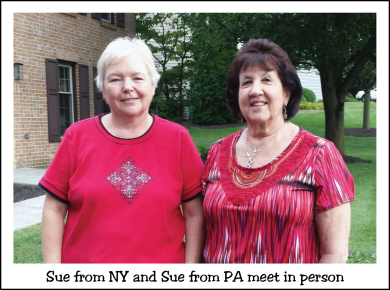
Sue and her husband decided to take a road trip last week. They started off in Maryland, then went to West Virginia, and on the final leg of their journey came to Harrisburg, Pennsylvania, where I live and spent a few days with my husband Marc and me. We had a great time meeting in person and being able to speak to each other face-to-face. Sue and I thought it would be interesting for me to have a conversation with her husband Steve as spouses of diabetics. She, in turn, had a conversation with my husband Marc. The following is a result of my conversation with Steve.

Sue from PA: What was your reaction when Sue was diagnosed as a diabetic?

SteveS_Head SquareSteve: I thought that since we had gotten through it with our son Steve, who was diagnosed as Type 1 at age 4, that hers wouldn’t be as bad because she was diagnosed as a Type 2. I was worried, but I knew I could handle it.

Steve: How was it when Marc was diagnosed for you, because you hadn’t been through it?

Sue from PA: Initially when Marc came home from the doctor and told me he had diabetes, I was pretty shocked. Then I started to educate myself about diabetes and I realized that I had a misconception of what it involved food-wise. I always thought that you couldn’t have sugar. I soon learned that sugar was the least of my worries. It was actually carbohydrates that were the real villains since they turn into sugar.

Sue from PA: What do you do to help Sue with her diabetes management?

Steve: I keep track of her monitoring, make sure that she is taking her medications, help her with her placement of her pods (OmniPod is the pump that she uses to deliver her insulin), help her when she is hypoglycemic and make sure she gets something to eat or drink to bring her blood sugar back to normal. At times I have taken her place in watching the grandchildren and have taken them places where she would have taken them normally, and at times I have driven her to the store when she has needed to get something and didn’t feel as though she could drive.

Steve: How long has Marc had his diabetes, and how have you taken care of him?

Sue from PA: Marc has had his diabetes for approximately 19 years. I am very fortunate in that he can do his everyday care by himself. He is totally responsible for his insulin pump and when he had a CGM he was totally responsible for changing his sensors. Basically, I manage his food by counting his carbs for each meal that I prepare. I am responsible for saving his life when he gets hypoglycemic, and I am constantly reminding him that he owes me big time since I’ve had to save him more times that I can count of my two hands. I have learned to give him the glucagon when he blacks out and I have leaned to recognize the symptoms when he starts to go low.

Steve: Sue has also told me that she doesn’t know what she would have done without me and how grateful she is that I have been able to help her through this.

SuePA_SteveNYSue from PA: Emotionally, what’s it been like to live as the spouse of a Type 1 diabetic?

Steve: At times it has been very stressful. At times I am truly emotional over it. Sometimes I have been scared but I made a commitment in my wedding vows, in sickness and in health to love her always and I would never leave her because of her health.

Steve: On that same topic, how has it been for you?

Sue from PA: (Heavy sigh). It’s been a challenge. I don’t think there is ever a day when I don’t worry about him. One of the biggest issues for us is the lack of his having a CGM due to being on Medicare and them not covering it. When my children became independent and were able to be out on their own at night, as most mothers do, I never truly fell into a deep sleep until they were home and the house was locked up. Now I never fall into a deep sleep even though my husband is right beside me. I am always aware that in the snap of a finger he can go into a hypoglycemic low, at which point I might have to jump out of bed, and I literally mean jump, to make sure to get juice or a soft drink into him to prevent him from going unconscious. During those times when it’s happening so fast that he does become unconscious, I need to give him the glucagon. Even though I’ve done it numerous times, my hands still shake and my heart beats almost out of my chest. I’m just always worried when I am not with him. I can understand how you feel, Steve, because I feel the same way. I will always honor my wedding vows. But you have to make light of it sometimes to be able to live with the situation. I can truly say that seeing someone you love having a hypoglycemic low is something you never forget. They are drenched in sweat, their eyes are unfocused and they have no idea of what is happening. It’s frightening.

Sue from PA: Steve, do you have anything else you want to add to this conversation?

Steve: In less than a year Sue will turn 65 and will go on Medicare. I hope and pray that when her insurance no longer covers her, Medicare will be there to cover her with her diabetic supplies and necessary devices that she needs, i.e. her CGM.

Sue from PA: Diabetes had been a true education for me. Because of Medicare’s lack of coverage of the CGM, I have become an advocate. I have done things I would have never thought I could do. I blog, I did a podcast, I wrote an article for my local newspaper, and recently I have become involved in S-2689, the Medicare CGM Access Act that was introduced into the Senate on July 30, 2014 by Senators Susan Collins (R-ME) and Jeanne Shaheen (D-NH). It addresses the growing concern that people with Type 1 diabetes who are over the age of 65 cannot obtain coverage for the critical and potentially life-saving Continuous Glucose Monitor (CGM) through Medicare, even if they used these technologies successfully prior to becoming Medicare eligible. A few weeks ago I sat in on a telephone conference with representatives from Dexcom, Medtronic, J & J and Animas and also a representative from the endocrinologists association, among others. I was one of just a few to be invited to sit in on this telephone conference.

Sue from PA: I thank Steve for having this conversation with me. Most of the people I come into contact with are the diabetics. I’ve not had much contact with the spouses and it’s good to be able to speak about what it’s like for us, the caretakers. I hope that we can have more conversations in the future.

In closing, I would like to ask everyone reading this who has not yet signed the JDRF Petition or clicked on the link that asks their Senators to support S-2689 to please do so. It’s so important to the many diabetics on Medicare who cannot get a CGM because it isn’t covered by Medicare. So many are on fixed incomes and can’t afford the cost of the CGM and the sensors.

Click here to email your U.S. Senators to urge them to co-sponsor legislation that would ensure Medicare covers CGM
Click here to sign a petition to urge Medicare to act now to cover CGM

*****

If you are interested in participating in the Conversations project, click here for information.

Conversations: Two Type 1 Diabetics Have a Chat

Conversations Banner_T1T1My husband Steve and I just returned from a car trip to Maryland and West Virginia to visit relatives. On the way home I had decided I wanted to meet Sue from Pennsylvania, my fellow frequent guest blogger on Laddie’s Test Guess and Go blog. Sue and I had initially met on the ADA Type 1 board a year and a half ago, and since then we have talked on the phone twice weekly and become good friends. I live in a town called Farmington in the Finger Lakes region of western New York, and Sue lives in Harrisburg, the capital of Pennsylvania. While we were there Sue and her husband Marc took Steve and me to Hershey, where we took the Great American Chocolate Tour. A wonderful outing for diabetics, don’t you think? LOL

Sue and I came up with the idea of interviewing each other’s spouses while we were there, so we could each get the perspective of a fellow diabetic and supportive spouse. The following is a discussion between me and Marc, two Type 1 diabetics. As you will note, we have similar stories.

Sue: Marc, how did it come about that you were diagnosed as a diabetic?

MarcB_Head SquareMarc: I was diagnosed at age 49. I started losing weight very slowly but continuously. One day I realized my pants size dropped from a 38” waist to a 34” waist. Then a 32” fit well. As this was happening, friends were taking notice that I had lost a lot of weight. These same friends were asking me if I felt okay. My answer was that I felt fine. What really got my attention was a trip from Harrisburg to Atlanta. One day in the middle of our stay in Atlanta, I noticed that I was going to the bathroom approximately 4 or 5 times each hour. On the trip home (872 miles), I had to pull over at every single rest stop to go to the bathroom. I thought that I might have a urinary tract infection. I went to my doctor, where he pulled some blood and informed me that I had Type 2 diabetes.

Marc: Sue, how were you diagnosed?

Sue: In 1988 I lost several pounds over the summer with no effort. I also made frequent bathroom trips and was very thirsty, but I attributed it to the hot summer weather, and besides I was thrilled with my new dress size. In the fall I went for a pre-op blood test at the hospital. My doctor’s office called me the next day and told me that my blood sugar was 480. I replied that I knew what that meant, because my 17 year old son had been diagnosed as Type 1 at the age of 4. When I went to the doctor’s office, I was told that I was a Type 2 diabetic. I accepted this diagnosis because my mother was a Type 2 diabetic. My doctor gradually put me on various Type 2 diabetes pills and increased the dosages in an effort to improve my blood sugar, but it was never where it should have been. Eventually insulin was added to the mix, and I quickly regained the weight that I had lost. In 2000 my PCP referred me to an endocrinologist at the Joslin Center in Syracuse, NY. There I was told that like my son, I was a Type 1 diabetic.

Sue: How were you initially treated for your diabetes?

Marc: Initially I went to my family doctor and he put me on Metformin and instructed me to test my blood at least once a day. For the first year to year and a half, the Metformin seemed to work. I slowly gained back weight but at the same time, my diabetic numbers were escalating upwards. That is when the doctor recommended that I see an endocrinologist. When meeting with the endocrinologist he said to me, “You’re not going to like this. You need to be put on insulin as of today. Your family doctor did not do you any favors.”

SueNY_MarcPAMarc: How has your life changed since being diagnosed as a Type 1 diabetic?

Sue: As I transitioned from being a caretaker of a Type 1 to a Type 1 myself, I became more conscious and sympathetic of what my son goes through every day in trying to manage his diabetes. I used to think that if he did the right thing, his diabetes would be well controlled. I came to realize that there are very many variables to diabetes that we don’t understand such as how dietary fat delays the blood sugar in rising, and stress, a simple cut or a common cold could affect the direction blood glucose numbers go.

Sue: How has your life changed?

Marc: Luckily my wife is more energetic about things that I do, things that I eat, the amount of carbs I eat, etc. then I am.   I have to be more careful about what I eat. I am a person who likes pizza, ice cream, donuts, steak sandwiches, etc. Now because of diabetes, I have to think twice. My overall control of my A1C is not as good as I would like it to be (lack of CGM). When I had a functioning CGM my A1C was as low as a 6.9 and without it I’m up at 7.9. Of course my doctor wants me back at 7 or less.

Sue: Marc, please share why you don’t now have a functioning CGM.

Marc: I did have one. It was always covered by the insurance that was provided to me by my employer. When I turned 65 and entered Medicare, my existing CGM was in need of replacement. Medicare denied coverage and I am now at Level 4 in the appeals process, trying to get Medicare to cover this needed device.

Sue: How has your life changed without the use of your CGM?

Marc: I have been told by my present endocrinologist that I am a brittle diabetic and I have been suffering from hypoglycemia unawareness (the inability to detect when my blood sugar drops to a dangerous level making it possible for me to become disoriented, combative or in the most severe circumstance, blacking out). Basically, it affects every facet of my life.

Marc: Sue, I find it interesting that you are using an OmniPod pump. I use a Deltec Cozmo which I realize is an older pump. How would you rate your OmniPod?

Sue: Excellent question Marc. The OmniPod is my first and only pump since December, 2007. Like many people, I did not like the idea of having a device attached to me. I finally came to realize after reading discussions on the ADA Type 1 board that the pump was the way to go. I chose the OmniPod over the tubed pumps because I thought it would be more user friendly. I love it and have never looked back. My son has been on the MiniMed pump since January, 2008 and he loves his pump. Different strokes for different folks.

Thanks to Marc for joining the conversation at Test Guess and Go. Please join us tomorrow when Sue from Pennsylvania and my husband Steve have an honest and insightful conversation in which they compare their experiences as the spouse of someone with Type 1 diabetes. I hope you will read it.

*****

If you are interested in participating in the Conversations project, click here for information.

Upcoming Conversations

Conversations Banner_All

Laddie_Head SquareI am excited to preview two posts to be published this week at Test Guess and Go as part of the Conversations series.  These two blogposts are exactly what Kate Cornell and I envisioned as we wrapped up our Type 1/Type 2 Conversations and invited others to join the project.

Those of you who follow my blog have noticed that my co-bloggers, Sue from NY and Sue from PA, have been on vacation in recent months.  Sue from NY has taken several long trips and had some great family time with children and grandchildren.  Despite being busy, she has not been cured of diabetes and therefore has not permanently abandoned us.  Sue from PA had a bad fall in June that resulted in a severe shoulder injury.  Hampered by pain and the awkwardness of one-handed typing, she needed time away from the computer and her blogging suffered as a result. She did keep busy behind the scenes with her advocacy work for Medicare coverage of CGMS.

But they’re back!

Last week on the way home from a family trip, Sue from NY and her husband Steve stopped in Harrisburg, PA to spend a few days with Sue from PA and her husband Marc.  SueNY_SuePAIt was the first in-person meeting for the two Sue’s.  Inspired by the Conversations project, they decided to rope this husbands into discussing diabetes.  They didn’t interview their own spouses; they talked with the other Sue’s spouse.  The result is two very interesting conversations.  The first will be published tomorrow and highlights Sue from NY who has Type 1 diabetes along with Type 1 Marc from PA.  Their stories are remarkably similar as both were initially misdiagnosed as Type 2 because of their age.

The second conversation to be published on Thursday is between the spouses, neither of whom has diabetes.  Sue from PA and Steve from NY have a frank discussion about what it is like to be the spouse of someone with Type 1 diabetes.  Although never wavering in support of their spouses, both talk about the fears and emotional toll of being the life partner of someone with Type 1.

Please come back tomorrow to read Conversations: Two Type 1 Diabetics Have a Chat and on Thursday for Conversations: Two Spouses of Type 1 Diabetics.

Join the Conversation

Conversations Banner_All

Laddie_Head SquareI really enjoyed my Type 1/Type 2 Conversations with Kate Cornell of Sweet Success: My Life with Type 2 Diabetes.  Our first foray into collaborative blogposts was a four-part series.  We had ideas for about ten posts, so I don’t think that this is the end of Kate/Laddie conversations.  But for now we’ve retreated into our respective corners with a greater understanding of what the “other type” of diabetes thinks and experiences.

When Kate and I started our project, one of our goals was to inspire others in the Diabetes Online Community (DOC) to initiate similar conversations.  Real communication is often lacking in our 21st Century world and the DOC has not been exempt from conflict and misunderstandings.  Fortunately many bloggers have become increasingly vocal about working to unite as one community regardless of medical history or type of diabetes.  (A good example of this is Kerri’s post titled Learning from My Peers.)  Together we can make progress; individually we spin our wheels.  We don’t need to agree on everything and we certainly aren’t the same.  But we can talk to each other.  We can respect each other and we can learn from each other.  We can build bridges to make the DOC a stronger community.

Kate and I hope that others in the DOC will jump on the communication bandwagon and initiate some conversations.  Type 1/Type 2 discussions are great, but don’t be limited by that combo.  How about a LADA talking to Type 1 diagnosed as a child?  How about a Type 2/Parent of a Type 1 dialog?  How about a pregnant Type 1 talking to a young T1 mother?  How about a conversation with your spouse or child?  Maybe a cat-lover and dog-owner (or would that generate too many fireworks?)  The possibilities are endless.

If you would like to participate in the Conversations project, please check out the Conversations page at Test Guess and Go.  You’ll find a few hints on how to proceed and information about obtaining the Conversations banner and graphic if you’d like to use them.  (I can easily customize the graphics to fit whatever your conversation is, so be sure to let me know what you need.)

What are the rules?

  1. Be respectful.
  2. Have fun and be creative.  If you don’t want to write a long post, consider using Storify with Tweets and/or Instagram photos.  Write limericks back and forth.  Publish email conversations.  Write comic strips.  Create vlogs.
  3. Feel free to tackle controversial subjects but don’t avoid fluff pieces that will make us smile.
  4. Choose a partner.  A familiar online friend, a new Twitter follower, a big-name blogger, a new blogger, an acquaintance from a TuDiabetes message board.  Don’t be shy and send an invitation.  The collaboration is just as important as the finished product.
  5. Don’t forget #1.  Be respectful.

If you need help or ideas, please contact me or Kate through the contact form on her homepage.  Once you’re published, send me your link and I will add it to the list of blogposts on the Conversations page.

Please help the project grow.  All you have to do is join the conversation!

*****

If you missed any of our Kate’s and my conversations, you can find them here:

Type 1/Type 2 Conversations: Talking about Weight

Type 1/Type 2 Conversations: Diabetes in the Great Outdoors

Type 1/Type 2 Conversations: Friends and Family

Type 1/Type 2 Conversations: Food, Glorious Food

*****

Type 1/Type 2 Conversations: Food, Glorious Food

Conversations Banner

Kate_photo_RKate:  I love food, who doesn’t?  Unfortunately, I love bread way more than I love broccoli; pizza more than salad.  I will admit that my diet wasn’t very healthy through most of my adult years.  I tried, now and then, to “do better” but eventually drifted back to my usual fare.  After my diagnosis of T2 I was faced with the need to make some significant changes to what I ate.  It hasn’t been easy.

People with T2 may take oral meds, injectables and sometimes, insulin.  They may control their diabetes with diet and exercise, for a while.  The one thing that we all have to deal with is figuring out what we can eat and still control our diabetes.  Here’s where it gets really frustrating.  I have never been to a nutritionist or dietician for assistance with my meal planning.  I know that there are many, many T2s who can say the same thing.  I taught myself what to eat (and not eat).  I also know some T2s who have seen a professional to learn what/how to eat and have been amazed at some of the recommendations they’ve received.  If you participate in any online forums or FB groups, the myriad of recommendations you can receive for what you can eat is mind boggling!  “You can’t eat that.” “You should definitely eat this.” “low carb” “low fat” “lots of fat” “whole grains” “no grains” “Okra water” “cinnamon” “vinegar” “whole cows” “no meat” “bacon wrapped everything” “sugar free” “never consume sweeteners” The list goes on and on and on.  Can you blame people for being confused and frustrated?  The fact that mainstream diabetes organizations continue to push lots of carbs has always amazed me.  I am encouraged by this recent study that says that it’s better to lower carb consumption for people with diabetes.  Ya think?  I don’t push any specific way of eating for people with diabetes, that’s your choice, but I have learned that I simply cannot eat bread (even whole wheat), pasta, potatoes (even sweet), cereal (even oatmeal), crackers…so many things.  And yet, when I read “diabetes friendly” recipes online they nearly always contain these ingredients.  Heck, even “healthier” cookie recipes contain flour and sugar to a degree that makes them off limits to me.

I could go on forever on this topic.  I could write a book!  The point I’d like to make is that people with T2 simply must make drastic changes to what they eat in order to maintain good blood glucose in the long run and yet they aren’t encouraged to do that.  Yes, stopping fast food and making your own burgers at home is better but shunning the bun is better yet.  Don’t get your panties in a twist and tell me “but we can eat anything in moderation!”  Maybe you can, for a while.  I used to be able to do that too, but now I can’t.  Without insulin to lower a high glucose reading, I have to deny myself certain foods unless I’m willing to deal with the consequences.  That doesn’t mean that I’m eating cardboard.  I eat a wide variety of delicious foods; foods that take preparation and planning.  In this one area I feel that T1s have an easier time of it.  Yes, you can eat anything you want because you can bolus your insulin for the carb consumption.  I know that isn’t easy, but it’s possible.  SO jealous here.  So Laddie, what’s your take on food and how it fits into your diabetes treatment?

Laddie_Head SquareLaddie:  Last September I wrote a blogpost titled “Food” and this is one of my favorite paragraphs from that post:

Like almost everyone with Type 1 diabetes, I’ve spent my life trying to find the magical balance between food as nutrition, food as pleasure, food as a social hub, food as a deterrent to low blood sugars, and food as an emotionally-charged addiction.  Diets are prescribed like medicine with the assumption that if you play by the rules, things will work perfectly.  Anyone who has had Type 1 for more than five minutes knows that food, blood sugar, weight control, and insulin rarely play nice together and it’s hard to keep guilt out of the equation.

Reviewing that paragraph, I could easily change all of the “Type 1” references to “Type 2” and everything I wrote would still be true (except maybe the insulin reference).  Diets are handed out to people with diabetes with the implied guarantee that they are the ticket to success.  Follow the plan and you will have good blood sugars, weight loss, no diabetic complications, and so on.  Unfortunately diets are hard to follow and with diabetes, what you eat is only one piece of the blood sugar puzzle.

When I was diagnosed in 1976, I was given an Exchange diet with a prescribed number of bread, vegetable, fruit, protein, fat, and dairy portions for each meal and snack.  Because of the limitations of my once-a-day insulin shot, that diet really meant:  “Eat all of the time and hope to avoid passing out from a low at 4:30 every afternoon.”

Over the next 25 years, newer insulins led to more flexibility in the our diets and all of a sudden with carb counting, we could eat like a “normal” person.  We were told that “a carb is a carb” and birthday cake was allowed as long as it fit into our nutrition plan.  The  “heart-healthy” diet mandated that fats were bad and carbs were good.  More bread.  More pasta.  The fact of the matter is that as someone with Type 1 diabetes, I can’t match the digestion of carb-laden foods with the peaks and duration of my insulin.  I go high; I go low.  I eat carbs; I want more carbs.  I feel guilty because my numbers aren’t good and I’m exhausted from rapidly changing blood sugars.  That’s the glucocoaster life.

Some people, myself included, are looking for ways to get off the glucocoaster and these days you see many options for healthy eating with diabetes.  At one extreme is Dr. Bernstein’s Diabetes Solution: A Complete Guide to Achieving Normal Blood Sugars with the recommendation of a diet high in fat/protein with a carb limit of 30 grams per day.  At the other extreme are athletes who eat thousands of calories and 400-600 grams of carbs per day.  In the middle are people doing their best to follow diets prescribed by their medical professionals with varying carb targets and varying degrees of success.  There are people with diabetes following the Paleo diet, others eating gluten-free, and some paying no attention at all.  We’re all searching and realizing that there is no easy or perfect diet.

I personally believe in Bernstein and have dramatically reduced my carb consumption in the last 10 years.  Unfortunately as I write that, I am having a vision of chocolate-covered donuts (a constant theme in my blog).  My current BG is 83 (Bernstein nirvana!).  But it is the result of multiple boluses after afternoon highs in the 200’s from eating a bowl of cherries.  Okay, it was two bowls….  I pre-bolused an appropriate amount of insulin and still spiked.  I followed the rules, got a bad result, and ended up feeling guilty.  I sometimes wonder if eating a mostly low-carb diet has made me more sensitive to carbs when I do eat them.

Kate is envious of those of us with Type 1 who are able to use insulin to incorporate more carbs into our lives.  I can’t imagine seeing a high blood sugar and not having a tool to bring it down.  At the same time insulin is not a fix-it-all and introduces the fear of severe lows without always eliminating outrageous highs.  Insulin or not, eating with diabetes is hard.

Food Glorious Food_Nutella

Kate_photo_RKate:  We are so similar!  Your comment about donuts really hits home.  I know what I should eat and often feel very satisfied with lower carb meals, and yet the call to eat the carbier foods is never far away.  Sigh.  It’s also interesting what you said about possibly being more sensitive to carbs now that you’ve lowered your carb intake.  I feel the same way.  Two summers ago I tried an extremely low carb diet for a month and had great success.  Once I tried to slowly add some carbs back into my diet (like a bit of bread or cereal) my blood glucose went through the roof!

One of my frustrations has been my HCP’s reluctance to let me try insulin.  My A1c is quite good, even though my fasting numbers are in the 130s at best.  I am better controlled than most of her patients and so my concerns over higher numbers are dismissed.  I’m told to “lighten up” and eat a more “normal” diet but I’m commended for my better numbers which wouldn’t exist if I ate more normally.  I will admit to having dealt with burnout recently mostly because I can’t just eat whatever I want.  I’m tired of constantly thinking about food.  Like you Laddie, it’s a daily challenge.  I’ve actually “lightened up” a bit and have been allowing myself to eat things I normally wouldn’t eat and doing it (mostly) without guilt.  I feel better mentally but my numbers aren’t so great.  How do we find the balance we need between eating a healthy diet most of the time, allowing for splurges now and then and keeping the amount of medications we need to take at a minimum?  I could eat whatever I want, ruin my good numbers and be allowed to add insulin to cover my carbs.  Is that the right thing to do?  I don’t think so.

I’ve been told by a D parent online that it would be nice if their child “only had to stop drinking soda”.  I hope that this conversation shows that living with T2 isn’t that simple.

Laddie_Head SquareLaddie:  Kate is right when she indicates that the best diet for someone with diabetes is often a compromise between nutrition/physical health versus emotional health/guilt-free living.  Does that mean that we have to eat junk food to be mentally healthy?  I hope not, but most of us enjoy sweets and carb-laden foods because they are delicious and probably addictive.  Food is the centerpiece of many social functions and we want to be part of the crowd.

My mental health is the best when I follow my lower-carb diet and enjoy mostly in-range blood sugars.  For whatever reason, the rewards of that lifestyle aren’t sufficient to keep me on the straight and narrow for long.  So I try to accept deviations from my “ideal” diet to avoid a life mired in guilt.  At the same time I find that every time I return to a lower-carb diet, I seem to be able to stay on it longer than the last time.

Food is delicious.  Food is fuel.  Food is fraught with temptation.  We’re bombarded with mixed messages from medical professionals and popular media about what constitutes a healthy diet.  I wish that I had great words of wisdom for everyone with diabetes.  I don’t.  My only advice is to keep learning, be open-minded, and do your best.  And try again tomorrow.

Kate_photo_RKate: It’s obvious from this conversation that food is big in the lives of people with diabetes, despite their type.  It is a struggle for most, one that will never be easy I’m afraid.  But hey, food isn’t easy even when you don’t have diabetes.

This is the last conversation in our series.  I hope you’ve enjoyed them and that they have opened your eyes or prompted conversations between you and others.  Next week we will be publishing a “wrap-up” post inviting you to start your own conversations.  We’ll give you some suggestions and Laddie has generously offered to share the graphics that she has created.  (Aren’t they great?)  Thank you for joining us in our effort to knock down some of the barriers between types.

*****

If you missed the first three posts, you can find them here:

Type 1/Type 2 Conversations: Talking about Weight

Type 1/Type 2 Conversations: Diabetes in the Great Outdoors

Type 1/Type 2 Conversations: Friends and Family

*****

This post was originally published on July 29, 2014 on Kate’s blog, Sweet Success: My Life with Type 2 Diabetes.