The Vibe After Two Months:  Part 1 – Report Card

Laddie_Head SquareI have been using the Animas Vibe for two months. I believe that the decision to upgrade from my two-year old Ping was a good one and I am content that this will be my pump until the warranty expires in November 2016. The basis of this satisfaction surprises me because the reasons I like the pump have little to do with why I thought I wanted it.

I am writing a 3-part series about my experience. Today will be an overall report card for the Vibe, primarily discussing whether it makes the grade as a pump/CGM system. Part 2 will be an evaluation of how the Vibe performs as a CGM receiver. Part 3 will be an evaluation of the Vibe as a stand-alone pump.

*

In November 2012 I made the decision to purchase the Animas Ping because it was in line to be the first pump integrated with a Dexcom CGM. Despite poor results with the Medtronic SofSensors, I had really liked the integration of CGM data into my Revel pump. After using a Medtronic pump along with a Dexcom CGM for several years, I strongly believed that I wanted a single device merging my insulin pump and CGM.

When the Vibe was finally released in January 2015, I began to question the wisdom of following through with the upgrade. I was concerned that the CGM software was already out-of-date, that future Dexcom transmitters would lack compatibility with the Vibe, and that I might have insurance problems getting a new CGM system because the Vibe functions as a CGM receiver. After meeting with an Animas Rep in early February, I made the decision to follow through with the upgrade. You can read about that decision and my early impressions of the pump here.

After two months, I am happy with the Vibe as a pump, but I am back to using the Dexcom receiver full-time. In my opinion, the Vibe gets a poor grade as a SYSTEM in real time and earns a good grade in reviewal made. To clarify, the integration of the CGM into what is essentially an Animas Ping pump is clumsy and occasionally nonsensical when it comes to the decisions/actions that I make with my pump and CGM on a daily basis. It is difficult to move from the CGM functions of the device to the insulin pump functions. Unlike the Medtronic “system”, there is no meter that sends BG numbers automatically to the pump. At the same time because I can download the Vibe to Diasend along with my BG meters, Dexcom receiver, and now even my Fitbit (!), I have a great platform for merging and reviewing my diabetes and health data.

In a January review of the Vibe, Mike Hoskins of Diabetes Mine mentioned that his Animas trainer talked about the Vibe “in terms of a dwelling — the two components used to be separate housing units, but now they co-exist under the same roof and are more like different rooms within one big home.” That is a great image, but I take it even further to say that the Vibe is a duplex with the pump in one unit and the CGM in the other. They are adjacent to each other, but they have separate entrances and there are no adjoining doors. To get from one device to the other, you must go outside and walk down the sidewalk to the other side of the building. Rather than adding value to each other, I find that the CGM part of the Vibe makes the pump functions more cumbersome than they are when the CGM is disabled.

Duplex Vibe

The only time that the Vibe works well as a system is when all of my devices have been downloaded to Diasend. In reviewal mode, it is a success because I can see reports merging  pump and meter data with my CGM. Unfortunately it is time-consuming to download everything (especially the Vibe) to Diasend, so it is unlikely that I will do this frequently. I am starting to get a little cyborg excitement envisioning an Apple watch showing real-time Dex tracings, Fitbit steps, and insulin pump data. A brave new world for sure and definitely not what the Vibe delivers.

In the next post in this series, I will write about how the Vibe functions as a CGM device and talk about what I consider some of the shortcomings of the Dexcom integration. Part 3 of the series will highlight my views on the Vibe as a stand-alone pump.

As a hint of what is to come, I like the Vibe as a pump. At the same time, I have become comfortable with the idea that longterm my CGM data is going to end up on my phone, Apple/Pebble watch, or some other device. Unless the CGM integration improves the function of the pump and does more than be a poor replacement for a Dex receiver in my pocket, a pump/CGM combo doesn’t seem to add much value to my diabetes life.
My Vibe Decision

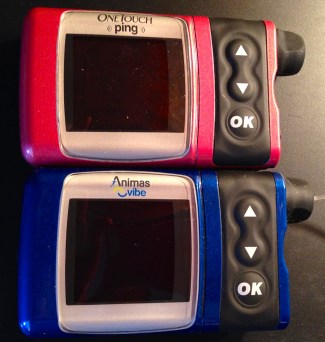
Laddie_Head SquareA photo is worth a thousand words and the photo below shares that I decided to upgrade to the Vibe.

After I published  “The Vibe: Should I Upgrade?” on Feb. 5, a lot of things happened in the next 24 hours. As I mentioned in the blogpost, I was scheduled to meet with an Animas rep that afternoon to see the pump live.

The Animas rep was very nice and professional as she showed me the Vibe and allowed IMG_1118me to push buttons. I was immediately surprised that I did not dislike the pump and thought I could live with the CGM graphs on the small screen. Although I am still convinced that the design of all/almost all insulin pumps leaves a lot to be desired, I left the meeting with an incredible result: I didn’t hate the Vibe. I liked it enough that I decided on the spot that I would upgrade.
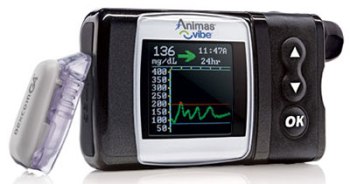
Amazingly, the next morning someone from Animas called to confirm my color selection for the Vibe (Blue!) and to indicate that she was ready to process the order. The pump was scheduled to be delivered on the next Thursday. At this point things became complicated as she called back to say that there was a problem with the credit card on file. After she couldn’t get three different credit cards to work, I started to wonder if I was on the Animas Sh*t List because of numerous negative comments about the Ping and Vibe on my blog.

The problem was finally resolved on Tuesday and despite the delay, I was promised a Thursday delivery. In fact Thursday morning at 9:00AM my Animas contact promised that the pump would be delivered that day. I didn’t believe her because UPS hadn’t even activated the tracking number yet. Of course the pump was not delivered on Thursday and I was frustrated because of the many things I had cancelled to stay home. At the same time the day was not a total waste because I cleaned most of the house and finished a couple of chores I had been avoiding. Finally UPS activated the tracking number and showed a Friday delivery.

I have now been using the Vibe for 4 days. Do I love it? No. Do I think the upgrade was the right decision? Yes, for several reasons.

  1. I was content with the Dexcom G4 and wasn’t convinced that I was having better results with the recent software upgrade. Therefore I have decided not to stress over the lack of the G4AP (Artificial Pancreas algorithm) software update in the Vibe.
  2. I am very happy to have less one medical device in my pockets.
  3. I have a history of losing my Dexcom receiver in bed at night. Now all I have to do is find the pump tubing and reel in the CGM like a 5-pound walleye.
  4. There are some improvements in the menu system, although not as many as I think are needed.
  5. This decision is only binding for 21 months and then I will select my last pump before Medicare. My choice now was to stay with the Ping or upgrade to the Vibe. The Snap, the t:slim, the Medtronic 530G, and other pumps were not part of the decision. It was Ping vs. Vibe and nothing else.
  6. Because I got the pump directly from Animas, I am going to optimistically assume that there will be no insurance ramifications when it is time to get a new Dexcom receiver. Maybe I will be so happy with the Vibe that I won’t even bother with another receiver.

Right now I am stumbling through the Vibe menus primarily because I was so adept at the Ping. One important feature of the Vibe is the ability to populate the recommended bolus by pressing the Up arrow. Unfortunately I am still Pinging and start to scroll before I remember to simply press the Up button. I will adjust and I – just – need – to – slow – down.

My biggest frustration is how many button pushes it takes to get from the CGM screens to the bolus menu. It is five/six button pushes to move from the CGM screen to the Bolus ezCarb/ezBG menu. The lack of an Esc or Back button on Animas pumps is a major design flaw IMO. In his review of the Vibe, Mike Hoskins of Diabetes Mine talked about the pump and the CGM living in the same house but being different rooms:

You can think of this system in terms of a dwelling — the two components used to be separate housing units, but now they co-exist under the same roof and are more like different rooms within one big home.

That’s my biggest takeaway. I have a pump. I have a CGM. They are in the same piece of hardware, but they are totally separate. In fact it seems that Animas forgot to even build a door between the two rooms.

With the Vibe I am finding that I am using the CGM in “static mode.” I push the button to see the CGM Data Screen showing my BG number, the trend arrow, and the insulin on board (IOB). Because it takes so long to change screens to the 1-hour, 3-hour, and other CGM trend screens, I usually don’t bother. I like the 3-hour screen and wish that I could just push the Up button twice to get there. But no, I have to wait for the 1-hour graph to load before I can push the button again to move to the 3-hour screen.

When I began using the Vibe, I made the decision to go all-in and not continue to use my Dexcom receiver. I can always go back to using the Dex receiver at any time and be no worse off than before the upgrade, but I hope to ultimately be happy using one integrated device. So far I believe that the pump functions of the Vibe are an improvement over the Ping, but for me the CGM part is a definite downgrade from the Dex receiver. Chances are that I will get used to it and be fine.

In my previous Vibe blogpost I provided links to other reviews of the Vibe. Since then I have read a couple others that you might be interested in.

Active Diabetic is a young Canadian who is an incredible athlete. His bio minimizes his achievements:  “I’m a cyclist, runner, climber, backpacker and oh yeah, I’m an insulin dependent diabetic too!” I “met” him last year during Diabetes Blog Week and was very inspired by his accomplishments and attitude. In May he published a blogpost that indicated that he would use the Dex receiver rather than deal with the Vibe for his CGM. But 10 days ago he wrote a follow-up post and shared that he is totally on board with the Vibe. Both posts are well-written and super informative, so check them out.

Kerri of Six Until Me wrote a post last week sharing her thoughts on the Vibe after using it for a couple of weeks. As always, you’ll find some helpful information.

Tarra who uses a Dexcom in tandem with Duchess, her diabetes alert dog, is mostly happy with her Vibe. Check out her post from yesterday.

Sara of Moments of Wonderful has just started the Vibe and today posted a video highlighting a few of the Vibe features.

I’m okay with my Vibe but not in love. It is definitely a #firstworldproblem that I can complain about a pump/CGM combo. As life goes, it’s pretty insignificant that the color screens are slow and I have to wait a few seconds for the graphs to populate. But children dying because they lack access to insulin. That’s important. If you haven’t donated to Spare a Rose, Save a Child, it is not too late. Click here and donate. No donation is too small and every gift makes a difference.

The Vibe: Should I Upgrade?

Laddie_Head SquareAfter eight years of using Medtronic pumps, I switched to the Animas Ping in 2012 to be eligible for the $99 upgrade to the highly anticipated Animas Vibe. I am totally committed to Dexcom and the Vibe was in line to be the first pump released in the US with Dexcom integration. Two-plus years later the Vibe has finally been approved by the FDA and is actively shipping.

I ordered my upgrade before noon on the first day that Animas accepted orders. Many people are getting delivery of their pumps, but I haven’t heard a peep. Did everyone order before me or is it because my Ping was supplied through Edgepark rather than directly from Animas? I have no idea how Animas is determining shipping order, but I hope that I have not been lost in their system. “Call Animas” is on my To Do list.

Last week I picked up the phone to contact Animas and then stopped. Do I really want the Vibe?

The Vibe (as will the t:slim/Dex integrated pump) is based on the Dexcom G4. The recent G4AP (Artificial Pancreas algorithm) software update will not be included nor will any future improvements in the Dexcom platform.

Unfortunately when a pump/CGM combo is approved by the FDA, the device is “frozen” in time with the hardware configuration as approved. I don’t know how software updates are handled by the FDA, but one source told me that the Vibe as configured will not allow software changes. Now that Dexcom has multiple hardware and software upgrades in the pipeline, a 4-year (or for me a 2-year) commitment to an older version of the Dex might be a bad decision. In the short run I can keep using my Dex receiver to access the new software. The just-released Share receiver will also be an option because it is compatible with the current generation of transmitters.

Now a word on the “current generation of transmitters.” Vibe purchasers new to CGM are being sent the high-profile Dex transmitters that were replaced by smaller transmitters a few months ago. I assume that the Vibe was submitted to the FDA with the old transmitter and wonder if it will take another FDA submission to change that. Fortunately the only difference between the transmitters is size although I personally can’t wait to get the small transmitter when my warranty expires in February. The new transmitter is compatible with the Vibe.

Dexcom is already talking about the next generation G5 transmitter that will have the ability to communicate directly with cell phones without the use of a receiver. The G5 mobile system transmitter will not be compatible with the Vibe.

pump_animas_vibeMy Animas warranty expires in December 2016 and I should probably just get the Vibe. The fact that it will populate the recommended bolus rather than scrolling up from zero is a huge improvement. Because I will pay the upgrade fee out-of-pocket, technically my insurance company shouldn’t know that I have the Vibe and then potentially refuse reimbursement for a Dexcom receiver when that warranty expires in August.
Unfortunately it seems that nothing is private when it comes to medical things. My doctor has to write orders for the Vibe and I wonder if Edgepark will be the shipper rather than Animas. Somehow I believe my insurance company will end up knowing about the switch. Maybe I am just being paranoid. Everyone else has been assuming that they will have no problems continuing to use the Dex receiver if that is their choice. But I think that many of us will see the day when insurance companies refuse to cover the cost of CGM receivers because we have pumps functioning as receivers.

I have not yet read one review of the Vibe that is overwhelmingly positive and I know of one person who has already returned it. Kerri Sparling’s preliminary review was the closest to being positive because she didn’t address any of the negatives. She promised a more complete review later and I will be interested to see what she writes. She is upfront about her sponsorship relationship with Animas and you can trust her when she says that her opinions are not for sale. Another Ping user, Sara at Moments of Wonderful also wrote about looking forward to receiving her Vibe. In my opinion anyone who has been using the Ping (except for fans of the Ping meter/remote) will most likely see the Vibe in a more positive light than users of other pumps. There is a definite learning curve to adjusting to the idiosyncrasies of Animas pumps.

Most non-Ping reviewers of the Vibe have been highly critical of the poor menu system, the low resolution color screen, the lag time of button pushes, and other negatives. I believe that Johnson & Johnson missed the boat by not starting from scratch when designing this pump. IMO Mike Hoskins of Diabetes Mine summed it up best:

my honest final verdict is this: the Vibe feels like an outdated, counter-intuitive medical device that seems like it would have been more relevant if released several years ago as promised. Today, it doesn’t feel innovative, but rather like a device that’s filling a market need for choice only because it promised that a long time ago, and it’s “better late than never.”

When I purchased the Ping, I underestimated how much I would hate the menu system and how long I would regret the decision. Because I have no option to change pumps until 2016, my feelings about the Ping are inconsequential as I make my upgrade decision. Frankly two years after the purchase, I have to admit that I have become a whiz at moving through the menus; the scrolling and button pushes have become second nature and I rarely think about them anymore. But it took a long time. The Ping has been a workhorse for me with no technical problems in two years. (I had my pump replaced once due to cracking of the battery compartment, but it was a quick process with good customer service.) Another important feature of the Ping is the waterproof guarantee. With the Vibe I like the idea of having a waterproof CGM receiver.

So what am I going to do? Today I am meeting with an Animas rep to get a hands-on look at the Vibe. Some early reviews have criticized how many button pushes it takes to access the CGM info and how slow the pump moves from screen to screen. The display is small and a different shape than the Dexcom receiver. If I upgrade, will I even use the CGM part of the pump except on an occasional basis? Is it worth $99 to populate the bolus recommendation with the push of one button? Will I be able to see the Vibe CGM in the sunlight because I find it impossible to see my Ping screen when hiking? (The Dexcom is bad in the sun; the Ping is worse.) Is there a risk that when my Dexcom receiver goes out of warranty that my insurance will not approve a new one because the Vibe functions as a receiver?

Had Animas contacted me about shipping the Vibe a few weeks ago, I would have jumped on board immediately. Now I am not so sure.

I’ll keep you updated on what I decide. I wish that I felt excited about getting the Vibe and maybe I will be once I make the decision. At some point I need to contact Animas. Or maybe they will get in touch with me….

If you’d like to read recent reviews of the Vibe, here are some to check out:

Kerri Sparling at Six Until Me

Melissa Lee at A Sweet Life

Adam Brown at Diatribe

Mike Hoskins at Diabetes Mine

Manny Hernandez at Ask Manny

Sara Nicastro at Moments of Wonderful

The Lantus Experiment Part 1

Laddie_Head SquareIn a recent blogpost I wrote about my plans to experiment with using Lantus along with my pump. Although unusual, this is not a novel idea and is described by Dr. Steve Edelman in a 2004 article as the untethered regimen.

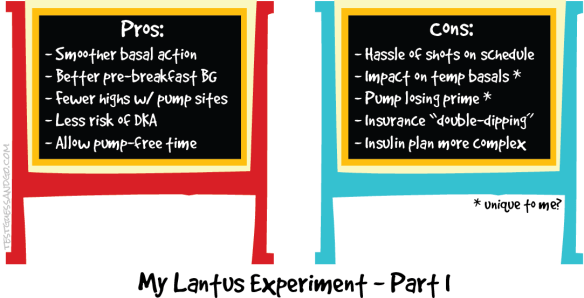
Starting in late November I used Lantus in tandem with my pump for two weeks. Although there were measurable benefits to injecting part of my basal, there were some definite negatives that were specific to my insulin requirements and the type of pump that I use. There were also a few things such as ease of use and expense that demanded consideration.

I started the trial by giving about 75% of my total basal split between two injections of Lantus: one at 7:00AM and the other at 8:30PM. There was nothing scientific about that except those were convenient times and I wanted any Lantus overlap to be first thing in the morning which is a problematic time for me. The balance of my basal was programmed into my pump with a little less through the night and a little more in the morning and evenings.

Let’s start with the positives. For the first couple of days I felt that my blood sugar between meals and overnight was more stable than it had been in ages. The most noticeable effect was in the mornings before breakfast. I often struggle with my BG starting to rise the second I get out of bed. It is not an easy basal fix because I tend to go low in the dawn hours before getting up. Sometimes I take a bolus right after getting up and that helps. But sometimes that bolus makes me go low. And other times I have already started to go high and struggle to get back on track even with boatloads of insulin. With the slight overlap of Lantus at this time, my BG remained stable almost every day until I chose to eat. It was a wonderful result.

The addition of Lantus also minimized BG rises after changing infusion sets. Set changes tend to be a problem for me even though I’ve tried lots of the tricks of the trade to avoid that: extra prime, never change sets in the morning, leave old site in, put new site in a few hours before using, and increase basal rates for several hours. I have never found anything that works every time. Of course nothing works every time with diabetes….

Now for some negatives.

At this stage in my life my basal rates are extremely low. After taking 75% of my basal by injection, I was left with only an average of 0.1 units per hour to be delivered by pump. The total of Lantus and Novolog ended up being a slight basal increase for me and maybe that is the reason I felt as though my BG levels were more stable.

The first problem I had with the untethered regimen was with temporary basal rates which I use on a regular basis. Unlike my previous Medtronic pumps where you can set temp basals either to a specific amount or by a percentage change, the Animas Ping only allows percentage adjustments. With a 0.1 hourly rate, it was difficult to make meaningful changes to my total basal. As I thought of insulin adjustments for my winter hiking excursions, even if I set my pump basal to Off, a reduction of 0.1 per hour might not be sufficient.

Another result of the extremely low basal rates on the pump was that it lost prime three times during the two week period. (Losing prime is an extremely annoying problem with Animas pumps and results in no insulin delivery until you correct the problem.)  If you are in the middle of Target, you don’t really want to reach down your pants to unhook your tubing to re-prime the pump. And that is if you’re lucky enough to hear the musical chime that the pump is no longer delivering insulin. Technically some children use basal rates as low as 0.1/hour and the pump shouldn’t have lost its prime. But it did with both of the reservoirs that I used.

My Lantus Experiment_1

After a few days I began to have daytime lows probably because of the increased basals. So I reduced the Lantus by one unit. Then a few days later I tried another reduction and decided to take it all at night and none in the morning. I increased my pump rates to compensate for the reduction in Lantus. Very quickly I lost the benefits that had been provided by two injections of Lantus. Frankly that means that I didn’t have a clue what was going on anymore.

Although I do not have insurance problems buying both Lantus and pump supplies, it is certainly a more expensive regimen and could be considered to be “double dipping.” Many people justify a pump purchase by indicating that long-acting insulin can’t be customized to fit their basal needs. So here I am saying that the pump by itself isn’t doing the job and I need to add Lantus to the mix….

I also got to the point that the addition of two Lantus injections and the corresponding cell phone alarms added too much complexity and regimentation to my life. Diabetes takes up a huge chunk of my brain power already and I don’t need more nagging demands from it.

So I decided to go back on the pump full-time after the 2-week experiment. I was back to where I was before the experiment. But not exactly. I suspect that increased basal rates were part of the reason I benefited early on and my basal rates are set slightly higher than before. But not a lot because I am trying to avoid lows.

Try not to go too high. Try not to go too low. That’s Type 1 diabetes in a nutshell. Not much has changed, I guess….

This should be the end of the story, but it is not. Please stay tuned for the next installment of the Lantus experiment.

*****

Disclaimer: Nothing I say here should be construed as medical advice and please do not change your insulin regimen without consulting your medical team. At the same time remember that diabetes is a life-long science experiment (Thank-you Ginger Viera!). When things aren’t going well, take some time to investigate different diet plans and alternative ways of dosing your insulin. And no matter what, test your blood sugar often and always carry glucose tabs:-)

Why I Don’t Download

Laddie_Head SquareThere are many discussions around the DOC about data interoperability and ownership of data. There are also survey results that indicate how rarely most people with diabetes download their devices.

Last week I had an endocrinologist appointment. I know that I am guilty-as-charged about not downloading my devices very often. But I always do it prior to endo appointments. I consider data extraction a tedious process and it seems to take forever. To figure out if the download time is a legitimate excuse or whether I am just a slacker, I decided to chart my experience.

10:38  I gather up the necessary cords and my two Freestyle meters. My pump and CGM are of course close by in my pockets.

10:40  I prepare my Animas Ping pump for the download. I change the Display Timeout from 15 seconds to 1 minute. If I don’t do this, the pump will sometimes turn off before the Diasend Uploader can start reading its data. Then I suspend the pump and unhook it from the infusion set. I open the Diasend Uploader and attach the wireless upload device to my computer.  I start the download which is always a slow process. After the pump is downloaded, the Diasend uploader asks for my login info and I type it in.

10:47  I have finished the download of my pump and I download Freestyle Lite Meter #1 to Diasend. Quick and and easy.

10:48  I download Freestyle Lite Meter #2 to Diasend. Once again, quick and easy.

10:49  I plug in my Dexcom G4 receiver. The download to Diasend is simple and finished within a minute.

10:50  I follow the Uploader prompt to go to the Diasend website and sign in.

10:51  While the Dexcom receiver is attached to the computer, I open Dexcom Studio and download the CGM data to the Dexcom program.

10:53  All of my devices are downloaded and I cram the cords back into my “Diabetes Download” handy-dandy storage box.

I have invested 15 minutes in my diabetes download project. If I didn’t have an endo appointment and just wanted to view the reports on the computer, the bulk of the work would be done. Both Diasend and Dexcom Studio do a good job of displaying reports clearly and quickly.

But I want to save some of the reports to my “Medical Reports” folder and print them out for my doctor to review.

10:54  In Dexcom Studio I open the Summary Report in Microsoft Word using the last 14 days of data and save it to my computer. Then I print it for my endo. I have felt that I have really been struggling lately with my diabetes, but the reports look quite good. When you’re stuck in the trees, life can look bad although the forest view is quite respectable.

10:57  I go to the Diasend website to print reports. The Compilation Report is the most useful summary because it merges data from my pump, meters, and CGM. I also like one of the CGM reports. I save both to PDF.

I am going to digress here and talk about how some endocrinologists hate Diasend reports. They look fabulous on the computer and many doctors view them that way. But when they are printed, the charts are so small that they are almost unreadable. HEY DIASEND! NOW THAT YOU FINALLY DOWNLOAD ALL OF MY DEVICES, PLEASE PRINT THE REPORTS SO THAT MY DOCTOR CAN READ THEM!  

We own a full version of Adobe Acrobat (a different program than the free Adobe Reader) and I am able to crop the Diasend reports and enlarge them. They are still small but better than the standard reports. My endo will be able to read them. I print the reports and save them to my computer.

11:08  My pump and CGM are back in my pocket. Freestyle Meter #1 is in my purse and Freestyle Meter #2 is on the floor by the stairs to be returned to the master bathroom on my next trip upstairs. (I never put anything on the stairs because my first frozen shoulder developed after a fall from stepping on shoes left on the stairs.)

So here’s a summary:

15 Minutes: That’s what it takes to download my diabetes devices to Diasend and Dexcom Studio. If I didn’t want to print anything, various reports are immediately available.

30 Minutes: That was the total time to download my devices, print several reports for my doctor, and save those same reports to my computer. Obviously I spent more time than other people might.

15 minutes. 30 minutes. That is why I don’t download all of my diabetes devices very often.Download Time

Okay, now it is time to stop making excuses. The data from my Dexcom G4 is by far the most useful information I have when it comes to evaluating blood sugars. I can download the receiver to Dexcom Studio in one minute. It takes another minute to download to Diasend. And maybe another minute to find the download cord and open the computer programs. So from start to finish it’s two or three minutes. I can even save a minute by downloading to only one program instead of two.

So what have I learned from my time study? I have learned that it would make sense to start downloading my Dex G4 on a more regular basis. It’s super quick unlike the time and effort that it takes to download four devices. I can download my G4 to Diasend (unfortunately not yet to Dexcom Studio) on my MacBook and that is even faster and more convenient than with my Windows desktop.

Will I change? I actually think I might. (Just for my Dexcom, not the other devices)

One last question: If I download my data, am I supposed to look at it?

Musings on Approaching Medicare

Sue_HeadSquare2I will turn 65 in May, which means I will be Medicare eligible. I have several friends and family members who thought going on Medicare was a wonderful blessing, because they now had affordable health insurance that also covered extras like well exams and gym memberships. Of course I think that Medicare is a blessing for seniors. However, for Type 1 diabetics who have had use of a continuous glucose monitor (CGM) to give them a continuous readout of their blood sugars, thus minimizing hypo and hyperglycemic episodes, this often meant that they lost whatever health insurance plan they were on, and were forced to go on Medicare. Unfortunately, Medicare presently does not cover CGM’s because they consider it “precautionary equipment”.

Anyone who regularly reads Test Guess and Go and has read Sue from Pennsylvania’s blogs about her husband losing his CGM coverage and his numerous appeals to get it reinstated already knows what a futile effort that is. Thankfully, Sue’s husband was able to get CGM coverage through the Veterans Administration. There is presently a House bill (H.R. 5644: Medicare CGM Access Act of 2014) and a companion Senate bill (S. 2689) that would facilitate Medicare coverage of CGM’s. If you haven’t already done so, please ask your representative and senator to co-sponsor these important bills.

I am somewhat apprehensive as I approach Medicare. I say somewhat, because I am lucky to have retiree health insurance through the school district I worked for, and will be able to continue with this insurance after I go on Medicare. I presently have excellent coverage of my CGM, but at one time I received a denial of coverage, appealed the decision and won my appeal. I am concerned that my insurance plan will follow Medicare guidelines and deny coverage. I will not know until I go on Medicare, so I will have to wait and see what happens, but I am hoping that they will continue to cover my Dexcom CGM. I am continually thankful that I have it, and am amazed at how much my quality of life has improved despite sometimes annoying beeps that warn me of impending high and low blood sugars.

I have been using the Omnipod pump since 2007, my one and only pump. I know that Medicare does not cover this pump, so if my retiree insurance won’t continue to cover this pump I will be forced to use a tubed pump. This is not such a big deal to me as continuing to use the Dexcom.Medicare Questions

If I am unlucky and my insurance plan won’t continue to cover my Dexcom, I will join the hundreds of other senior Type 1’s who can’t benefit from CGM coverage, putting their lives  in danger every day. I pray that we can get more momentum for these bills and get them both signed into law.

If you have not previously contacted your Senators and U.S.
Representative to support CGM Coverage by Medicare, please
click here to go to the JDRF page that contains links and
easy-to-follow instructions to have your voice heard.

The Vibe is Approved!

Laddie_Head SquareThe Vibe is approved.

I say “Finally!” but I say that with excitement not grouchiness.

Kerri of Six Until Me has a sponsorship relationship with Animas and shared the news this morning on Facebook. Rather than have me repeat her words, check out her blogpost here.

I will definitely upgrade to the Vibe once I learn the details of the ezAccess Upgrade Program. When I purchased my Ping two years ago, I was guaranteed a $99 upgrade fee to the Vibe when it was released. I didn’t think that this pump/Dexcom combo would take so long to come to market and I might have purchased a different pump had I known the wait was going to be so long. On the other hand, I don’t know what pump I would have purchased instead and I am glad today to have the option of ordering the Vibe.

Although I am not as excited about the Vibe release as I would have been a year ago, there is no risk for me to upgrade. I previously wrote that the Vibe will not have the recent Dexcom software upgrade. I have also worried that the small Dexcom screen might not be big enough to  show my Dexcom graph clearly and I am concerned about the difficulty of seeing the Vibe screen in the sunlight. The Dex receiver doesn’t perform well in the sunlight either, so that is probably a toss-up. If I don’t like how the Vibe works with my Dexcom, I can just disable it on the pump and go back to using my receiver. Or my understanding is that I can use both devices simultaneously. So no risk.

The Vibe will also get rid of my biggest dislike of the Ping because the recommended bolus will self-populate rather than make me scroll up to it from zero. Huge improvement!  People who use the remote meter with their Ping may have to thing twice about upgrading to the Vibe because my understanding is that the new pump will not have this feature. I do not use the remote so that is a non-issue for me.

As you know, I have been one of many people working to have Medicare approve CGMS for seniors. If that does not happen by the time I get to Medicare, the Vibe eliminates the need for a CGM receiver and that will save me money. However, I don’t think it is known whether the Vibe will be covered by Medicare and the ezAccess Upgrade Program brochure states that “Medicare patients are not eligible for ezAccess.” Because I am still using private insurance and my Ping is in warranty, I am eligible at this time and I can wait to see how it plays out with Medicare.Vibe Upgrade

So this is an exciting day and I look forward to my upgrade to the Animas Vibe.  Although I struggled with the Medtronic Sofsensors, I really liked my years of having my CGM integrated with my pump. I like having one less thing to carry.  And I like having my CGM attached to me with the tubing of my pump. I have never permanently lost my Dex receiver, but I always worry about it. I also like that my cgm receiver will be integrated in a waterproof pump.

Click here to read the news release.  It indicates that the pump will start shipping in January 2015. Once again, thanks to Kerri for sharing this link on Facebook:-)

I was able to order my Vibe this morning by calling the Animas
number 1-877-937-7867 and pressing Option 3. I spoke briefly 
with one agent and was then transferred to another representative
who helped me with the upgrade. Just so you know, I will actually
be charged $799 for the upgrade and receive a $700 credit when
my Ping is returned. So the final cost of the upgrade is $99. For
fun and excitement, I ordered my Vibe in blue.

The Grouch is Back!

Laddie_Head SquareTwo weeks ago I wrote a grouchy blogpost about my frustrations with diabetes devices. Things got a little better for a while, but today THE GROUCH IS BACK!

I am sitting here with a high BG that is 99% likely the result of an infusion set change earlier today. I find that no matter what kind of set I use, I more often than not get highs after insertion. I have a grab bag of tricks that I use to avoid the rise, but none of them worked today. I finally gave up and inserted a new set.

These problems are not the fault of my pump, but they are the fault of an insulin system that makes me utterly dependent on the short-acting insulin delivered by my pump. Why should I have to accept high BG numbers for 4-6 hours every three days? I hate these “blameless” highs. I ate a small breakfast today followed by a 3-mile walk. Then I changed my infusion set and my BG climbed from the 80’s to the mid 200’s in the next couple of hours. If I’m going to have a snarky high, I should at least get to have a cupcake or a chocolate-covered donut.

My Dexcom G4 was not an innocent bystander to this mishap. In fact it was continuing its 2 month vacation from accuracy. Because I felt good and the Dex showed my BG to be level, I didn’t test after breakfast until late morning. I was surprised to see a BG of 181. It didn’t make sense so I tested again: 180. I took a correction bolus and calibrated the Dex which was off by 75 points. I was well up in the 200’s before my BG began to fall as the result of several correction boluses and the new infusion set. When my BG finally started to drop, I gave the Dex an extra 30 minutes to see if it would react. Not even close and I recalibrated it downwards. This is the third day of a sensor that has been a problem from the start.

So what am I going to do besides tear out my hair and curse everything related to diabetes?

First I’ll call Dexcom whose reps have been very helpful by replacing sensors and giving advice during the last couple of weeks. I’ve been using new hardware for the last month and the next step might be to try another new transmitter.

Secondly I am going to make changes to my insulin regimen. In a recent post titled Lantus is Lovely and Amazing,  Katy of Bigfoot Child Have Diabetes revisited the idea of her son using Lantus in tandem with his pump. She saw the benefits as minimizing the effects of a pump failure/bad site and a way to give her son more flexibility for water activities and in general some pump-free time. The use of the pump along with Lantus (or Levemir) is called the Untethered Regimen and is best described by Dr. Steve Edelman in a 2004 article. I have used the untethered regimen several times on beach vacations and wrote about it in a July 2013 blogpost.

I have always thought that the untethered regimen makes a lot of sense. An infusion set insertion, a bad site, or a pump problem will have less of an effect with Lantus in the background. Because you take some of your basal with the pump, you still have the ability to reduce or increase basal rates as needed. I’ve had great success when I have used the Lantus/pump combo in the past and as I said in a comment on Katy’s post: “It works so well that I’ve often wondered if I should do it all of the time.”

So that’s what I am going to do. It’s time to experiment with changing up things because I am not happy with where I’m at. I’ve lost confidence in my ability to get good results by doing my normal “right things”. Of course the real villain here is Type 1 diabetes and there is no doubt that I am going through a bad period where minor things are affecting my blood sugar quickly and erratically.

I have ordered Lantus from the pharmacy and will start using the untethered regimen when I have the long-acting insulin in hand. Will I stay on a combined Lantus/pump regimen for the rest of time? Probably not, but I think it will make things easier in the near future. It could be that I just need an increase in basal, but I’m tired of tweaking things and overreacting to highs and lows.

One thing that I always try to remember is that my body does not know the difference between bolus and basal insulin. Formulas and rules of thumb are just that. Sometimes I need to be creative to figure out ways to deal with blood sugar excursions. Please realize that I have used the untethered regimen before so this is not me going off wildly without understanding what I am doing. I see my endocrinologist in two weeks and this will certainly give us something to talk about. She knows that I am a headstrong and self-managing patient and she has never been upset by that. In fact she always emphasizes that this is “my diabetes” and she is my coach.

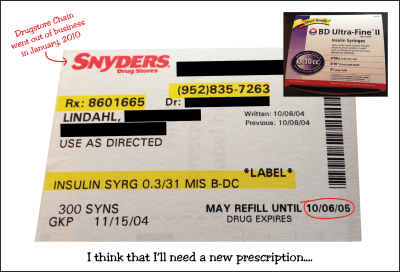
The final topic for today is related to syringes. Whenever I’ve used syringes in recent years, I have pulled them from a box purchased on 11/15/04. Do you think I should buy new ones???

Syringes_Old

Disclaimer: Nothing I say here should be construed as medical
advice and please do not change your insulin regimen without
consulting with your medical team.

The Grouch Addresses D-Tech

Laddie_Head SquareI am a tech-happy Type 1 diabetic. A new diabetes device gets my heart racing and I treasure my D-devices almost as much as my iPhone and iPad. Maybe more? Nah…. Until there is an iPump, I will love my iPhone and iPad more. But my life is immeasurably better because of my insulin pump, continuous glucose monitor, and even blood glucose meters.

I have come to terms with riffraff hanging off my body and filling up my pockets. I don’t mind the daily minutiae of using these devices and I take things like changing infusion sets and poking my fingers in stride. I’m old enough that I don’t wear cute dresses any more and don’t have to worry about accessing a pump tucked in my underwear. I don’t care about black dots on my fingers and the red spots and occasional bruises that tattoo my body. I am not burdened by my diabetes devices.

At the same time I am very frustrated with my D-devices.

I have been using an Animas Ping since 2012 and am still irked by its menu system. Two years ago I made the decision to purchase this pump despite its shortcomings because I thought the release of the combo Ping/Dexcom device was just around the corner. My Bad. It’s now November 2014 and the rumor these days is that the Vibe release is just around the corner….

Some of my frustration for this delay is directed at Johnson & Johnson which didn’t submit the pump to the FDA until April, 2013 after several years of hinting that the submission would be in the near future. The Vibe was released in Europe in June, 2011 and I sit here 3-1/2 years later hoping to upgrade to one. The fact of the matter is that when the Vibe is finally released in the USA, it will be a 4-year-old pump. In some ways it will be little different than the Animas Ping as it was approved by the FDA on July 1, 2008.  So you could argue that Grouch D-Techthe Vibe is really a 6-1/2 year old pump. My understanding is that the G4 software update just released by Dexcom will not be included in the Vibe. Therefore the Vibe will be an old pump integrated with an out-of-date Dexcom receiver.

In general I am incredibly frustrated with the whole FDA process. I don’t understand why it takes a couple of years to review something that has been in use in Europe for several years. I don’t understand why if Dexcom has been given FDA approval for its latest update that neither Animas or Tandem will be able to include that update in their pumps that integrate with the Dex G4. In my opinion the lengthy FDA approval process punishes innovation and motivates manufacturers to stay with old devices superficially decorated with trivial new bells and whistles. Many or most diabetes tech devices are developed by US companies and we see the overseas market getting access to them years before we do. It’s cheaper and faster for manufacturers to get approval in Europe.

Are users of diabetes tech safer in the USA than in Europe? I’ve never seen proof of that.

The iPhone 4 was released in April, 2011. Some of you might be using it happily: unless you want to use IOS 8 / unless you have a new iPad which can’t use iCloud optimally unless all of your devices are using IOS 8 / unless you don’t mind your phone freezing up on multiple websites and apps / unless you want a beautiful, new sleek device. What if you had to purchase an iPhone 4 today and pay the same price as an iPhone 6?  Yeah, that’s the same excitement (not!) that I feel about the Vibe when and if it is ever released.

Yes, the FDA is trying to keep me safe. Please don’t tell them that the most dangerous thing I can do is go back to injections and accidentally substitute my fast-acting Novolog for my Lantus shot. Or carelessly give my basal insulin twice because I couldn’t remember if I had already given the injection. Insulin is a dangerous drug and everyone with Type 1 diabetes knows that we occasionally play Russian Roulette with our lives.

I recently read Cell by Robin Cook where a smartphone app called iDoc became an integral part of the medical care for test subjects. People with diabetes were implanted with an internal insulin pump that was controlled by iDoc.  iDoc was a master of blood glucose control until the patient got another medical condition (cancer, heart disease, etc.) that threatened to make their health care costs skyrocket. At that point, iDoc programmed a lethal dose of insulin for the diabetic patient. Dead as a door nail. Maybe I would like some FDA oversight on iDoc….

Continuing my frustrations with D-Tech, last Thursday I read reports of the new software release for the G4 by Dexcom. I quickly tried to update, but the Dexcom website was having problems. Kind of like the FDA crash on Monday, Nov. 3 at the #DOCasksFDA event. Don’t these people know that the DOC doesn’t fool around when it comes to sharing information? We arrive quickly and in large numbers and don’t fool around. There is no such thing as a trickle down release of information in the DOC.

Fortunately the Dexcom website was back working in an hour or two and I successfully updated my Dexcom receiver. Because my current sensor was almost two weeks old, I started a new sensor to inaugurate the new software. It ended up being the worst sensor start that I have ever had in my two years of using the G4. Within a few hours, I had Dex results that were a hundred points too high. A recalibration resulted in Dex results that were 80 points too low. Two days later the results were still not in line. Argh!

I hate D-Tech.

My Dexcom debacle has a happy ending (I hope!) and several of my last sensors are being replaced. I had been having problems before the update and I think the rotten sensor start was just an unhappy coincidence. I have had superb customer service from Dexcom in the last couple of days. The jury is still out on whether my problems have been sensor related or equipment related, but I am hopeful that I am back on the right track.

Totally unrelated to my rants in this post, my pump case cracked yesterday when I inserted a new battery. I called Animas and only had to wait 2-3 minutes before talking with a Pump Rep. A new Ping will arrive on my doorstep tomorrow.

Okay, maybe I love D-Tech.


A Thank-you Note to Laura C.

Laddie_Head SquareDear Laura,

We’ve never met in person or crossed paths in the diabetes online community (DOC). I was diagnosed with Type 1 diabetes in 1976 at the age of 24. When my children were born 30+ years ago, I naively never worried about them getting Type 1. When I became involved in the DOC over 10 years ago, I quickly became a supporter of parents of children with Type 1. At the same time I gave thanks every day that I had diabetes instead of my children. Most of the parents whom I’ve met in the DOC would happily live with Type 1 if they could take the burden away from their children. I suspect that you feel the same way.

I recently listened to you and your husband talk on the Oct. 20 DSMA ‘Rents podcast about CGM in the Cloud. I have read many blogposts and listened to multiple interviews about the Nightscout system and am amazed by the #wearenotwaiting project. The technological support and peace of mind it provides for people with diabetes and their parents/families is wonderful. Although some adults with diabetes are using the system, I personally don’t need it at this time. As a diabetes tech junkie, I’ve been tempted to buy the gear and set it up, but so far I’ve resisted.

But Nightscout is not what this letter is about.

I am 62 years old and will be on Medicare in 2.5 years. I have used continuous glucose monitoring (CGM) for over five years and have found the Dexcom G4 to be a life-changing device for me. I am safer, my blood sugars are more tightly controlled, and I feel better both physically and mentally. When I reach Medicare age, I will have used a CGM for almost 8 years with full insurance coverage. I am terrified of the day that current Medicare policy will deny me that coverage. I am befuddled by decision makers who label CGM as “precautionary and without proven value” while this still-improving technology has a proven track record, can save money by reducing hypoglycemia-related ER visits/hospitalizations for seniors, and is a fundamental technology of the Bionic Pancreas.

Today I write to thank you for your closing remarks on DSMA ‘Rents:

“And the other thing I’ll add real quick as the Advocacy Team Chair for our Rochester Chapter of JDRF-  None of this would be possible without the CGM technology and there’s a bill currently going through Congress right now to allow seniors on Medicare access to CGM. Most, I think it’s like 95% of private insurance, covers CGM’s whereas our seniors don’t have access to them. And I feel like just because our son [name withheld] is 6 and not 66 doesn’t mean he is any more or less deserving of this technology. So all these great things that we have because we have access to it, I think our seniors deserve as well. So I’ll just put that pitch in there.”   (Loc. 55:07)

In the last year and a half, the issue of Medicare CGM coverage has moved to the front page Dear Laura Cof DOC advocacy. (One of the leading champions of this issue is my co-blogger Sue from Pennsylvania.) Those of us with insulin-dependent diabetes on Medicare or approaching age 65 have appreciated the support of parents, families, friends, medical professionals, and people with all types of diabetes. With the whole diabetes community supporting us, we have had and will continue to have a louder voice than we would otherwise.

But the fact that you took the time to conclude your interview concerning your project and your son with the importance of my issue is incredibly heart-warming.

So I thank you, Laura. If I ever had doubts that those of us affected by diabetes can be a united and supportive community, your eloquent remarks smashed them. I will sleep better knowing that you are on my team.

Sincerely yours,

Laddie Lindahl

Test Guess and Go

If you have not previously contacted your Senators
and U.S. Representative to support CGM Coverage
by Medicare, please click here to go to the
JDRF page that contains links and easy-to-
follow instructions to have your voice heard.