A Blogging Vacation

Laddie_Head SquareI’ve been on a blogging vacation. It wasn’t intentional, but one missed post turned into another missed post. And another missed post. Before I knew it, my twice weekly postings had turned into none. Blogs aren’t supposed to be a burden, so I’m not feeling too guilty. Unfortunately my blogging vacation has been accompanied by a lapse in my diabetes care.  A few (well, maybe a lot of) bad decisions along with infusion set problems have resulted in a series of days (weeks?) with less than optimal numbers.

My diabetes care is never perfect, but for the most part I do pretty well and spend a lot of time in my “target range”.  For much of the last year I have had success with a low carb diet (most of the time) and an insulin regimen that has controlled my morning blood sugar spikes (most of the time). So what has thrown everything out of balance?

A little bit of this and a little bit of that.

Balance is the hardest part of Type 1 diabetes. Without a functioning pancreas, our bodies have no sense of equilibrium. We live on a tightrope where good numbers are a small step from catastrophic lows and higher numbers seem to send the glucocoaster spiraling out of control. It’s the reality that everything today is connected to everything yesterday and will influence everything tomorrow.

I eat a couple of chocolate chunk cookies. Okay, they are the (huge!) chocolate chunk cookies (delicious!) from Costco. I take a boatload of insulin and my BG numbers seem to stay in check. But at 2:00AM my Dexcom screams that my BG is high and rising quickly.  I program a correction dose into my pump and unfortunately wake up with a low at 6:00AM. Two glucose tabs and before I know it, I’m back to 180 and rising quickly. I test frequently and take enough insulin to vanquish two plates of pancakes, a banana split, and half a loaf of Wonder Bread. But wait, I didn’t eat any of those things. I either ate nothing or my normal 17 carb breakfast of Greek yogurt and apple or blueberries. The dog walk that usually prevents huge post-breakfast BG spikes is rewarded with numbers in the 200’s.

My endocrinologist claims that overnight lows result in hormones that ultimately cause highs. I think she’s right because the more overnight lows I have, the more daytime highs I see. The more I correct the highs, the more I end up low. Dexcom tracings that resemble the Himalayas multiply rapidly and refuse to give way to somewhat gentler blood glucose slopes.

The cookies are long gone and the sweet, yummy, chocolaty taste is a pleasant guilt-laden memory.  The problem is that my diabetes remembers the indiscretions and even when I’m eating a judiciously low-carb meal, my body is quick to spike and quick to crash. Add frustration and diabetes burnout to the mix and it’s hard to get back on the straight and narrow.
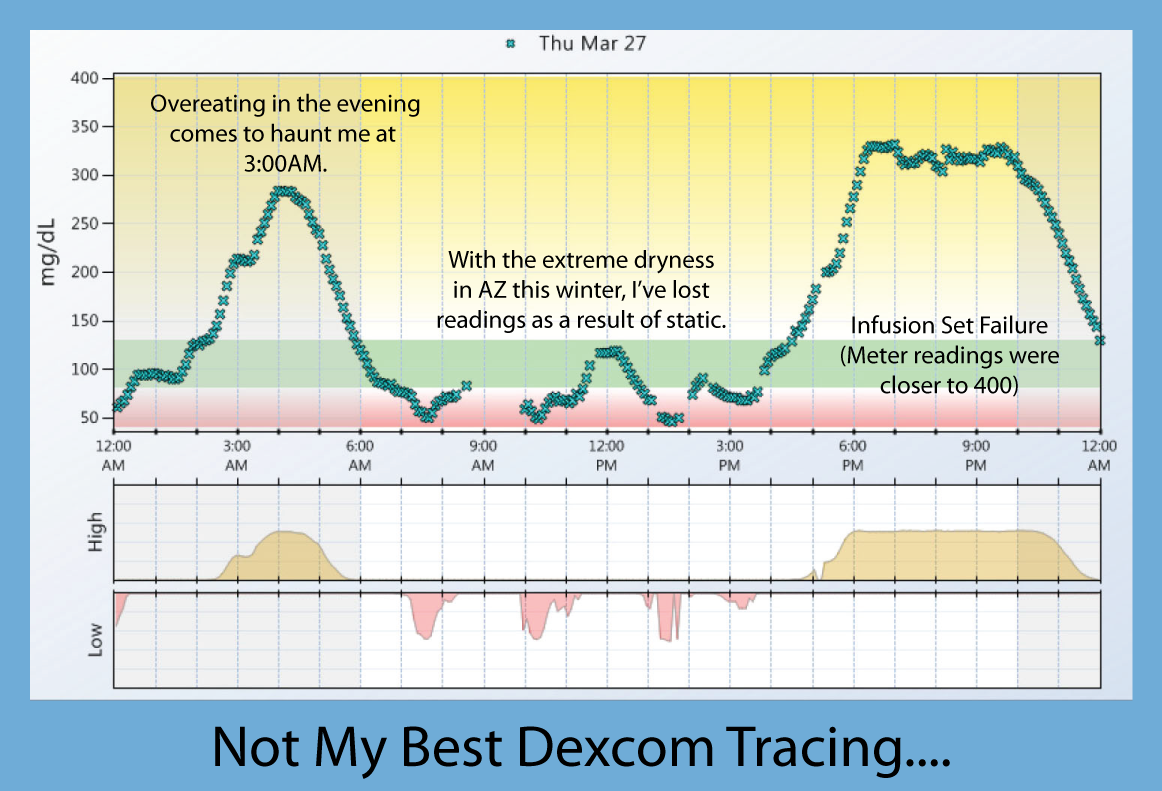
Dexcom Tracing

Mixed in with things I can control are things like infusion set failures. I have used angled sets (Silhouettes and Comfort Shorts) successfully for most of my pumping life. Skin problems, inflammation at pump sites, and insertion pain have motivated me to explore other types of sets. In my last supply order, I included a box of Insets and a box of Cleos. I started with the Insets and loved the pain-free insertion.  Since I weigh a little more than the last time I used 90-degree sets, I was encouraged by the performance of the first 9 sets with no pain, no failures, and all of them lasting 3 days. Then came #10. It was a blast from the past with an absolute failure five hours after insertion. I rarely get insulin blockages with angled sets. This site failure reminded me why I had quit using Quick Sets ten years ago and learned to live with the horrible insertion needles of angled sets. I’ll use the box of Cleo’s and probably go back to Comfort Shorts. I can stand a little pain and inflammation to have reliable insulin delivery.

After covering a lot of subjects here without much sense of direction, I’ll wrap up by saying that I’m back to blogging after a brief hiatus. Judging from the last two days, I think my diabetes care is back on track. In many ways these two things go hand-in-hand because they are reflections of how much diabetes is like a spoiled child who demands all of our attention and won’t settle for less than 100%. Not even when you want a vacation….

A Springtime Walk in Arizona

I just couldn’t do diabetes today. As much as I like blogging, sometimes I think it is a bit twisted to write long posts about diabetes a couple times a week. So today I am expanding my WordPress skills and for the first time using a photo gallery in a blogpost.

After sending my husband off to the airport this morning to head back to Minnesota, I took Abby the Black Lab for a walk around my Arizona neighborhood. I hope the beautiful photos I took will brighten the day of those of you in northern climates. If it’s too painful to watch, keep in mind for next year that I have a guest room.

If the short slideshow does not begin automatically, hover your mouse over the photo and click the arrow. When you can’t stand it anymore and want to return to your world of cold and slush, click on pause.

This slideshow requires JavaScript.

Diabetes Cookbooks: A First Time for Everything

IN JANUARY I SAW A REQUEST FROM THE BOOK DEPARTMENT OF THE AMERICAN DIABETES ASSOCIATION FOR BLOGGERS WHO MIGHT BE INTERESTED IN READING AND REVIEWING BOOKS. AS SOMEONE WHO ENJOYS READING AND IS ALWAYS LOOKING FOR BLOG TOPICS, I JUMPED AT THE OPPORTUNITY.  RATHER THAN BEING ASSIGNED A BOOK, I WAS ABLE TO SELECT THE BOOK(S) I WANTED TO REVIEW.  I DECIDED THAT I WOULD OPT FOR BOOKS THAT WERE A BIT OUTSIDE MY COMFORT ZONE: BOOKS THAT RIGHTLY OR WRONGLY I MIGHT NOT NORMALLY READ.  THE BOOKS THAT I CHOSE WERE PROVIDED TO ME FREE-OF-CHARGE, BUT MY REVIEWS, AS ALWAYS, ARE MY OWN OPINIONS.

*

Laddie_Head SquareTwo weeks ago I was having a glass of wine with some girlfriends and one of them asked: “When was the last time that you did something for the first time?” I did not have to think for very long to come up with an answer.

The one thing that I have done in recent weeks that was a first time experience for me was to use a diabetes cookbook.  Actually not just one cookbook, but two.  I have had diabetes for 37 years and until recently, I have never owned nor used a cookbook that was intended for people with diabetes.  I may have cut out a few recipes from magazines like Diabetes Forecast or Diabetes Health, but I don’t think I ever fixed any of them.

You might wonder whether I have anything against diabetes cookbooks.  I don’t think so. In general I’m not very interested in cookbooks and most of the cookbooks I own were gifts or purchased to support a fund-raising project. I don’t like to cook and I keep waiting for my husband to have a mid-life crisis and decide that he would like to be a chef. Unfortunately that doesn’t seem to be on his agenda.  My guess is that newly-diagnosed diabetics are a big market for cookbooks, but when I was diagnosed in the 1970’s, I wasn’t carb counting and didn’t need the nutritional analysis that is now contained in diabetes cookbooks.

When I decided to go outside my comfort zone and review two ADA cookbooks, I actually got excited about doing it the “right way”.  For me that meant choosing 4 or 5 recipes from each cookbook and following them exactly. (I have a bad habit of altering recipes and then wondering why they are not as good as advertised.) It also meant using the carb counts as provided and evaluating whether the nutrition info was a helpful tool in my diabetes life.

3D Family ClassicsThe first cookbook I delved into was the ADA standard bearer titled The Family Classics Diabetes Cookbook.  This is a collection of 140 “favorite” recipes from Diabetes Forecast Magazine.  My overall impression was that this is a well-organized cookbook with beautiful photographs and clear detailed instructions.  There is a good mixture of standard favorites such as Old-Fashioned Beef Stew, Classic Potatoes Au Gratin, and Classic Baked Artichoke Dip along with newer-style recipes such as Chickpea Tabbouleh, Tilapia Tacos, and Zesty Broccolini and Garlic.

I tried five recipes from this cookbook.  My two favorites and recipes that I will make again were Fresh Greens Soup with White Beans, Basil, and Tomatoes and Provencal Zucchini and Yellow Squash Medley.  Two other recipes were just fine and maybe worth repeating.  I only disliked one recipe and it was because of ingredient substitutions designed to make the recipe lower in fat than the original dish.

That leads me to a discussion of the “dietary philosophy” of this book.  The recipes are consistent with traditional ADA clinical guidelines prescribing a “heart healthy” diet with an emphasis on eating low-fat with a significant number of calories coming from healthy carbohydrates. This cookbook was published in 2012 and precedes the ADA’s 2013 acknowledgement that low-carb diets might be a successful tool for weight loss and diabetes management. Although the ADA has modified its stance on dietary recommendations, most physicians still advise their patients to follow a traditional low-fat diet.  Therefore this cookbook is a good resource for good food with a low-fat emphasis.  There are also some good recipes that are not high in carbohydrates if that is your preference.

3D Smart ShopperThe second cookbook that I tried out was The Smart Shopper Diabetes Cookbook. This cookbook by Robyn Webb, MS was filled with quick and easy recipes designed to be “stress-free” by using ingredients “from the Deli Counter, Freezer, Salad Bar, and Grocery Shelves”.  This book was published in 2013 and Webb’s introduction addresses the idea that there is no “one-size-fits-all nutritional approach for people with diabetes.”  She attempts to provide a variety of recipes that emphasize healthy fats, high fiber, varying amounts of carbohydrates, and lots of flavor.  Detailed nutritional information for each recipe is provided so that you can make up your own mind about which recipes are appropriate for your meal plan.

Because I am generally a lazy cook, I liked some of the short-cuts she used to make a healthy meal without too much time in the kitchen.  My favorite recipe was Chicken, Artichoke, and Spinach Soup with a close second-place finish for Mexican Chicken.  The other 2 recipes that I tried were fine, but I would probably try another new recipe before repeating them.  And there are definitely a few other recipes that are on my list to try:  Rosemary Turkey Salad and Salmon with Blueberry Salsa.

One thing that I liked, but haven’t used yet was the daily menus provided at the end of the book.  I find that when I want to experiment with a new style of eating, it is helpful to start with a structured program with daily menus.  Just follow the rules and don’t think too much.  These menus very much remind me of the balanced diet that was the basis of the Exchange System that I used in the first half of my diabetes life.  Although I carb count now, I still think in blocks of 15 grams and really feel that the Exchange System was not a bad way to eat.

Summary:  I enjoyed trying new recipes and expanding my normal dinner options beyond meat and vegetables cooked with little creativity.  The carbohydrate counts provided were helpful and saved me a little time.  At the same time, none of the measurements in either book were provided in grams, so I was stuck with guessing at what is the ubiquitous “medium banana” or “large onion.” Because I selected relatively low carb recipes to try, I was comfortable with guessing at some of the quantities.

I am very impressed with Robyn Webb, MS and would love to see the ADA publish a Low Carb cookbook with her input.  Although I am not perfect in living a low carb lifestyle, I am convinced that it makes my diabetes life easier and I would love to infuse some creativity into my menus.  I’ve definitely found some “keeper” recipes in the two ADA cookbooks that I explored.  But a whole low-carb cookbook would be fabulous and I would buy it in a minute.

If you would like to purchase the cookbooks that I reviewed or any other books in the American Diabetes Association Store, please go to this link:  http://www.shopdiabetes.org/  Also, Amy Tenderich at Diabetes Mine recently reviewed and raved about another ADA cookbook titled The Mediterranean Diabetes Cookbook.  To read her review, click here.

Becoming an Advocate

The topic for the February DSMA Blog Carnival is:  “Advocacy is a topic that is often discussed in the Diabetes Online Community.  Can you be one and not even know it?  What is your definition of an advocate?”

*

Laddie_Head SquareUntil recently, most of my thoughts about advocacy were laced with guilt.  I’ve spent a good bit of my life “talking the talk” and not “walking the walk”.  I’ve been reluctant to advocate publicly for fear that the continuing responsibility of taking a stance would be more than I wanted to handle.  I have been quick to criticize myself for being one who rides on the coat tails of the Real Advocates in the Diabetes Online Community (DOC).

Early November 2013 was a low point for me.  November is Diabetes Awareness Month and many members of the DOC undertake huge projects to show their commitment to advocacy.  As a relatively new blogger, I was totally unprepared for the onslaught of informational posts, photo projects, and tributes to diabetes heroes.  I felt like a total slacker.  By mid-month, my self-criticism mellowed a bit and I took a realistic assessment of what I had done and what I was doing.  My 11/15/13 blogpost convinced me that although I wasn’t an established leader in the DOC, I was slowly becoming comfortable participating in advocacy projects.

I think that “advocacy” is taking something you believe in out into the world.  Beliefs are easy.  Sharing them with others is harder.  Crusading to turn your beliefs into reality is harder still.

I find advocacy terrifying.  In his “What is an advocate?” post, Stephen of Happy-Medium stated that “An advocate is not someone who is afraid of the word “advocacy“.  I disagree with Stephen.  I am slowing morphing into an advocate and I’m still terrified of the word.  Once you move your convictions from the comfort of your brain and the safety of your soul to the outside world, there is no going back.  The doors are wide open and you’re out there to stay.

On November 1, 2013 I would have said that I was not an advocate.  People like Scott Johnson would have tried to convince me that I was wrong with the argument that telling my story as a blogger was enough to grant me membership in the “A Club“.  My two co-bloggers, Sue from New York and Sue from Pennsylvania, would have called me an advocate because of the behind-the-scenes work that I was doing to help them with blogposts, graphics, and logistics.  Many of my friends, both D and non-D, would have awarded me advocacy status because of my active lifestyle showing what is possible with and despite diabetes.

Frankly I think that I became an advocate on February 11, 2014.  That is the day that I sent a letter to my family and some of my friends asking them to participate in the Spare a Rose, Save a Child campaign.  My first blogpost about Spare a Rose was easy to write because I knew that most of the readers would be members of the DOC.  That’s not advocacy.  They already knew about it and supported it.  I wrote a good post, but I was just going through the motions.  It was advocacy when I pinned a scarlet “A for Advocacy” on my chest and wrote a second post to spread the message to the larger world.

I disagree with people who say that I have been an advocate for a long time despite my opinion that I wasn’t.  I was a believer; I was a follower; I worked on projects.  In my mind I did not become an advocate until I was able to look in the mirror and say “You are an Advocate.” I did not become an advocate until I was brave enough to say to others “This is what I believe and I am proud and strong enough to share my beliefs with you.

Advocate5This post is my February entry in the DSMA Blog Carnival.  If you’d like to participate too, you can get all of the information at http://diabetescaf.org/2014/02/february-dsma-blog-carnival-3/

Spare a Rose: Part 2

Laddie_Head SquareToday I sent a letter to most of my friends and family members. It was easy for me to write a blogpost that was read by most of the DOC. It was harder to send an appeal to my “real life” friends and family.

I know that the goal this year for the Spare a Rose, Save a Child campaign is $10,000 and we have almost reached it. I think that we can do better than that. Don’t be comfortable in your DOC niche. Be brave and send your appeal out to your co-workers, your neighbors, your family, and your friends.

728x90tag_Spare a Rose

This is the letter that I emailed to most of my friends and family.

Dear Friends and Family,

Most of you know that I have had Type 1 Diabetes for 37 years.  As the beneficiary of good insurance and financial security, I have consistently had access to expert medical care along with the latest and greatest technologies. Most importantly, I have never had to worry about the availability of insulin without which I would quickly die. I have lived a good life with and despite of diabetes and hope to continue to do so for many years.

The Diabetes Online Community (DOC) is sponsoring a huge campaign this Valentine’s Day:  Spare a Rose, Save A Child.  This campaign supports Life for a Child, a program of the International Diabetes Foundation (IDF).  Life for a Child addresses the needs of children in developing  countries, many of whom die within a year of a Type 1 diabetes diagnosis because of lack of insulin and medical care. To understand the scope of the problem, please watch the short video at this site:  http://www.idf.org/lifeforachild/the-programme

Spare a Rose, Save a Child is simple: buy one less rose this Valentine’s Day and donate the value of that flower to children with diabetes.  Your loved one at home still gets flowers and you both show some love to children around the world who need it. 

One rose, one month of life. A dozen roses, a year of life for a child with diabetes.                                            http://www.p4dc.com/spare-a-rose/

I write a blog about diabetes and I encourage you to read my blogpost about Spare a Rose, Save a Child:  https://testguessandgo.com/2014/02/03/spare-a-rose/

It is a rare occurrence for me to approach my friends and family about supporting programs that I am involved in.  I embrace this cause wholeheartedly and encourage you to donate this week as we get ready to celebrate Valentine’s Day.

To donate, go to:  http://www.p4dc.com/spare-a-rose/give/   You will use PayPal to send your gift directly to the IDF.

Please note the down arrow that gives you choices of how much to donate.  Spare 1 Rose = $5 = 1 month of Life for a Child. 2 Roses = 2 Months and other options up to 2 dozen roses for 2 years of life for a child.

As we approach Valentine’s Day 2014, let us all be generous in sharing our bounty with children all over the world.  To us, a rose is small.  To a child with diabetes, that rose represents another day, another month, another year of life.

With thanks to all of you-

Laddie

Miscellany

Laddie_Head SquareToday’s post is a bullet point view of a few things that are relevant to my life these days.
*

*

  • I seem to be able to relate almost everything in my life to diabetes. A few weeks ago I was playing golf and needed to know the distance to the pin so that I could select the proper club. I used my laser range finder which measures the exact distance to the hole by zeroing in on a crystal receptor on the flagstick. Someone asked me what the distance was and I confidently answered 161 yards. One of my playing companions had also taken a measurement and indicated that her device read 125 yards. I took another reading and also measured in the 120’s. Had I use the erroneous reading and hit a good shot, my golf ball would have gone into the desert past the green and resulted in a double or triple bogey. My immediate thought was that this was just like a blood test with diabetes. If my meter gives an erroneous reading, I over- or under-dose my insulin and end up with an unexpected and undeserved high or low BG reading.Golf Desert
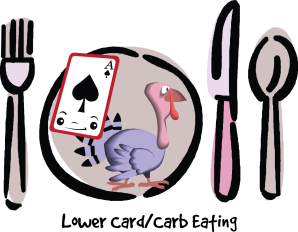
  • I write most of my blogposts on my iPad and find that I make the same typing mistakes and get the same crazy autocorrects over and over again.  My pinkie finger must not reach far enough for the “a”, so my most common mistake is to type “disbetes” instead of “diabetes”. Although I get a red line under disbetes, it does not autocorrect to diabetes. Some people would love to change the name of Type 1 diabetes, but I don’t think “disbetes” will have many supporters. A second mistake I often make with diabetes-centric writing is to write “lower card eating” instead of “lower carb eating”. One would think that I have an Ace of Spades on my plate instead of a piece of turkey. An email to Sue from New York after her sleep consultation ended up with two mentions of her “creep” consultation.  Good thing I corrected those mistakes before sending the email although Sue did think the sleep study was somewhat creepy.                                                                             Plate Turkey
  • Autocorrects also sabotage my writing.  “Bolusing” is often rejected by my iPad which insists on  a substitution of “blousing”. The statement that I bloused 3 units of Novolog with my lunch is somewhat nonsensical. This is the third blogpost in a row where I have mentioned the podiatrist/author Neil Scheffler. The rejection of “Scheffler” for “Scheduler” brings to mind James Bond and Batman villains.  Holy Guacamole, Batman, stay away from the The Scheduler!                                            The Scheduler
  • Olympics Trivia.  Late in January Abby the Black Lab’s sister was on the NBC Nightly News with Brian Williams in a feature about the threat of terrorism at the Sochi Olympics. Because black labs don’t have an aggressive bone in their bodies, that statement warrants an explanation. Abby’s littermate, Jackie, belongs to a Minnesota friend who is going to Sochi to watch her daughter compete in one of the skiing events. My friend was interviewed at her home about whether the terrorism threat was waylaying her family’s plans (it’s not) and the beginning of the clip showed Jackie bouncing and jumping up. “Not very good behavior” thought Abby who is jealous of her sister’s celebrity status.                                                                                                  Abby and Jackie Sister2                                                 
  • Super Bowl Trivia. Pete Carroll, coach of the Seattle Seahawks, lived down the street from us when he was a Defensive Backs Coach for the Minnesota Vikings in the late 80’s. His two oldest children are the same age as my boys and they went to school together. Extremely nice family and congratulations to Pete and the Seahawks for a job well done.                                                                                    Seahawks
  • My Arizona podiatrist is now my new best friend because the cortisone shot on Tuesday has returned my heel to A+ status. Hopefully this injury will not return.                                                                                                                                         Call the Podiatrist_2

That’s it for today, my friends.

Jinxed Again!

 Laddie_Head SquareA while back I wrote a post about how I jinx myself when I think things are going well. The mere hint of positive vibes is enough to send my life into a downward spiral. In late January I wrote a post reviewing the book Things You Need to Know About Diabetes and Your Feet by Neil M. Scheffler, DPM, FACFAS. I talked about the importance of foot care along with mentioning (or was it boasting?) that I had no foot problems and had never seen a podiatrist.

Fast forward to two days after that post. I was walking with a friend and out of nowhere started having pain in the back of my right heel. Nothing popped; nothing twisted; it just started hurting. I finished my walk and figured that the pain was minor and would go away. I hobbled around for a few days and continued with most of my regular activities. I iced the foot often and used a topical gel for pain relief. Once or twice when it was really painful, I took a couple of ibuprofen tabs. That is a big no-no for me because I am already on a prescription NSAID for my arthritis. The ibuprofen really helped, but it is safely back in the medicine cabinet. If the pain is so bad that I feel I need it, I should be talking to my doctor and not abusing prescription or over-the-counter medications.

The pain continued to get worse and my next step was to quit all activities except for sitting on the couch and icing the heel regularly.  Every so often it seemed as though it was better, but a walk across the room quickly dissuaded me of that notion.

I think that you can guess where this story is going. Suffice it to say that she who had never seen a podiatrist before has now seen a podiatrist.

Call the Podiatrist

Tuesday I went to a foot doctor recommended by a friend and had the heel checked out. Fortunately x-rays ruled out anything like bones spurs and he believes that it is an inflamed nerve. He injected the heel with an anesthetic steroid concoction and I am supposed to go back in two weeks.

The doctor seemed very knowledgeable about my feet. Because of my diabetes he did an extensive visual inspection and checked for pulses and sensation. After asking how long I had had diabetes, he did a little math in his head, and questioned how I could have Type 1 (Juvenile Diabetes) because I had been diagnosed as an adult.  Argh!  Very nicely I indicated that Type 1 is the result of an autoimmune attack and age of diagnosis has nothing to do with it. End of conversation.

In all of my years with diabetes, this is the first time that I have ever had a steroid injection. I was expecting a huge jump in my blood sugars, but so far the effect has been minor. Initially I used a temporary basal of 130-150% which was similar to what I had used for couch camping.  Yesterday I started to go low and returned my basals to normal. Overnight I started to run somewhat high and I have upped my basals again with a few correction boluses. So far the pain relief from the injection has been worth any disruptions in blood sugar.

The first afternoon after the injection was nirvana because the anesthetic was still active and I had no pain. Two days later I can walk normally and that’s a huge improvement. I am still taking it easy and will continue to ice the foot. Abby the Black Lab was thrilled to get a walk around the block yesterday after two weeks of home confinement. I checked with Dr. Google and he/she/it indicated that it usually takes a few days for a steroid injection to take effect and I am optimistic that I will continue to improve.

Have I learned anything from this?  Absolutely YES! I think that I have learned to keep my mouth shut. I now realize that blogging is a threat to my health and I should take up a less risky hobby such as sky-diving. When it comes to reviewing books about feet, I’m going to stick to The Foot Book by Dr. Seuss:

Left foot, left foot,

right foot, right

Feet in the morning

feet at night

And that’s all I have to say on the subject.

Diabetes Art Day 2014

Laddie_Head SquareThis is my first year participating in Diabetes Art Day.  Lee Ann Thill started this project in 2010.  2014 marks the fifth year that people with diabetes and/or affected by diabetes are using art to share their stories and emotions along with increasing awareness about diabetes.

My art expresses my feelings about everyone in the Diabetes Online Community (DOC) and pays particular tribute to two of the brightest stars whom we have lost in recent weeks.  First is Barbara Bancroft who was an active participant at TuDiabetes with the screen name of jrtpup.  She was beloved by members of that community and you can read the many tributes to her here.  Secondly I am honoring Dean Devalerio, a fellow Minnesotan.  I knew Dean online through Facebook and was fortunate to get to know him in person through our Type 1 Saturday meet-up group. Although he was a new friend to me, others of our group had known him a long time and the community of PWD’s in the Twin Cities will have a little less sparkle without Dean. Dean was one of the early supporters of Diabetes Art Day and this year’s Art Day is dedicated to him.

My “art” uses stars made from the sparkly blue attachments collected from my Animas Ping pump reservoirs.  I call it “The Stars of the DOC.”

DiabetesArtDay_2014

To view the 2014 Gallery for Diabetes Art Day, go here and then select the 2014 Gallery or browse through the artwork from previous years.

Spare a Rose

Laddie_Head SquareThe Diabetes Online Community has come together again in 2014 to sponsor the Spare a Rose, Save a Child campaign.  The message is simple, but powerful.  Buy one less rose this Valentine’s Day and donate that $5 to the Life for a Child program sponsored by the International Diabetes Federation (IDF).  Your gift of $5 will provide a month of insulin and diabetes supplies for a child in parts of the world where these life-saving medications and supplies are desperately needed.  Or consider donating the equivalent of a dozen roses and giving a year of life to a child with diabetes.

728x90tag_Spare a RoseThe website for Spare a Rose, Save a Child was created by members of the DOC as a source of information about the Spare a Rose program.  If you are a blogger, you can find links and images at this site to use to spread the important message about this campaign.  This one-page information sheet will tell you everything you need to become involved.

If you wish to donate, use this donation form to send your gift directly to the IDF using PayPal.  Please note the down arrow that gives you choices of how much to donate.  (Spare 1 Rose = $5 = 1 month of Life for a Child. 2 Roses = 2 Months and other options up to 2 dozen roses for 2 years of life for a child.)

As we approach Valentine’s Day 2014, let us all be generous in sharing our bounty with children all over the world.  To us, a rose is small.  To a child with diabetes, that rose represents another day, another month, another year of life.

To donate, click on this image.

To donate, click on this image.

Feet

A few weeks ago on Twitter, I saw a request from the Book Department of the American Diabetes Association for bloggers who might be interested in reading and reviewing books. As someone who enjoys reading and is always looking for blog topics, I jumped at the opportunity.  Rather than being assigned a book, I was able to select the book(s) I wanted to review.  I decided that I would opt for books that were a bit outside my comfort zone: books that rightly or wrongly I might not normally read.  The books that I chose were provided to me free-of-charge, but my reviews, as always, are my own opinions.

*

Laddie_Head SquareMy first selection was a short book by Neil M. Scheffler, DPM, FACFAS titled 21 Things You Need to Know About Diabetes and Your Feet.

Why did I pick this book?  I chose it because I currently have no issues with my feet related to diabetes and I usually skip the chapter on foot care when reading diabetes books. By selecting this book, I wanted to force myself to read and learn everything that the podiatrist author deemed important. I also wanted to compare his recommendations to what is happening with my care team, my feet, and my diabetes.

The Book

Dr. Scheffler has written a concise guide to just about everything you need to know about having healthy feet and about the specific risks that those of us with diabetes face. Like every other discussion about diabetes and feet, he spells out the grim statistics on the first page and doesn’t take long to start talking about amputations. Fortunately he very quickly moves on to the good news as stated by the Center for 3D 21 Things-Feet_CroppedDisease Control (CDC) that “comprehensive foot care programs, i.e., those that include risk assessment, foot-care education, and preventive therapy, treatment of foot problems, and referral to specialists, can reduce amputation rates by 45% to 85%.”

The “21 Things” referred to in the title are the 21 chapters of the book. Topics include the Diabetes Foot Care Team, Diabetic Neuropathy, Foot Ulcers, Shoes and Socks, and Emergencies. One thing that I particularly appreciated was the discussion that foot care requirements are not the same for everyone.  Kind of a YDFMV (Your Diabetic Foot May Vary) attitude. (Thanks, Bennet of YDMV.)   Although the author states that everyone should check their feet daily, he is quick to concede that a recently diagnosed Type 1 in her twenties probably does not have the same needs as someone who is a senior citizen with 20 years of diabetes and numbness in his feet.

My Feet

So how do I measure up with the care of my feet which have carried me through 37 years of Type 1 Diabetes?

I’ll tell you the bad stuff first. By the third paragraph of Chapter 2, I’m already looking at a failing grade. Rather than an annual exam with a foot specialist, I have never seen a podiatrist in my life except for a free 5-minute exam at the ADA Expo in October. I wear sandals and thonged flip-flops frequently.  Last year I didn’t go to the doctor for a bloody toe from an extended downhill climb in wet hiking boots. My endocrinologist does not check my feet.

Before you take me into custody for a foot intervention, let me explain myself.  My feet have always been in good shape and the last time my endo saw them, she stated that she wished all of her patients had feet as well-cared for as mine. Although many endocrinologists check feet at every visit, the ADA Standards of Care only require an annual comprehensive foot exam that includes checking for pulses and sensation as well as a visual screening. For me that exam is performed at my annual physical by my internist and my endo questions me to ensure that it has been done.

I am fortunate to have no numbness in my feet.  I can feel the tiniest grain of sand and quickly respond to shoes or socks causing irritation. I use moisturizing foot creams daily to prevent painful heel cracks. My flip-flops are thick-soled with good arch support and I only wear them at home (okay, also at the beach).  I wear high-quality socks such as Thorlo and Smart Wool. When hiking I often put on dry socks at lunchtime and always wear gel protectors (they’re like toe socks) on my second toes to prevent the kind of injury I had last year.  I am still agile enough to inspect my feet and clip my nails.

Believe me, I take foot care very seriously even though I don’t follow every rule. I accompanied my father-in-law to many podiatrist appointments for wound care of foot ulcers resulting from Type 2 diabetes and congestive heart failure. One of my friend’s husband with diabetes had a leg amputated a few years ago. I have heard Kelly’s story of her continuing battle to save her foot as she fights various tissue and bone infections. There are others in the DOC who struggle with balance and numbness in their feet.

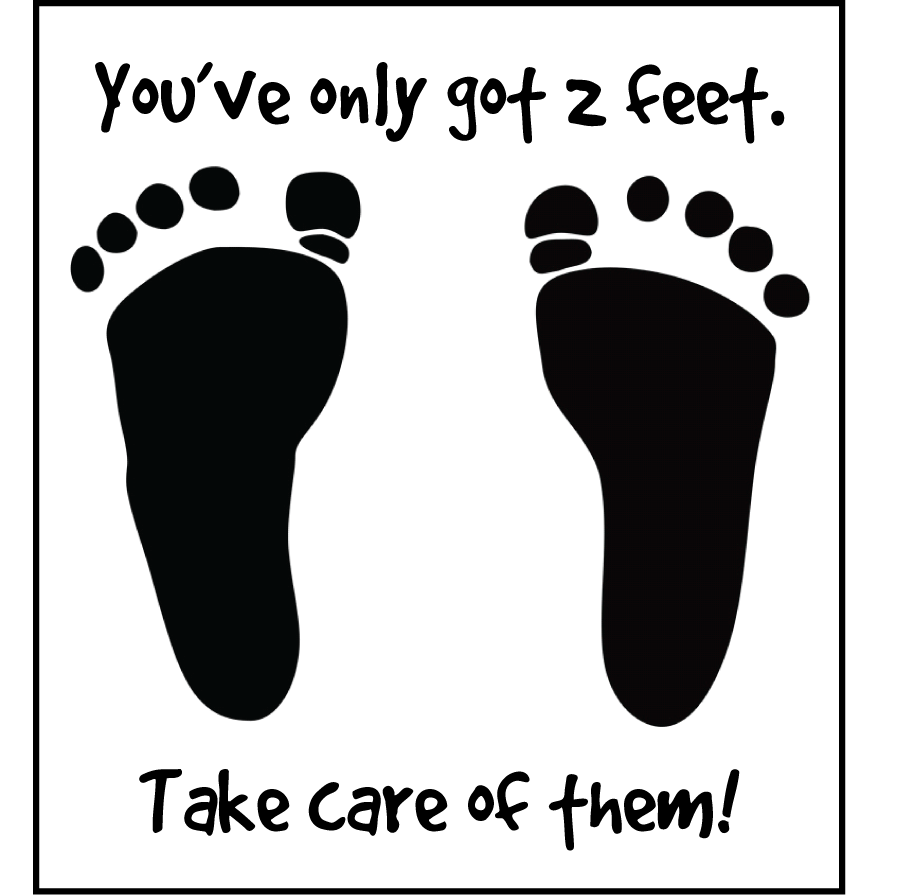
Two Feet

I’m not stupid. This is serious stuff. Although Dr. Scheffler would wish that I saw a podiatrist, I think that he would approve of how I care for my feet, work on achieving good blood sugars, and very importantly, don’t smoke.

I am getting older and have had diabetes for a long time. Just because I have never had a podiatrist appointment in the past doesn’t mean that I never will in the future. In fact I probably will.  And like everything with diabetes, what I do is not necessarily what you should do. Follow your good sense, the advice of your medical team, and take care of your feet.

If you would like to purchase this book or any other books in the American Diabetes Association Store, please go to this link:  http://www.shopdiabetes.org/