Countdown to Medicare with Type 1 Diabetes:  5 Months / Anxiety

Laddie_Head SquareThere are frequent online discussions about addressing mental health issues along with physical concerns when living with diabetes. I am lucky to be mostly immune from things like diabetes burnout and depression. I don’t like diabetes but it doesn’t haunt or slow me down much. I come from a family with a history of depression but its dark clouds have never settled over me for very long. Still…

I have a tendency towards anxiety. The kind of worry that radiates in my chest and aches in my belly. It has never been so crippling that I have felt the need for professional help and I have been helped by progressive relaxation tools I learned from a book many years ago. Deep breathing and exercise also help.

I am very in tune with my anxiety. It surfaces when I need to make a decision or address a problem and I don’t feel in control. Sometimes the issues are trivial or at least very fixable, but my rational brain can’t convince my gut that I shouldn’t be stressed. I won’t call them silly, but my anxiety worries are not life-or-death. Maybe it is a leaky roof. Maybe it is a grandchild getting her feelings hurt. Maybe it is Christmas. Maybe it is thinking about what needs to be done to sell our house and we don’t even plan on selling the house.

Maybe it is Medicare.

I have been trying to get a handle on Medicare options for several months. I haven’t decided whether I know too much or not enough. I wake up many nights at 2:00AM and start thinking about Supplemental versus Cost* plans. I walk the dog and my stomach cramps thinking of Competitive Bidding. Part B insulin and test strip brands are a constant concern. This stuff is important, but not so important that I should be losing sleep.

But anxiety does not always make sense.

I finally have premium costs and plan information for 2017 and I am making worksheets to compare my options. I have only one decision that could have an impact beyond my first year on Medicare and that is the Supplemental versus Cost plan decision. Supplemental (Medigap) policies are only required to accept me (a person with pre-existing conditions)countdown-to-medicare-5-months during the first 6 months that I am on Medicare. After that I can be denied coverage or charged higher rates. At the same time there are guidelines about having guaranteed Medigap rights and some of those scenarios will grant me needed flexibility in the future.

The things that stress me are discrepancies like one plan agreeing that insulin for a pump will be covered under Part B and a similar plan saying it won’t. (That can be a big deal because Part B insulin does not go into donut hole calculations.) I think the plan saying no is wrong, but what do I do about it and do I dare risk signing up with that company? I need to consider that company because it happens to offer CGM coverage. Yes, I am lucky to have the option of CGM coverage with one plan! But I need to consider the whole package, not just one thing. More homework to do.

Another thing that is stressful is trying to figure out what pump and testing supplies cost. For the most part I have been using the negotiated prices from my current BCBS policy. But one friend shared his test strip cost info with me and it looks as though he is paying 20% of what I consider a high retail price compared to what a negotiated price should be. Am I right? Right or wrong it certainly makes me wonder what prices I should be using to figure out my anticipated costs.

Another thing that kicks me in the gut is competitive bidding. This is only relevant if I choose a Supplemental plan because Cost plans use their own suppliers. DPAC has published a couple of blogposts recently that scare the bejesus out of me. One post was written by a person with diabetes on Medicare and the other was written by someone who owns a durable medical equipment company. These are great articles to spur advocacy, but frightening for those of us anticipating Medicare.

One benefit of participating in the DOC is that I have support from other people affected by diabetes. A downside is that I read stories of people having nightmare experiences with Medicare. As a blogger, I get emails from readers sharing their stories and problems. At the same time I know many people with Type 1 who are doing fine on Medicare but those people don’t write much about their experiences. I mostly hear the bad stuff.

anxiety

I have anxiety. Some of it is unreasonable. I live in Minnesota and have several good (not perfect) options for Medicare. My husband still works and his income will provide a buffer from the shortcomings of Medicare. At the same time some anxiety might be reasonable because healthcare reimbursement at all levels in the United States is under siege and people with diabetes are getting hit particularly hard.

I expect that my next Countdown to Medicare post in December will outline some specifics of my choices. Obviously cost is a major concern, but so are things like drug formularies, test strip brands, and requirements for getting pump supplies. I have already eliminated choices that do not network my current doctors and I am looking at the plans of two different companies. It is likely that I will choose a plan that allows me to avoid competitive bidding because anyone with a tendency towards anxiety might not survive that disaster.

More to come. 😀

*

**Minnesota is one of very few states that offers Cost plans. These plans are hybrids that combine features of traditional Medicare and Advantage plans. Most people reading this post will not encounter Cost plans in their Medicare journey.

********

Please note that Medicare began reimbursing the Dexcom G5 continuous glucose monitor  in 2017. Most of my concerns in the Countdown to Medicare series are still relevant. But the details may have changed by the time you read this post.   Laddie 6/28/18

A Diabetes Data Machine

Laddie_Head SquareI am currently involved in a couple of projects that require tracking my diabetes data. The good part is that some of the data is automatically logged with little or no input from me. The bad part is that I am using 3 different apps on my phone and must enter food information twice. The good part is that I have learned new things about my diabetes. The bad part is that I am uber-involved in the input of data and not paying much attention to the output.

Big Blue Test

Most of you are familiar with the Big Blue Test sponsored by the Diabetes Hands Foundation. Every test logged between October 14 and November 14 will result inBig Blue Test Logo a $3 donation to support people with diabetes. Three charities will receive $5000:  Diabetes Sisters, We Are Diabetes, and the Riverside Community Diabetes Collaborative.

The Big Blue Test is by far the easiest of my current data projects. I use the app on my phone and it’s a quick 30 seconds to record my exercise. Although participation is easy, I am no Big Blue Test slouch. Yesterday I managed to input 5 (!) tests. Dog walk. Gym session. Rake. Rake again. Dog walk. That translates into a $15 donation for diabetes.

If you are participating in the Big Blue Test, keep up the good work. If you are not involved, check out this link to learn more. It’s not just walking and running. You can include housework, yard work, weight work, and dancing. You can help a couple of diabetes groups while receiving the physical and mental benefits of moving your body. Sounds like a win for all.

mySugr Consulting

I continue to be a beta-tester for the mySugr consulting module. As outlined in my September post, mySugr is launching a feature to allow virtual coaching from Gary Scheiner and the team at Integrated Diabetes Services. You can learn more about themysugr-copy program here and here.

Today I am not addressing the coaching experience except to say that Gary Scheiner does a better job of understanding my D-data than I do. Instead I am writing to share that amazingly I am still logging after 3 months!

I am still learning shortcuts for entering my data and have reduced the number of data points I am tracking. I continue to enter food and carb counts, but don’t classify the food anymore as vegetable, meat, etc. Similarly I am not distinguishing between food and correction bolus amounts, just total insulin. What I like about mySugr is the ability to customize my logbook to show only the data points that are important to me and to list them in an order that makes sense to me.

My newest “cool” discovery about mySugr is that if I use the workout app on my Apple Watch, it automatically transfers the activity to mySugr. Another diabetes/life datapoint automatically logged!

Glu and T1D Exchange

Glu is the patient community of the T1D Exchange and provides an easy way to participate in research relating to type 1 diabetes. I am currently part of a study about blood sugar results and treatment satisfaction for T1 adults using pumps or multiple daily injections.blip_logo

The logging requirements of this study are not difficult because most of my data goes into Tidepool’s Blip. If you don’t know about Tidepool and their innovative diabetes apps, check it out here. I download my Animas pump and Freestyle meters once a week. My Dexcom CGM automatically links with the Blip Notes app on my iPhone. My only daily responsibility is to create a Blip note whenever I eat. I click on #food and record the meal with the carb count. To make it easy, I copy and paste the meal info just entered into mySugr. Takes 30 seconds or less.

Where to from here?

The Big Blue Test ends November 14.

The mySugr logging has no end date and I’ll keep at it a while longer. But not forever.

The T1D Exchange study lasts 4 weeks.

I have learned a lot from this intensive logging. I tend to eat a little bit all of the time and now have visual proof that my BG is better when I eat more at meals and reduce snacking. I have done some basal testing and am seeing better CGM tracings. Better basals allow for less snacking.

But I am tired of logging. My head is exploding with numbers and my brain is drowning in data. I am thinking about diabetes too much and will be happy to quit recording my life in a couple of weeks. Being a diabetes data machine is fine for a while, but for me the benefit gets lost when I do it too long. For sure I will quit before Thanksgiving because there is no way I want to start the holiday season being accountable for my food decisions….


Thoughts on Patient Empowerment

Laddie_Head SquareI recently read two articles by Dr. Niran S. Al-Agba, a pediatrician in Washington State and blogger at MommyDoc. I discovered her posts through KevinMD.com and have added her blog to my Feedly list. As a grandmother with 40 years of Type 1 diabetes, you might wonder why I plan to follow the writings of this young pediatrician. I think it is because her thoughtful views on the roles of patients and physicians in our healthcare system (or lack thereof?) give voice to some of my opinions and experiences.

The first article I read was titled “Building Better Metrics: Focus on Patient Empowerment.” Mid-article Dr. Al-Agba writes something that many of us who use insulin believe is essential: “Patient-centered care is often talked about as a virtue worthwhile to attain because it puts them at the heart of their healthcare team. Empowerment goes one step further by actually giving power and authority to the patient.”

She goes on to share the characteristics of an “empowered activated patient” as listed by ENOPE (European Network on Patient Empowerment):

  • Understands their health condition and its effect on their body.
  • Feels able to participate in decision-making with their healthcare professionals.
  • Feels able to make informed choices about treatment.
  • Understands the need to make necessary changes to their lifestyle for managing their condition.
  • Is able to challenge and ask questions of the healthcare professionals providing their care.
  • Takes responsibility for their health and actively seeks care only when necessary.
  • Actively seeks out, evaluates and makes use of information.

I don’t know about you, but I believe this list describes me and many of us living with diabetes. At least most of the time.

The second article by Dr. Al-Agba is titled “Building Better Metrics: Patient Satisfaction Can Be Done Right!” Building on the first article, she writes that physicians are often more comfortable with “standards of care” and need to become more comfortable in the role of giving information, sharing options, and empowering patients to take more control. She goes on to discuss that sometimes that means disagreeing with a patient’s decision while respecting the right of the patient to make that decision.

That idea really hit home for me based on a recent experience with a new physician. My longtime internist retired this summer and suggested that I follow one of his younger partners to a nearby clinic that is part of a large provider system. Until now all of my doctors have been part of independent clinics. Such practices are starting to be an anomaly in big cities and I was not opposed to moving into a “system.” I knew that it wasdoctor-patient-respect probably a good idea to narrow my network of doctors as I look to future health insurance and Medicare restrictions.

In August I had my annual physical with the new internist. He asked several questions and for the most part seemed to accept my answers. Many queries seemed to be coming from a computer-generated checklist which I suspect was labeled “Old Lady with Diabetes.” I had to fight the urge to say “Hey, that’s not me!”–because of course that is me. Our only area of conflict was over statins which I have resisted up until now. In May I wrote about my previous doctor’s support for my decision to avoid that class of drugs. I felt a bit bullied by the new doctor but given that it was his first week in the new system, our first meeting, and already an overly long appointment, I decided to let it go. And I agreed to give statins a try.

Two months later I am experiencing clear side effects from the statin drug and have chosen to stop taking it. One thing that I love about my new medical system is a complete online health record along with the ability to send secure messages to my health team. I was able to share my statin decision without talking to anyone or feeling that I was hiding something from the new medical team. I wrote several drafts of the email and believe that I ended up with a respectful but confident and empowered message.

I did not get a reply to the message nor did I expect one. I am sure that it will be a item of discussion next time I see this doctor. I am very comfortable with the idea that he can strongly disagree with my decision. However, I need to feel that he respects my right to make that decision. If not, I will look for a new internist. However, based on most of the August appointment, I am optimistic that as we get to know each other, we will do just fine. Fingers crossed.

Countdown to Medicare with Type 1 Diabetes: 6 Months / The Journey

Laddie_Head SquareI occasionally have readers who contact me by email rather than leave comments on my blogposts. Kathy K from New York is one of those readers. She and I have an amazingly number of things in common. She was diagnosed with Type 1 diabetes in 1974 at age 23 after recently graduating from school and getting married. I was diagnosed in 1976 at age 24 after recently graduating from school and getting married. She has 2 children and 5 grandchildren. I have 2 children and 5 grandchildren. Do you see a pattern here?

Kathy is a few steps ahead of me in the Medicare process. Today she has written about some of her experiences as a newcomer to Medicare. There is no doubt that she knows “diabetes.” In addition to living with Type 1, she is a retired RN and BSN Certified Diabetes Educator.

Welcome, Kathy K from New York, and I hope that this is the first of many guest posts!

*****

The Journey that is Medicare

kathy-krieg-headshotThank goodness that I found Laddie. I was fuming with frustration trying to get my first prescriptions, pump supplies and strips through Medicare. Even though Laddie is not quite there yet, her blog regarding her journey toward Medicare eligibility sounded exactly like mine.

The  psychological profile of most persons with Type 1 diabetes who use an insulin pump probably include such traits as independence, controlling, problem solving and motivated. (well maybe that’s just me!) I have lived with Type 1 diabetes for 42 years and thankfully had excellent health insurance and a wonderful physician willing to let me “run the show”

What a shock to realize that Medicare regulations takes all that away. You all know how we make sure we have enough pump supplies on hand, strips to cover frequent testing and insulin. I am here to tell you to be sure to have enough on hand to withstand ins and outs of new insurance rules.

Some of the biggies are Medicare does not cover CGM. Only 100 test strips are allowed if you take insulin and calculating your individual costs for medications is an accounting nightmare! But wait, there’s more to share. Do not take any of those restrictions at face value. My motto “Never take NO for an answer.” As many people that you call looking for help, that’s as many different answers you can get for the very same question.

Here is what I found out along my journey.  I am now knee deep in the muddy waters of Medicare coverage. Medicare has been approving some CGMs. A very specific appeal process needs to be followed but even courts have directed Medicare to approve of these devices. With that said, contact your supplier for help. They will probably offer you a decreased price for persons who have to pay out of pocket. My experience with Medtroniccountdown-to-medicare-6-months is that before you order supplies, you have to sign a disclaimer that states:  1) bill Medicare the full price and you will proceed with the appeals process to get the bill for $473.00 for a box of 5 sensors. If the appeal fails, you are responsible for the entire amount. Or 2) I want the sensors but will pay a decreased price up front now and cannot then bill Medicare and go through the appeals process. This price is about 45% off or approximately $260.

Another fact to keep in mind for those on an insulin pump, the insulin used in the infusion device is covered under Part B of your Medicare health insurance. Do not back down on this one. Find a pharmacy that has experience billing this way and use them. For me that was Walgreens. My Walmart pharmacist looked at me like I had two heads when when I was trying to explain this. I have a Medicare supplement policy that picks up all costs that are not paid by Medicare. So my cost $0!! Yep, that’s right—$0 for my Humalog insulin. My infusion sets and reservoirs are also covered under this same policy. That is one of my biggest successes in this journey. A new order for pump supplies, for me reservoirs and infusion sets, cannot be started until you only have 5 sets left!!! or 81 days from the previous order.

Another change I encountered is that I can no longer get my test strips from the pump company. There is a bidding process for providers in some areas and whomever Medicare chooses as the winner of the bid is the type of strips and the place where you need get them. Additionally, you will only be allowed 100 strips per month. Not nearly enough for me and probably you too! Once again Medicare also known as CMS, has a process for appeal. You need to supply a log of your tests and a physician note documenting the need. I have yet to submit for strips. I am not due to reorder yet.

Lastly, at least for now, is drug coverage. This is the biggest stumbling block for me. I tried the mail order supplier the insurance company suggested. I am quite dissatisfied with this company and that is another long story. I am finding it difficult to follow how much each of my medications cost and how far down the line to the donut hole I am. Hopefully, that’s a learning curve I will master soon.

DISCLAIMER:  Please do your own research into your specific state and insurance companies regulations. This is just my experience in the journey that is Medicare.

ONE MORE THING:  I have an additional psychological trait. I am so stubborn with a 2 year-old’s “ME DO IT!” attitude. Hummmm… A 2 year-old battles Medicare! Stay tuned.

Moosh and Monsters:  A Journal about mySugr

Laddie_Head SquareI am currently one of the beta-testers for the coaching module which has just been added to the mySugr Diabetes Logbook app. You may have seen a recent announcement about this feature which will allow users to receive virtual coaching from Gary Scheiner and other CDE’s of Integrated Diabetes Services. To learn about the program, check out “mySugr Coaching – your shortcut to great diabetes management” by Scott Johnson, the USA Communications Lead for mySugr. Another good source of information is this Diabetes Mine article by Mike Hoskins titled “A New Age of Mobile Diabetes Education and Coaching.”

I have been using the mySugr Diabetes Logbook full-time for two months. To best describe the experience, I am sharing my journal of insights, problems, and opinions. Please note that I am in the early stages of the coaching experience and will share that story in another blogpost.

Journal

Thursday 7/21/16:  I saw Scott Johnson at an ADA seminar today. He asked if I would like some personal consulting sessions with Gary Scheiner of Integrated Diabetes Services. I have several times been a phone call away from calling IDS for help, but have never done it. So of course I said yes. According to Scott, the details of the project are still a little sketchy but will involve using the mySugr Logbook app to communicate virtually.

I like mySugr and have always thought that it is by far the best of the diabetes logging apps. But I have never been a faithful user. Too much data entry has always sidelined me after a week or two.

Friday, 7/22/16:  I began using mySugr again. I have to admit that it has been a year since I last used it and it is much more functional than before. My Dexcom CGM data ismy-monster automatically synced to the app through Apple Health. Most of the data entry is easy with icons and the ability to customize, rearrange, and delete line items. My personal monster whom I named Glukomutant is cute.

Friday 7/29:  I am a week into logging and a day into using the Accu-Chek Connect meter provided to me by mySugr. The meter automatically sends BG numbers to my phone and the mySugr app.

The Connect meter makes mySugr infinitely easier to use because it is one more piece of data that I don’t have to type in. The hardest part of having my phone be a medical device is that I am using my sometimes-bad memory to coordinate data from the Dexcom app, the mySugr app, my pump, my meters, and my life. Scott showed me a couple of shortcuts and let me know what info he enters and what he ignores. He indicated that the app will “moosh” all data entered within 10 minutes into one entry. “Moosh” is Scott-lingo for “fetch and combine.” For example, I test my BG and enter a correction bolus. A few minutes later I decide I to eat and enter my food, carb count, and a couple of tags. It will “moosh” it all together into one log to prevent an unwieldy number of entries in the logbook.

Right now I keep forgetting bolus details the second the pump delivers the insulin and I have to go to the pump history menu to get the info. I’m sure that I will get better at remembering numbers and not get so tangled up creating an entry. Long term mySugr hopes to automate all data sources so that there is very little manual data entry.

Tuesday, August 2:  Today I started a new Dexcom sensor. For the 2 start-up calibrations, I got the following numbers from the Accu-Chek Connect meter: 85 / 108. I did a 3rd test to get a better sense and got 78. This is why I use Freestyle meters. I will try to stick with the Accu-Chek meter for my trial and I did order a bunch of test strips. Out of curiosity I tested on my Freestyle Lite meter. I got 84 / 87. For consistency I used the Accu-chek to calibrate my CGM which interpreted the two tests as 96. Since Freestyle is often considered to test on the low side, the numbers aren’t too horribly different.

Saturday, August 6:  The mySugr app allows basal changes by the hour or half-hour. When using half-hour, I would prefer that the basal rate still show the hourly rate because I have never thought of basal rates in half-hour segments although I often change rates on the half-hour. Does that make sense?

logbook-en-homescreenSaturday, August 6:  I am used to reviewing my CGM tracings and feel as though I get a good overview of the “forest.” With mySugr I feel as though I am down in the trees with a lot of emphasis on average and deviation, both of which are highly affected by a single number. I think that once I have more weeks of data, the summary reports will be more helpful.

Saturday, August 6:  Once again not thrilled with meter. CGM 145, Accu-Chek 118, Freestyle 138. Most of the time the meter is fine and aligns very well with my Freestyle. It syncs amazingly fast to my phone.

Sunday, Aug 7:  Would like an icon for combo/extended bolus and maybe a way to log it besides using notes.

Although the ability to take photos of food is nice, I rarely do it. One of the most useful features is Search. Since I live in a rut and often eat the same foods every day, I can search by things such as “Lunch” and “Salad” and compare how I have bolused for similar meals in the past.

Thursday August 11:  Love how the app learns words I use. For example: CGM, Oatmeal, Walking.

Wish pump bolus info was synced. I do everything on my pump and then enter it again on app. I have accessed my pump history more times in the last month than the previous four years. Wish I remembered it better.

Would like an icon for CGM calibration.

Sunday, August 14:  I learn something new every day. When scrolling down BG numbers, I see that the ones from the Accu-Chek meter are marked with a “Verified” symbol while manual entry ones aren’t.

Saturday, August 20:  I am definitely in the habit of logging, but am hitting the wall of data fatigue. It is quite horrible to see how many “interactions” I have with diabetes every day.

Wednesday Aug 24:  Noticed that my step count from Apple Health is now included in the mySugr daily summary. I love data that I don’t have to enter!

Sunday, Aug 28:  I need to learn more about the reports and graph. Would like to see the graph in landscape view.

Wednesday, Sept 7:  When I activated the consulting module, I filled out everything. Then when I went to settings to activate the camera for a selfie, everything was lost. The perils of being a beta-tester. 🙁

Monday, Sept 12:  Learned that I can swipe an entry to the right to see a menu of Share-Edit-Delete (I had been selecting the entry and pressing the Edit button). This is so much faster. Scott probably showed me this and I forgot. #OldAge. 😀

Saturday, September 17:  My consulting request has been submitted and I am waiting to hear back from Gary. I usually think that my numbers are erratic and unexplainable. However mySugr reports show that my 7-day, 14-day, and 30-day summaries are eerily consistent. I am nervous about having someone review my data.

To be continued…. 

***

Fitbit Fun

Laddie_Head SquareIn the spring of 2015 I wrote a couple of blogposts (here and here) about how much I enjoy using a Fitbit and how I find it to be a motivating addition to my diabetes toolbox. A year and a half later I am still using my Fitbit and participating in a regular challenge with members of the diabetes community. (Thanks to Sue R who invites me every week!)

Although I am a self-motivated Fitbit user and would tackle my daily step goal without DOC competition, I still enjoy the motivation resulting my daily interactions with other D-people. Recent thoughts include:

I have a good chance of beating Kerri of Six Until Me in a challenge for the first time ever because she had a baby by C-section two weeks ago. I wouldn’t be so stupid as to place a bet on my results once that “little tomato” “biscuit” “fourth chair” is a month old….

My trick of attaching my Fitbit One to my pump tubing is gaining traction as I recently witnessed Scott Johnson borrow an old-style Fitbit (Zip and One, unlike the more recent bracelet models) so that he could clip it to his pump tubing to track his steps on the basketball court.

David E has moved from being an “also-ran” to an unbeatable champion almost every week. I’m not sure that he is more active these days. I think that he is just becoming better at syncing his Fitbit so that his steps count.

Just so your know!  On Monday Fitbit added a new do-it-yourself challenge called “Adventures.” If you click on “Challenges” from your phone/tablet Fitbit home screen, you’ll see a section called Adventures. This allows you to select a daily or multi-day hike to challenge yourself and receive the rewards of 180º photos at landmarks along the trail. Today I selected the Vernal Falls hike which requires 15,000 steps. (The options that show up in your adventures are based on your average steps.) Although my daily goal is 10,000 steps, my average is closer to 15,000 and that is why all of my adventure options require a lot of steps. As I type this blogpost, I am 331 steps short of my goal and I will walk around the house this evening to make sure I reach my destination.

img_0439

Because I am a hiker, I enjoy the idea of “Adventures” and it is something different from my normal goals. If you need motivation to pull your Fitbit out of the junk drawer, check out Adventures on the Fitbit website and see if it interests you. If nothing else, you can download some new wallpapers from the Yosemite Adventure as seen below:

img_1004

See you out on the Fitbit trail!

Countdown to Medicare with Type 1 Diabetes: 8 Months / Drugs and Donuts

Laddie_Head SquareWhen you start investigating Medicare plans, it is easy to get overwhelmed with letters and options. Parts A, B, C, and D are well-known, but depending on where you live, you may find Parts F, G, K, L, M, and N.

In this blogpost I plan to be simple and just talk about Part D Medicare prescription drug coverage. That’s a joke because there is nothing simple about Part D.

Let’s start with a few straightforward facts:

  • Part D is regulated by Medicare but all drug plans are administered by private companies.
  • Part D plans provide coverage for generic and name-brand drugs. All plans must Countdown to Medicare 8 Monthsprovide at least a Medicare-approved level of coverage, but can vary by specific drugs covered, rates, and pharmacy networks.
  • In order to purchase a Part D plan, you must be eligible for Medicare Part A and/or enrolled in Part B. You must also live in the plan’s service area.
  • You may purchase Part D as part of a Cost/Advantage plan or as a stand-alone Part D plan.
  • Part D coverage is not required. However, if you do not purchase it when you are first eligible, you may be subject to penalties and higher premiums when you do. Those penalties will continue for as long as you participate in Part D. Like for the rest of your life.

The most complicated part of standard Medicare drug coverage is understanding the four cost stages, particularly the coverage gap or donut hole.

The first stage is the Deductible Stage where you pay 100% of your prescription drug costs. The maximum deductible allowed by Medicare in 2016 is $360. Some plans have lower deductibles.

Once you satisfy your deductible (doesn’t take long if you have diabetes!), you enter the Initial Coverage Stage. In this “cost sharing” phase you pay either a copay or a percentage copayment depending on your drug plan. In 2016 this stage continues until the payments by you and your plan combined total $3310. For example, you buy 4 vials of Lantus with a total contracted price of $1000. You have a coinsurance plan where you pay 25% or $250 and the plan pays 75% or $750. The entire $1000, not just your out-of-pocket cost, counts towards the $3310 amount to put you into the Coverage Gap or Donut Hole.

If you use insulin, you can see how quickly you will enter the donut hole where the out-of-pocket drug costs increase significantly. In 2016 under a standard Medicare Part D plan, you can expect to pay 45% of the cost of covered name-brand drugs and 58% of the cost of generics once you reach the coverage gap. I could write a book trying to explain the donut hole, but here are a few things to put it in context.

The donut hole terminology came from the Medicare Modernization Act of 2003 (MMA) in which prescription drug coverage became available to all Medicare beneficiaries. If you are interested in the history of this law, check out this publication by Jonathan Blum who was a professional staff member to the Senate Finance Committee at that time.

As recently as 2010, most Medicare beneficiaries paid 100% of drug costs once they reached the coverage gap. One of the few changes made to Medicare by the Affordable Care Act was the implementation of a blueprint to gradually eliminate the donut hole by 2020. A good explanation of these changes can be found in this Medicare publication “Closing the Coverage Gap—Medicare Prescriptions are Becoming More Affordable.”

Part D Rectangle

One unanswered question I have about the coverage gap is how the $4850 to enter the catastrophic stage is computed. I have attended two Medicare information meetings and both insurance companies indicated that the $4850 is totally paid by me. However, the Medicare publication mentioned above states: “Although, you’ll only pay a certain percentage of the price for the brand-name drug, the entire price (including the discount the drug company pays) will count toward the amount you need to qualify for catastrophic coverage.” If you know the answer, please leave a comment. Once I get to Medicare, I suspect I’ll figure it out.

The last stage of Part D prescription drug coverage is the Catastrophic Coverage Stage. In 2016 you pay either $2.95 for generics and $7.40 for brand-name drugs or 5% of drug costs, whichever is greater.

Just when things look complicated enough, there is another consideration for those of us who use insulin pumps. Although insulin is usually purchased through a Part D plan, it is covered under Part B for pump users. Fine and dandy, but it can be extremely difficult to find a supplier for Part B insulin. To get a clue how difficult, read Sue from Pennsylvania’s post “Hey, He Needs his Insulin!” One reason is that many pharmacies rarely deal with this and plead ignorance. Another reason is that the reimbursement rate for Part B insulin is so low that pharmacies/suppliers lose money when selling Part B insulin. A 2013 Lincoln Journal Star article states:

A Medicare spokeswoman said the price is set in federal law — at 95 percent of the average, wholesale price in effect on Oct. 1, 2003. So it requires Congress to change it, she said in an email to the newspaper.“

The cost savings for buying insulin under Part B are substantial. Medicare pays 80% of the cost and a supplemental/advantage/cost plan should pay the remaining 20%. Insulin is therefore usually provided at no cost to someone using a pump. In addition, insulin under Part B is excluded from Part D donut hole calculations.

That’s it for today. I hope that this blogpost has provided some information without totally putting you to sleep. I have done my best to research Medicare drug coverage and if any of what I have written is incorrect, please send me a message along with a dozen donuts.

Most of us think that when we grow old, we will play golf, watch TV, do crossword puzzles, and relax on the patio. I am beginning to think that I’ll be sitting at my desk trying to figure out Medicare….

*************

Most of the information in this blogpost comes from current publications of Blue Cross Blue Shield of Minnesota and HealthPartners. I attended community meetings offered by those companies in July. The official Medicare website is also an excellent resource.

Friday Notes

Laddie_Head SquareYesterday was a busy diabetes day. In addition to just having diabetes (and believe me, that’s enough!), I attended an advocacy training program sponsored by the American Diabetes Association (ADA) and there was a vote by an FDA Advisory Committee regarding the Dexcom G5.

Number #1: My DiabetesNothing momentous to say about my diabetes except that yep, I’ve still got it. I had a big unexpected BG spike after a restaurant salad lunch. Maybe there was hidden sugar in the salad dressing. Maybe my glass of wine decided to be a problem. Maybe it was the mid-morning peanut snack dosed with an extended bolus. Maybe it was because it was 90+ degrees outside with off-the-chart humidity even though I was comfortable inside with air conditioning. Maybe it was because it was Thursday. This is the sort of stuff that makes it a miracle that those of us dealing with Type 1 even have a modicum of sanity left in our lives.

Number #2: ADA Advocacy Training:  I attended a late afternoon Advocacy Training seminar sponsored by the American Diabetes Association. I found it to be very empowering and in a moment of bravado, I signed up to be available for in-person office visits to my congressional representatives. I am a confident advocate when writing, but speaking and putting myself “out there” border on terrifying.

The ADA has a good app for advocacy and I suggest that you check it out. It provides information on national and state advocacy priorities and links to easily become involved in ADA advocacy. Search for “Diabetes Advocacy” in the app store.IMG_0298

Because Scott Johnson was the reason that I knew about this seminar, I can’t say that it was a surprise to run into him by the Diet Coke cooler. But it’s always a pleasure to see Scott.IMG_0295

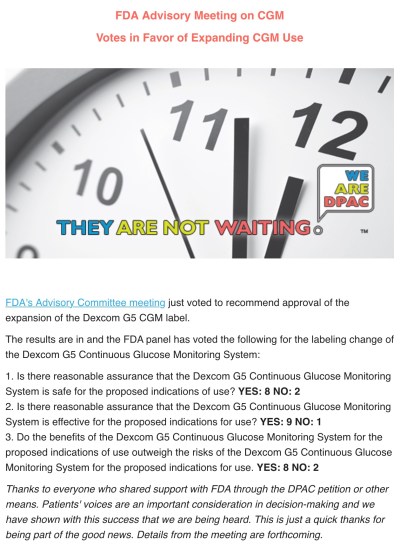
Number #3: FDA and Dexcom G5:  I was pleased to receive an email from Bennet Dunlap of DPAC sharing news from yesterday’s FDA Advisory Committee meeting on Dexcom G5 labeling. The panel voted 8-2 to recommend approval of a G5 labeling change to allow insulin dosing without a confirmatory BG meter test. The FDA will have to make the final approval, but it is likely that the advisory committee’s recommendation will be accepted. This change should help justify Medicare coverage for CGM’s as well as expand the use of CGM to more patient populations.IMG_0932

That’s it for today. Have a good weekend!


We Regret to Inform You

Laddie_Head SquareMy health insurance life is imploding and exploding. I can’t tell the difference between what I know and what I don’t know. What I heard last week isn’t true this week and might change again next week. In January I wrote about dreading Medicare. Today I think it might be the best thing that could happen to me.

On June 23 Blue Cross Blue Shield of Minnesota (BCBS) announced that it will discontinue full-service plans in the individual health insurance market beginning in 2017. This follows the exit or reduction in offerings by other companies in previous years. Minnesota was one of the states that created its own insurance exchange in 2014 after the implementation of the Affordable Care Act (ACA) and the results have been devastating for many of the 6% of citizens seeking individual insurance in the state. (The individual market covers people who do not have access to employer-based coverage and are not eligible for Medicaid or other publicBCBS Blexit programs.)

BCBS of MN is the only company so far to announce its exit from the 2017 individual market. Unfortunately it is the largest insurer in the market and its departure will affect 103,000 of the approximately 300,000 Minnesotans who purchase individual insurance. The recent announcement by BCBS follows a premium hike of over 50% in 2016. This increase was justified by the carrier’s reported loss of $265 million dollars in the 2015 individual market.

My 2016 monthly premium was 61% higher than in 2015 and was accompanied by a slightly higher deductible. If BCBS is continuing to experience unsustainable losses with the huge premiums that I am paying, my fear is that no company will be able to survive longterm in this market. Unfortunately as rates soar, many young and/or healthy individuals are choosing or being forced to go without insurance. The downward spiral of an unsustainable market is intensified as the insured population gets older and sicker and costs skyrocket.

I have no idea what the landscape for the individual insurance market in Minnesota will look like next year. It seems questionable that the remaining players can absorb the 103,000 people stranded by BCBS. Will other insurers pull out? Will exorbitant premiums, high deductibles, limited networks, and poor coverage be the norm? What will be the effects of the presidential election with one candidate vowing to repeal the ACA?

All I know is that I received a letter that says:

“We regret to inform you that at the end of this year, Blue Cross and Blue Shield of Minnesota will be discontinuing all individual and family insurance plans sold to members in Minnesota directly, through an agent or broker, or on MNsure. As a result, you will not be able to renew your current plan or select another Blue Cross plan for coverage in 2017.”

I personally only have to deal with this for three months in 2017 and will transition to Medicare on April 1. I know others who do not have this option. Some of them have Type 1 diabetes and the outlook is bleak.

Yes, Medicare is definitely starting to look pretty good.

*****   Relevant Articles   *****

http://www.startribune.com/blue-cross-eyes-major-exit-from-individual-market/384303131/

http://www.startribune.com/regulators-approve-premium-jumps-averaging-as-much-as-49-percent-in-minnesota/330275391/

Countdown to Medicare with Type 1 Diabetes: 10 Months / Sources of Information

Laddie_Head SquareAlthough 10 months before my 65th birthday seems early to investigate my Medicare options, it’s really not.

First, I can sign up for Medicare three months before my 65th birthday and January is seven months away.

Secondly, I will be doing most of my research this fall in a period that overlaps with the October 15 – December 7 open enrollment period for all Medicare beneficiaries. That is good because there will be a lot of 2017 plan information available at that time. That is bad because most insurance brokers and company representatives will be busy and it might be hard to get individual attention.

Thirdly, as someone with a pre-existing health condition, my initial selections can have lifelong effects. If I do not choose a Medigap (Supplemental) policy during my one-time Medigap Open Enrollment Period (the first six months after I turn 65), I can be refusedCountdown to Medicare 10 Months Medigap coverage or charged higher rates in the future. Although an Advantage plan may seem more favorable in the short run, I need to analyze that decision on a longterm basis knowing the problems of switching to a Medigap policy in the future. Minnesota has the highest concentration of seniors with Medicare Cost plans. These plans are a hybrid between Advantage and Supplemental policies and may end up being a good choice for me.

My sources of information at the moment are:

Federal government:  Websites such as Medicare.gov and Cms.gov are the most reliable source for current Medicare information and regulations.

SHIPs:  State Health Insurance Assistance Programs (SHIPs) provide free one-on-one insurance assistance to Medicare beneficiaries and links to resources for senior citizens in each state. They are state-specific grant-funded projects of the U.S. Department of Health and Human Services. Select your state on this site to obtain the relevant phone number and website. In Minnesota I am linked to the Minnesota Board on Aging along with the Senior LinkAge Line® and MinnesotaHelp.info®.

Insurance Companies:  Commercial insurance websites currently provide information about 2016 plans. The 2017 plans will be released in October. Help numbers and retail store appointments are some of the options offered. Most companies also sponsor group sessions which provide information on Original Medicare, plan choices, and differences among the plans. Last year I attended an insurance company-sponsored meeting titled “Medicare 101.” This year I will attend one or more sessions provided by the companies whose plans I am considering.

Miscellaneous Websites I can Google specific topics and receive multiple website recommendations. It’s a good idea to evaluate the reliability of the data and the source of the info (government vs commercial vs good information vs snake oil).

Books and Publications:  Most of the websites mentioned above have free pamphlets and downloadable books. I have already downloaded the 160-page “official U.S. government Medicare handbook” titled Medicare & You 2016 from the Medicare.gov publications link. You can also purchase commercial books such as Medicare for Dummies.

Insurance Brokers Insurance brokers who specialize in Medicare are a good source for individual help. They earn commissions from the insurance companies and are free for users. In recent years I have worked with an excellent broker for private insurance and recently touched base with the Medicare specialist in the same firm.

Friends with diabetes:  I have already gained useful information from some of my Type 1 friends already on Medicare. For learning the ropes of navigating Medicare with an insulin pump and a CGM, they are a practical and valuable resource.

In some ways learning about Medicare is not that different from learning about diabetes. A lot of it seems confusing and overwhelming at first. As you learn more, you begin to understand how things fits together and become more confident about your decision-making skills. At the moment I would argue that my diabetes expertise greatly outweighs my Medicare knowledge, but I think I’m on the right road.

If you have other sources of information about Medicare, please share them in the comments. Advice is always welcomed!