It’s Always Something

Laddie_Head SquareI’ve got a secret list.  A list that I won’t share even if I knock on wood with Woody Woodpecker-like fervor.  A list that the mere mention of the Top Ten (or is it the Bottom Ten?) would jinx me for sure.  If you’ve got diabetes, you probably have a list like this.  It’s the list of diabetes complications that you don’t want to get.  It’s a list with negotiated rankings.  I could deal with this as long as that doesn’t happen to me.  I know that this might be inevitable, but I’ll be okay as long as I don’t have to live with that.  I know I’m brave, but please, please, please never test my courage with <fill in the blank>.

Some of the complications on this list are life-threatening.  Other things are merely cosmetic or at worst a minor irritation.  Some line items are thought to be the result of too many high blood sugars (let’s add a boatload of guilt here!) while others are related to autoimmunity, duration of diabetes, and age.  Some of these complications share the clubhouse with diabetes and doctors aren’t sure why.  My list is always changing because things that I have never heard of keep jumping into my medical chart.

My most frustrating health issue right now is a skin problem called disseminated granuloma annulare (GA). It doesn’t hurt; it doesn’t itch; it is ugly, ugly, ugly.  The most common form of GA is localized with a small number of clustered nodules usually on the hands, feet, knees or elbows.  These clusters often disappear in a year or two with no treatment.  Disseminated (or generalized) annulare granuloma is an out-of-control inflammatory condition that can tattoo your whole body with a variety of nodules, red patches, and unsightly blemishes.  It can last for ten or more years.

Two and a half years ago I had a bunch of bumps on my elbows.  Thinking that they might be the beginning of psoriasis, my rheumatologist recommended a dermatology consult.  My dermatologist indicated that the bumps were not psoriasis (yeah!).  She believed that they were granuloma annulare and took a biopsy to confirm.  I had never heard of this condition and quickly consulted my online physician, Dr. Google.

There is not a lot of information on what causes granuloma annulare.  In a 2013 case report by Mariele De Paola et al., it is stated:

The pathogenesis of GA remains still obscure. Possible pathogenetic factors suggested include humoral and delayed type hypersensitivity, vascular damage, metabolic disorder, or primary collagen and/or elastin alteration mediated through an immunologic mechanism.

One study indicates that diabetes is in the picture about 10-15% of the time while another study indicates that there is no statistical correlation between GA and Type 2 diabetes.  A 2007 retrospective analysis at the Mayo Clinic found insulin-dependent diabetes in about 10% of the GA cases studied and thyroid disorders in 16%.  These statistics at best show a weak link to diabetes, but most researchers still keep it in the equation.  A 2006 article about granuloma annulare by Peggy R. Cyr, M.D. reports that there is a stronger link to diabetes in those patients who have the disseminated variant that I have.

The American Diabetes Association positions granuloma annulare at the bottom of its list of skin complications of diabetes.  I wish that my experience was as simple as the ADA advises: “See your doctor if you get rashes like this. There are drugs that can help clear up this condition.”

My somewhat localized granuloma annulare exploded last fall.  By December it was spreading noticeably from day-to-day and was officially disseminated granuloma annulare. The prescription-strength cortisone cream that helped two years ago was useless.  Because this variation of GA is unusual (about 15% of all cases), there are no large clinical trials to guide my dermatologist in choosing an effective treatment.  Instead she keeps showing me the “big brown book” with the list of medications that have been helpful for patients in small anecdotal studies of 1 to 10 patients.  Many of these drugs overlap with medications for rheumatoid arthritis, psoriasis, and acne and the list includes Dapsone, Accutane, Plaquenil, and Remicade.  As Dr. Cyr writes: “The possible benefit of treatment, which is unclear given the lack of clinical trials, must be balanced against the significant toxicities of most of these treatments.

No Photos AllowedI am currently taking nicotinamide which is a water-soluble member of the B vitamin group.  Nicotinamide rarely causes side effects even at high doses and my dermatologist has prescribed this treatment because of its lack of toxicity.  The basis for the use of this product is a 1983 paper by Alice Ma, M.D. discussing the complete clearing of generalized granuloma annulare in one (!) patient after 24 weeks of high doses of nicotinamide.  It has also been used successfully for inflammatory acne and that is probably the more likely justification for using it for GA.

Is nicotinamide helping me?  Some days I think so.  Other days I think not at all.  Is GA affected by blood sugar levels?  Not in my experience and not according to any articles that I have read.  Is GA related to other health issues besides diabetes?  Granuloma annulare has been linked to autoimmune thyroid disease, some types of cancer, and HIV infection in addition to diabetes.  Is GA autoimmune?  No, it’s inflammatory, but inflammation and autoimmunity go hand-in-hand when you have clusters of autoimmune/inflammatory conditions as I do.

One thing that I find interesting is that when I write about my medical issues, I usually link them to Type 1 diabetes.  Granuloma annulare actually seems to have a stronger correlation with thyroid disease but typically I have glossed over that.  I suppose I do that because I have never been symptomatic for hypothyroidism and the little pill I take every morning is an inconsequential part of my life.  On the other hand, diabetes always demands attention and is woven into almost every minute of every day.

An important issue is what granuloma annulare is doing to my psyche.  One good thing is that GA rarely shows up on the face.  Therefore I can live the rest of my life in turtlenecks and long pants.  A great solution for cool weather but not so great for summertime….  The hardest part is that I can follow my doctor’s orders and still have no control over the unsightly lesions.  When you have Type 1 diabetes, you get used to the idea that WHAT I DO MAKES A DIFFERENCE in my health.  GA abuses that notion daily.  I have to admit that I am getting used to dealing with it and I try to remind myself that it’s not itchy, painful, or life-threatening.

Growing older with a cascading series of autoimmune/inflammatory issues requires an acceptance of today without worrying about tomorrow.  My secret list of diabetes complications will always be in my back pocket, but being afraid of it accomplishes nothing.  Granuloma annulare is a frustrating skin condition and I hope that it eventually goes away.  But there is no reason to let it ruin today or tomorrow.  It is what it is and nothing more.

Gluten-Free

Laddie_Head SquareI am a doubter.

But I have a bunch of autoimmune/inflammatory issues that anecdotal stories report improvement when switching to a gluten-free diet.  I don’t have celiac or at least it’s highly unlikely that I have celiac.  I don’t have any of the digestive issues that often go along with celiac.  I’ve had the blood tests and all were negative.  I feel perfectly fine regardless of what I eat except when I am plagued with guilt at some of my poor food choices.

I am a doubter.

At my last endocrinology appointment I asked my doctor whether she thought a gluten-free diet might help me as I struggle with clusters of autoimmune issues, most recently a skin problem called disseminated granuloma annulare.  I expected her to say “no.”  She didn’t.  I indicated that I didn’t know if I had the discipline to follow a gluten-free diet.  She asked me whether it was worth getting rid of the dermatological problem to change my diet.  I couldn’t argue with her.  She indicated that there is no scientific evidence to support a GF lifestyle for people like me, but she has patients who feel that it has made a significant difference.

I am a doubter.

Yesterday I began a 3-week trial of eating gluten-free.  I have been working hard in the last two years to eat lower carb, so a gluten-free diet is not a huge change.  In fact since there is no gray area with gluten-free, it may help me avoid the post-dinner “eat a lot of crap.”  One pack of Ritz peanut butter crackers will nullify my trial and I don’t want to do that.  I don’t plan to buy many products that imitate real food but with no gluten.  Meaning I plan to go without bread rather than buy breadly concoctions that purport to be bread.  Actually I may need to buy some GF bread because I don’t think that I can live without my natural peanut butter.

Gluten Free

I am a doubter.

One of my favorite people in the Diabetes Online Community is Katy from Bigfoot Child Have Diabetes.  Her son was diagnosed with celiac disease last year and I have marveled at the changes she has made in her kitchen and cooking.  My GF experiment would be truly epic if I could move in with Katy for three weeks and eat her tantalizing chocolate chip cookies for breakfast, lunch, and dinner….  Jewels from SheSugar runs a gluten-free household, but admits that she doesn’t suffer with a bit of cross-contamination while her daughter with celiac suffers greatly.  I have decided to do my best to eat GF without worrying about cross-contamination.

I am a doubter.

I’m not from Boulder.  That is an inside joke.  Boulder, Colorado is a trendy community.  No matter what the latest fad for eating or living is, you’ll find Boulder residents leading the way.  The husband of one of my Arizona friends (they’re officially from Boulder) has had measurable success eating gluten-free.  My friend indicated that it was easy to avoid gluten in Boulder because half the population is gluten-free and almost every store has a huge assortment of GF products.

I am a doubter.

I made it through one day.  I am keeping a log of my eating with carb counts and insulin bolus amounts.  Every food so far has a check in the Gluten Free column.  My endocrinologist indicates that a 3-week trial is sufficient.  If I had digestive issues or “not feeling good” issues, I would agree with her.  With my skin issues, I don’t know whether 3 weeks is enough.  But I’ll deal with that 3 weeks from now.

Follow-up

Laddie_Head SquareIn Thursday’s blogpost I discussed how I had considered postponing my endocrinologist appointment because I didn’t like what it might reveal.  I went to the appointment as scheduled and except for my interaction with one of the nurses, it was uneventful.  My doctor is part of a large endocrinology group and I have never received anything other than knowledgeable and professional care from her, the nurses, and the support staff.  Thursday was an exception, but in a more humorous than problematic way.

I had never met the nurse who called me back, but I assumed that she was a regular in the practice.  The first question she asked was “Are you taking your Lantus?”   No, because I don’t take Lantus. I use an insulin pump.  “Are you taking insulin with your meals?”  Of course I am because I have Type 1 and rarely eat without taking insulin.  “How is it going with your Novolin?”  Rather than explain that Novolin refers to NPH, Regular, and various mixed insulins produced by Novo Nordisk, I explained that I had never been asked these questions before and suggested that maybe they didn’t make sense.  “Did you bring your meter today?”  Yes, but I downloaded everything to Diasend and you can print out the reports for my doctor.  “That’s good and I’ll do that.  Did you bring your pump with you today?”  Silence.

Later in the appointment I learned that this nurse is one in a series of temps replacing the usual nurse who is on maternity leave.  Her ignorance wasn’t particularly annoying; it was just odd.  She couldn’t have been nicer and was doing her best to follow whatever instructions she had been given for updating my chart.  After taking my blood pressure, she said that she’d leave everything else for the doctor and quickly escaped to print Diasend reports.  For my visit her lack of knowledge was inconsequential, but it was a reminder of how little some medical professionals know about diabetes.

And now (drumroll please) my doctor appeared.  Her first question, as always, was “How are you?”   That can be an ultra-trite question, but I think she asks it to give me the opportunity to set the direction of the appointment which is never long enough to cover everything.  I believe that she would be open to discussing anything whether it be BG numbers, thyroid issues, or mental health.

My concern of the day was my multiple autoimmune/inflammatory issues and wondering if she had any opinions on whether a change in diet (particularly gluten-free) might be beneficial.  She indicated that there is no strong scientific evidence to indicate that a gluten-free diet would make a difference in my health, but anecdotally she has patients who feel that it has made a difference.  She suggested I give it a 3-week trial.

Now is not the best time for a gluten-free trial.  I am dealing with a frustrating skin condition called granuloma annulare (a topic that warrants its own blogpost).  Because I have the disseminated form of GA, I have abandoned topical products and am in the early stages of trying to find a drug that will slow down or eliminate the autoimmune/inflammatory condition.  I see my dermatologist this week and expect that I will be moving to a new class of drugs.  It doesn’t make sense to change my diet at the same time that I change medications because I won’t know if any improvement is from the new drug or the elimination of gluten.  So a gluten-free experiment will have to be put off for a while.  My opinions about going gluten-free are also worthy of a dedicated blogpost and I’ll save those thoughts for another day.

Back to my endo appointment.  I have been frustrated by overnight highs that occur between midnight and 2:00AM.  My endo ignored those and was more concerned FollowUp_Clipboardwith the lows that precede those highs.  I guess that I was aware of the lows but didn’t see the cluster of them the way that she did with her usual expertise at seeing patterns in CGM tracings.  Sometimes I think that I’m too deep in the trees to see the forest.  In my opinion, both the lows and highs are caused by the same thing:  too much after-dinner eating that is not matching up well with my insulin.  She’d like to see me reduce my basal and bolus rates through the evening.  I’d like to see a reduction in post-dinner snacking which is really the cause of both the highs and lows. I am working on the problem and already seeing some improvement.

I didn’t get any comments on my weight gain (!) so it’s back to me to deal with it or not deal with it.  At the very least I don’t want to gain more weight.  My guess is that if I take care of the blood sugar problems from evening snacks, the weight will take care of itself. Imagine that.  Everything is related to everything else.

In summary I survived the appointment.  My thyroid tests were in range and my A1c was much better than expected.  I only see my endocrinologist twice a year so the countdown to December has started.  20 minutes with her.  262,780 minutes with me running the show.

Endo Appointment

Laddie_Head SquareI have an appointment with my endocrinologist this afternoon.

Last week I wrote myself a note to call and postpone this appointment.

I’ve gained about 5 pounds in the last year. I’m thin and that is not the end of the world, but for me this is a big gain. I am now over a threshold number that I haven’t seen in ten or twelve years. My endo is pretty observant and I suspect she is going to notice the pounds. I keep reading research reports that indicate that people who are thin and people who are obese have the worst life expectancy numbers. So I can argue that it is good for me to have gained weight and maybe it is. Or maybe not. Or maybe it doesn’t matter at all. None of that changes the fact that I have gained weight that I am having a hard time losing.

My Dexcom graphs are ugly. I have a 10-year run of A1c’s that I privately take great pride in. But it is rare that I have a blood draw that I don’t think that this is the A1c that will end my streak. We read about hypoglycemia unawareness and hyperglycemia unawareness. Even with Dexcom Studio and Diasend (and previously Carelink), I definitely have A1c unawareness. I don’t have a clue what my report card will reveal. I do know that if I postpone this endo appointment, I can definitely have better results in a week month year.

I have had great success in the last couple of years by reducing the number of carbs that I eat. I strongly believe that diabetes, whether Type 1 or Type 2 is a disease of carb intolerance. I’ve read books like Why We Get Fat by Gary Taubes, Wheat Belly by William Davis, and The Diabetes Solution by Richard Bernstein. These books make sense to me. You need to read these books.

My weight gain is the result of following a low carb diet with plenty of high calorie foods such as cheese and nuts and then eating carbs In addition to that diet. My Dexcom tracings are good during the day. A glass of wine, dinner, and then cravings for nuts and SF Jello with mounds of whipped cream lead to lows at midnight followed by Himalayan spikes at 2:00AM.

But I didn’t cancel the appointment. Avoiding this appointment would be little different than hiding candy bar wrappers in the garbage. Avoiding this appointment would be little different than not testing my blood sugar because I don’t want to see the result.  Endo OfficeAvoiding this appointment would be little different than refusing to step on the bathroom scale. Avoiding this appointment would be hiding and in some ways “lying by omission”.
Not getting an A1c today doesn’t change the patterns of my blood sugar for the past few months. Whatever the status of my health is today isn’t going to change by not printing out my Dexcom tracings or Diasend reports. I am an adult and for better or worse, I need to be accountable for my lifestyle and decisions.

Avoiding my doctor is a slap in the face to her education, experience, and value in my life. She has never belittled me or made me feel guilty. She has always supported me and made sure that I have access to the latest medical technologies and the most appropriate medications. She is my doctor in order to help me live as healthy a life as I can with Type 1 diabetes. How can she help me if I don’t go see her and tell her the truth?  Maybe she will have some suggestions to level out my BG at night so that I can have an occasional CGM alarm-free night. Maybe she will say something to help me get back on the right self-care track. I am starting to have more autoimmune/inflammatory issues and maybe she will have some advice about whether I should give a gluten-free diet a try.

So I am going to see my endocrinologist this afternoon and I think I’ll survive it.

Then and Now

Laddie_Head SquareLast week I was rummaging through an old file cabinet and came across a folder titled Medical. I was amazed to find envelopes of medical bills from 1976 to 1982. If I had to pick the most important seven-year period of my life, these years might win the prize with such defining moments as my marriage, my diabetes diagnosis, our first house, and the births of our two sons. Browsing through this paperwork was like taking a walk back in history and discovering long-forgotten facts to back up or alter some of my fuzzy memories.

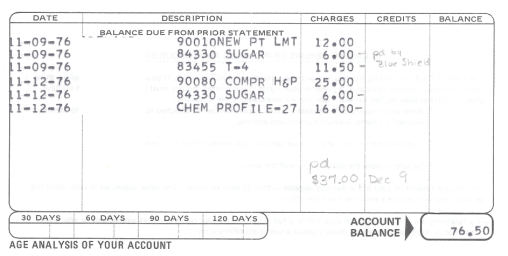
First is the 1976 doctor’s bill for my diabetes diagnosis. In the blogpost sharing my diagnosis story, I mentioned only one doctor’s visit and my memory about the timing of my hospital admission was off. This bill clearly shows that I had a new patient visit on November 9 (Tuesday) and then what was probably a pre-admission physical on the 12th. Although I was thirsty and losing weight, I was not in DKA and did not enter the hospital until a week (!) after diagnosis.Doctor Bill_Diagnosis_1976

Prices were just a bit cheaper in 1976…. Two office visits with lab work totaled $76.50 and according to my notes in pencil, Blue Shield paid the lab fees.

The total charge for my three-night hospital stay was in the ballpark of what I am now charged for an endocrinologist appointment with lab work.Scan_Diagnosis_Hosp_1976_Blog

A 1977 bill shows that my routine diabetes check-ups cost $12 for the visit and $6 for a blood sugar test. Home self-monitoring of blood sugars was not available in 1977, so this was one of the approximately 4-6 “Sugar” tests I had per year.Scan_Bill_Doctor_1977_Blog

A insurance form filled out by the pharmacy in 1977 shows that I was reimbursed $3.91 for a two month supply of insulin. I was only on one type of insulin (Lente) in those days.Scan_Insulin2_1977_Blog

I have copies of lab results going back to the mid-80’s and I have always assumed that those reflect my first A1c tests.  False memory for sure because this 1978 bill clearly shows a charge for a Glycosylated HGB.Scan_Bill_Doctor_1978_Blog

Now for the fun and games! Here’s an insurance report with the charges for a 2013 routine endocrinologist appointment with lab work. Just a wee bit more than the 1977 total of $18.Doctor Bill_2013_Blog

A 2013 Walgreen’s receipt shows 4 vials of Novolog insulin at a retail price of $719.89 ($180 per vial) along with the insurance-negotiated price of $563.15 ($140 per vial). It is not the same insulin product that I bought in 1977 for $3.91 and a better comparison might be with the Walmart brand of NPH that you can buy these days for about $25.Scan_Insulin_2013_Blog


Summary:  Diabetes care has come a long way since I was diagnosed in 1976.  One daily shot of pork-based insulin has been replaced by an insulin pump using a genetically-modified analog insulin. Urine tests with Diastix and occasional “Sugar” tests at the doctor’s office have been superseded by home glucose meters and a continuous glucose monitor.

The cost of diabetes care has gone up astronomically, but so has the quality of care. Last Thursday I played golf, walked the dog, and did yard work. My Fitbit showed that I walked over 23,000 steps for a distance of 10 miles. I am 62 years old and have had diabetes for over 37 years. If I were still using 1976 standards of care, it is doubtful that I would be in such good health these days. Who knows if I would even be alive? Yes, I wish that insulin still cost $3.91. But I am truly thankful for the medications and medical devices that allow me to get up every morning knowing that diabetes won’t stop me from living another day. Another good day.

Musings On Being the Parent of an Adult Type 1 Diabetic

Sue May 2013_Head SquareWhen I started blogging at Test Guess and Go, in my first blogpost I introduced myself as the mother of a boy who was diagnosed with diabetes in 1975 at the tender age of 4, and I recounted the trials of those early days. It has now been 39 years since that diagnosis day. I also shared that I became a Type 1 diabetic in 1988. While I would never wish diabetes on any parent, I do believe that my diabetes has helped me to understand what my son is going through and why I need to not be critical when he experiences hypo and hyperglycemic episodes. I realize that in spite of our best efforts, diabetes has a mind and life of its own.

When your child is young and in your care, you can somewhat manage his day to day diabetes control. As he grows up, you encourage him to learn to take charge of his health and become independent. That is a parent’s job. And when he goes away to college, you are a little apprehensive, but realize that it is time to let go.

A couple of years after Steve graduated from college, he moved to New York City to seek employment in the theatre, his chosen profession. In those years before he acquired a pump and continuous glucose monitor, there were many close calls of hypoglycemia episodes. In July of 1999, my husband and I had spent a wonderful weekend away celebrating our 30th anniversary. When we returned home, there was a message on our phone from our daughter informing us that her brother had had a hypoglycemic episode while on his way to the subway. He had collapsed and broken his leg. The next morning we drove to NYC, picked him up at the hospital and brought him upstate to live with us while he recuperated. In January of 2000 we drove him back to his Queens apartment. In those days his diabetes was out of control and it took him longer to recuperate than it would now.

In May of 2000 his eyes started bleeding (proliferative retinopathy), and he began what would become ongoing laser treatments on both eyes. At that time he gained full-time employment with health insurance benefits at NYU and had to give up his dream of acting.  A couple of years later he found out that he had neuropathy. Two years ago he moved back upstate and he hasn’t needed laser on his eyes since then. I pray that it continues. His eye doctor says it’s due in part because he is not experiencing the level of stress he had while living and working in NYC.

Grow Up2Because Steve lives alone, there has been no one to keep an eye on him and we have to have faith that he will be okay. In essence, we have had to Let Go and Let God. And let’s face it, once your child is born, no matter what his circumstances and health are, you will worry about him for the rest of your life. Unlike the animal kingdom, I believe we are genetically hardwired to do this. And it’s OK as long as we let them manage their life on their own without trying to interfere. I confess that I sometimes struggle with this. Then I remind myself that if he wants my advice, he’ll ask for it, and if he doesn’t ask, he doesn’t want or need it.

It makes me sad when I read the stories of mothers and fathers today who are learning to cope with their child’s Type 1 diagnosis, but I take comfort knowing that in recent years there have been many advances in managing diabetes, including pumps, continuous glucose monitors, blood glucose meters, carb counting, new insulins, etc. There has also been much research into an artificial pancreas and we are now seeing ongoing trials. It is my fervent hope that when today’s Type 1 children are my son’s age, they will not have the complications that Steve has experienced and their parents will not have the heartache of seeing their child suffer from these complications.

Diabetes Soldiers

Banner_DBlog Week

Today’s Topic:  Back for another year, let’s show everyone what life with diabetes looks like!  With a nod to the Diabetes 365 project, let’s grab our cameras again and share some more d-related pictures.  Post as many or as few as you’d like.  Feel free to blog your thoughts on or explanations of your pictures, or leave out the written words and let the pictures speak for themselves.


Laddie_Head SquareIn yesterday’s post, I mentioned that I am trying to convert from a Windows user to a MacBook junkie.  It hasn’t happened yet. I am a MacWinBookDows person. I need them both.

Today I started with a photo of 52 crystals lined up in a row.  The crystals are the beautiful blue pieces that operate my Animas reservoirs. A long time ago I learned that I don’t need to change my reservoirs on the same schedule as my infusion sets. Each reservoir lasts me for about a week. So these 52 crystals represent a year of reservoirs for me.  A year of insulin. A year of life. These crystals represent the soldiers that keep me alive. Day after day. Reservoir after reservoir. Week after week.

They remind me of Chinese soldiers. All in a line. Powerful, but regimented. One, two, three, four, five. The Great Wall of China.

My kitchen has back splash tiles that measure 3.5 by 3.5. Add in the grout and each tile embraces 5 Animas crystals.10 tiles with 2 leftover crystals equals a year.

This morning I lined up 52 crystals. I cropped my photo and then used various filters in Pixelmator to show my Diabetes Soldiers in different costumes. I couldn’t figure out how to do the final cropping on my MacBook, but Photoshop on my Windows Desktop delivered my final photo: Diabetes Soldiers, Diabetes Soldiers Black & White, Diabetes Soldiers Sepia, Diabetes Soldiers Green, Diabetes Soldiers Blurred & Colored, Diabetes Soldiers Bumped, Diabetes Soldiers Vortex and Colored, Diabetes Soldiers Inverted.

Diabetes Soldiers. One, two, three, four, five. Animas reservoirs keep me alive. One, two, three, four, five. Insulin keeps me alive.

Every day.

Thank-you.

Mantras and More

Banner_DBlog Week

Today’s Topic:  Yesterday we opened up about how diabetes can bring us down. Today let’s share what gets us through a hard day.  Or more specifically, a hard diabetes day.  Is there something positive you tell yourself?  Are there mantras that you fall back on to get you through?  Is there something specific you do when your mood needs a boost?  Maybe we’ve done that and we can help others do it too?

*

Laddie_Head SquareAll day long I’ve tried to think of something to write on mantras.  Reading multiple #DBlogWeek posts about mental health has not done much to inspire me. I’m feeling a little gloomy reading about the struggles of my fellow DOC members. Right now I just want to yell “GROUP HUG!

I wasn’t a cheerleader and “push ’em back, push ’em back, way back” doesn’t doesn’t seem to have much relevance beyond what I should be doing to dessert at the table: “Push it back, push it back.” I’m not much into meditation and “Om” mostly reminds me of Sheldon’s throat singing on The Big Bang Theory.

The Little Engine That Could is a charming and inspirational children’s book, but “I think I can, I think I can” seems a little trite on my 1,460th insertion of a long-needled Silhouette infusion set. I know I can, but I still don’t want to.

“Take one for the team” implies that because I have diabetes, I am statistically saving another person from getting diabetes. If only.

I’ve often written about getting up every day and trying to do a better job with my diabetes. For the most part, that is what I do. But I can’t use the “Try, try, try again and you shall succeed” mantra. What will be the measure of my success? That I didn’t die? That my diabetes is cured? That I have a good A1c? The only good prize to win with diabetes is that you don’t get the bad prizes. “I guess that is a good prize,” she says, smiling….

Just Do ItMaybe “Just do it” should be my mantra. With visions of a Nike swoosh, that can be inspirational like climbing Mt. Everest. Or swimming the English Channel or finding a cure for cancer. I’d look good in a Michael Jordan basketball uniform (not!).

But “Just do it” can also mean “Quit thinking about it, you ninny, and do what has to be done.”  Test your blood sugar, count your carbs, change your pump site, calibrate your Dexcom, order your supplies, bolus for meals, do it again. Do it again and again and again. Don’t think about it. Just do it.

Yeah, that’s the one. Just do it.

Always an Optimist

Banner_DBlog Week

Today’s Topic:  May is Mental Health Month so now seems like a great time to explore the emotional side of living with, or caring for someone with, diabetes. What things can make dealing with diabetes an emotional issue for you and / or your loved one, and how do you cope?


Laddie_Head SquareI don’t carry a lot of emotional baggage with my diabetes.  I knew very little about diabetes when I was diagnosed as a young adult in 1976 and I didn’t know that I should be sad, mad, or depressed. Both of my parents had issues with depression and for whatever reason, I have been spared that journey into darkness.

I began my diabetes life before home glucose monitoring was available and my insulin regimen was one shot a day of Lente. I followed doctor’s orders when it came to testing my urine and taking my insulin. I wasn’t perfect when it came to my exchange diet, but I followed the diet plan more often than not. Diabetes wasn’t filled with too much guilt and I had no expectation of perfect control. In some ways I was also very naive. It was never part of my mental make-up that I even had diabetes. To this day my self-conception is that I am active and healthy and that whatever the stereotypes and realities of diabetes are, that’s not me. A phrase in the songs of several artists (The Band, Good ShapeCasey Shea, Harlan Howard, and more) fits me perfectly:  “I’m in pretty good shape for the shape I’m in.”  Stupid for sure, but it helps keep mental demons at bay.

Lest you think that I am all smiley-face and Pollyanna about diabetes, I find it to be an incredibly frustrating and mind-tangling condition to live with. Most of the time my blood sugar responds in a somewhat expected fashion. Things aren’t perfect, but the tracings on my Dexcom are familiar and not totally from Mars. Then days like yesterday. My BG started climbing after my morning walk when usually it stays level or trends low. Multiple corrections and a lunch of only 18g carbs rocketed my numbers high and higher. It was the day to change my infusion set and two changes later (the first one hurt), nothing improved. Boatloads of insulin finally brought things down just in time for dinner. Stir-fried chicken and vegetables (no rice!) re-launched my BG to the stratosphere.

Most people who know me think that I am incredibly disciplined and rarely veer off the path of lowish-carb good nutrition. Ha! Not so! A “good diabetic” would have spent the evening drinking oodles of water and avoiding the snack cupboard. Unfortunately my most common reaction to unexplained and “undeserved” highs is to say “What the heck!” and start gorging on crackers, cookies, and ice cream. Add another glass of wine to the mix and moderation is banished.

Frustration with diabetes. Disappointment in my lack of willpower. Guilt for sure. A night of Dexcom squawks. A recipe for mental anguish and depression.

But morning comes. And just as I have on each of the 13,693 days since I was diagnosed with diabetes, I get up and resolve to do a better job today. Another day filled with diabetes, but a new day nonetheless.

A Diabetes Poem

Abby with Abby Crown_no backgroundToday’s Topic:  This year, Diabetes Blog Week and TuDiabetes are teaming up to bring out the poet in you! Write a poem, rhyme, ballad, haiku, or any other form of poetry about diabetes. After you’ve posted it on your blog, share it on the No Sugar Added® Poetry page on TuDiabetes, and read what others have shared there as well!

Thanks to Abby the Black Lab who has taken time off from her busy day of napping to share some thoughts about diabetes.


 A Diabetes Poem by Abby the Black Lab

I don’t know fancy poetry,
But I do know how to rhyme.
Diabetes is a pain-in-the-butt
All of the time.

I’m not a smart alert dog.
I don’t smell lows or highs.
But I do wish that diabetes
Would take a big good-bye.

At eighty pounds I’m big and black
And always need a hug.
I’m just a big old lapdog
And cuddly like Lancet the Pug.

It’s true that I am just a dog.
Dog biscuits make me drool.
I am so glad to not count carbs
Diabetes is so cruel.

I’m starting to get old and stiff.
My joints are getting sore.
It’s sad to know that one gray day
DSMA walks will be no more.

Glucose meters come and go.
Diabetes seems to stay.
It’s faithful like a big black dog
And never goes away.

If I could bark and scare away
Type 1 and Type 2 likewise.
I’d ask for heaping bowls of food
And not the Nobel Prize.

So diabetes, please be cured
And don’t come back another day.
You’re not a friend like cats and dogs,
That’s all I have to say.

Banner_DBlog Week