
 Yesterday Tom Beatson of Phoenix, Arizona celebrated his 72nd anniversary of living with Type 1 diabetes. I’ve been lucky to get to know Tom in recent years through Valley Pumpers, an insulin pump support group that I attend during the winter months in Arizona. Many people in the diabetes community know Tom through Facebook and other online venues. He’s an incredible guy who is always kind, inspirational, smart, and opinionated. Tom has participated in the Joslin 50-year Medalist Program and supports diabetes research through the Joslin Diabetes Center.
If you’d like to learn more about Tom, check out this TuDiabetes interview from January 2013. In this video he and Richard Vaughn (diagnosed in 1945) discussed living with Type 1 diabetes for over 70 years.
Below you will find Tom’s story as he shared it in an email and on Facebook yesterday. I asked Tom if I could post his statement and photo here today and he graciously gave me permission.
With no further ado, here is Tom Beatson in his own words:
“Today is my anniversary. Exactly one year after Pearl Harbor was the first day I was sick with T1D Type 1 Diabetes. I was 10 years old. Two days later Dr. Wright made a house call and decided I needed to be in the hospital. Since my mother didn’t know how to drive, Dr. Wright drove me and my mother to the hospital in his car. Shortly after arriving at the hospital I lapsed into a coma. Of course, insulin saved my life. I don’t have any records or recollections by my parents, but I think I was comatose for several days, and remained in the hospital for a month. That was 72 years ago, in 1942.
Lots of people have asked me how or why I have survived through all these years. I don’t have a magic answer for you. I take one day at a time and do the best I can. It’s been pointed out to me that I have a lot of determination, and that has been very helpful.
Another thing that has been helpful is exercise. When I was about 45 I started riding a bicycle and did that for 35 years. During those years I accumulated 106,000 miles. I have stopped riding currently because of soreness in my lower back, but hope to resume bicycle riding.
Back in the 1940s the insulin pump hadn’t been invented yet, so I used shots every day for 52 years. That was long enough to earn me a 50-year medal. Then in 1995 Dr. Levy started me on the insulin pump. My control has been much  better using the pump. I am currently on my fourth pump – the Animas Ping. It was preceded by the Cozmo, 508, and 506. Since I’m on Medicare, they won’t approve a CGM. Their rules are not medically sound. My daily dose ranges between 35 and 45 units of Humalog insulin.
Since I am already 82 I’m not very optimistic about seeing a cure within my lifetime. But I’m keeping a close eye on the Bionic Pancreas that Dr. Ed Damiano is working on at Boston U. His goal is to get FDA approval by 2017, and that’s when I reach 75 years of T1D, so I’m hoping to be able to get a Bionic Pancreas in time for my 75th anniversary.
Unlike some of you who still claim no complications, I’ve been dealing with retinopathy for 50 years. It remained background until about 10 years ago, when one eye became proliferative. And I’ve got kidney problems. But I have no neuropathy and no gastroparesis. My hearing is still good. I’ve had chronic lymphocytic leukemia for 20 years with a white cell count around 60,000 but it never gets high enough for them to treat (80K). And I have colitis.
What was the biggest mistake of my life? I never got married, and have lived alone for more than 50 years.”
Thank you, Tom, and best wishes for many more years of good health with Type 1 diabetes. I’ll give you a call in three years and see how you like your 75th Anniversary gift of a Bionic Pancreas!
 some of the speakers. Titles of recent shows have been The Source of Creativity, the Balance within Us, The Edge, and The next Greatest Generation?. The topics are always interesting and this podcast exposes me to lots of ideas and subjects that I might otherwise know nothing about.
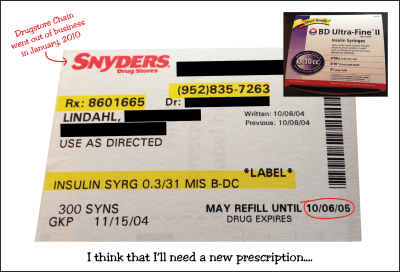
 Over the weekend I was asked by fellow Minnesotan


 What happens if a traffic accident leaves you unable to speak? For that matter, what happens if you are a diabetic with hypoglycemia unawareness and suffer a severe low while operating a motor vehicle? I can go even further and ask what happens if you have a heart condition and suffer an incident while driving your automobile? There are many what ifs. I recently found out about a program called the Yellow Dot Program. I learned of this program when my fellow blogger Sue and her husband Steve were visiting us from New York during the summer. Somehow we got into a diabetes discussion, and the subject of this program came up because they had a Yellow Dot on the driver’s rear windshield of their car and the Yellow Dot booklet in their glove compartment. I googled my Pennsylvania State Department of Motor Vehicles and found out that Pennsylvania had the program and immediately sent away for the booklet which contains the Yellow Dot and information about using the booklet to inform police and first responders in the case of an accident.
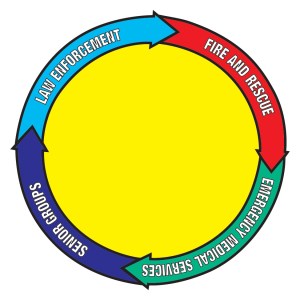 vehicle’s rear windshield alerts police and first responders to check your glove compartment for vital information to ensure you receive the medical attention you need. While it was specifically created for traffic accidents, I have been told by my Department of Motor Vehicles that they are now adapting it to include any type of medical issue including diabetes. That wonderful yellow dot on the rear driver’s window of your vehicle will alert the police or first responders that you are not drunk…you are having a diabetes-related incident.
 Do people with Type 1 diabetes have better insurance coverage because our type of diabetes is worse? Well, maybe yes. All types of diabetes are the “bad” kind, but Type 1 is flashier bad. We wear the costume of “cute little kid” even though we can be anything from an infant to an 80- year-old crotchety old guy. We pass out at inopportune times and occasionally scare the crap out of everyone with seizures. Our BG numbers can range from 30-450 in a single day and we don’t consider a jump from 100 to 110 in fasting BG to be significant. Without insulin we could die in a couple of days or weeks. In general Type 1 is more dangerous in the short run and yes, we need pumps and CGM’s more than most people with Type 2.
 This post is a mixture of important and not-very-important stuff. If you’re like me and getting tired of ‘heavy” and “try to change the world” issues, you might want to just read the last section which deals with autumn colors and burned-out lightbulbs. November is coming soon and I need to re-energize myself when it comes to diabetes advocacy. I will — because diabetes never takes a vacation.

 Most of us try to live a healthy life. Yeah, we make some bad decisions but we also do a lot of things right. I always think that it is funny how many of us share photos of post-doctor appointment cupcakes. Why do we work hard to prepare for medical appointments and then revel in “forbidden” treats afterwards? Are we just being healthy to impress our medical professionals? Beats me, but I always feel the need to “reward” myself after a stressful appointment or lab test.
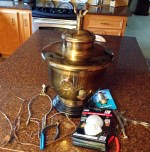 So far I have not had a great experience with long-lasting power-saving lightbulbs. My latest glitch was the rattling and sizzling demise of a $15 lightbulb. I put in another bulb and it died in a day or two. Being the electrical whiz that I am, I determined that I needed to replace the burned out socket in the lamp. A trip to the hardware store, a new socket, and a $20 LED bulb solved the problem. The new bulb is advertised to last 22.8 years and ultimately save me $231. I’ll be 84 years old when it bites the dust (unless it’s like the old one which only lasted a month).
 Mid-October is a colorful time in Minnesota. This photo was taken late last week on an early morning dog walk. Unfortunately strong winds and cold temperatures have resulted in a blanket of beautiful leaves in my yard. But one good thing: Raking counts as exercise for the Big Blue Test!


 Test Guess and Go