Baby Steps

Sue B_Head SquareFor months I have been blogging about the roadblocks my husband has faced in getting a CGMS. He used one before going on Medicare, but a replacement system prescribed by his endocrinologist was denied by Medicare. We went through Levels 1, 2, and 3 of the Appeals process and had a hearing with an Administrative Law Judge on June 26, 2013. After being promised a decision in three months, we are  at seven months and still waiting for the judgement to be drafted so that we can find out if we got a “Fully Favorable Decision” or not.

In the meantime, I have been in contact with a Legislative Assistant of Representative Carol Shea-Porter [D-NH1].  In December 2013 Shea-Porter introduced a bill into Congress (H.R. 3710) which provides for coverage of Continuous Glucose Monitoring Systems by Medicare if recommended by a doctor. Unfortunately this bill is being given little chance of passing, but I believe it is an important step in bringing attention to the important issue of CGMS coverage for senior citizens.

I have also been in touch with the Global Marketing Director of Dexcom and she has indicated that together with Medtronic, they are forming a coalition to plan a big legislative push with respect to CGMS and Medicare.

I have been cautioned that it is too early to become excited about a speedy change in Medicare policy. But for me this is exciting news. I have gone from feeling totally alone in my crusade to knowing that a Congresswoman, Dexcom, and Medtronic are taking steps to influence Medicare to change the guideline.  For the many diabetics on Medicare who need a CGMS and can’t afford the cost of the device and sensors (my husband being one of them), there is a glimmer of hope that victory will be achieved now that some of the big-time players are becoming involved in the fight.

Climb the MountainThe steps being taken now are just baby steps and it is still a long way to the top of the mountain. There will come a time when I, together with many others, will need to have our voices heard. We will need a groundswell of support from the Diabetes Online Community to help change Medicare policy to provide for CGMS when medically necessary for senior citizens with diabetes.

Right now we are in the early stages of figuring out how to do this in the most effective way. I urge you to keep reading Test Guess and Go as we update our progress.  Please contact me if you have any information or contacts who will be helpful in pursuing this goal. If you are on Medicare (or will soon be on Medicare) and are concerned about your safety in living with diabetes without a CGMS, please reach out to me to add your name to my growing list of advocates.

Baby steps.  So small, but the first steps on the road to victory.

Oh What a Night!

Sue May 2013_Head SquareNo, I’m not referring to the popular song by The Four Seasons. I’m referring to last night.

After dinner I checked my blood sugar, got a reading of 246, and dosed 5 units of Apidra on my pump, which is what I normally dose for a 250 reading. I went to bed around 9, and woke up to four loud beeps and a reading of 50 on my Dexcom around 12:30 am. I ate two glucose tablets and went back to sleep. Around 1:15 am my Dexcom beeped four times again, and after doing a finger stick and getting a reading of 54, I once again ate two glucose tablets and a small box of raisins and went back to sleep. Another hour passed, another four beeps, and this time the Dexcom read 40. What on earth was going on? This time I drank a small box of juice, and once again returned to sleep. After another hour I got the four beeps again. I got up and swallowed a tablespoon of maple syrup, the old standby my husband always used when I was comatose from a low. When I woke at 7:30 this morning, my fingerstick showed a reading of 83. So overnight I consumed approximately 55g of carbs, and still only woke with a blood sugar of 83!

BG Numbers off a Cliff

Now before I got the Dexcom, I wouldn’t have been awakened four times in one night. My husband would have been awakened by me convulsing. He would have then proceeded to force feed me tablespoons of maple syrup and then wait patiently for me to wake up. This used to happen to me several times a year. It has only happened once in the four years that I’ve been using the Dexcom.

At the present time, Medicare doesn’t approve the use of a continuous glucose monitor. I will be on Medicare in a year and a half. At that time, I anticipate that like Sue from Pennsylvania’s husband, my Dexcom will be a thing of the past. Sue’s husband had a telephone hearing last summer with the Medicare administrative law judge, and he is still awaiting the decision.

As Sue stated in her December 26th post titled The Crusade Continues, there is a bill being introduced to Congress, H.R. 3710: Medicare CGM Coverage Act – to amend title XVIII of the Social Security Act to provide for coverage of continuous glucose monitoring systems (CGMS) as durable medical equipment under Medicare, and for other purposes. In my opinion, after young children, seniors are the ones who most need CGMs. I pray that this bill gets signed into law, and this age discrimination by our government becomes a thing of the past.

The Crusade Continues

Sue B_Head Square

As 2013 comes to a close, I can’t help but think about all the ways that I’ve grown this year.

At the start of  the year, I was waiting to hear from the Administrative Law Judge’s office to find out when my husband was going to get a date for his Medicare appeal for his CGMS. Before we actually got the date, I saw a Letter to the Editor in Diabetes Forecast Magazine from Janice Allen in Foresthill, California asking why Medicare would not cover her CGMS. That prompted me to Google her name and attempt to find her address. Fortunately Google is an amazing tool and there is almost nothing that you can’t find on it. I wrote Janice a letter and was pleasantly shocked when she called me within a few days of mailing it. That was the start of my advocacy. After I spoke to her, I decided that something needed to be done to change the Medicare CGM guidelines and if not me, who else? I was really tired of sitting on my hands and taking chances day-by-day with my husband’s life because he didn’t have a working CGMS.

I started surfing around the internet and came upon the American Diabetes Association Forums.  I found a post there from a woman in New York with a reference to CGMS. So I put a comment on the post and that started a wonderful friendship with Sue from New York. We quickly became fast e-mail friends and that translated a short time later into phone friends. Through her, I met Laddie who graciously offered me the opportunity to guest blog on her site. Laddie is one terrific person. Aside from the fact that she’s a gifted writer, she’s a good friend as well. She’s my go-to person for education about diabetes since I am not a diabetic and there is so much that I don’t know about it. She has also helped me tremendously as I navigate the blog world as a regular contributor to Test Guess and Go.

After my first blogpost I started hearing from others who were experiencing the same problem as my husband. They also were denied coverage of the CGMS. All are on Medicare; some are paying for their CGMS out of pocket and others, like my husband are going without. All are suffering in some shape and form because of Medicare’s decision not to pay for the CGMS.

Recently I was fortunate to connect with a Massachusetts woman, Carol Lewis, who shared the information that on December 11, 2013, Congresswoman Carol Shea-Porter of New Hampshire introduced a bill into Congress addressing the problem of CGM coverage by Medicare:   H.R. 3710: Medicare CGM Coverage Act – to amend title XVIII of the Social Security Act to provide for coverage of continuous glucose monitoring systems (CGMS) as durable medical equipment under Medicare, and for other purposes.  In this bill, CGMS coverage will include a transmitter, receiver, sensors, and test strips required for use. This is the first time, to my knowledge, that anyone in either Congress or the Senate has attempted to do anything about CGMS coverage. In early 2014 I will be posting more information about this bill and asking everyone to contact their Congressperson to request that they support this bill.

I have always shied away from calling attention to myself, but over the past year I have found that this is no longer possible. I have a husband who has a specific need and that need is a CGMS which for him is lifesaving. I can’t sit around and watch while he goes day in and day out without one. I also can’t sit around and watch anyone in the future who might need a CGMS go through the same process that we have been going through. It’s long and arduous and there have been many times when I’ve felt like throwing up my hands and packing it in. But each time I’ve felt this way, someone has been there to encourage me to continue.

New Year Crusade

I say that it’s my year of growth simply because along the way, I have learned so much about diabetes. I know that I have much more to learn. Along the way, I have met many people who have now become a part of my life. I have blogged. I have developed a relationship with Jim Bock of Diabetes Forecast. He has been a great source of help in having our story told in the magazine in the December 2013 issue. And recently I have developed a relationship with Congresswoman Shea-Porter’s legal assistant as well as Amy Wotring of the American Diabetes Association.

I thank each and everyone who has read my blogs and responded with a comment. I thank Sue and Laddie who have been an integral part of my journey. Most of all I thank my husband Marc who has been my life partner for the past 44 years and who is the reason why this is so important to me. I hope someday in the near future that Marc will open our front door to find a box containing a brand new CGMS that has been paid for by Medicare.

To everyone, I wish you a Happy and Healthy New Year.  You will be hearing more from me in 2014.

THIS POST IS MY DECEMBER ENTRY IN THE DSMA BLOG CARNIVAL.  IF YOU’D LIKE TO PARTICIPATE TOO, YOU CAN GET ALL OF THE INFORMATION AT HTTP://DIABETESCAF.ORG/2013/12/DECEMBER-DSMA-BLOG-CARNIVAL-3/‎

*

The Ultimate Pump!

I’ve been working on this post for a few months, but other topics kept pushing themselves to the front of the line.  On  11/7/13 @MHoskins2179, @txtngmypancreas, and @AMNimlos used Twitter to brainstorm the idea of having custom-made pumps.  Argh!  My idea was going mainstream!  I immediately called my lawyer, filed my patents, and got back to work.  A few weeks later I have gotten no indication that the interlopers have backed down and I guess we’re at an impasse.  Consider Microsoft vs. Apple, Dell vs. Gateway, Best Buy vs. Circuit City, Target vs. WalMart and if you’re still interested, I have a bridge in Brooklyn I’d like to sell you.

 

Laddie_Head SquareI’ve decided to buy a custom-made pump.  No pump on the market has all of the features I want and many of them have features that I definitely don’t want.  So I’ve decided to do what we used to do for many of our family’s computers. I’m going to find a small, reliable company to assemble a pump with the hardware and software from various pump companies as specified by me.  Working with the Comparison of Current Insulin Pumps at Diabetes Net, I’ll select components line by line.  I’ll also include some features that are not available on current pumps, but should be.  When I’m finished, I’ll look forward to having my ideal pump.

Size and Shape:  Because I don’t mind tubing and prefer small infusion sets in contrast to the size of even the newest Omnipod, Insulet will end up having no presence on my custom pump.  Although I like the idea of the smaller and lighter Asante Snap, I plan on having an integrated CGMS and will need a larger screen.  So I choose the Tandem t:slim for its sleek modern look and the largest useable screen.

Reservoir Options:  I have used both Medtronic and Animus pumps and have no preference for one reservoir system over the other.  But since I am designing my dream pump, I will go with the pre-filled Asante reservoirs which in my ideal world will be available in multiple sizes with all insulin types and non-proprietary connection types.  For me it will be a 200ml Novolog pre-filled reservoir.  (Of course ideally I would have access to the next generation faster insulins, but let’s be realistic here….)

Touchscreen or Buttons:  This is an easy choice.  I will go with the Tandem touchscreen where I can enter numbers on a keypad rather than scrolling up-down-up-down and continually missing my target number.  My Animas Ping requires even more scrolling than my Medtronic pumps did and has a bad habit of continuing to scroll after I release the button.  Almost anything will be an improvement for me over the Ping.

Screen:  I enjoy the readability of the black background with bright color screens of my Ping and Dexcom G4 and I will continue with color.  The downside of these screens is the difficulty of seeing some of the colors in bright sunlight and Medtronic boring gray does have some merit.  I don’t know how color is used on the t:slim, but I do like how the Ping uses white text with colors for highlighting.  The white text is much easier to read in sunlight than colors such as red.  Whoever chose red for the numbers and graphs depicting lows on the Dexcom did not do their homework.  Check out my blog post from 8/29/13.

Basal and Bolus Increments:  in most areas, I would be happy with the rates of Animas, Medtronic, or Tandem.  I would definitely like the t:slim’s options for temporary basals because I am frustrated by the Ping which only allows 30 minute increments.  Even 15 minute increments per the Asante Snap would be fine.  I also like the Medtronic option of setting temporary basals as either an exact basal rate or a percentage.

Bolus Calculator Options:  There is no pump that has exactly what I want.  I want a straightforward and streamlined menu system where I can calculate and administer bolus insulin logically and quickly.  According to Wil’s 7/22/13 post at LifeAfterDx, the Asante Snap requires only 6 steps versus the 14 steps of the Tandem t:slim to bolus for a meal.  Tandem has fallen for the FDA-endorsed idea that users actually pay attention to the warning and “Are you sure?” screens that pop up on their pumps.  If the FDA knew how little most users paid attention to safety screens and warnings, they probably wouldn’t allow any of us to use a pump.   I was satisfied with Medtronic menu system and totally hate navigating through the Ping system.  So I will check out the Asante menus and either select that or Medtronic.

Power source:  For this line item I am definitely in the battery camp and have no interest in a rechargeable pump.  I can’t count the times that I have been unable to use my Verio meter because I ignored the charging warning.  Same with my battery powered toothbrush.  Compared to the price of most of my diabetes supplies, a battery is a cheap power source.  I have carried an extra pump battery in my meter case for years and I feel more confident in this back-up plan than the idea of finding a cord and power source to recharge my pump.

Motor and Memory:  I don’t know enough about pump motors to have much preference.  As far as memory, it looks as though the Tandem keeps the most info.  So I’ll go that direction and try to convince myself to download my devices more often.

Software Download:  I haven’t seen Tandem’s software, so I’ll be conservative and go with Carelink.  The one requirement for my pump software is that it be compatible with all of my devices regardless of brand.   And it should work like my Fitbit with all devices automatically downloading with Bluetooth.

Waterproof:  I’m not sure that the Animas Ping is really more waterproof than other pumps, but I appreciate the fact that because they guarantee the replacement of my pump if I have water damage. So I’ll stick with Animas.

CGM:  Although I know that Medtronic’s Enlite sensor is a huge improvement over the previous Sof-sensor, I am committed to a Dexcom CGM for my pump.  But I want Medtronic software to integrate the CGM readings into my pump..  As much as I like Dexcom, I miss the information that is readily available on Medtronic pumps.  I like that you can scroll backwards in time and see actual sensor values rather than just graphs.  I like predictive alerts and missed those when I switched to Dexcom.

Blood Glucose Meter:  In an ideal world, all brands of meters would be compatible with all brand of pumps and have universal connectivity.  I find Freestyle to be the most accurate for me and I will stick with that.Pump Puzzle Shifted_No Back

*

Summary:  The whole idea of a custom-designed pump is a pipe dream.  We will never see online promises of build to order, unleash the power, get the best, the fastest and the ultimate pump.  Because I have rarely had a computer work properly for four years, I know that I should appreciate the FDA review of our pumps.  At the same time I am frustrated with the sub-optimal and old-fashioned devices that are compromises between safety and good design.  But I can’t complain too much.  I started my diabetes career thirty-seven years ago peeing on strips and taking insulin once a day.  I am a happy camper with my Animas Ping, Dexcom CGM, and Freestyle meter.  But a girl can dream, can’t she?

Sunlight and the Dex G4: A Bad Mix

Laddie_Head SquareI’ll start this post by saying that I am very happy with my Dexcom G4.  It is by far the most accurate of the CGMs that I have used, the previous two being the Medtronic Sof-Sensor and the Dexcom 7+.

But I think that it has one serious problem and I am surprised at how little I have seen written about it.

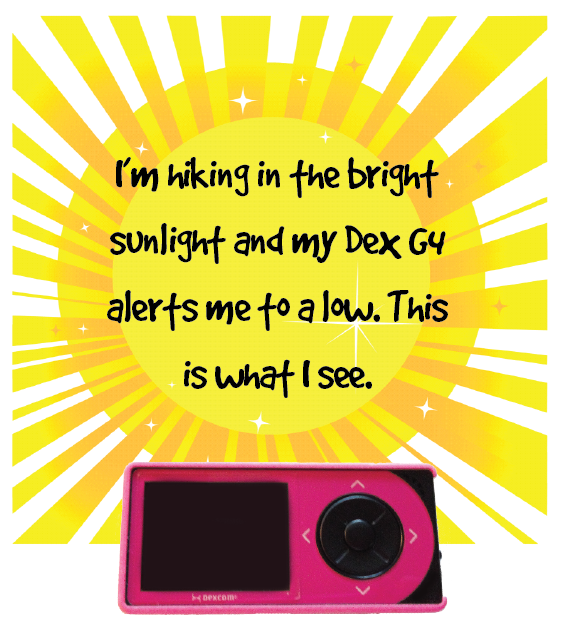
The G4 has a beautiful color screen and uses yellow for highs, white for in-range readings, and red for lows.  When I hike in Arizona and am in bright sunlight with little or no access to shade, I cannot read anything on my Dexcom that is in red.  I can see the white numbers the best and can vaguely see the yellow numbers.  But even when I put my receiver in the skimpy shade of a desert bush and use my hand to shield the receiver as much as I can, I cannot see the red numbers or read the red low alert screen.  My glasses have transition lenses which turn dark in the sun, but I think that it is a reasonable expectation that people spending time outside will be wearing sunglasses.

So when I am hiking with my G4, how do I know that I am low?  I can see the white numbers fairly well and the yellow numbers a little less well.  So if I can’t see the number at all, then I must be low!  I don’t think that is exactly how the CGM is supposed to work…

Dex and SunWhen my Dex alerts me to a low, I know I need to test and take action.  My alert threshold is set at 70.  Does the current alert mean my BG is 69 and a glucose tab or two will take care of the problem?  Or is it 49 and I’m in danger of falling off a cliff?  I can’t answer that question because I can’t read the number.  When I’ve been in bright light for a long time, it is also difficult to see the directional arrows to know if my BG is dropping, stable, or rising.

I’m sure the idea of using red for lows was thought to be a good one because red is often associated with danger and emergencies.  Unfortunately testing of the screen readability must have taken place in a lab not out in harsh sunny conditions.  I wrote a long email to Dexcom about this problem and never received a response.  I will call them soon just to get the problem on record.  I can see things on my iPhone screen in the sun, including red text, so a fix of this issue is not an insurmountable problem.  An easier fix might be to stop using red for any of the vital information.

There is a December 2012 thread in the TuDiabetes Dexcom Users group about this issue and I bumped it up on Monday to see if others ran into the problem this summer and there are a few new responses.  The original author of the thread was a cyclist who couldn’t see her G4 numbers and arrows without getting off the bike and moving into the shade.  As she said, this wasn’t a good option for races.

Is anyone else having this problem?  Any suggestions or solutions?