
 How good do we have to be?
Or maybe I should ask how good do I have to be? Because what is good enough to keep me healthy might not be good enough for you. Diabetes complications can be a capricious foe giving retinopathy or gastroparesis to people who have relatively good numbers and leaving others living with erratic sky-high numbers unscathed. But we mostly know that the better we do, the better off we’ll be.
Me, I’ve made it through 44+ years of diabetes with no major complications. At age 69 my eyes, kidneys, nerves, and cardiovascular system are seemingly okay. Same for my sister at age 72 with 40 years of Type 1. Something crummy in our genetics made us susceptible to Type 1. At the same time something good in our genes is protecting us from diabetes complications. In 2005 the Joslin Diabetes Center launched the 50-year Medalist study to investigate why a select group of people had managed to thrive despite longterm Type 1 diabetes. I am not sure that they have found definitive answers but I think that I share in the good fortune of those longtime survivors. My endocrinologist insists that hard work and newer insulins/technology are what have protected me but I strongly believe that luck and “unknown protective factors” are also in the mix.
Diabetes social media is inundated with people who use CGMs, pumps, newer insulins, smart computer algorithms, strict diets, incredible motivation, and lots of diabetes know-how to push the boundaries of what blood glucose numbers are achievable for those of us with Type 1 diabetes. Some people argue that we are entitled to and should target “normal” blood glucose numbers. But what is normal? The lab normals for my A1c tests indicate that results between 4.0 and 6.0 are normal. The CDC indicates that an A1c of 5.7 and below is normal. But an A1c of 5.7 equates to an average blood sugar of 126 and a 6.0 A1c is a 136 average. Those aren’t “normal“ although they are good for people with existing diabetes. Dr. Bernstein insists that normal is a blood glucose of 83 and our bodies are being damaged by anything higher. That 83 translates to an A1c of 4.5. So depending on whom you listen to, normal can be anywhere from 4.5 to 6.0.
As a contrast to Bernstein’s beliefs there are studies and other diabetes doctors claiming that an A1c of 6.5 is good enough and that anything lower has diminishing returns. Stacy Simms of the Diabetes Connections Podcast has a 2019 interview with Dr. Bill Polanski of the Behavioral Diabetes Institute and Dr. Steve Edelman of TCOYD called “Evidence-Based Hope and Type 1 Diabetes: New Info, New Optimism.” These doctors cite research studies and argue that “decent care” might be good enough and that might include A1c’s as high as 7.0 or 7.5.
Interlude: I am hesitant to mention Dr. Edelman since his recent three donuts video is causing conflict in the diabetes online community (DOC). But lots of things cause conflict in the DOC and I believe that it is medicinal to laugh at many of the absurd things we do to live with diabetes. I like donuts, especially the old fashioned ones with chocolate icing, and am not too proud to admit that I have eaten three at one sitting. And yes, the BG repercussions were horrible. I don’t look at Dr. E’s video as a how-to or permission to gorge on donuts. But I do like his attitude that I shouldn’t be mired in guilt at occasional dietary indiscretions.
So what blood glucose numbers and target ranges should those of us with Type 1  diabetes strive for?
Is there an optimal balance between diabetes mental health and diabetes physical health?
Is diabetes social media filled with numbers games that don’t necessarily translate to better overall health?
Are we playing the numbers game rather than focusing on a good life?
I should insert here that many people with diabetes are struggling to achieve any semblance of “good results” and please know that I respect your struggles. Diabetes is a tough adversary. Diabetes is especially tough when you struggle to afford insulin and technology. Diabetes is tough when you’re doing your best and it is never good enough.
This blogpost is targeting the superstars. The people on social media complaining about an A1c of 5.2 and wanting to be in the 4’s. The people who successfully achieve one target range and then immediately set a lower target range. The people who are critical of parents who allow their child a cupcake. The people who insist on low normal blood sugars when our doctors allow higher. The people whom I am jealous of. The people whom I think are crazy. The people like me who are never satisfied with how I am doing.
Is there ever a number that is good enough?
For sure I don’t know. I just know that I can’t live a “perfect” diabetes life. I make lots of good decisions but never reach the nirvana of a flat blood glucose tracing. I make lots of bad decisions and no amount of pumped insulin, injected insulin, and/or inhaled Afrezza can control the blood glucose spikes. And sometimes I make good decisions and still get a crazy high spike in the middle of the night. Hormones. Pump sites. Who knows? There is no end to the things that can go wrong.
And how will I ever know if I am living a D-life that is “good enough”?
One answer is that according to my standards, my numbers recently haven’t been “good.” Control IQ with my Tandem pump keeps me somewhat higher than my previous targets. At the same time I feel good. I hike 5 miles. I walk for 18 holes of golf. Although I’ve gained weight in recent years, my clothes still fit. So I am probably doing “good enough.”
Another answer is that although my numbers with Control IQ have been higher recently, my endo loves them. I really appreciate virtually having no lows and when I do have lows, I feel them more than I have in the last ten or twenty years. The fact of the matter is that I feel the same with an average of 125 as I feel with an average of 100. And if my average were 150, my guess is that I would still feel good. Is my body being damaged with higher numbers? My endo would say no and she would emphasize that at my age that it is hugely important not to have severe lows, falls from lows, and disorientation from lows. She very frankly says that I probably won’t live long enough to get complications from my current blood glucose numbers.
But I struggle to accept my current numbers. They “fail” compared to the stellar goals and numbers of some of my online diabetes friends. But they are probably great compared to most people with Type 1 diabetes. I often think my mental health is more at risk than my physical health when I look at my day-to-day life with diabetes.
I play golf and am pretty good at the game. To me diabetes and golf are about the same on the frustration scale. No matter how good a golfer you are, you wish you were better. I think that a 6-handicapper is just as frustrated or more frustrated than a 30-handicapper. Same with diabetes. You start to get BG numbers that you never thought were possible. But you know you could do better. You remember those 3 chocolate chip cookies last week. You remember the unexplained highs last Tuesday and the crazy lows after changing your pump cartridge yesterday. All of a sudden your time in range is not good enough because there are people on Facebook getting 100% with a much-tighter range.
Sometimes I wonder: Are we living diabetes instead of living life?
And BTW I can quit golf but I can’t quit diabetes.
Lots of questions. Not a lot of answers.
 I left Arizona in mid-April and have spent the last month in Minnesota watching snow melt followed by grass turning green and trees getting leaves. For better or worse, medical stuff has taken a good chunk of my time in recent weeks.
 occasional gagging and coughing. It turns out that she has chronic bronchitis which is kind of like COPD for dogs. Her treatment? A steroid inhaler. The vet told me that I could check out prices locally but recommended that I buy the inhalers from Canada. Sounds familiar for those of us on insulin…. One inhaler at Costco. $369. One inhaler from Canada. $69. My understanding is that while it is illegal to import prescription drugs from Canada, the ban is not being enforced. I am not losing sleep over the threat that I could go to jail for importing medication for my dog. Dr. Google mentions that canine patients can be “uncooperative” when dealing with inhalers and the
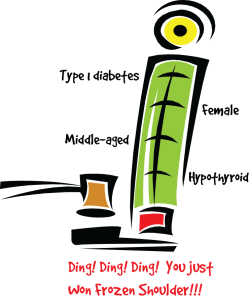 later the left again. Now it’s back to the right. Only the first one was horrible. The rest have been annoying and long-lasting but not hugely debilitating. Don’t tell me to stretch the shoulder in the shower. As I wrote in 2013, “if you can get rid of your “frozen shoulder” by doing a week’s worth of exercises in the shower, you don’t have adhesive capsulitis.” My experience with frozen shoulder indicates that it is an inflammatory disease-driven condition that is more related to duration of diabetes than A1c levels. Whatever. If you want to learn more about frozen shoulder, check out my “
 exercise regularly. I have never smoked, I eat a reasonably good diet, and my A1c is well within target range. I sleep okay for the most part and am not burdened with depression or an overly stressful life.
 I’ve got a secret list. A list that I won’t share even if I knock on wood with Woody Woodpecker-like fervor. A list that the mere mention of the Top Ten (or is it the Bottom Ten?) would jinx me for sure. If you’ve got diabetes, you probably have a list like this. It’s the list of diabetes complications that you don’t want to get. It’s a list with negotiated rankings. I could deal with this as long as that doesn’t happen to me. I know that this might be inevitable, but I’ll be okay as long as I don’t have to live with that. I know I’m brave, but please, please, please never test my courage with <fill in the blank>.
 I am currently taking nicotinamide which is a water-soluble member of the B vitamin group. Nicotinamide rarely causes side effects even at high doses and my dermatologist has prescribed this treatment because of its lack of toxicity. The basis for the use of this product is a
  Test Guess and Go