
It’s Not as Hard

Laddie_Head SquareI am at a stage in life where caring for my Type 1 Diabetes is easier than it has been for most of my life.  I initially titled this post as “It Gets Easier”.  I decided that to use the word “easy” anywhere on the same page as diabetes was a total travesty.  Diabetes of any type at any time is always hard.  Hard as rocks.  Hard as nails.  Hard as anything you can think of.  But right now for me it’s not as hard as it used to be.

Partial hypo-unawareness makes it easier for me not to over-correct.  No more sitting at the kitchen table in the middle of the night eating bowl after bowl of Frosted Flakes in a soaking wet nightgown.  No more drinking an appropriate glass of orange juice followed by just one Wheat Thin that turns into half a box.  Most of my nighttime lows are taken care of by one or two glucose tabs eaten from the stash on my bedside table.  (Note to self:  don’t tell your readers how often you silence Dex alarms to roll over and go back to sleep.)

I am currently retired from my part-time job and I am able to walk my dog every morning right after breakfast.  Through most of my years with diabetes, breakfast has been my most problematic meal.  The same meal could have post-prandial readings that varied by a hundred or more points from day to day.  By walking immediately after eating, I usually prevent the extreme spikes that require large doses of insulin to bring me back to an in-range reading.  Although I occasionally have an outrageous high with no discernible reason, most of my mornings are somewhat level and predictable now.

I am lucky to be able to escape Minnesota winters and spend several months in Arizona.  This means that my exercise level can be consistent throughout the year rather than taking a nosedive in the endless dark, cold, and ice of winter in the Upper Midwest.  I am a true believer that exercise is the key to a successful life with diabetes and consistency in exercise helps for stable basal rates.

My newest continuous glucose monitor, the Dexcom G4 Platinum, has improved my physical and mental health in almost immeasurable amounts.  This is my 3rd CGM system (after the Medtronic CGM and the Dexcom 7+), but it is the first one that has been life-changing.  Occasionally it will cry wolf for non-existent lows, but in general it is incredibly accurate and alerts me to lows before I reach the 50’s and 40’s.  I can go about my day with the confidence that it will alert me when I’m out of range and it lets me forget diabetes sometimes.

At age 61, I’m past those pesky hormones that can wreak havoc with BG levels throughout the month.  There are some definite downsides to having fewer hormones, but blood sugar control is not one of them.

I eat fewer carbs than I used to and average about 100 grams per day.  In the old days, that was considered Low Carb.  Because there are so many people who go much lower than that these days, I think I’m now on the low end of Moderate Carb. I believe that each one of us has to make our own choices when it comes to our diet, but I have never been able to match insulin to high carb meals and snacks.  By reducing the post-meal peaks, I’ve gotten rid of many of the lows that result from preventing or treating those highs.
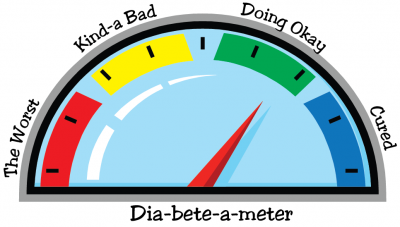
Diabete a MeterI think the reason I’m feeling good these days is that my hard work seems to be having good results.  We’ve all had spells where we do the “right” things and diabetes just laughs at us.  But right now it’s smiling.  How long will it last?  Probably not long.

So do I have Type 1 Diabetes figured out?  Nope. I still love sweets and struggle with evening carbfests that lead to bad overnight highs and lows.  I still have highs that make no sense at all.  When I go high, I can’t seem to take enough insulin to bring my BG back to normal.  I have daily lows in the 60’s and 70’s.  I am fighting my third frozen shoulder despite having good A1c’s.  I have to take diabetes into account for almost every activity in my life.

But most of the time, I’m doing okay.  And that’s a win in my book.

Pin the Tail on the Donkey: Buying a New Pump

This post is my June entry in the DSMA Blog Carnival. If you’d like to participate too, you can get all of the information at http://diabetessocmed.com/2013/june-dsma-blog-carnival-3/ The topic is: How do you select the diabetes devices you use? To others looking into new or replacement devices, what would be your best advice to someone shopping around?

Laddie_Head SquareWhen I select medical devices, I put on a blindfold, turn around 3 times, and pin the tail on the donkey.  Oops, wrong game.  But that is what it felt like when I bought my last pump in December 2012.

When I began my pump search, I was using an out-of-warranty Medtronic Revel pump and a Dexcom CGM (continuous glucose monitor).  I had previously used the Medtronic CGM and found it to be painful and inaccurate.  But I loved having a sensor augmented pump and only having to carry one device.  So a pump/CGM combo was my #1 criteria for my next pump.  Unfortunately there was no device on the market that had the features I desired given that I was unwilling to use the Medtronic CGM.

Medical device companies are prohibited from giving detailed information about pumps in development and they have no control over how long FDA approval will take.  So ultimately I had to make my purchase decision based on my best guess of which future pump would have the features I wanted along with a guess of how soon it would get to market.  So I put on my blindfold and went to work.

Pin the TailI was very happy with my Medtronic pump and I knew that their improved Enlite sensor system would “soon” be available in the USA.  Animas was on track to release a pump that would be combined with the newest Dexcom G4 Platinum CGM.  The new kid on the block, the Tandem t:slim, was a touchscreen rechargeable pump that would also eventually link up with Dexcom.  I didn’t have any reason to consider the Accu-Chek pump, so I ignored it in my decision.  I don’t mind tubes and was not interested in the Omnipod.

Normally I would love to make a chart and compare features pump by pump.  But I didn’t have sufficient information to do that with my most important decision points. I had no way to evaluate the Medtronic Enlite sensor system, and I wasn’t willing to leave Dexcom to take a chance on it.  I found the Tandem pump intriguing, but they had no upgrade program in place and I wasn’t willing to risk not having an affordable pathway to buy their future sensor integrated pump.  I chose Animas because it will be the first pump released with an integrated Dexcom CGM and I am guaranteed a $99 upgrade fee to get that pump.

Am I happy with my Animas Ping pump?  Not really.  I knew that I would hate the menu system, but I actually underestimated how much I dislike it.  But it’s a good pump and it does the job of delivering my insulin safely.  Do I regret my decision?  No, because I made the decision based on the future which has not arrived yet.  I am still waiting for the Animas Vibe to come to market and I think that it will fix the things I don’t like about the Ping.  It will definitely give me the pump/Dexcom combo that was and is my #1 requirement.

My advice to others who are shopping for their first pump or a new pump?

Do your homework:

  • With yourself.  Decide which features are most important to you.  Do you want tubeless?  Do you require a large reservoir?  Do you want a Pump/CGM combo?  In most cases you won’t get everything on your wish list, so be open to considering several brands of pumps.
  • With the pump companies.  Visit their websites and request their brochures.  If a local rep is available, meet with him/her to see the pump and learn more about it.  Omnipod even has a non-operational sample pod that allows you to try it out on your body.
  • With your medical team.  If this is your first pump, your medical team may require classes about pumping and carb counting before prescribing a pump.  I think it’s valuable to ask for your team’s opinions on pumps, although ultimately you should get what you want not what your doctor likes.  Your doctor’s office might also have demo pumps and infusion set samples.
  • With your insurance company.  Many insurance companies will cover all pump brands.  But if they don’t, it’s good to know that up front.  For example, Medicare will not pay for the Omnipod at this time.  Also, it’s a good idea to determine your financial responsibility for the pump purchase and the ongoing supply expense.
  • With other pumpers and the online community.  Message boards and blogs are a wonderful source of information and opinions on pumps.  Fortunately most people end up happy with the pump that they choose, but it’s still helpful to learn as much as you can about the pros and cons of each brand.

It has been six months since I purchased my pump.  The questions I would have liked answered then are still unanswered.  The Animas/Dexcom pump has been submitted to the FDA, so there has been progress.  I have some regret that I did not go with the t:slim, but for the most part I think I made the right decision.  And if you think about it, it’s only 3-1/2 years until I go shopping for my next pump!

To Dose or not to Dose?

Laddie_Head SquareTo dose, or not to dose, that is the question.

That’s not exactly what was phrased by Hamlet in the opening soliloquy of the Shakespeare play. But it is a question heard frequently around the diabetes online community when considering our CGM (continuous glucose monitoring) systems. And it is a question that some would argue has life or death implications.

My answer to this question is sometimes, in certain circumstances, and within certain guidelines.

To Dose or not to DoseMy current CGM is the Dexcom G4 Platinum and it is by far the most accurate system that I have used. The numbers are almost always in the ballpark with my meter readings. Twitter is littered with my photos of identical G4 and Verio meter readings. Earlier this week I downloaded my Dex into Dexcom Studio and my 3 meters into Diasend. Comparing the 2-week reports from each, my average BG differed by only 3 points. The standard deviations were also 3 points apart and my graphs were remarkably similar. So essentially I am getting the same information from these devices.

Like everyone with Type 1, I am awash in data and make decisions knowing that none of the numbers are 100% accurate. My meters are allowed to have a 20% variance. My pump is very precise in its insulin delivery, but my body’s absorption of insulin may vary based on the location and age of the infusion set, my exercise patterns, and various hormonal excursions. There are inherent inaccuracies in carb counting. Food labels are allowed a 20% fudge factor. Fruits may differ in their carb impact based on ripeness or variety. One portion of vegetable soup might have more potatoes than another portion filled with green beans and squash. So the Dex CGM is not perfect, but neither are my other tools.

Meter and Dexcom2I start my day with a fasting BG reading on my meter. If a correction is needed, I bolus for it. If my Dex calls for a calibration, I record the number. After this I will rely on my G4 for my breakfast bolus and throughout the morning for alerting me to lows and highs. Late morning I’ll take a fingerstick and make sure that the Dex is still on track. If a correction bolus or snack is needed, I’ll take it. Then when lunch comes, I’ll usually use my Dex as the guide for my bolus along with carb counts. Same for the afternoon, dinner, and throughout the evening. I use the meter for a “grounding” every few hours, but rely on the Dex the rest of the time.

I play the game of mistake management and try to minimize the number of diabetes mistakes that have serious consequences. If I am woken at night by a high alert from my Dex, I will double check the reading with my meter before taking a correction bolus. That is because an overdose of insulin while sleeping is potentially life-threatening. If my Dex wakes me with a low alert, I often pop a couple of glucose tabs from my bedside table without a meter confirmation. The result of a Dex mistake in this case is just an errant high from eating glucose tabs.

Similarly, I take driving with Type 1 Diabetes very seriously. If I’m on the south side of BG 100 or have any symptoms of a low, I will always test with my meter before driving. No way that I want to have a low at 65 miles per hour. On the other hand, if the Dex shows me level at 110 and I feel good, I’ll probably trust the Dex and head out. At this point I’m comfortable I’m in a target range that is safe although I may not know the exact number.

During the daytime, I usually trust the Dex high alert and bolus based on it. I have to admit that I get some false lows from my G4, but I get very few false highs. Sometimes it will alert me with a 180 reading and I think “no way!” But the Dex is usually right.

My trust in my G4 is bolstered by an average of 8 meter readings a day. Some of these are for calibration. Others are before driving or halfway through a round of golf. In general, my meter helps me trust my Dex while the trends on my Dex helps me trust my meter. (As a caveat, I don’t trust the Dex on the first day of sensor insertion and I lose confidence as it approaches Day 14.)

In summary, I confidently bolus throughout the day based on my Dexcom G4 readings. Why can I do this? First, because I also test a lot with my meter. Secondly, because I have the Dexcom G4 to alert me if I make a mistake.

(I will end this post by reminding everyone that Dexcom and our doctors advise us never to bolus based on our CGM numbers.)