Countdown to Medicare with Type 1 Diabetes: 8 Months / Drugs and Donuts

Laddie_Head SquareWhen you start investigating Medicare plans, it is easy to get overwhelmed with letters and options. Parts A, B, C, and D are well-known, but depending on where you live, you may find Parts F, G, K, L, M, and N.

In this blogpost I plan to be simple and just talk about Part D Medicare prescription drug coverage. That’s a joke because there is nothing simple about Part D.

Let’s start with a few straightforward facts:

  • Part D is regulated by Medicare but all drug plans are administered by private companies.
  • Part D plans provide coverage for generic and name-brand drugs. All plans must Countdown to Medicare 8 Monthsprovide at least a Medicare-approved level of coverage, but can vary by specific drugs covered, rates, and pharmacy networks.

  • In order to purchase a Part D plan, you must be eligible for Medicare Part A and/or enrolled in Part B. You must also live in the plan’s service area.
  • You may purchase Part D as part of a Cost/Advantage plan or as a stand-alone Part D plan.
  • Part D coverage is not required. However, if you do not purchase it when you are first eligible, you may be subject to penalties and higher premiums when you do. Those penalties will continue for as long as you participate in Part D. Like for the rest of your life.

The most complicated part of standard Medicare drug coverage is understanding the four cost stages, particularly the coverage gap or donut hole.

The first stage is the Deductible Stage where you pay 100% of your prescription drug costs. The maximum deductible allowed by Medicare in 2016 is $360. Some plans have lower deductibles.

Once you satisfy your deductible (doesn’t take long if you have diabetes!), you enter the Initial Coverage Stage. In this “cost sharing” phase you pay either a copay or a percentage copayment depending on your drug plan. In 2016 this stage continues until the payments by you and your plan combined total $3310. For example, you buy 4 vials of Lantus with a total contracted price of $1000. You have a coinsurance plan where you pay 25% or $250 and the plan pays 75% or $750. The entire $1000, not just your out-of-pocket cost, counts towards the $3310 amount to put you into the Coverage Gap or Donut Hole.

If you use insulin, you can see how quickly you will enter the donut hole where the out-of-pocket drug costs increase significantly. In 2016 under a standard Medicare Part D plan, you can expect to pay 45% of the cost of covered name-brand drugs and 58% of the cost of generics once you reach the coverage gap. I could write a book trying to explain the donut hole, but here are a few things to put it in context.

The donut hole terminology came from the Medicare Modernization Act of 2003 (MMA) in which prescription drug coverage became available to all Medicare beneficiaries. If you are interested in the history of this law, check out this publication by Jonathan Blum who was a professional staff member to the Senate Finance Committee at that time.

As recently as 2010, most Medicare beneficiaries paid 100% of drug costs once they reached the coverage gap. One of the few changes made to Medicare by the Affordable Care Act was the implementation of a blueprint to gradually eliminate the donut hole by 2020. A good explanation of these changes can be found in this Medicare publication “Closing the Coverage Gap—Medicare Prescriptions are Becoming More Affordable.”

Part D Rectangle

One unanswered question I have about the coverage gap is how the $4850 to enter the catastrophic stage is computed. I have attended two Medicare information meetings and both insurance companies indicated that the $4850 is totally paid by me. However, the Medicare publication mentioned above states: “Although, you’ll only pay a certain percentage of the price for the brand-name drug, the entire price (including the discount the drug company pays) will count toward the amount you need to qualify for catastrophic coverage.” If you know the answer, please leave a comment. Once I get to Medicare, I suspect I’ll figure it out.

The last stage of Part D prescription drug coverage is the Catastrophic Coverage Stage. In 2016 you pay either $2.95 for generics and $7.40 for brand-name drugs or 5% of drug costs, whichever is greater.

Just when things look complicated enough, there is another consideration for those of us who use insulin pumps. Although insulin is usually purchased through a Part D plan, it is covered under Part B for pump users. Fine and dandy, but it can be extremely difficult to find a supplier for Part B insulin. To get a clue how difficult, read Sue from Pennsylvania’s post “Hey, He Needs his Insulin!” One reason is that many pharmacies rarely deal with this and plead ignorance. Another reason is that the reimbursement rate for Part B insulin is so low that pharmacies/suppliers lose money when selling Part B insulin. A 2013 Lincoln Journal Star article states:

A Medicare spokeswoman said the price is set in federal law — at 95 percent of the average, wholesale price in effect on Oct. 1, 2003. So it requires Congress to change it, she said in an email to the newspaper.“

The cost savings for buying insulin under Part B are substantial. Medicare pays 80% of the cost and a supplemental/advantage/cost plan should pay the remaining 20%. Insulin is therefore usually provided at no cost to someone using a pump. In addition, insulin under Part B is excluded from Part D donut hole calculations.

That’s it for today. I hope that this blogpost has provided some information without totally putting you to sleep. I have done my best to research Medicare drug coverage and if any of what I have written is incorrect, please send me a message along with a dozen donuts.

Most of us think that when we grow old, we will play golf, watch TV, do crossword puzzles, and relax on the patio. I am beginning to think that I’ll be sitting at my desk trying to figure out Medicare….

*************

Most of the information in this blogpost comes from current publications of Blue Cross Blue Shield of Minnesota and HealthPartners. I attended community meetings offered by those companies in July. The official Medicare website is also an excellent resource.

Friday Notes

Laddie_Head SquareYesterday was a busy diabetes day. In addition to just having diabetes (and believe me, that’s enough!), I attended an advocacy training program sponsored by the American Diabetes Association (ADA) and there was a vote by an FDA Advisory Committee regarding the Dexcom G5.

Number #1: My DiabetesNothing momentous to say about my diabetes except that yep, I’ve still got it. I had a big unexpected BG spike after a restaurant salad lunch. Maybe there was hidden sugar in the salad dressing. Maybe my glass of wine decided to be a problem. Maybe it was the mid-morning peanut snack dosed with an extended bolus. Maybe it was because it was 90+ degrees outside with off-the-chart humidity even though I was comfortable inside with air conditioning. Maybe it was because it was Thursday. This is the sort of stuff that makes it a miracle that those of us dealing with Type 1 even have a modicum of sanity left in our lives.

Number #2: ADA Advocacy Training:  I attended a late afternoon Advocacy Training seminar sponsored by the American Diabetes Association. I found it to be very empowering and in a moment of bravado, I signed up to be available for in-person office visits to my congressional representatives. I am a confident advocate when writing, but speaking and putting myself “out there” border on terrifying.

The ADA has a good app for advocacy and I suggest that you check it out. It provides information on national and state advocacy priorities and links to easily become involved in ADA advocacy. Search for “Diabetes Advocacy” in the app store.IMG_0298

Because Scott Johnson was the reason that I knew about this seminar, I can’t say that it was a surprise to run into him by the Diet Coke cooler. But it’s always a pleasure to see Scott.IMG_0295

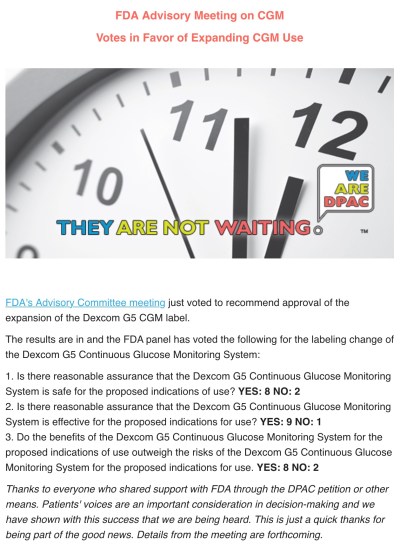
Number #3: FDA and Dexcom G5:  I was pleased to receive an email from Bennet Dunlap of DPAC sharing news from yesterday’s FDA Advisory Committee meeting on Dexcom G5 labeling. The panel voted 8-2 to recommend approval of a G5 labeling change to allow insulin dosing without a confirmatory BG meter test. The FDA will have to make the final approval, but it is likely that the advisory committee’s recommendation will be accepted. This change should help justify Medicare coverage for CGM’s as well as expand the use of CGM to more patient populations.IMG_0932

That’s it for today. Have a good weekend!


We Regret to Inform You

Laddie_Head SquareMy health insurance life is imploding and exploding. I can’t tell the difference between what I know and what I don’t know. What I heard last week isn’t true this week and might change again next week. In January I wrote about dreading Medicare. Today I think it might be the best thing that could happen to me.

On June 23 Blue Cross Blue Shield of Minnesota (BCBS) announced that it will discontinue full-service plans in the individual health insurance market beginning in 2017. This follows the exit or reduction in offerings by other companies in previous years. Minnesota was one of the states that created its own insurance exchange in 2014 after the implementation of the Affordable Care Act (ACA) and the results have been devastating for many of the 6% of citizens seeking individual insurance in the state. (The individual market covers people who do not have access to employer-based coverage and are not eligible for Medicaid or other publicBCBS Blexit programs.)

BCBS of MN is the only company so far to announce its exit from the 2017 individual market. Unfortunately it is the largest insurer in the market and its departure will affect 103,000 of the approximately 300,000 Minnesotans who purchase individual insurance. The recent announcement by BCBS follows a premium hike of over 50% in 2016. This increase was justified by the carrier’s reported loss of $265 million dollars in the 2015 individual market.

My 2016 monthly premium was 61% higher than in 2015 and was accompanied by a slightly higher deductible. If BCBS is continuing to experience unsustainable losses with the huge premiums that I am paying, my fear is that no company will be able to survive longterm in this market. Unfortunately as rates soar, many young and/or healthy individuals are choosing or being forced to go without insurance. The downward spiral of an unsustainable market is intensified as the insured population gets older and sicker and costs skyrocket.

I have no idea what the landscape for the individual insurance market in Minnesota will look like next year. It seems questionable that the remaining players can absorb the 103,000 people stranded by BCBS. Will other insurers pull out? Will exorbitant premiums, high deductibles, limited networks, and poor coverage be the norm? What will be the effects of the presidential election with one candidate vowing to repeal the ACA?

All I know is that I received a letter that says:

“We regret to inform you that at the end of this year, Blue Cross and Blue Shield of Minnesota will be discontinuing all individual and family insurance plans sold to members in Minnesota directly, through an agent or broker, or on MNsure. As a result, you will not be able to renew your current plan or select another Blue Cross plan for coverage in 2017.”

I personally only have to deal with this for three months in 2017 and will transition to Medicare on April 1. I know others who do not have this option. Some of them have Type 1 diabetes and the outlook is bleak.

Yes, Medicare is definitely starting to look pretty good.

*****   Relevant Articles   *****

http://www.startribune.com/blue-cross-eyes-major-exit-from-individual-market/384303131/

http://www.startribune.com/regulators-approve-premium-jumps-averaging-as-much-as-49-percent-in-minnesota/330275391/

Subtracting the Adjunct from Dexcom G5

I will preface this blogpost by reminding you that I am not a medical professional and I am not suggesting that you do what I do.

Laddie_Head SquareSetting the Scene:  On July 21 Dexcom will have an Advisory Panel hearing with the FDA to discuss whether Dexcom’s G5 CGM should be officially approved for dosing insulin. (This Diatribe article gives information on the meeting and how to provide comments or attend in person.) Currently the G5 has “adjunctive” labeling which means that it is approved by the FDA to be used with confirmatory finger stick testing. Non-adjunctive labeling will help CGM’s receive approval for Medicare coverage as well as justify CGM use for more people with diabetes. In September 2015 the G5 was approved with proper calibration for insulin dosing in Europe.

Background:  Three years ago I wrote a blogpost about how frequently I dose off of my Dexcom. In that post I mentioned bolstering my Dexcom confidence with an average of 8 meter tests a day. Not much has changed since then except I now back up my Dexcom with only 4-6 daily finger sticks. Two of those BG tests are for calibration so it is evident that I am relying on Dexcom for most of my BG information.

Dexcom Blindman’s Bluff:  Earlier in June I decided to test my confidence in the Dexcom G5 and play a game that could be called Dexcom Blindman’s Bluff. The purpose was to experiment with reducing the number of meter tests even further and to consider whether I have enough trust in a CGM to allow it to be the basis for all insulin dosing as it might be in an artificial pancreas (AP) system.

Articles about improvements in AP technology seemed to be published daily. Many clinical trials report average blood glucose numbers in the high 120’s to the low 140’s. For the vast majority of people with Type 1 diabetes, those numbers would be a significant improvement.

I am a T1 who has managed to have lower averages than that for many years. Would I be willing to trade a higher A1c for a huge decrease in the mental burden of diabetes alongBlindFolded Woman with a significant reduction in variability and the number of lows? I suspect that I would although I know some T1’s who definitely would not. Secondly, would I trust a Dexcom sensor to give sufficiently accurate results to dose insulin without my input?

For 48 hours on June 7-8, I decided to accept all numbers in my Dexcom target range of 70-160. The rule was No peeking at my G5 screen for any reason other than to act on prompts for calibration and alerts for out-of-range BG’s. I would use my Freestyle meter only for calibrations. I would rely on Dex alert numbers as the basis for correcting lows and highs and no meter tests for confirmation were allowed. Before eating I would not check my Dex for my current BG status and I would dose insulin based only on the carb count of the food I was eating and my anticipated activity level. If I hadn’t received an alert, I knew that my BG was somewhere between 70 and 160 and that was it.

Because I had Dexcom alerts and calibrations, I didn’t believe that I was doing anything horrendously dangerous. After all, those of us diagnosed with Type 1 diabetes before the mid-1980’s had no home blood glucose monitoring and played “chicken” with diabetes every day.

Results: I had no problems blindly following my Dexcom G5 for 2 days and I was comfortable letting Dexcom run the show. That confidence came with a couple of caveats. The sensor was a week old and had already proven itself to be reasonably accurate. I was close to home both days and not climbing mountains, playing golf, or eating chocolate-covered donuts.

I am the first to admit that my results were skewed for the experiment because I tried to avoid anything that would push my BG out of range. It was two days of the best diabetes numbers that I have seen in ages. But good numbers weren’t the purpose of the experiment and when I got a couple of low alerts overnight, I treated them with no meter confirmation and the same with an afternoon high.

Dexcom Clarity Graphs

This experiment reinforced how little I can feel differences in my blood sugar. Most of the time I had no clue where my BG was in my range. 75 or 155? I had no idea.

Although a two-day test is not sufficient to prove that I would trust the Dex as the compass for an artificial pancreas, it did show me how quickly I could adjust to accepting all numbers in a target range and letting a tech device deal with the minutiae. The idea of not thinking about blood sugars all of the time was very enticing and a slightly higher A1c, especially with less BG variability, might be a small price to pay for a more “normal” life.

Longterm:  Two days was only a toe in the water of using a CGM as my primary blood glucose guide. I thought about doing a longer test, but I couldn’t think of any reason to continue using a CGM blinded. Trends, spot-checks, and pre-meal info are crucial features of CGM use and it is an artificial, somewhat silly game to do without them.

Even when personal experiments aren’t scientific and don’t prove a lot, they definitely relieve the tedium of diabetes and that is something I need. A more apt experiment for testing the G5 as a non-adjunctive device would be where I used my meter only for calibrations and as Dexcom recommends in Europe, when BG is low or changing rapidly. I don’t need to do that test because that’s close to what my life is right now.

Countdown to Medicare with Type 1 Diabetes: 10 Months / Sources of Information

Laddie_Head SquareAlthough 10 months before my 65th birthday seems early to investigate my Medicare options, it’s really not.

First, I can sign up for Medicare three months before my 65th birthday and January is seven months away.

Secondly, I will be doing most of my research this fall in a period that overlaps with the October 15 – December 7 open enrollment period for all Medicare beneficiaries. That is good because there will be a lot of 2017 plan information available at that time. That is bad because most insurance brokers and company representatives will be busy and it might be hard to get individual attention.

Thirdly, as someone with a pre-existing health condition, my initial selections can have lifelong effects. If I do not choose a Medigap (Supplemental) policy during my one-time Medigap Open Enrollment Period (the first six months after I turn 65), I can be refusedCountdown to Medicare 10 Months Medigap coverage or charged higher rates in the future. Although an Advantage plan may seem more favorable in the short run, I need to analyze that decision on a longterm basis knowing the problems of switching to a Medigap policy in the future. Minnesota has the highest concentration of seniors with Medicare Cost plans. These plans are a hybrid between Advantage and Supplemental policies and may end up being a good choice for me.

My sources of information at the moment are:

Federal government:  Websites such as Medicare.gov and Cms.gov are the most reliable source for current Medicare information and regulations.

SHIPs:  State Health Insurance Assistance Programs (SHIPs) provide free one-on-one insurance assistance to Medicare beneficiaries and links to resources for senior citizens in each state. They are state-specific grant-funded projects of the U.S. Department of Health and Human Services. Select your state on this site to obtain the relevant phone number and website. In Minnesota I am linked to the Minnesota Board on Aging along with the Senior LinkAge Line® and MinnesotaHelp.info®.

Insurance Companies:  Commercial insurance websites currently provide information about 2016 plans. The 2017 plans will be released in October. Help numbers and retail store appointments are some of the options offered. Most companies also sponsor group sessions which provide information on Original Medicare, plan choices, and differences among the plans. Last year I attended an insurance company-sponsored meeting titled “Medicare 101.” This year I will attend one or more sessions provided by the companies whose plans I am considering.

Miscellaneous Websites I can Google specific topics and receive multiple website recommendations. It’s a good idea to evaluate the reliability of the data and the source of the info (government vs commercial vs good information vs snake oil).

Books and Publications:  Most of the websites mentioned above have free pamphlets and downloadable books. I have already downloaded the 160-page “official U.S. government Medicare handbook” titled Medicare & You 2016 from the Medicare.gov publications link. You can also purchase commercial books such as Medicare for Dummies.

Insurance Brokers Insurance brokers who specialize in Medicare are a good source for individual help. They earn commissions from the insurance companies and are free for users. In recent years I have worked with an excellent broker for private insurance and recently touched base with the Medicare specialist in the same firm.

Friends with diabetes:  I have already gained useful information from some of my Type 1 friends already on Medicare. For learning the ropes of navigating Medicare with an insulin pump and a CGM, they are a practical and valuable resource.

In some ways learning about Medicare is not that different from learning about diabetes. A lot of it seems confusing and overwhelming at first. As you learn more, you begin to understand how things fits together and become more confident about your decision-making skills. At the moment I would argue that my diabetes expertise greatly outweighs my Medicare knowledge, but I think I’m on the right road.

If you have other sources of information about Medicare, please share them in the comments. Advice is always welcomed!


Considering the Heart | Part 3 | My Story

I delayed finishing this blogpost because despite my research on cardiovascular disease, I felt quite ignorant about my specific risks. After recent lab work, a specialized CT scan, and a visit with my internist, I am comfortable that I am competent to share my story.

Laddie_Head SquareIn Part 1 and Part 2 of this series about cardiovascular disease (CVD), I mentioned my tendency to play the “Not Me” card and dismiss the possibility of heart disease. My rational self knows better and I am aware that statistics indicate that my risk is significant. To date I have never experienced cardiac symptoms nor been diagnosed with CVD.

The American Heart Association website indicates that cardiovascular risk is determined by a combination of uncontrollable and modifiable factors. I do not get a good grade on uncontrollable risks. I am a post-menopausal woman who has had Type 1 diabetes for almost 40 years. I have a family history of heart disease including a father who had a heart attack before age 55. I have the negative factor of long-term use of prescription-strength NSAIDs for my inflammatory arthritis.

At the same time all is not gloom and doom because I have many checkmarks in the “heart-smart” column of things that reduce CVD risk. I am not overweight and IConsidering the Heart exercise regularly. I have never smoked, I eat a reasonably good diet, and my A1c is well within target range. I sleep okay for the most part and am not burdened with depression or an overly stressful life.

My blood pressure is in target range for “normal people,” but I have flirted with being out of the recommended range for people with diabetes. I am currently on a  low dose of blood pressure medicine and have no problems with it. Because BP meds have been shown to provide kidney protection for people with diabetes, I figure that I am getting a double benefit from it.

Eight months ago I had an out-of-range cholesterol test for the first time ever. Because my lipid numbers have always been ideal and my HDL (“good” cholesterol) is insanely high, my internist was okay with the “wait and watch” philosophy before prescribing statins. I saw my endocrinologist a few months later and she strongly suggested I start a statin drug. The 2016 Standards of Care in Diabetes includes this recommendation:  “In all patients with diabetes aged ≥40 years, moderate-intensity statin treatment should be considered in addition to lifestyle therapy.”

In December I accepted a prescription for a low dose of a statin. I filled it, took the pills for a month, and quit. I BECAME A NONCOMPLIANT PATIENT. I quit because I wasn’t mentally ready to take a drug that I swore I would never take. I also wanted one more cholesterol test without medication to confirm the previous results. This spring after great results from a repeat cholesterol test and a coronary artery calcium scan ($100 out-of-pocket), my internist and I agreed that it was appropriate for me to refuse a statin drug at this time. (This blogpost is not about the statin controversy and I suggest that you do your homework on statins and work with your medical team to make the best decision for you.)

I sometimes worry that I have characteristics that will lead to suboptimal diagnosis and care in case of a cardiovascular event. This article by Carolyn Thomas of Heart Sisters describes why women often delay seeking medical care mid-heart attack and I realize that I could be such a woman. I know that I might be apt to dismiss symptoms as “nothing” or sit at home wondering if my symptoms are significant. I am definitely the personality who might drive herself to the ER with chest pains. Even worse as someone with T1 diabetes, I know that I am at risk for an asymptomatic heart attack. Symptoms of a stroke are probably more clear than those of a heart attack and I know that it is important to not delay treatment for those symptoms.

I’m now at a point that I am somewhat educated about cardiovascular disease and knowledgeable about my risk factors. I work hard to be an empowered patient and although I don’t always agree with my doctors, I listen to them. I do my best to eat well and live well. After that, there is not much that I can do except try not to get run over by a bus tomorrow….

Summary: I hope that my series on cardiovascular disease as related to Type 1 diabetes and being a woman has taught you something and inspired you to educate yourself. Some of my diabetes friends have already been diagnosed with CVD issues and the rest of us are “at risk”. None of us should live our lives in total fear of where statistics might lead us. At the same time we shouldn’t stick our heads in the sand and be stupid.

A lot of the data contained in my first two posts is gloomy. I think that it is important to remember the statistic from the EDIC study that intensive diabetes therapy can reduce cardiovascular events by 42%. As much as you may hate the monster that is diabetes, do your best to manage it. We’ll never be perfect, but maybe we can make a difference.

Please remember that I am not a medical professional. Although this post presents information about cardiovascular disease and Type 1 diabetes, it is by no means complete. Do your homework and talk to your medical professionals about your risk.

*****

Related Posts

Considering the Heart | Part 1 | Type 1 Diabetes

Considering the Heart | Part 2 | Women with Type 1 Diabetes

Diabetes Tips and Tricks in Photos

Laddie_Head SquareIt’s Day 5 of Diabetes Blog Week and we survived! There are no blue ribbons or trophies to be awarded today. Instead we can be satisfied with having touched base with old friends, creating new online friendships, and gaining new insights into diabetes. Not a bad payoff! Certainly there were a few laughs and tears along the way and I for one am exhausted. For the fifth time this week I thank Karen Graffeo of Bitter-Sweet™ for having created DBW 7 years ago and for continuing to inspire and organize the D-troops every year.

Today’s Topic:  Let’s round out the week by sharing our best diabetes tips and diabetes tricks. From how you organize supplies to how you manage gear on the go/vacation (beach, or skiing, or whatever). From how you keep track of prescription numbers to how you remember to get your orders refilled. How about any “unconventional” diabetes practices, or ways to make diabetes work for YOU (not necessarily how the doctors say to do it!). There’s always something we can learn from each other. (Remember though, please no medical advice or dangerous suggestions.) 

I am a little bummed that I’m not allowed to give dangerous medical advice today. Rather than get thrown off the DBW island, I will not share tips on calibrating your CGM while BASE jumping in the Grand Canyon. I will not divulge the rules of used-syringe Pin-the-Tail-on-the-Donkey. I will not confess that I can test my BG and do a correction bolus before the traffic light turns green. I won’t describe how one of my D-friends has extended the life of an infusion set for 28 days. Just know that it is related to poor health insurance and that she says it quits itching after 5 days.

No, I will not tell you stuff like that. Instead I will share a couple of Fitbit tricks along with a travel tip.

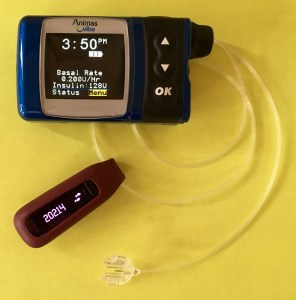
My most original trick is that I attach my Fitbit One to the tubing of my insulin pump. Both devices live in my pocket with the tubing running through a hole in the pocket to the infusion set. Since I have begun linking my Fitbit with the pump, I have neither forgotten to wear it nor sent it to Fitbit death in the washing machine. Please note that I played golf yesterday so I had a lot of steps for the photo!

IMG_0069

Another tip related to Fitbit is that if you use Diasend, you can link your Fitibit to that website. When you open the Compilation Report, you are able to see your step and calorie averages along with your pump, CGM, and meter data. I do not enter food data into Fitbit, so the calorie number in the photo below is meaningless.

Diasend Compilation with Fitbit_2

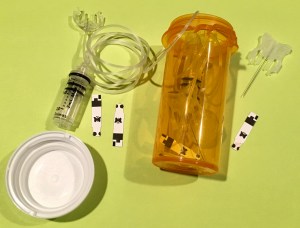
My final tip is that I use empty prescription medicine bottles for used test strips and sharps when I travel. I keep it in my combined cosmetic/D-supply bag. It helps ensure that grandchildren, hotel maid service personnel, etc. are protected from blood and gore contamination and don’t get stuck by anything. I used to use old test strip bottles, but they were too small and not see-through.

IMG_0059

That’s it’s for today!

*****

To read other blogposts on this topic, click here.

Consistent Inconsistency

Laddie_Head SquareIt’s now Day 4 of Diabetes Blog Week and the homestretch is in sight. I am starting to fade a bit when it comes to daily writing and reading about diabetes. Fortunately I’ve read some great blogposts this week and am inspired to make it to the finish line. Today the subject is healthcare and our fearless DBW leader, Karen Graffeo of Bitter-Sweet™, has given us permission to get grouchy. Right now I have good doctors and good insurance. Not everyone else is as lucky.

Today’s Topic:  Most people who live with a chronic illness end up with a lot of experience when it comes to dealing with healthcare. How would you improve or change your healthcare experience? What would you like to see happening during medical visits with your healthcare team? How about when dealing with your health insurance companies? What’s your Healthcare Wish List or Biggest Frustration? Today is the day to share it all!

Wow. I think that those of us with diabetes could write an encyclopedia on this topic. The thing that bothers me the most about the healthcare system in the United States is the consistent inconsistency of it.

New year ==> New Insurance plan ==> Used Humalog last year. Forced to switch to Novolog.

New job ==> Different insurance company ==> Current endocrinologist is now out-of-network.

Same year ==> Same insurance plan ==> Won’t cover my brand of pump anymore.

Next-door neighbors with Type 2 diabetes  ==> My insurance reimburses diabetes education ==> Yours doesn’t.

Next-door neighbors with same income ==> You work for a large corporation and pay $500/month for health insurance ==> I am self-employed and pay $1000/month for similar insurance.

An insurance company pays my dentist $75 for an office visit ==> I don’t have dental coverage and must pay $135 for the same visit.

I have my 65th birthday ==> When I was 64 I had full insurance coverage for a CGM ==> Now it is considered “precautionary” and not reimbursable.

I could go on and on but it would drive me crazy. What worries me most about our healthcare system is that it is going to get worse before it gets better:-(

*****

To read more posts on this topic, click here.

Language and Diabetes

Laddie_Head SquareToday is hump day and we are halfway through 2016 Diabetes Blog Week. DBW used to last for seven days and I am happy that it has been reduced to five days. Although the topics were handed out ahead of time this year, I wasn’t motivated organized enough to get a head start. By Friday I will be crying “Uncle!”  with sore typing fingers and a brain devoid of ideas. Despite my enjoyment of the international camaraderie of diabetes, I will be ready to get back to popcorn and cable TV. Once again, thanks to Karen Graffeo of Bitter-Sweet™ for abandoning her knitting and cat to run the DBW show.

Today’s Topic:  There is an old saying that states “Sticks and stones may break my bones, but words will never hurt me”. I’m willing to bet we’ve all disagreed with this at some point, and especially when it comes to diabetes. Many advocate for the importance of using non-stigmatizing, inclusive and non-judgmental language when speaking about or to people with diabetes. For some, they don’t care, others care passionately. Where do you stand when it comes to “person with diabetes” versus “diabetic”, or “checking” blood sugar versus “testing”, or any of the tons of other examples? Let’s explore the power of words, but please remember to keep things respectful.

The problem with words, especially when writing on the Internet and not talking face-to-face, is that what one person hears might not be what the other person thinks she is saying. The hole gets deeper as one person criticizes, the other gets defensive, more words are exchanged, and other people chime in from the sidelines. World wars have been ignited over less.

I do my best to think about what I am writing. For the most part I stay out of arguments. Some people are adamant that right and wrong are polar opposites and easily distinguishable as black and white. I am comfortable living in a the world of gray where most issues are neither completely right nor completely wrong.

That being said, I do have one pet peeve.I am a Person

I hate being called a diabetic (noun). I hate being called diabetic (adjective). I hate being referred to as that old diabetic bag in Room 3. That hasn’t happened…yet.

It is a cumbersome phrase to write, but I am a person with diabetes.

I don’t buy diabetic socks because they are unnecessarily expensive. Socks don’t get diabetes anyway. I don’t buy diabetic foot creams or vitamins for diabetics. Rip-offs for sure. I do however own diabetic pants. These are LLBean cargo pants that have enough pockets to carry my pump, CGM receiver, phone, glucose tabs, Fitbit, and car keys. I revel in the tackiness of calling them diabetic pants and I own a boatload of these slacks. Some have been cropped and hemmed to be capris.

Many people are comfortable being called diabetic. Their decision, not mine. If I edit the writing of a friend or co-blogger, I will flag “diabetic” and suggest substituting “person with diabetes.” But life is too short to go ballistic when someone doesn’t phrase things the way I would.

Call me wishy-washy if you like. I am a person with diabetes who happens to wear diabetic pants.

***

To read other Diabetes Blog Week posts on this topic, click here.

Joslin Medalists: Rx for the Soul

Laddie_Head SquareWelcome to Day 2 of Diabetes Blog Week. I started writing today’s post by describing the mental baggage that comes along with diabetes. In a roundabout fashion, my post didn’t end up where I had planned to go. So I began again. I hope that a profile of the Joslin 50-year Medalists qualifies as a discussion of mental health and diabetes. As always, thanks to DBW organizer Karen Graffeo of Bitter-Sweet™ for her hard work harnessing the 2016 voices of diabetes.

Today’s Topic: We think a lot about the physical component of diabetes, but the mental component is just as significant. How does diabetes affect you or your loved one mentally or emotionally? How have you learned to deal with the mental aspect of the condition? Any tips, positive phrases, mantras, or ideas to share on getting out of a diabetes funk?

This week I have been revisiting articles and videos about the Joslin 50-year Medalists. Elliott P. Joslin, M.D. believed that proper self-care would lead to a healthier life for people with diabetes. Following his vision, the Joslin Diabetes Center began awarding medals in 1948 to people who had lived with diabetes for 25 years. In 1970 the program expanded to award 50-year bronze medals. Since then 4,000 people have received 50-year medals along with 65 recipients of 75-year medals.

In 2005 the Joslin Diabetes Center began the 50-year Medalist study to investigate why this group of people had managed to thrive despite longterm Type 1 diabetes. Surveys along with physical exams, genetic tests, and lab work found that over 40% of the medalists did not have serious eye disease, 39% were free of nerve damage, 52% did not have cardiovascular disease, and fewer than 15% had kidney disease. And amazingly, 66% of these T1’s still had measurable insulin production. What made them special?

It also emerged from this study that most of the Medalists were optimists. Multiple articles and videos highlight Medalists attributing some of their longterm success to positivity, a good attitude, and a sense of humor. Does that mean that they never had bad days and never got stuck under black clouds of diabetes burnout? I doubt it. In my opinion it  means that they persevered and lived what they considered a successful and happy life despite diabetes.

Some memorable quotes:

“Like so many of the other Medalists, my story is one of good attitude, good doctoring, and good parenting.”          -Amy Schneider *

“But I tell everybody the two miracle drugs that God gave me: insulin and a sense of humor.”          -Annette Richardson **

“The fun part of life just took on a different perspective.”          -Louise Jesserer *

“Attitude, especially a positive attitude is important. You can’t be perfect.”  Kathryn Ham *

“I feel that if it doesn’t work so well today, tomorrow is another day. We should get up and think it’s going to work better.”          -Judith Ball *

“If I can do that, you can do anything…. It’s all possible.”          -Joel Bernstein *

My favorite takeaway from the Joslin profiles of the Medalists is that “one of the most common attributes, apparently is that Medalists like to dance!”

I don’t think that there is a better image that I can leave with you today than visions of people with diabetes dancing.

Young, old, glass syringes, insulin pumps, urine tests, CGM’s

Dancing

People from all over the world

Dancing

Dancing with diabetes

Dancing to forget diabetes

Just dancing

Dancing with Diabetes


*These quotes are from the Joslin Medalist Stories videos.

**This quote is from Words of Wisdom from Joslin 50 Year Medalists, a 6/06/2011 video by Kerri Sparling-Six Until Me.

*****

To read other Diabetes Blog Week posts on this topic, click here.

To learn about the application process for a Joslin 25-year certificate or a 50-year medal, click here.