The Saints We Call Our Family

Sue May 2013_Head SquareThis blog is dedicated to all the saints who are our husbands, wives, children, parents, siblings, and any other family members who live with us diabetics and look out for our well-being day in and day out.

Sue from Pennsylvania is a contributing blogger here.  She has shared the work involved with trying to get her husband approved for a Dexcom CGM which he had been on for years until Medicare denied payment. She and her husband had a  telephone hearing with an administrative law judge while in their endo’s office. They are anxiously awaiting the judge’s decision. She lives in daily fear that her husband, who suffers from hypoglycemia unawareness, will have an accident or otherwise get hurt. Sue has been contacting her senators, representatives, other Type 1 diabetics, Diabetes Forecast editors, as well as federal judges. She is even planning on sending a letter to President Obama.   This advocacy has turned into a full time job for Sue; she is truly her husband’s earthly saint.

I am also an online friend of Mary who has both an adult son and daughter with Type 1 diabetes. Her son lives on his own, while her daughter who is mentally challenged requires almost constant supervision to control her diabetes.  Mary has been a longtime member of the DOC, and has gained and shared much wisdom in the fine art of managing the day-to-day details of her daughter’s diabetes.  Mary has been working on having her daughter live in an assisted living arrangement in her own home which she will share with two other mentally challenged women.  Mary’s children are truly blessed to have her as their mother.Inspiration_Clouds

My husband has had to live with the stress of keeping both my son and me safe.  My son has lived with Type 1 diabetes for 39 years, and I for 25 years. My husband has had to bring both of us out of comas when we went hypo during the night, as well as give us glucose during the day.

Last night while our son was visiting, he decided to return home.  When he went to get his stuff, I noticed that his blood glucose meter was on the table and I told him not to forget it. He just stood there, so I told him to check his blood sugar. He got a reading of 38 mg/dl. My husband immediately got him a can of soda to drink.

After he drank the soda my son took off and got in his truck. He got his keys out and tried to start the truck. My husband pried the keys out of his hand. My son got another key and tried to put it in the ignition. At that point my husband ordered him to sit in the passenger seat and then drove him home. I followed in our car. My husband and I were still shaking on the ride back home.

My son uses a Medtronic pump and CGM. His CGM read 128 while his meter read 38 and it never gave him a warning that his blood sugar was dropping. It is my hope that I can convince him to begin using a Dexcom CGM which I feel is more reliable.  My husband has been my and our son’s guardian angel all these years.

Who are the saints you call your family?

It’s Not My Fault?!

Laddie_Head SquareMy mother was not a hoarder.  In fact, if there is anything that is the opposite of a hoarder, that is what my mother was.  She threw away everything.  Therefore I don’t have much stuff from my childhood.

But I do have my report cards.  All of them starting in first grade.

So what does this have to do with Diabetes?

My 1st Grade teacher wrote a comment that I had a hard time accepting mistakes and always blamed them on someone or something else.

Fast forward to Type 1 Diabetes.  I do fine with comorbidities.  Those are the things that go along with Type 1 Diabetes but are not caused by diabetes.  I have hypothyroidism.  It is not a result of abnormal blood sugar, but rather the same autoimmune process that destroyed my beta cells.  It is something that I could have done nothing to avoid. It is not my fault and I accept it openly and without guilt.

Similarly I have an autoimmune form of arthritis.  No guilt.  You can’t blame me.  It’s a result of my rogue immune system.  Same with a skin condition I have that comes and goes.

I am on my third frozen shoulder and that enters the murky area between complication and comorbidity.  The exact cause of frozen shoulder is not known.  One theory for why people with diabetes get it at a higher rate than the rest of the population is that high blood glucose causes an abnormal thickening of the collagen and fibrous material in our tendons and ligaments.  But other conditions such as age, hypothyroidism, Parkinson’s disease, and having a recent shoulder injury are culprits in the onset of this painful condition.  Ironically two of my frozen shoulders have come during periods when I had extremely low A1c’s, so there is definitely more to it than BG levels.  But at the same time I could never argue that I have normal blood sugar so the collagen theory makes sense.

Currently I have none of the complications of Type 1 that are commonly considered to be the result of high blood sugar levels.   No kidney disease, no retinopathy, no neuropathy.  Ha!  I’m free of complications and nothing is my fault.

The problem with that logic is that if you turn it around, you point your finger at those Complications Manwith complications and say it was “their fault.”  We all know how hurtful and untrue that remark is.  And as hard as I work to control my diabetes, I don’t know that one of those things won’t be on my plate next week.

Diabetes does not play fair.  For whatever reason, some people get multiple complications and others seem to remain relatively unscathed.  Sure, studies show that lower A1c’s increase our odds of good health and that gives most of us motivation to fight the diabetes battle every day.  But good A1c’s are not a guarantee against complications and diabetes does not sign a contract promising good outcomes for every individual.

So where am I when it comes to blaming other things and other people?  I have come a long way since 1st Grade and work hard to accept responsibility where appropriate.  The idea that comorbidities are easier to accept than complications is still part of me even though intellectually I think it is mostly a meaningless distinction.  When my rheumatologist confirmed in May that I was indeed dealing with frozen shoulder again, his first question was “What is your A1c?”  I was surprised that my first reaction was being defensive that he thought it was “my fault.”

This post has become riddled with terms such as comorbidity, complication, fault, blame, responsibility.  Those are words that never leave our Type 1 brains.

One of the best discussions about the line between blame and responsibility was in a 2/25/13 post by George at Ninjabetic.com.  You should read the whole post, but what has stuck in my head are these words:

“Sometimes it is good to remember that this stuff is my responsibility but not all my fault. That is the difference. It’s not my fault that I have diabetes. It’s not my fault my body doesn’t do what it’s supposed to.

But to not take care of my responsibilities and to allow bad things to happen to my body because of negligence is my fault.

The line is thin but there is a difference between the two.”

Thanks to George, there is not much else to say on the subject.

An Interview With My Sister

Laddie_Head SquareMore than once when writing about my relationship to the Diabetes Online Community (DOC), I have mentioned that I spent a huge part of my Type 1 Diabetes life knowing no one else with diabetes. That is not completely true. My older sister has Type 1.

So why do I keep forgetting that?

We have never lived closer than 1000 miles apart since our diagnoses. We were both diagnosed as adults at a time that long preceded personal computers and online communities. We periodically talk about diabetes on the phone or during infrequent family gatherings–mostly weddings and funerals. Although we like each other just fine, we are just not part of each other’s day-to-day lives, diabetes or otherwise.

So when it came time this summer for a long-planned family vacation and I am now blogging about diabetes, I decided that it would be fitting to interview my sister. I figured that I would learn as much as my readers will. My bribe of a late afternoon piña colada sealed the deal.

I did not tape the interview, so her answers are in my words and accompanied by my comments about her answers.

I was diagnosed in 1976 at age 24.  When were you diagnosed and how old were you?  I don’t know the exact date, but I was diagnosed in the winter of 1981 at age 31.

Comment:  I was able to find out my exact diagnosis date by contacting my hospital.  My sister has no interest in doing so.

Tell me about your diagnosis.  I had been going to the doctor for six months with nonspecific symptoms and receiving no diagnosis or care plan. I came back from a business trip and was so ill that I could barely make it home. I called the doctor and was told I probably had a virus. Feeling worse in the morning, I went to the doctor’s office and remember the nurse saying “You didn’t tell me that you couldn’t breathe.” I remember nothing more until a few days later when I regained consciousness in the ICU.

Comment:  We also discussed how she felt in retrospect that in the months preceding Girl with Syringesher diagnosis her doctor had only considered the possibility of Type 2 diabetes. I was immediately diagnosed at my first doctor visit and was never once treated as though I might be anything other than a Type 1. Was the difference because I was in my mid-20’s and she was over 30? Was it the speed of onset? Was it a different doctor and a different city? Or just good luck for me and bad luck for her?

What has been the hardest part of a Type 1 for you.  The lows, especially since I live alone.

Comment:  One of the hardest parts of dealing with Type 1 is that insulin which keeps us alive is the thing that can kill us. Most outsiders think that shots are the worst part of diabetes, but I agree with my sister that the lows are the worst.

Have you ever participated in the DOC?  No.  Do you even know what it is?  No.  Now that your sister has a blog, will you read it?  Maybe, if you send me the link again.

I have several other autoimmune conditions.  Do you?  No. I do have high blood pressure and take meds for that. Other than that, it’s just insulin.

Comment:   I have several other autoimmune conditions such as hypothyroidism and an inflammatory type of arthritis. But I don’t have high BP.

You have always been more open about your diabetes than I have.  You took injections in the kitchen while I always went to the bathroom.  Did you notice this?  No.  What are your opinions on this?  It’s something I have to do and it’s no big deal. It’s who I am.

Comment:  I am more open about my diabetes than I used to be. I’ve been on a pump for nine years so the issue of injecting in front of others is moot. I probably still wouldn’t be as blasé about it as my sister is.

As you consider the future, what are you afraid of in terms of diabetes and your health?  Nothing.

Comment:  When I mentioned my fear of being in a nursing home and being killed with Girl with Pumptoo much insulin or bring forced to run high all the time, my sister said her hope is to have something massive like a heart attack kill her before she gets to that point. I think we all hope to stay healthy up to the point of death, but most of us don’t get that opportunity.

What else we discussed:  When asked about a pump or a CGM, my sister said that she is not going there and she doesn’t want to deal with the technology. She uses Lantus now only because she was forced to switch a few years ago when Ultralente stopped being manufactured and her stockpile ran dry. She still uses Regular instead of a rapid insulin. I always laugh and tell her how much better things could be if she investigated some of the newer insulins and technology. But I don’t nag because her medical decisions are not my business. She does admit that when she retires in a few months she will start seeing a new endocrinologist. She will not be surprised if the new endo pressures her to make some changes.

My A1c is much lower than that of my sister. However, after decades of Type 1 we’re both relatively healthy. I would have a hard time arguing that I am substantially more healthy than she is. I do lead a much more physically active life than she does and maybe her regimen would not work for her if she tried to do what I do. But that’s only supposition.

Summary:  Although our care regimens couldn’t be more different in terms of technology  and results as measured by numbers, I think that we are definitely on the same page when it comes to the goals for our diabetes care. As my sister so eloquently summarized at the end of the interview: “My aim is to manage my diabetes so that every day in my life is a wonderful day.”

I’ll second that any day.

A Frightening Lesson for a Spouse

Sue B_Head SquareIn 2000 after my husband Marc had knee surgery, I experienced for the first time what severe hypoglycemia looks like.  After being cooped up in the house with Marc for over a week, our son came for a visit and I decided to take the opportunity to visit a friend who lived a few houses from ours. When I left the house, both my husband and son were sitting on our family room sofa watching television.

I was gone for no more than an hour.  When I came home, only our son was on the sofa.  I asked him where his dad was and he said that Marc had gone upstairs.  I went to check on Marc and found him face up, half on and half off the bed.  He was drenched in sweat and his eyes were fixed and staring.  I tried to speak to him and got no response.  I had no idea of what was happening.  I yelled for our son who came bounding up the stairs and was as shocked by what he saw as I was.  I reached for the Ambulancephone and hysterically called 911.  I was told that the EMS was on their way and I should stay on the phone with the 911 operator.  I can remember yelling at Marc not to die on me because I really thought that this was happening.

I know the EMS came quickly, but to me it seemed like forever.  They took one look at Marc and said that he was having a very low blood sugar episode.  They gave him an IV and within a few minutes, Marc started to come around.   He didn’t remember one thing about what had happened…he didn’t even remember going upstairs to our bedroom.  This is what can happen when blood sugar dips so low.  The EMS said it was at 39 which is dangerously low.

Until that day I never even knew that there was such a thing as hypoglycemia.  Marc’s sugars had pretty much been under control since he was diagnosed in 1996.  He might have Book for Spousehad a mild low here and there, but nothing that incapacitated him.  I can only say that my scare level was at its highest peak during this episode.

Needless to say, this terrifying incident was only the beginning of a long, long journey into the world of being the spouse of someone with Type 1 Diabetes and hypoglycemia unawareness.  Over the years since this first episode, we have gone through many times when my panic level rose above and beyond anything that I have could have ever imagined.  Matter of fact, there have been many instances when this first episode paled in comparison to what was to come.  That will be a blog post for a later date.

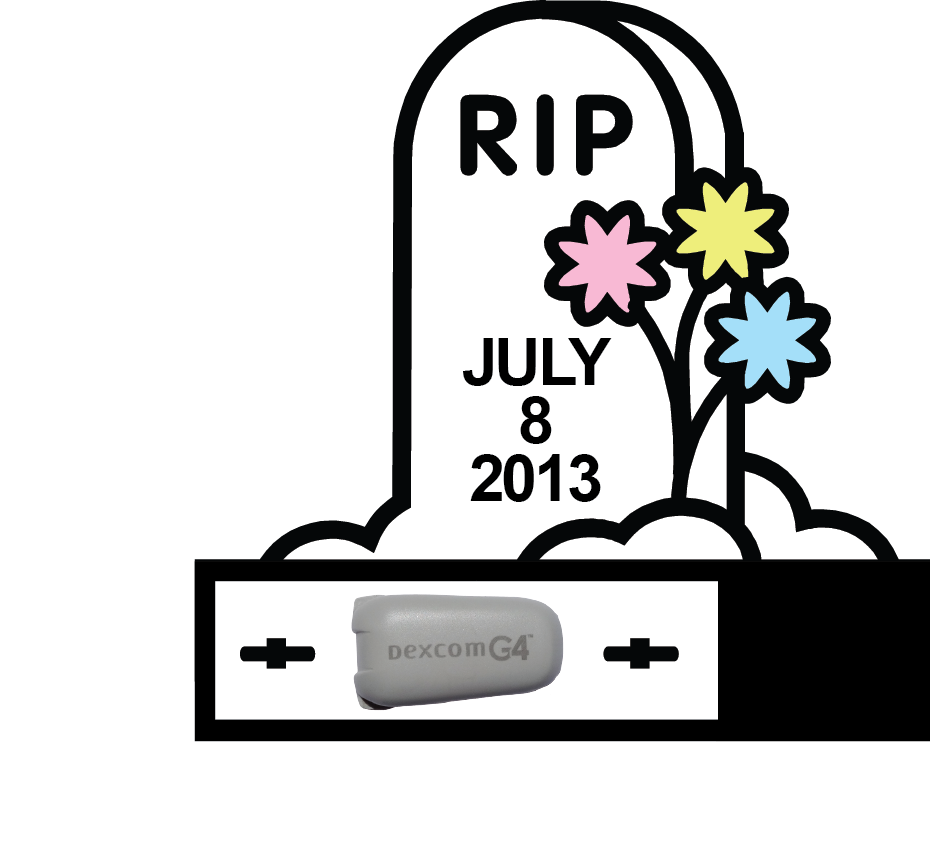
Rest in Peace, My Dexcom Transmitter

Laddie_Head SquareIn early June my friend Katie at Diabetic Advocate wrote about the death of her Dexcom G4 transmitter.  Because many of us got the G4 within a month of each other in October and November, my assumption is that we will soon be seeing a lot of posts about dead transmitters which only carry a 6-month warranty.  Sad to say I did not follow Katie’s advice to order a new transmitter as soon as I passed the 6-month mark.

Fast forward to mid-July when I was scheduled to leave for a week-long international vacation.  Three days before the trip, I got a series of Out-of-Range symbols with no readings for several hours each.  This was with my receiver in my pocket about 3 inches away from the transmitter.  When the sensor would reconnect, it said my battery was OK.  But then it would quickly go back to the no-transmission mode.  It was obvious that the grim reaper was hovering around my transmitter.

I had expected that I would receive more warning that my battery was failing.  Unfortunately I went from a perfect transmitter to a defunct one in a period of two days.  I am used to the battery icon on my pump that goes from full charge, to 3/4 charge, to 1/2 charge.  Well, that is not how my G4 transmitter failed.  There was no message that “I am working perfectly now, but I am feeling low.”  It was “Hey, you stupid lady, you should have replaced me last month when I reached six months old.”

Dexcom RIP_ColorBecause I did not have time to replace the transmitter before I went on vacation, I left my Dexcom home.  The first night in a strange condo in another country, I woke up at 2:00 AM with a BG of 37.  Oh yes, there is a reason that I use a CGM.  I hadn’t seen a BG in the 30’s in months.  That’s how good my Dexcom G4 is at doing its job.

On one hand, it was probably fine that I was without my G4 on this vacation.  We were at the beach with water activities from dawn to dusk. It was likely that I would have forgotten my non-waterproof G4 receiver in my pocket and ruined it in the ocean or pool.  But I did miss the early warnings of highs and lows that the G4 provides me.

The morning after I returned from vacation, I contacted Dexcom and Edgepark to order my new transmitter.  No, actually it was a whole new Dexcom G4 system because I was  out of warranty.

I want you to take away two things from this post.

First, you might not get much warning that your transmitter is going bad.  If you are past six months, order the new one so that you will not have the two-week delay that I had in getting my new transmitter.

Secondly and very importantly, if you paid for the upgrade to the Dexcom G4 out-of-pocket, know that your warranty only goes to the date that your 7+ system was warrantied for.  It is not based on the date you purchased your G4.  For me, my Dexcom 7+ had been replaced in June 2012.  I paid out-of-pocket for the upgrade to the G4 in November 2012.  So my warranty expiration happened in June, not November.

I am lucky that I have good insurance and I have had very good results working with Edgepark.  I know that some people will carry their hate of Edgepark to their grave, but they have always provided me with excellent service. I called Edgepark the day after I got home from vacation and had the new Dexcom system in hand 5 days later.

My pockets are full again.  My pump in my left pocket.  My glucose tabs are in the leg pocket of my cargo pants.  My Dexcom G4 is in my right pocket.  And phone, you’re back in the purse because I have no pockets left!

My Insurance Appeal for Dexcom Coverage

Sue May 2013_Head SquareIn January 2010 I started using the Dexcom Seven Plus Continuous Glucose Monitor (CGM).  I had wanted to go on the FreeStyle Navigator CGM System because of its reputation for accuracy, but I went to the Syracuse Joslin Center to meet with the certified diabetes educator, she advised me to go on the Dexcom Seven Plus instead.  I reluctantly agreed.  Of course it turned out to be the right decision because not long after that Abbott stopped selling the Navigator in the U.S.

Anyone who uses the Dexcom knows what a life changer it is with controlling blood sugars.  I used to have at least two severe overnight hypoglycemic episodes every month.  I’ve only had one since going on the Dexcom.  Yes, there are nights when my husband and I are woken repeatedly by Dexcom alerts for high or low blood sugar. However, that is a small price to pay to avoid waking up wet with sweat and seeing my husband sitting next to me with a concerned look on his face.  What he went through to bring me to back to consciousness was much worse.  I know that experience because our son also has Type 1 diabetes and I have been on the caregiver side of severe hypoglycemia.

A year after going on the Seven Plus, my personal diabetes manager (PDM) that controls the sensor went out of warranty.  In February 2011 Dexcom sent me a new one.  I had changed from one Blue Cross insurance plan to another during the year, and although my new company had been paying for the sensors, they sent me a letter of denial stating the following:

“According to Corporate Medical Policy and peer-reviewed literature, continuous glucose monitoring systems are medically appropriate for patients who are currently using an external insulin pump and, for patients over 18 years of age, diabetes is poorly controlled as evidenced by unexplained severe hypoglycemic episodes defined as an episode of low blood sugar resulting in a profound degree of cognitive dysfunction (e.g., stupor, seizure or unconsciousness) which requires external assistance for recovery.  The medical records submitted by Dexcom do not indicate any of the above conditions.  Therefore, these services are not medically necessary and are ineligible for coverage for DOS 2/15/11.”

I immediately called the insurance company and was told that I could appeal the decision.  I composed a letter of appeal stating that both Dexcom and I had called to get authorization before the replacement PDM was shipped.  Dexcom had sent them records of my blood sugars and my endocrinologist’s letter of medical necessity.  When I had called, I was told that no pre-authorization was needed, just the letter of medical necessity.  So we both thought we were good to go. In the letter, I detailed numerous episodes of severe hypoglycemia, one resulting in cuts after falling into a glass table (luckily it was safety glass), and sometimes needing assistance from medics or transport to the emergency room.  I provided them with a copy of the bill from the hospital, as well as printed reports showing numerous blood sugar readings below 50 from my Dexcom and OmniPod pump.  In my final paragraph, I stated:

“In consideration of the fact that I am using an external insulin pump, over 18 years of age, and I have poorly controlled diabetes as evidenced by unexplained severe hypoglycemic episodes resulting in a profound degree of cognitive dysfunction, I believe that the CGM provided by Dexcom is in fact medically necessary for the effective management of my blood sugars.  In the event that I were to discontinue use of the Dexcom, I believe that I would resume having severe hypoglycemia episodes that would require outside assistance, i.e. a 911 call for assistance and/or emergency room hospitalization, and have higher A1C’s and increased variability in my blood sugar ranges.”

In June they reversed their decision and paid Dexcom.

Dex Insurance Appeal

I have since transitioned to the Dexcom G4 Platinum CGM and now enjoy increased accuracy and ease of use.

In two years I will be of Medicare age and I know that all the rules regarding continuous glucose monitors will be different.  I am thankful for people like Sue from  Pennsylvania who is assisting her Type 1 husband in appealing Medicare’s denial of payment with an administrative law judge.  I pray that they and others will pave the way for Medicare to change their policy of nonpayment for CGM systems so that Type 1’s can continue to stay safe in their retirement years.

Hiking with Diabetes – Part 2

Laddie_Head SquareI started writing the second part of this series and got bogged down in too many temporary basal rates and 50% boluses.  So now I’ll start over on a different tack.

Slowly, but surely, my hiking plan has come down to a couple of rules.  Although my blood sugars may go on a different adventure every hike, these rules/guidelines seem to remain constant.

The first rule is that safety must be the primary goal of my insulin and food regimen.  Actually safety starts with my preparations for the hike.  I have a printed list that I use every week.  On the surface it may seem a bit neurotic, but it’s very easy to go down my list every Thursday evening and confirm that I’ve packed my Glucagon kit, extra snacks, a second tube of glucose tabs, and extra socks.  My list has all the basics including a hat and hiking boots.  That might seem like overkill, but one person in my group did forget her boots one week and hiked 11-1/2 miles in the Goldfield Mountains in sandals.  So don’t laugh too hard at my list.  Then I do another last-minute list for Friday morning:  water in my camel reservoir, lunch, my phone, and a bottle of water for the car.

I’ve been brainwashed by many people on the Internet who claim that they never go above BG 140.  With lower-carb eating, consistent exercise, a pump, and a CGM, I often try to be “perfect” and make corrections on readings that should maybe be left to simmer.  Slowly but surely while hiking, I’m learning to see readings in the 130’s and 140’s and leave them alone rather than correct them.  Most of those readings eventually end up in a good range.  Occasionally the 145 turns into a 185 and that warrants a correction.  What’s frustrating is that I can never figure out why one week 145 goes to 95 and another week it goes to 200.  But I’m working hard to accept that I feel good at 140 and I don’t feel good at 65 with two arrows down on the Dexcom.  So the second rule is:  leave the heck a 140 BG alone!

My third rule is to ask for help if I need it and to stop to rest if necessary.  This rule is not always related to diabetes.  Our hikes are hard and occasionally everyone needs a rest.  Well, maybe not Caroline.  But the rest of us occasionally get over-heated, sore feet or leg cramps, so it’s not always me.  Part of being strong is the willingness to accept weakness.

My fourth rule is to do my best to understand my limitations while having confidence that I am prepared for the hike and that I am strong enough to complete it no matter how Weavers Needle_Framedifficult.  The hardest hike that I have ever completed was a 2012 13-mile loop around Weaver’s Needle in the Superstition Mountains.  Some of the elevation changes were exhausting and the day was much warmer than anticipated.  This year in 2013 I chose not to go on one hike because I thought the combination of difficulty and heat would be too much for me.  So I think I’m doing a good job of balancing the goal of pushing myself while being sensible to not put myself in a dangerous situation.

My fifth and final rule is to enjoy every minute of every hike.  Be safe, but not frightened.   Be strong, but admit weakness when necessary.  Trust that I have my diabetes under control while checking constantly to make sure that I am in control.  All in all, a sensible rule to live a successful and active life with diabetes.

Hiking with Diabetes Part 1

Laddie_Head SquareI am lucky to be able to escape winter in Minnesota and spend several months in Arizona.  Although I’ve always been active in sports such as tennis and golf, I have expanded my athletic repertoire to include hiking.  I belong to two women’s hiking groups in Arizona.  My primary group is a serious gung-ho group that hikes 8-12 miles with significant elevation changes on a typical Friday.  Many of the places we hike are in mountainous areas where we have no cell phone coverage.  My second group is more casual with shorter hikes on more populated trails.  Although I certainly carry food, glucose tabs, and water with my casual group, I am not too concerned with diabetes causing a problem.  So most of my comments below are related to my more rigorous and remote hiking excursions.

HikerAlthough I’ve always made sure that my hiking companions know that I have Type 1, I’ve never done much else except ensure that my pockets and backpack have plenty of glucose tabs, granola bars, juice, and other food.  This year it finally struck me that it was absolutely insane to repeatably go out into the no-wheres of Arizona without a Glucagon kit.

I stopped getting Glucagon kits years ago because I’ve never needed one and they expire so quickly.  My husband would call paramedics 100% of the time before he would ever give me an injection.  If I’m low at the grocery store or mall, no stranger will know to find the orange kit in my purse.

This hiking season I finally got a new Glucagon kit.  Fortunately my hiking group includes a former RN and a former school principal who has a sister with Type 1.  Even if they weren’t along, the others in my group are strong and confident women who would take control if needed.  I wrote up a sheet to share with everyone describing the levels of hypoglycemia and directions to use the glucagon kit.  I indicated that I would handle mild lows myself and they would probably never be aware of them.  I wear a Dexcom G4 which gives me some guidance as to what is going on with my blood sugar.  I also have a One Touch UltraMini attached to my belt and I have perfected testing while walking without falling off a cliff.

My favorite advice for moderate hypoglycemia is if they ask me if I am OK and I say “yes”, don’t believe me.  I am getting better about admitting that I am low when asked.  But old habits die hard and I don’t want my false bravado to fool anyone into thinking I’m safe when I’m rapidly getting into trouble.  I also described symptoms that they might notice such as slurring of words and vacant eyes.

I discussed severe hypoglycemia and indicated that at this point I would be unable to eat food or drink juice.  Although the Glucagon kit comes with instructions, I wrote up a clear and more succinct page of instructions using some of the images from the Glucagon website.  I also mentioned that Lilly has an iPhone/iPad app if they want to review that.  The weakness of that app is that the instructions are just a copy of the printed material that comes with the glucagon kit.  Too wordy for an emergency situation IMO.

I feel confident that I will never be in a situation hiking where a Glucagon kit will be needed and I hope that my confidence is not misplaced.  I am very aware that if I experience severe hypoglycemia, Glucagon will be only part of the solution.  My hiking companions will still have to arrange for emergency help to evacuate me if I am sick from the Glucagon or the effects of severe hypoglycemia.  In areas where there is no cell phone coverage, that might mean spitting our group with some hiking out for help and some staying with me.   This whole scenario is something that I never want to visit, but my safety motto is to be prepared.Arizona Hiking Friends

I often joke with my hiking companions that my aim every Friday is to not end up on the evening news.  Unfortunately lost and injured hikers are a regular occurrence on Arizona newscasts.  So far I have succeeded in that goal through hundreds of miles of hiking.  I’ve been sore, dirty, and exhausted many weeks, but never on the news.  Hallelujah!

A Crusader for Medicare Coverage of CGM

Please welcome Sue from Pennsylvania who will be a regular contributor to my blog. Sue is the wife of a Type 1 diabetic and a crusader for the coverage of Continuous Glucose Monitoring Systems by Medicare.  I will be Medicare age in four years and Sue is fighting the battle to help her husband and everyone like me who follows in his footsteps.

*

Sue B_Head SquareThis is my very first blog post, so here goes.  I am the wife of a diabetic.  My husband has had Type 1 diabetes for over 15 years.  He’s been on an insulin pump for most of that time.  About five years ago, he got his first Continuous Glucose Monitor (CGM) and it made a tremendous difference in his life.  He has brittle diabetes, hypoglycemia and hyperglycemia unawareness and before he got his CGM , would have episodes of very low blood sugar and in many instances, pass out because of this.  With his CGM, this no longer happened.

In June of 2012, he reached 65 and had to enroll in Medicare.  Since then, our life has been somewhat of a nightmare.  His CGM, at that time, was over 2 years old and starting to act up.  It no longer gave accurate readings and at times when he would go low or very high, it would no longer sound an alarm advising him to take immediate action.  When his endocrinologist wrote a prescription for a new CGM, his insurance company denied payment because unlike our private insurance, Medicare does not consider it a necessary device and in their words it is just a “precautionary” device. We have appealed the decision and had a hearing with an Administrative Law Judge on June 26, 2013 and are now waiting for the Judge’s decision.

For five years, my husband was able to lead a normal life without the constant worry of going into a state of confusion or comatose, especially when driving.  Now all that has changed and it’s put indescribable pressure on both of us emotionally and on him physically as well.  Having these peaks and valleys in blood sugars makes him tired and out of sorts most days.  Since he is gainfully employed and does quite a bit of driving in his job, it’s a constant source of worry that something awful will happen when he’s out on the road.

CGM CrusaderIt’s so hard to wrap our brains around the fact that something that is so lifesaving to my husband (and myself) is being denied by Medicare.  This is especially troubling in the face of the fact that our endocrinologist has gone to bat for us so many times during our quest to get a new CGM because she considers it of the utmost necessity for my husband.

Our hope is that our ALJ rules in our favor and that our insurance company upholds the Judge’s ruling.   After this happens, my mission in life is to have Medicare change their guideline for Continuous Glucose Monitors.

Two Updates to TSA Roulette

My previous post discussed the stress of going through TSA airport security when traveling with an insulin pump and how it can be like playing roulette.  I have two updates to that post.  One recounts a recent airport security experience.  The other describes a special TSA program for people with disabilities and medical conditions.

*

Laddie_Head SquareRandomly Not Diabetes

Late last week I returned home from an international family vacation and had an ironic adventure with airport security.

My trip out of Minneapolis was uneventful with a routine pat-down and hand swabbing.  Although the TSA agent at the AIT (Advanced Imaging Technology) scanner told me that “everyone goes through with their pumps”, he did not argue when I refused to do so.  The pat-down was efficient and the female agent was professional and kind.

My husband used online check-in for the trip home.  It went smoothly for him and the  children and grandchildren. But he was unable to check me in online.

At the airport I got my boarding pass with no problem and I assumed that the online  glitch was a thing of the past.  No such luck.  When my passport was scanned at the security desk, it was immediately confiscated along with my boarding pass.  I was instructed to go through the metal detector and then retrieve my documents from the agent on the other side.  That retrieval involved having my purse and backpack inspected compartment by compartment and item by item.  This was followed by a pat-down and hand swabbing.

Passport and boarding pass in hand, I headed for the gate.  When my boarding pass was scanned by the Delta agent, I was pulled aside for another search of my possessions along with another pat-down.

If you travel much, you know that I was just a passenger selected randomly by the TSA for enhanced security screening.  It was a scenario unrelated to diabetes that I neglected to put on my TSA Roulette Wheel.

After going through customs and retrieving my luggage in Atlanta, I received another security pat-down because of my insulin pump.  It was a fitting end to a three pat-down day for a Type 1 grandma traveling with a baby, a screaming 2-year old, a 5-year old, three adults, a group total of ten pieces of carry-on luggage, and an insulin pump.

TSA Cares

Yes, despite occasional evidence to the contrary, they actually do care and have a program called TSA Cares to prove it.

TSA Cares is designed to help people with disabilities and medical TSA Logoconditions navigate the security screening process.  The entry into the program is through a help line at 1-855-787-2227.  It is recommended that passengers call the help line 72 hours before a trip.  For many people the phone call will provide all the information and assistance necessary.  For others with more complex needs, the help line agent can arrange for a Passenger Support Specialist (PSS) to personally escort them through the screening process at airports with the program.

Meri Schumacher of Our Diabetic Life is the mother of 3 boys with Type 1 diabetes.  She wrote a very informative blog post about her recent experiences with Patient Support Specialists through TSA Cares.  She was very emphatic that the PSS program is at risk for being discontinued if more people do not use it.

So check out the program and give it a try if you think it would be helpful to you.  And be sure to spread the word to friends or family members who might benefit from TSA Cares and a Passenger Support Specialist.