Oh No, Not Again!

Laddie:  In last week’s post  about frozen shoulder, I mentioned that my story is almost identical to that of Sue from New York.  Similar age, same risk factors, and currently experiencing the condition for the third time.  I wouldn’t wish frozen shoulder on my worst enemy and I’m sorry that my friend’s story mirrors my own.

*

Sue May 2013_Head SquareMy first bout with frozen shoulder (adhesive capsulitis) began in 2002. I had noticed that it was becoming increasingly difficult to put my left arm behind my back and I couldn’t raise it very high. I tried not to use arm and shoulder thinking that rest would be the best medicine. Because it continued to get worse, I finally I went to my family doctor who told me I had frozen shoulder. I had never heard of frozen shoulder before.

The doctor suggested physical therapy, and I made an appointment to go. When I arrived I gave them my insurance card and was told my copay would be $20 a visit. I was set up to go three times a week. I remember on one of my first visits lying on my back while a strapping young man took hold of my arm and tried to move it up, all the while straining and exerting a great deal of pressure. I was amazed that my arm barely budged, and decided that the term frozen shoulder was very appropriate. I continued my daily walks with my husband. One day while walking I stepped into a crack in the sidewalk and the pain was excruciating. After that, I carefully watched where I walked. My physical therapy progressed as my shoulder gradually loosened, and I was given exercises to do at home with an arm band. I went to physical therapy from January until May, when I was told I could stop coming but continue my home exercises. My frozen shoulder gradually recovered almost completely.

In 2007 I once again got frozen shoulder, this time my right shoulder.  I didn’t have the degree of inertia that I previously had, so I decided to cope with it on my own. I did the exercises at home with the arm band, and a friend at work suggested some other things to try. Once again I gradually recovered from the frozen shoulder and moved on.  Slot Machine2I told myself that I was done with frozen shoulder since I’d had it in both shoulders already.

Now it is 2013 and once again my left shoulder is showing signs of freezing. I noticed it while descending the stairs and lifting my arm to turn off the light. I am being proactive and starting to exercise my arm, but I know that it will run its course in its own time, with or without any effort on my part. Because I was told during my first bout with frozen shoulder that it would get worse if I favored the arm and didn’t move it, I plan to keep using my arm and shoulder as much as possible.

And I will keep praying that number three is the lucky number that will end my story with frozen shoulder….

Argh! Frozen Shoulder

Laddie_Head SquareI am an expert on frozen shoulder.  Believe me, it is not something that you want to be an expert on.

Frozen shoulder is the layperson’s name for adhesive capsulitis and is a shoulder condition that results in stiffness, decreased ROM (range of motion), and often incredible pain. If you want medical jargon and links to a lot of the literature about frozen shoulder, I suggest you check out a 2008 article by Manske and Prohaska.  Or just Google the term and you’ll find tons of information.  Suffice it to say that if you get frozen shoulder, you can’t move your shoulder very well and it hurts a lot.

I will be using term “frozen shoulder” only to mean adhesive capsulitis.  Some people and even doctors describe any shoulder stiffness as frozen shoulder.  If you can get rid of your “frozen shoulder” by doing a week’s worth of exercises in the shower, you don’t have adhesive capsulitis.

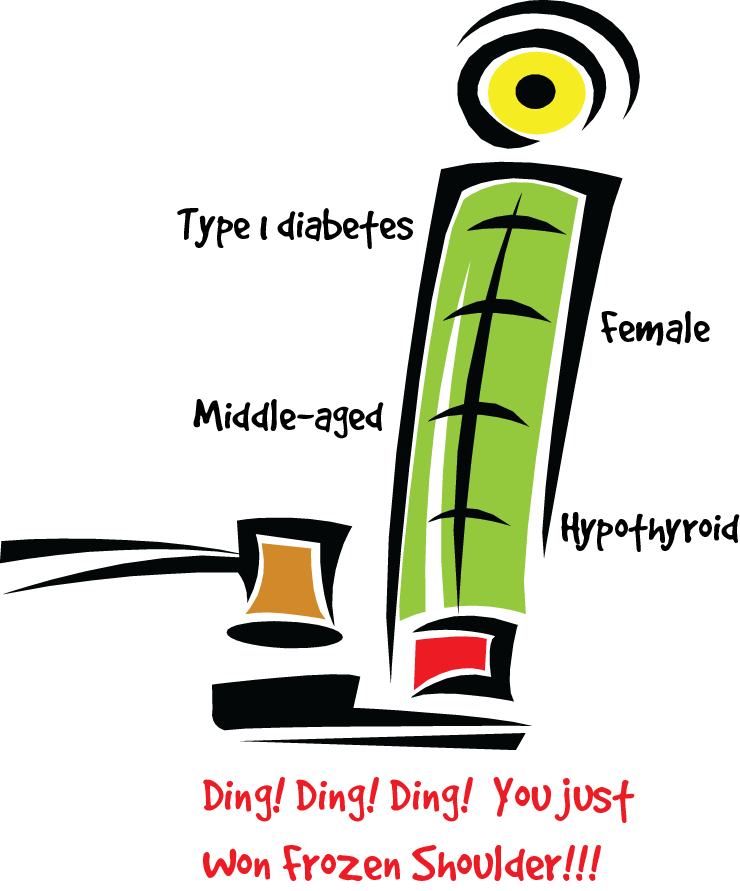
Diabetes is a huge risk factor for joining the frozen shoulder club.  Other risk factors include hypothyroidism, hyperthyroidism, Parkinson’s disease, cardiovascular disease, being middle-aged, and being a woman.  I win on four accounts:  woman, middle-aged, Type 1 diabetes, and hypothyroidism.  You don’t need to be middle-aged to win the lottery because I have a young Type 1 friend Cynthia who suffers greatly with frozen shoulder.

Frozen Shoulder Carnival GameAdhesive capsulitis has 3 stages, each which can last 3-6 months or longer.  Following along with the “frozen” analogy, the first stage is called the “freezing stage” and may be excruciatingly painful as the ROM of the shoulder slowly decreases.  When I had my first frozen shoulder, I slept in a reclining chair alternating ice packs and a heating pad for a few weeks because it was painfully impossible to lay in bed.  My next two frozen shoulders were moderately painful, but very manageable.

The second stage is the called the “frozen stage”.  It is characterized by decreasing pain along with increasing stiffness.  My experience in this stage is that strengthening exercises may be helpful but any stretching beyond gentle is futile. With the shoulder capsule totally immobile and full of adhesions, it won’t stretch and you run the danger of injuring other parts of your shoulder and neck if you push it too hard.

The third stage is the “thawing stage” when your shoulder slowly returns to normal.  There is only minimal pain with the stretching exercises and you can feel the correct things stretching.  Most people eventually have a full recovery from adhesive capsulitis although people with diabetes are less apt to achieve total remission.  Some people end up having surgery to release the shoulder, but my doctors are very anti-surgery for the condition. The vast majority of people only get frozen shoulder once or at most once in each shoulder.  Unfortunately another prize for having diabetes is that you may get it repeatedly.

The exact causes of frozen shoulder are not known but terms like collagen fibers, platelet derived growth factor, glycosylation, poor circulation, inflammation, and fibrofatty infiltration are tossed around.  Like most things with diabetes, doctors are quick to blame poor blood glucose control for the condition.  Upon diagnosing my third frozen shoulder in May of this year, my rheumatologist immediately asked “What was your last A1c?”  Rightly or wrongly, I was somewhat offended by the question because my A1c’s are always quite low and within the lab normal range.  On the other hand, I have Type 1 diabetes and my blood sugars are miles away from being “normal.”  So maybe I shouldn’t get so huffy.

What most doctors don’t know is that recent studies, including those led by Thomas and Yian, indicate that A1c’s are not associated with the development of frozen shoulder.  These studies found that the strongest correlation for those with Type 1 was with duration of diabetes. Similarly in a Finnish study headed by Arkkila,  A1c levels for the previous five years had no correlation to the onset of frozen shoulder.  In fact, the Type 1 patients with frozen shoulder had a lower mean A1c than the Type 1’s without the condition.  Ironically for me, two of my three frozen shoulders have coincided with the lowest A1c’s that I have ever had.*

Akkila Chart Frozen Shoulder

Frozen shoulder used to be listed on the last page of diabetic complications and was considered to be somewhat unusual.  More and more it is now being highlighted as a common problem for people with diabetes and it is often listed on the front page of complications.

I am not going to give a blow-by-blow account of my frozen shoulder history.  A synopsis is that my first one occurred on the left side after a shoulder injury in 2001 and was incredibly painful.  Along with physical therapy, time was the biggest healer and I was about 90% healed within a year.  My second one occurred about four years later on the right side.  It was not nearly as painful or debilitating as the first one, but it took longer to resolve. Number three is back on the left side and I’ve had symptoms for about 6 months.  I am optimistic that I will achieve at least a 90% remission.

I am not so confident that this will be my last dance with frozen shoulder.

Sue from New York is a contributing author to my blog and we are very close in age.  She has written about her frozen shoulder experience in a post which will be published on Monday.  It is uncanny how similar our stories are.  When you read her story, you will be reading mine.

*

Diet Coke: Friend or Foe?

I have been working on the follow-up to my Food post with a detailed description of my low-carb meals and snacks.  Unfortunately last week I really struggled with blood sugars.  There was no way to write about a “perfect” diet because nothing about my diabetes was perfect.  So I figured I would write about Diet Coke instead.

*

Laddie_Head SquareI have not had a Diet Coke since August 15.  According to my iPhone goddess Siri, that is 39 days or 1 month 8 days or 5 weeks 4 days or 0.11 year.  I have not had one cup, one can, or one sip.  Nada.

Usually it is hard for me to give up Diet Coke, but this time it’s been fairly easy.  One reason is that I spent a queasy weekend in New York City starting on August 16.  It had nothing to do with Diet Coke because both my husband and I had the tummy yuks complicated by bumpy taxi rides.  But somehow in my mind, the Diet Coke the day before seemed linked to my queasiness.

As someone with Type 1 diabetes, I have been fairly accepting of a Diet Coke habit.  There are so many restrictions in my life that it’s been easy to ignore the caffeine and artificial sweeteners in my favorite beverage.  The Internet is filled with the risks of diet soda including kidney damage, metabolic syndrome, cell damage, and rotting teeth.  How much those risks are coincidental and how much is cause and effect is debatable.  So make up your own mind.

What is actually my biggest concern is the phosphoric acid in dark colas.  I was diagnosed with osteopenia in 2007 and spent five years on Fosamax.  There are some studies that indicate that phosphoric acid in dark colas might be implicated in bone loss.  I have other osteoporosis risk factors, so one might argue that I should avoid Diet Coke.

The last time I gave up Diet Coke I allowed myself one day a week to indulge with no limits on the amount.  It worked quite well for several months.  I played a silly little game to keep me motivated.  On my digital calendar I added a daily task titled “No Diet Coke” repeating forever.  The box each day was colored blue.  At the end of each successful day I changed the color of the box to pink to reward my success.  The box on the day when I drank Diet Coke stayed blue and was renamed “Yes Diet Coke.”  After a while I got tired of doing the calendar changes.  I kept the one-day-a-week habit for a while longer.  But then one-day-a-week went back to three or four and eventually back to seven.  Because I had never pledged to do this forever, I didn’t feel too bad about the resumption of my addiction.

When asked about Diet Coke, most of my doctors have indicated that as long as you limit it to about one can daily, the risks are probably very low.  But that’s not how I drink Diet Coke Friend or Foesoda.  First, I don’t like Diet Coke out of the can very much.  I prefer fountain soda and alternate between the 32-ounce cups for $.69 at Super America and the equivalent $.89 refills at Holiday.  (It’s all about location because how far should you drive to save 20 cents?)  Secondly, I don’t drink the soda all at once.  I like to nurse it all afternoon and add more ice as needed.  It keeps me company in a friendly sort of way.  Third, as I’ve discussed when it comes to food, I don’t do moderation well.  I’m an all or nothing girl.

The danger of viewing Diet Coke as a friend is that my mother always considered cigarettes to be her friend. They kept her company, soothed her, gave her hands something to do, and were there for her every day.  Emphysema and lung cancer put the friendliness of her friend in doubt.

Although I like the idea of staying away from Diet Coke permanently, it likely won’t happen.  I refuse to beat myself up over it or view it as a failure.  I’ve got enough inner demons and don’t need to add more guilt to the list.  I’m currently drinking a lot of sparkling water/club soda and enjoy that very much.  But it’s not available at most of the  places where I would normally get a fountain soda.  When I take the grandkids to McDonald’s, I savor my Diet Coke while they play on the indoor playground and then get a refill to take home.  Or I’ve been known to have a 2- or 3-Diet Coke visit with Scott Johnson at the Golden Valley McDonald’s.  Iced tea is an option and might just have to do.  Of course now that Scott has a new bicycle and computer, he might start wanting to meet somewhere more upscale.  Yeah, right….

So today I didn’t have a Diet Coke.  I didn’t have one yesterday either.  But I’m making no promises about tomorrow.  And that’s just the way it is.

Thoughts on Brittle Diabetes

Sue May 2013_Head SquareThere was a recent blog post about brittle diabetes at Diabetes Mine in which the author says that for the most part, “brittle” is considered an outdated label.  He also states, “But some disagree, saying “brittle diabetes” refers not to everyday ups and downs, but rather to a rare but real condition in which the PWD has volatile blood sugar swings that are nearly impossible to control. It’s known as labile diabetes in clinical lingo and there are some in the patient D-community advocating to bring more awareness and recognition to this rare and severe form of type 1.”

In 1975 when my son was diagnosed at age 4 with what was then called Juvenile Diabetes, brittle diabetes was an often used term for hard-to-control diabetes. And let’s face it, in those days it was a given that Type 1 diabetes as we now call it was hard to manage on the best of days. With a once-a-day shot of NPH insulin and no method of blood sugar testing, my son’s control was a wild guess based on urine strip results over three months.  His pediatrician would look at the results and adjust the NPH dosage which would be the same every day until the next visit.

Fast forward to 1988 when at the age of 38 I was diagnosed with Type 2 diabetes. Several years later my diagnosis was changed to Type 1. From the start I had the advantage of test strips for testing my blood sugar. Several years later both my son and I learned to count carbs and give ourselves MDI (multiple daily injections). Now we both have insulin pumps and continuous glucose monitors which have greatly improved our ability to control our blood sugars.

One thing I have noticed through the years is the difference between my son’s and my level of control. He works a lot harder to manage his diabetes than I do. In the past he Man_Brittle_Finaldeveloped an extensive Excel spreadsheet where he recorded all of his food intake, exercise and insulin to share with his endocrinologist in the hope of achieving more stable blood glucose numbers. He has always had a difficult time with rapid blood sugar fluctuations and the addition of hypoglycemia unawareness compounds the problem. Yes he has the CGM, but with the 15 minute or so delay in the interstitial fluid catch-up, low blood sugars have caught him off guard many times. One time after he passed out from a hypoglycemic episode at work, he was admitted to a hospital for a week in an effort to get his blood sugars under control.

My diabetes experience has seemed to be much more level compared to his. In my 25 years of diabetes I have never experienced diabetic ketoacidosis (DKA) or even come close to it. In fact I believe that the highest blood sugar I’ve ever reached was at diagnosis and that was around 480. I never had the benefit of being tested for Type 1.5 or LADA (Latent Autoimmune Diabetes of Adults), but I suspect that is what I initially had.  At this point I consider myself simply a Type 1 diabetic.

Sue from Pennsylvania’s husband was diagnosed with Type 1 diabetes later in life and his doctor has told him that he has brittle diabetes.   Sue agrees with him.

Laddie’s thoughts on brittle diabetes are in part, “I think that because brittle has so many old-fashioned connotations that maybe doctors should start using another term for the “extreme” cases of Type 1.  In most of my years with diabetes and as recently as ten years ago, all of my doctors called everyone with Type 1 brittle to distinguish them from Type 2’s.  “Labile” was also a favorite term.”

I know that for the most part the medical establishment does not agree with the brittle diabetes label.  However, I strongly believe that there is a physiological reason for the differences in control between my son’s diabetes and mine. My final take is that diabetes is much harder to control for some people than others.

Food

Laddie_Head SquareVery few people in the diabetes community want to be preached at about what they eat.  That is not my aim in this post and if Mrs. Preachy makes an appearance, I’m going to slap her upside the head and boot her out.  What I want to do is talk about where I am with food and explore some ideas about food and Type 1 diabetes.  Most specifically I will be talking about carbs.

Like almost everyone with Type 1 diabetes, I’ve spent my life trying to find the magical balance between food as nutrition, food as pleasure, food as a social hub, food as a deterrent to low blood sugars, and food as an emotionally-charged addiction.  Diets are prescribed like medicine with the assumption that if you play by the rules, things will work perfectly.  Anyone who has had Type 1 for more than five minutes knows that food, blood sugar, weight control, and insulin rarely play nice together and it’s hard to keep guilt out of the equation.

In recent years I have been reducing carbs or at least fast-acting carbs.  Ten years ago I would have argued (and did argue) with anyone who suggested that I couldn’t manage my diabetes well while eating a lot of carbs.  I knew that things like cookies and candy were guilt-laden treats and better left alone, but I loved my breakfast with cereal, milk, fruit, and cottage cheese.  Other meals weren’t much different and I got used to high post-meal spikes followed by crashing lows because I didn’t know anything different.

Why did I start exploring alternative ways to eat and finally commit to low carb?  Because I was tired of the lows.  My lows and highs have always been intrinsically connected.  I have never been able to match insulin well to high carb meals.  I’ve pre-bolused until I went low before eating; I’ve tried the super bolus; I’ve experimented with combo boluses.  I’ve used Novolog, Humalog, and Apidra.  I’ve never tried Symlin for a multitude of reasons, but other than that I’ve done it all.  Carbs spike quickly for me and short-acting insulin stays around for a long time.  When I have a series of lows I tend to throw caution to the wind and eat a boatload of junk food resulting in stubborn highs.  After too many highs, I start rage bolusing and then end up low again.  After a while this gets to be an exhausting way to live.

Every time that I adopt a carbohydrate restricted diet, I find that my diabetes is much easier to manage.  Do my blood sugars flatline on my Dexcom?  No, but the Himalayan peaks and valleys are replaced by less jagged tracings with few excursions outside of my target range.  I’m not as hungry as when I eat fast-acting carbs and my cravings are greatly reduced.  I truly believe that carbohydrates can be just as addicting as tobacco, drugs, and alcohol.

I previously wrote a post about why you should read Dr. Bernstein’s Diabetes Solution.  My diet is not as restrictive as he espouses because I incorporate berries, apples, nuts, sprouted grain bread, and wine into my life.  I’ve read a few other books that reinforce the idea that no one, especially those of us with diabetes, should be eating a diet high in refined carbohydrates.  Why We Get Fat by Gary Taubes is a scathing indictment of the low fat/high carb diet prescribed by medical professionals for the last thirty years.  A lot of what he writes makes perfect sense to me as this ubiquitous heart-healthy diet has been accompanied by a huge rise in the rates of obesity and Type 2 diabetes.  Wheat Belly by cardiologist William Davis is a similar criticism of high carb diets along with the assertion that genetically modified modern wheat is a culprit in the obesity crisis.

Glucocoaster_FinalI am increasingly convinced that the theory that “Type 1’s can eat anything as long as they bolus for it” is questionable at best.  I also believe that “diabetic” diets with 45-60 grams of carbohydrates per meal set many people up for frustration and failure.  The “glucocoaster rides” described by many Type 1’s are indicative of the difficulty of matching current insulins to the blood glucose effects of carb-laden meals and snacks.  My experience has been that reducing carbs and therefore substantially reducing my bolus insulin has measurably reduced my highs and extreme lows.

I am not so naive to suggest that everyone with Type 1 diabetes should eat exactly as I eat.  Even with the food decisions I am currently making, it is still hard to analyze and manage everything that affects my blood sugar.  But if you are struggling or even just attempting to improve your numbers, you might find that carb reduction is a powerful tool and easier to incorporate into your life than you might think.  Just remember that major diet changes have to be accompanied by major insulin changes with a lot of testing.

I’ve been working on this post for a long time and have yet to come up with a version that satisfies me.  Recently two other bloggers have written posts that say exactly what I want to say and probably do a much better job of saying it.  The first is a post by Katie at Diabetic Advocate where she talks about her decision to eat low carb and photographs a series of meals.  She sums up her decision by saying: “I have reached a point in my life where I want better BG control MORE than I want to eat high carb foods.”  The second post is by Katy at Bigfoot Child Have Diabetes and explores the idea that maybe normal as symbolized by Cheetos isn’t something we should be striving for.  She hypothesizes that we’ve gone too far in the idea that PWD can eat anything.  She says exactly what I’ve been wondering and have been fearful of putting on paper.

I have not pinky finger pledged to forever lead a life devoid of fast-acting carbs.  But every time I go back on a low carb diet after a period of falling off the wagon, I stay on it longer than the previous time.  It makes sense to me.  I feel good.  My diabetes is easier.  I have fewer lows.  I look forward to a day when we have faster and more precise insulins, but at least for today low carb is where my decision box has landed.

A Call Not Made

Sue B_Head SquareI had a cousin whom I never really got the opportunity to know well.  My father and my cousin’s mother were brother and sister.  Growing up, our family lived in Philadelphia and my cousin’s family lived in Washington, D.C.  When they settled there I saw him occasionally but because he was older by 5 years, we didn’t have much in common.  The years passed and we saw each other less and less and then not at all.

When my husband was diagnosed with diabetes in 1996, I thought about calling him.  I knew that he had extensive knowledge of diabetes.   But as happens all too often, I kept putting it off thinking that I would eventually make that call.  Days passed, weeks passed, months passed and then years passed.  I never did make that call. Then came a day in March when I received an e-mail from another one of my cousins that he had died.

The other day I was speaking to Laddie, my new friend who graciously offered me the chance to write on this blog, and we were discussing people who are well known in the diabetes field.  I happened to mention my cousin’s name and not only did she know of him, but she sent me a link to a Keynote speech presented at the Friends for Life Conference that took place in July.  The address was given by Meri Schuhmacher and was posted on her blog, Our Diabetic Life.  I read that speech with tears in my eyes and a deep sadness that I never did pick up that phone to call this wonderful man.   I forwarded that speech to my cousin’s sister who has been a diabetic since early childhood.  She sent me a link to another blog post written by Tom Karlya.  From that post, I gained more insight into a man who was a psychologist, a professor of medicine and pediatrics, had written many publications, traveled to conferences all over the world, and was on many boards with his life’s focus being on improving the emotional care of people with diabetes.  He was also a gentle man who loved his family and nature and lived each day to the fullest.  Since I read these two blog posts, I have learned from other publications how well respected my cousin was in the diabetes community.

Richard RubinMy cousin’s name was Dr. Richard Rubin.  I never got to know him in life but through the writings of others, I am now getting to know him.  Every day since his death, I not only mourn him, but my loss in not picking up that phone.  If anything is to be learned from my experience, it’s that age old expression “never put off till tomorrow what you can do today”.   I lost the opportunity to get to know my cousin and find out for myself how wonderful he was and why he was so loved by his family and by those whose lives he touched.  His life was a life well lived and I wish I could have been a part of it.

The photo of Dr. Rubin is from a tribute to him published in the July, 2013 issue of Diabetes Care.

Jinxed

Laddie_Head SquareSometimes I jinx myself.

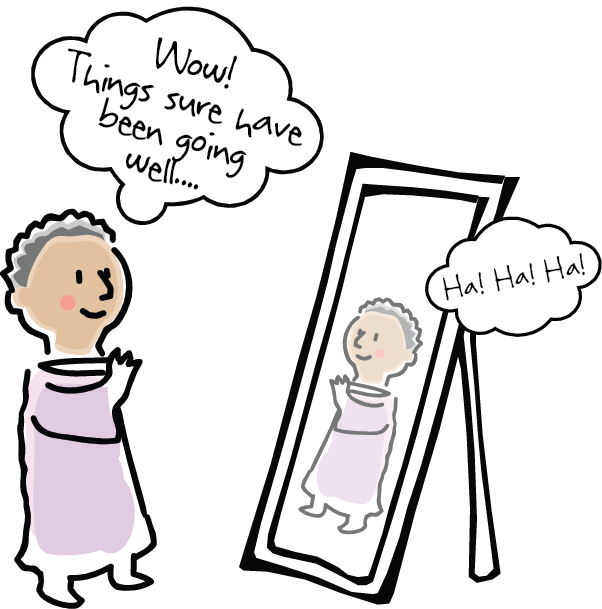
It seems that every time I write a post or just look in the mirror and think “Wow!  Things sure have been going well…” my blood sugar decides to go off on wild bumper car excursions.  Sometimes I can blame myself for the results–oh yes, I shouldn’t have had that double bowl of chocolate ice cream last night–but just as often it’s just one of those things.  It’s a reminder that hard work and good decisions usually lead to good results but that every so often diabetes throws a temper tantrum trying to remind me who’s in charge.

I get oodles of motivation when I do things right and I get good results.  However, when I think that I have done things correctly and I get bad results, I am very quick to say “What the hell!” and go off the deep end with bad decisions.

When the numbers are good, it’s easy to think that I am in control of everything that affects my blood sugar.  I can take my insulin adhering to all of the preset and tested ratios in my pump.  I can show incredible willpower and have an egg and spinach omelet for breakfast when I am starved for a bowl of cereal with bananas and milk.  Oh, how I do miss cereal for breakfast.

Things Going WellWhen the numbers are bad, I usually blame myself.  If I take responsibility for the good numbers, it seems logical that I should take credit for the bad numbers.  But there are times that I eat a low carb breakfast with an appropriate insulin bolus and my blood sugar soars into the 200’s.  If I understand correctly what books tell me, some of these morning blood sugar excursions are the result of hormones screaming at my liver to pump out glucose at the same time they try to interfere with the action of my insulin.  But where were those hormones yesterday and the day before when my body thought the same breakfast was hunky-dory and my numbers were great all morning.

Recently I participated in a study that was investigating whether blood sugar rises at the end of the two or three day life of a pump infusion site.  Today was the third day of what has been a fine infusion site, but when I was high through much of the day, I changed out the set.  My problem is that I usually go high when I have a new infusion set.  So I was high because of the old set and then high because of the new set.

So today I am ranting.  Highs are much more enjoyable when you have the guilty memory of a hot fudge sundae.  But I have been doing a really good job of eating low carb lately and totally ignoring the call of chocolate covered donuts.  So this isn’t fair.  You mean diabetes doesn’t play fair!  Wow, that’s not very nice.

My Take on Dr. Bernstein

Laddie_Head SquareI strongly believe that everyone with diabetes of any type should read Dr. Bernstein’s Diabetes Solution: A Complete Guide to Achieving Normal Blood Sugars.  I am neither advocating that you follow his teachings to the letter nor am I even suggesting that you try his WOE (way of eating).  But I believe that you should read the book.

Dr. Bernstein was diagnosed with diabetes in 1946 at the age of 12.  He indicates that for over two decades “I was an ‘ordinary’ diabetic, dutifully following doctor’s orders….”  In his twenties and thirties he began to experience significant complications including deteriorating vision, kidney disease, neuropathy, and cardiomyopathy.  During those years the medical community began to link high blood cholesterol to heart disease and it was a widespread belief that high amounts of dietary fat were the cause of this elevated cholesterol.  Therefore like many diabetics then and now, he was prescribed a low-fat, high-carbohydrate diet.

In 1969 Dr. Bernstein’s life changed dramatically when he saw an advertisement for a new device that hospital emergency rooms could use to test blood sugar levels to distinguish “unconscious diabetics” from “unconscious drunks.”  Although he was prohibited from buying the $650 device because he was not a doctor, his wife was a physician and she placed the order.  He began to use this device and went down in history as the first patient with diabetes to use a home blood glucose meter.  For a fascinating peak into the history of Blood Glucose meters, I encourage you to read David Mendoza’s interviews with four pioneers, including “Dick” Bernstein, who were instrumental in the development and ultimate widespread use of these meters.

Using his new meter, Dr. Bernstein quickly learned was that his blood sugars resembled a roller coaster with daily lows in the 40’s and highs in the 400’s.  Over the next four years he experimented with changes to his eating and insulin regimen that significantly improved his blood glucose levels and slowly eliminated many of the diabetic complications he had been experiencing.  Ultimately he developed a road-map to a destination that was “normal” blood sugars.  In order to have his ideas taken seriously, he attended medical school starting in 1979.  At almost 80 years of age, Dr. Bernstein continues to have a thriving medical practice and numerous publications describing his methods for controlling blood sugars.

Bernstein Book CoverThe foundation for Dr. Bernstein’s regimen is a strict diet with a limit of 30 grams of carbohydrates per day.  He has strong opinions about what types of insulins should be used and is a fervent opponent of insulin pumps.  The guiding principle in his teachings is “the law of small numbers” where if you eat small amounts of carbohydrates along with small amounts of insulin, you will have only small mistakes not big mistakes.  Dr. Bernstein sees the world in black and white with very few allowances for variance from his plan.  If you read his book, you will be given a detailed prescription for reaching the nirvana of “normal” blood sugars.

Dr. Bernstein has many followers who credit him with saving their lives and they follow his diet and other teachings to a tee.  There are multiple Facebook and other online groups with discussions about the Bernstein diet and philosophy.  There are also many people, and this probably includes me, who adopt some of his ideas with less stringent goals and see significant improvement in BG numbers.  Although he is still dismissed by much of the medical community as an extremist or even a quack, some of his ideas are becoming mainstream with the increased acceptance of low carb diets and lower A1c targets for people with diabetes.

Although few of us can live the Bernstein life perfectly and most of us don’t even want to try, why do I believe that everyone with diabetes should read this book?  The answer is  because the strongest message that comes out of the book is that you can successfully control your diabetes.  You are not a helpless victim destined for continual high and low bloods sugars along with a myriad of complications.  You have the power to make decisions that will improve your blood glucose numbers.  You can set goals and take steps to achieve those goals.  Some of the necessary changes will not be easy to incorporate into your life.  However, if improved blood sugars are a high priority, you can do it.

You are in control.  That is a powerful and inspiring message and that is why you should read the book.

Dr. Bernstein’s Diabetes Solution was first published in 1997.  The 4th and most current edition was released in 2011.

Part 2: The Times They Are A-Changin’

Laddie_Head SquareThe first part of this series focused on change coming as a result of the Affordable Care Act.  This post will discuss one change that has already occurred in my healthcare universe and how I expect it to impact my care.

Late in 2012 I received a notice from my internal medicine clinic that they were switching to a cash-only model starting on April 15, 2013.  The primary reason for the change was stated:  “The present insurance environment reimburses independent clinics less than large, corporate practices.  To continue to provide the high quality care that you have come to expect at our office, we need to change our business model.”

Initially I panicked because I thought I was going to be forced to leave a doctor whom I like and respect.  Doing my homework I learned that my insurance will cover visits to this clinic, but it will be as an out-of-network benefit and I will have to file the claims myself.  The out-of-network provision means that any difference between the billed amount and the charges allowed by my insurance company will be my responsibility.

There are actually 3 options for continuing my relationship with this practice.  The first is a straight fee-for-service plan where office visits are billed based on time and lab/procedure fees are reasonable because they lack the high mark-ups traditionally billed to insurance companies.

The second option is a fee-for-service plan with a $300 annual fee for “Enhanced Primary Care.”  This plan provides access to my doctor through phone, email, texts and online care.

Cash Only DoctorThe third option is a Comprehensive Care plan where everything including office/hospital visits, labs, EKGs, phone consults and emails is covered for a fee of $2500.  This option is basically concierge medicine as shown on the TV show Royal Pains (USA Network) minus the mansions, sports cars, helicopters, and obnoxious brother.

After some thought, I decided that my initial panic was unfounded and that I should not make any changes for the foreseeable future.  One reason is that my current insurance through the high-risk pool in Minnesota will disappear in 2014 when insurance companies can no longer refuse me coverage because of Type 1 diabetes.  It seemed silly to find a new internist in 2013 and risk having to change again in 2014.

A second reason is that in recent years I have only seen my internist once a year for a physical.  Despite being the queen of autoimmune chronic conditions for which I see specialists, I’m pretty healthy otherwise.  I figure that if I have no significant changes in my health status, there is no major financial risk to staying with this practice.  As I choose insurance in the coming years, I will need to be sure that I have coverage for out-of-network physicians even if it is with a higher co-pay than in-network doctors.

A third reason is that I will be on Medicare in less than four years.  Although this clinic will be cash-only for regular insurance, it will continue to accept Medicare.  There is a caveat with this acceptance.  In order to stay in the practice with Medicare, you are required to pay the annual Enhanced Primary Care fee of $300.  I am okay with this fee and understand the necessity for it.  Medicare reimbursement is often ridiculously low or nonexistent for many services.  I realize that my doctors and their staff need to make a living wage in order for the practice to thrive.  Also the telephone consults and online benefits included in that fee will be beneficial.

I have an appointment for my annual physical in three weeks and this will be my first visit under the new cash-only model.  I have selected the fee-for-service option because currently I don’t need the benefits of the Enhanced Primary Care or Comprehensive Care models.

Although I was initially frightened by these changes, I am starting to be more comfortable with the idea of a different financial relationship with my internist.  In many ways I think that this change may end up ensuring that I have better medical care in the coming years.

Each of the five physicians in the practice has a personal statement on their website explaining his view of the transition to a fee-for-service model and his future in medicine.  My doctor ended his statement with the following words:

“The decision to no longer accept insurance is the change we needed to make. It was a very difficult one….  I hope that our sensible pricing system reflecting the service and follow-up provided will be understood as necessary to keep our practice viable. I believe that the new care opportunities for visits and consults, telephone and email, will result in better services and allow us to continue to provide the type of care our patients expect and deserve for many years to come.

 I always knew I wanted to be a doctor. I still do. With the patient as my primary focus. Practicing medicine the way it was meant to be practiced.”

Those of the words of a physician that I am pleased to call “my doctor” and I hope that his decision to take the insurance company out of the equation will be a good decision for both of us.

Part 1: The Times They Are A-Changin’

Laddie_Head SquareWhen Bob Dylan wrote this song, I think that he was writing about civil rights, history, and the idea that change is coming whether you want it or not.  Sounds a lot like the Affordable Care Act.  Some of the provisions in this bill have already been enacted and we’ve seen increased coverage for preventative care and the ability for young adults to stay covered under their parents’ insurance until age 26.  But there are still big changes to come in 2014.

I have always had good insurance and know that I am very lucky.  In general I have been isolated from changes affecting “other” people.  My current insurance is through the high-risk pool in Minnesota.  It is expensive but the coverage is very good.

I am 61 years old and a synonym for my insurance in the coming years is going to be “change.”  Starting in 2014, I will purchase insurance through the MNsure Marketplace which is the health exchange set up in Minnesota as a result of the Affordable Care Act.  Right now I see nothing that indicates that I will get either cost savings or better coverage.  Using the calculator on the MNsure website, it looks as though my premiums will go up about $150 per month.  However that is not an apples and oranges comparison. I currently have a high deductible plan along with a Health Savings Account and the calculated amount from MNsure is for a “silver” plan with little information on the details.  So it is a waste of energy to spend much time thinking about this until the exact details are available in October.

I think that the hardest part about selecting a plan in the fall will be knowing exactly what my coverage will be.  Things like office visits and doctor fees will be easy to decipher.  As someone with Type 1 diabetes in Minnesota, it is unlikely that I will have to worry about coverage for my insulin pump.

But coverage for my Dexcom Continuous Glucose Monitor (CGM) will be problematic at best.  I have used a CGM for 5 years, so how do I prove that I need it?  I haven’t had a severe low requiring paramedics in ages.  I haven’t been having severe overnight lows.  I can hardly remember the last time I even needed my husband to get me some juice.  And why is that?

Because I use a CGM.

I suppose I can keep track of how many times the Dex alerts me to lows.  I can count the times it wakes me up at night to tell me my BG is 70 or dropping fast.  Although I always want to ignore these alerts and go back to sleep, I am very good at eating some glucose tabs from my bedside table and programming a temporary basal of zero on my pump for an hour.  I never correct a high without testing and most of the time confirm a low with a test before eating glucose tabs.  But I never do nothing.  Like many Type 1’s who use a CGM, I rarely have a night that it is not alerting me to something.  It’s a nagging parent and I don’t ignore it.

Another question will be test strip coverage.  My insurance has always provided me with the number of strips prescribed by my endocrinologist.  How will I be able to tell if my new insurance will do so?  And then we get to the issue of what brands of strips will be provided.  Will I know what the drug and supply formulary is before I select an insurance plan?

Speaking of the drug formulary, will I know what brands of insulin are covered?  Will my current insulin type be covered at a higher tier or maybe not covered at all?  Frequently I read blogs and message board posts by people being forced to change insulin types because of a formulary change by their insurance company.  To many decision makers at insurance companies, all fast-acting insulins are the same.  Those of us who use them know that the different chemical compositions and additives can make a big difference in our control and potential allergic reactions.

This fall I will be making a big decision about insurance.  I have started a list of questions to address as I compare plans.  I hope that I will have enough information to answer those questions.  Even if I don’t, I will have to make a choice and keep my fingers crossed that it is a good decision.

Change is coming and there is no exit off this freeway.

Highway of Change